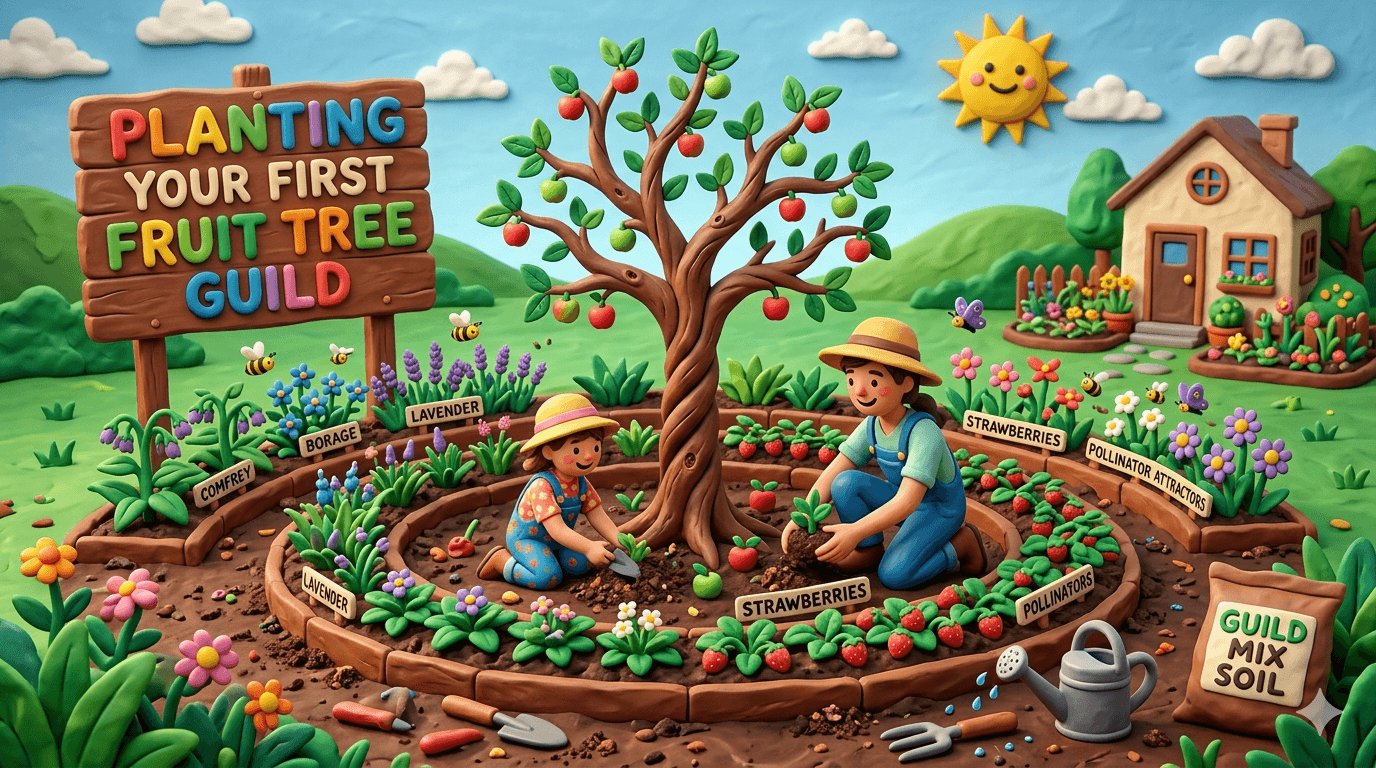
A fruit tree guild is one of the smartest things you can plant on a homestead. It takes a single fruit tree and surrounds it with carefully chosen companion plants that work together. The result is a self sustaining system that feeds the soil, attracts pollinators, repels pests, and produces more food with less work.
If you have ever planted a fruit tree by itself in the middle of a lawn, you have seen the struggle. The tree competes with grass for water. Pests move in with nothing to stop them. The soil stays bare and exposed. You end up mowing around it, spraying it, and fertilizing it every season just to keep it alive.
A guild flips that script. Instead of fighting nature, you work with it. You build a community of plants around your tree that each play a specific role. Some fix nitrogen in the soil. Some attract beneficial insects. Some send deep roots that pull minerals up from below. Together, they create a living system that improves year after year without you doing much of anything.
This guide will walk you through everything you need to know to plant your first fruit tree guild. We will cover what a guild is, how it works, which plants to include, how to lay it out, and how to care for it through the seasons. Whether you have one apple tree in the backyard or ten acres waiting for an orchard, guild planting is the way to grow fruit trees right.
Let us dig in.
What Is a Fruit Tree Guild?
A fruit tree guild is a permaculture planting method that mimics the layers found in a natural forest ecosystem. In the wild, trees do not grow alone. They grow surrounded by shrubs, groundcovers, vines, and herbaceous plants that all support each other. A guild recreates that layered community on purpose, centered around a single fruit tree.
The concept comes from permaculture design, a system of agriculture based on observing how nature builds stable, productive ecosystems. Bill Mollison and David Holmgren developed the principles in the 1970s. Guild planting is one of the most practical and accessible techniques to come out of that work.
In a guild, every plant has a job. Nothing is purely decorative. Each species is chosen because it performs one or more of these functions.
Nitrogen fixers pull nitrogen from the air and convert it into a form that plant roots can use. This is free fertilizer delivered directly to the soil. Clover, lupine, and certain shrubs like autumn olive do this naturally.
Dynamic accumulators send deep taproots into the subsoil and mine minerals that shallow rooted plants cannot reach. When their leaves drop and decompose, those minerals become available at the surface. Comfrey is the most famous example.
Pest repellents confuse or deter harmful insects through scent or chemical compounds. Garlic, chives, and certain marigolds are excellent at this. They create a chemical barrier around your tree without you ever reaching for a spray bottle.
Pollinator attractors bring bees, butterflies, and other beneficial insects to the guild. More pollinators means better fruit set on your tree. Flowering herbs like dill, fennel, and yarrow do this beautifully.
Groundcovers blanket the soil surface. They suppress weeds, hold moisture, prevent erosion, and keep the soil cool in summer. White clover does triple duty here because it also fixes nitrogen and feeds pollinators.
Mulch plants produce large amounts of organic matter that breaks down and feeds the soil. Comfrey is the champion of this category. You can cut it several times a season and lay the leaves around your tree as living mulch.
When all of these roles are filled, your fruit tree sits at the center of a self supporting ecosystem. The guild handles most of what you would otherwise do by hand: fertilizing, mulching, pest control, and weed suppression.
Why Plant a Fruit Tree Guild?
You might wonder if all of this is worth the effort when you could just plant a tree and call it done. Here is why guilds pay for themselves many times over.
Less work over time
A newly planted guild requires attention in the first year or two while things get established. After that, the system takes care of itself. The nitrogen fixers feed the tree. The mulch plants build soil. The groundcovers suppress weeds. You spend less time fertilizing, weeding, and watering than you would with a standalone tree in bare soil or grass.
Healthier soil
Guild plants build soil from the top down and the bottom up at the same time. Groundcovers and mulch plants add organic matter to the surface. Deep rooted plants like comfrey pull nutrients up from below. Nitrogen fixers add the element that most soils lack. After a few years, the soil under a guild is darker, softer, and more alive than anything nearby.
Our composting 101 guide explains how decomposing organic matter feeds the soil food web. A guild does the same thing without the compost pile.
Better fruit production
More pollinators visiting your tree means better fruit set. Healthier soil means a stronger root system. A stronger root system means more energy for fruit production. Guilds do not just keep your tree alive. They help it thrive.
Natural pest management
Monocultures attract pests. A single apple tree in a lawn is a beacon for every codling moth and aphid in the neighborhood. A guild breaks up that signal. The mix of scents, textures, and flowering times confuses pest insects. Meanwhile, predatory insects like ladybugs, lacewings, and parasitic wasps move in because the guild gives them food and habitat.
More food from the same space
A guild is not just about the tree. Many of the companion plants are edible too. Herbs, berries, and edible groundcovers turn the space under your tree into a multilayer food garden. You harvest fruit from the tree, herbs from the middle layer, and greens or berries from the ground level.
Choosing Your Fruit Tree
Any fruit tree can be the center of a guild, but some are easier to work with than others. Here are the best options for beginners.
Apple trees
Apple trees are the classic choice for a first guild. They grow in USDA zones 3 through 8. They are hardy, forgiving, and widely available. Semi dwarf varieties are ideal because they stay manageable in size while still producing heavy crops. A semi dwarf apple reaches 12 to 15 feet tall and starts bearing fruit in three to four years.
Most apple trees need a pollination partner, so plan to plant at least two different varieties within 50 feet of each other. The guild plants will help attract pollinators, but you still need compatible pollen from a second tree.
Pear trees
Pear trees are long lived, pest resistant, and low maintenance once established. They work well in zones 4 through 8. Asian pears are especially beginner friendly because they produce fruit on younger trees and resist fire blight better than European varieties.
Peach and plum trees
Stone fruits are excellent guild candidates in warmer climates (zones 5 through 9). They are self fertile in many varieties, which means you only need one tree. They grow quickly and produce fruit within two to three years. The downside is a shorter lifespan than apple or pear trees.
Cherry trees
Sweet cherries need some space and a second tree for pollination. Sour cherries are self fertile and more compact. Both work well in guilds and produce fruit that birds love, so plan to share or net the tree when fruit ripens.
Use our planting calendar to find the best time to plant fruit trees in your zone.
Essential Guild Plants and Their Roles
Here is a practical list of proven guild plants organized by the role they play. You do not need all of them. Pick two or three from each category to build a well rounded guild.
Nitrogen fixers
| Plant | Notes |
|---|---|
| White clover | Low growing groundcover. Fixes nitrogen and feeds pollinators. |
| Crimson clover | Taller and showier. Annual in most zones. Great pollinator plant. |
| Lupine | Beautiful flowers. Fixes nitrogen and attracts beneficial insects. |
| White Dutch clover | Perennial groundcover. Tolerates mowing and foot traffic. |
Dynamic accumulators
| Plant | Notes |
|---|---|
| Comfrey (Bocking 14) | The single most valuable guild plant. Deep roots mine potassium and calcium. Produces massive amounts of mulch. Use the sterile Bocking 14 variety to prevent spreading. |
| Yarrow | Accumulates phosphorus, potassium, and copper. Attracts beneficial insects. |
| Dandelion | Yes, the weed. Deep taproots break compacted soil and bring minerals to the surface. |
| Chicory | Deep rooted. Accumulates potassium and calcium. Edible leaves and roots. |
Pest repellents
| Plant | Notes |
|---|---|
| Garlic | Repels aphids, borers, and many beetle species. Plant a ring around the tree. |
| Chives | Repels apple scab and other fungal diseases. Produces edible flowers. |
| Nasturtium | Trap crop for aphids. Edible flowers and leaves. Sprawling growth covers ground. |
| Marigold | Repels nematodes in the soil. Attracts hoverflies that eat aphids. |
Pollinator attractors
| Plant | Notes |
|---|---|
| Dill | Attracts beneficial wasps, ladybugs, and pollinators. Self seeds readily. |
| Fennel | Powerful pollinator magnet. Give it space because it can inhibit some plants. |
| Bee balm | Native perennial. Attracts bees and hummingbirds. Beautiful flowers. |
| Borage | One of the best bee plants available. Self seeds. Edible flowers. |
| Lavender | Attracts pollinators and repels certain pests. Prefers well drained soil. |
Groundcovers
| Plant | Notes |
|---|---|
| White clover | Does triple duty: groundcover, nitrogen fixer, and pollinator food. |
| Creeping thyme | Fragrant, evergreen, drought tolerant. Handles light foot traffic. |
| Strawberry | Edible groundcover. Spreads by runners and produces fruit in partial shade. |
| Violets | Shade tolerant. Edible flowers. Native and low maintenance. |
Tip
Comfrey is the single most important plant in a fruit tree guild. It mines deep minerals, produces enormous amounts of mulch biomass, attracts pollinators with its flowers, and suppresses weeds with its dense leaf coverage. If you plant nothing else around your tree, plant comfrey. Use the Bocking 14 variety, which is sterile and will not spread by seed.
Designing Your First Guild Layout
Designing a guild is simpler than it looks. Think of it as a series of rings spreading outward from the trunk of your tree.
The center ring (0 to 2 feet from the trunk)
Keep this area mostly clear. Do not plant anything directly against the trunk. Mulch around the base of the tree but leave a few inches of bare soil right at the trunk to prevent moisture from causing bark rot.
Plant a ring of bulbs like garlic, chives, or daffodils about one to two feet from the trunk. These low growing plants repel pests and do not compete with the tree for light.
The middle ring (2 to 6 feet from the trunk)
This is where your hardest working guild plants go. Plant comfrey at three or four spots around the ring, spaced evenly. Add yarrow, bee balm, or borage between them for pollinator attraction. Tuck in a few nasturtiums or marigolds for pest control.
The middle ring is the engine of the guild. These plants produce the most biomass, attract the most beneficial insects, and do the heaviest lifting in terms of soil improvement.
The outer ring (6 to 10 feet from the trunk)
This is your groundcover zone. Seed white clover or creeping thyme across the entire area. If you want edible groundcover, plant strawberry runners in patches throughout this ring.
The outer ring suppresses grass and weeds that would otherwise compete with the tree for water and nutrients. It also creates habitat for ground dwelling beneficial insects like ground beetles that eat pest larvae.
Putting it all together
Here is a sample layout for an apple tree guild using plants from the lists above.
Center ring: A ring of garlic and chives 18 inches from the trunk.
Middle ring: Four comfrey plants spaced evenly around the tree at about 3 feet out. Two borage plants and two yarrow plants between the comfrey. A couple of nasturtiums trailing along the ground.
Middle to outer transition: Dill and fennel planted on the south side where they get the most sun. One bee balm on the east side.
Outer ring: White clover seeded across the entire area from 6 feet out to the edge of the tree's canopy drip line. A few strawberry plants tucked in on the shadier north side.
This guild fills about 300 square feet of ground and requires roughly 20 to 30 individual plants plus clover seed. The total cost for plants and seeds runs between $30 and $75 depending on your sources.
How to Plant Your Fruit Tree Guild Step by Step
Timing matters. The best approach is to plant the tree first and build the guild around it over two seasons. Trying to do everything at once is overwhelming and puts too much pressure on a young tree.
Year one: plant the tree and start the groundwork
Step 1: Plant the fruit tree. Dig a hole twice as wide as the root ball and just as deep. Do not amend the soil in the planting hole. You want the roots to grow outward into native soil, not circle in a pocket of rich mix. Set the tree so the graft union sits two to three inches above the soil line. Backfill, water deeply, and mulch with three to four inches of wood chips in a ring around the tree. Keep the mulch a few inches away from the trunk.
Step 2: Sheet mulch the guild area. Lay cardboard over the entire guild zone out to about 10 feet from the trunk. Overlap the edges so no grass can poke through. Cover the cardboard with four to six inches of wood chip mulch or straw. This kills the existing grass and begins building soil underneath. By spring of year two, the cardboard will be mostly decomposed and the soil beneath it will be soft, moist, and full of earthworm activity.
Step 3: Plant the garlic and chive ring. These can go in during fall, right through the mulch layer. Push aside the mulch, cut a hole in the cardboard, and plant the bulbs directly into the soil. They will establish roots through winter and be up and growing by early spring.
Step 4: Seed white clover. Scatter white clover seed over the outer ring area on top of the mulch. Clover is tough enough to germinate through a thin mulch layer. If the mulch is thick, rake it back slightly, scatter seed on the soil or cardboard surface, and cover lightly.
Year two: fill in the guild
Step 5: Plant comfrey. In early spring, plant comfrey root cuttings or small starts at your chosen spots in the middle ring. Comfrey establishes fast and will be producing harvestable leaves by midsummer.
Step 6: Add the remaining perennials. Plant borage, yarrow, bee balm, nasturtiums, and any other guild plants you have chosen. Space them according to their mature size. Water them in well and mulch around each one.
Step 7: Add strawberries. Plant bare root or potted strawberry starts in the outer ring where they will get at least four hours of sun. They will send out runners and fill in gaps on their own.
Step 8: Fill any bare spots. If you see exposed soil anywhere in the guild, seed it with clover or scatter more mulch. The goal is zero bare ground by the end of year two.
Note
Do not fertilize a fruit tree guild with synthetic fertilizer. The nitrogen fixers and dynamic accumulators provide all the nutrients the tree needs. Adding synthetic fertilizer disrupts the soil biology that makes the guild work. If the tree looks pale or slow growing in the first year, add a top dressing of quality compost around the drip line. Our composting 101 guide covers how to make your own.
Caring for Your Guild Through the Seasons
A mature guild needs very little maintenance. Here is what to do each season to keep things healthy and productive.
Spring
Cut back any dead perennial growth from last year. Scatter a light layer of compost around the base of the tree. Check the mulch layer and add more if it has thinned over winter. This is a good time to divide and replant comfrey if it has grown larger than you want.
Watch for the tree's bloom period. If pollinators seem scarce, your guild may need more flowering plants. Add borage or bee balm to fill the gap.
Summer
Chop and drop comfrey leaves two to three times during the growing season. Cut the leaves at the base and lay them on the ground around the tree as mulch. They break down quickly and release potassium and other minerals into the soil surface.
Water the tree deeply during dry spells, especially in the first two years while it establishes its root system. The guild's groundcover and mulch layer will reduce your watering needs significantly compared to a tree planted in bare soil or lawn.
Fall
Let the guild plants go to seed where appropriate. Dill, borage, and clover will self seed and come back thicker next year. Add a fresh layer of mulch over the guild area. Fallen leaves from the tree itself are perfect for this. Just let them lie where they fall.
Plant garlic bulbs in the center ring for next year's crop.
Winter
Leave the guild alone. The dead plant stalks provide habitat for overwintering beneficial insects. The mulch layer protects the soil from freeze and thaw cycles. The clover stays green in mild winters and goes dormant in cold ones. Nature handles the rest.
Common Fruit Tree Guild Mistakes
Even simple guilds can go sideways if you miss a few key details. Here is what to watch for.
Planting too close to the trunk. Keep all plants at least 12 to 18 inches from the trunk. Plants touching the bark trap moisture and create conditions for fungal disease and bark rot.
Skipping the sheet mulch step. If you try to plant a guild into existing grass, the grass will outcompete your guild plants every time. Sheet mulching in year one is essential. It kills the grass, builds soil, and gives your guild plants a clean start.
Using spreading comfrey varieties. Regular comfrey (Symphytum officinale) spreads aggressively by seed and root fragments. It will take over your guild and become a nuisance. Always use the sterile Bocking 14 variety (Symphytum x uplandicum), which stays exactly where you plant it.
Planting too many things at once. It is tempting to fill every square inch of the guild on day one. Resist this. Start with the tree, the groundcover, and three or four key companion plants. Add more species in year two and three as you learn what works in your specific conditions.
Ignoring the canopy. As the tree grows, the shade under it increases. Some guild plants tolerate shade well (comfrey, violets, strawberries). Others need more sun (lavender, fennel, most herbs). Be prepared to adjust your plant choices as the canopy fills in over the years.
Forgetting to chop and drop. Comfrey and other mulch plants only improve the soil if you cut them and leave the leaves on the ground. If you let them grow without cutting, they still help, but you miss out on the massive soil building benefits of regular chop and drop cycles.
Scaling Up: From One Guild to a Food Forest
Once your first guild is thriving, the natural next step is to plant more. A collection of fruit tree guilds spaced 15 to 25 feet apart (depending on tree size) becomes the foundation of a food forest.
A food forest is a layered planting system that mimics a natural forest but uses edible species at every level. The canopy layer is fruit and nut trees. The understory is smaller fruit trees and berry bushes. The shrub layer is currants, gooseberries, and blueberries. The herbaceous layer is the guild plants. The groundcover layer is clover and strawberries. The vine layer is grapes or kiwi growing up through the canopy.
You do not need to plan all of this on day one. Start with one guild. Get it growing. Learn what works on your land. Then add a second tree and guild next year. In five years, you will have the beginnings of a productive food forest that produces fruit, berries, herbs, and soil building biomass with minimal inputs.
This is permaculture at its most practical. Not theory. Not a diagram in a textbook. A real, producing system that feeds your family and improves your land at the same time.
What to Do This Weekend
You have everything you need to get started. Here is the simplest path to your first fruit tree guild.
Choose your tree. A semi dwarf apple or pear is the safest bet for beginners. Buy from a local nursery if possible. They will carry varieties suited to your climate.
Pick your spot. Full sun, good drainage, and enough room for a 15 to 20 foot canopy at maturity.
Order your guild plants. At minimum: one comfrey start (Bocking 14), one packet of white clover seed, one garlic bulb (break it into cloves for planting), and one packet of borage seed. That is a complete starter guild for under $15.
Sheet mulch the area. Lay cardboard over a 20 foot circle around your planting spot. Cover with wood chips or straw.
Plant the tree. Follow the steps above.
Plant the garlic ring. Push aside mulch, cut through cardboard, plant cloves 18 inches from the trunk.
Seed the clover. Scatter it over the outer ring.
Wait for spring, then add comfrey and borage.
That is your guild. In three years, you will have a productive fruit tree surrounded by a self sustaining community of plants that feeds the soil, attracts pollinators, repels pests, and produces food at every level. All from a system that nature designed and you simply copied.
If you want to see how guild planting fits into a broader homestead plan, our homesteading for beginners guide connects all the pieces. For help timing your tree and guild plantings, the planting calendar gives you personalized dates based on your zip code. And when you are ready to build the soil that makes everything grow better, our composting 101 guide is the place to start.
Your first guild is waiting. Go plant it.
Frequently Asked Questions
A fruit tree guild is a permaculture planting technique that surrounds a central fruit tree with carefully chosen companion plants. Each plant fills a specific role such as fixing nitrogen, attracting pollinators, repelling pests, accumulating minerals, or covering the ground. Together, they create a self sustaining ecosystem that improves soil health, reduces pest pressure, and increases fruit production with less work than a standalone tree.
The most reliable guild plants include comfrey (Bocking 14 variety) for deep mineral mining and mulch production, white clover for nitrogen fixing and groundcover, garlic and chives for pest repelling, borage and bee balm for pollinator attraction, and yarrow as a dynamic accumulator. Nasturtiums, dill, and strawberries are also excellent additions. Choose two or three plants from each functional category to build a well rounded guild.
Keep all plants at least 12 to 18 inches from the trunk to prevent moisture buildup and bark disease. Plant pest repelling bulbs like garlic and chives in a ring about 18 inches out. Place comfrey and other middle ring plants 2 to 6 feet from the trunk. Seed groundcovers like white clover from about 6 feet out to the edge of the tree's canopy drip line.
Yes. Sheet mulch the area under the tree's canopy with cardboard and wood chips to kill existing grass. Wait a few months for the cardboard to break down, then plant your guild species into the prepared soil. Be careful not to damage major surface roots when planting. An existing tree with an established root system will benefit quickly from the added soil biology and nutrient cycling that guild plants provide.
Most guilds reach a self sustaining state in two to three years. The groundcover and clover establish in the first year. Comfrey and perennial herbs fill in during year two. By year three, the system is cycling nutrients, suppressing weeds, attracting pollinators, and building soil with minimal input from you. The tree itself may take three to five years to begin producing fruit depending on the variety.
Yes. A guild around a single dwarf or semi dwarf fruit tree fits in a space as small as 10 to 15 feet across. Dwarf apple and pear trees work well in small yards and can be the center of a compact guild. You can scale down the number of companion plants while still filling the key roles of nitrogen fixing, pest repelling, and pollinator attracting.
A fruit tree guild is a single planting unit centered on one tree with its companion plants. A food forest is a larger system made up of multiple guilds and additional layers including understory trees, shrubs, vines, and root crops. Think of a guild as the building block of a food forest. Start with one guild and expand over time to create a full multi layered food forest on your property.
Generally no. The nitrogen fixers and dynamic accumulators in a well designed guild provide the nutrients the tree needs naturally. Adding synthetic fertilizer disrupts the soil biology that makes the system work. If your tree looks pale or growth seems slow in the first year, top dress with quality compost around the drip line instead of using chemical fertilizers.

Cole
Founder & Lead Researcher
Cole is the founder of Plan Your Homestead. He works in clinical research and brings a research-first lens to every guide on the site, drawing on a long family line of farmers for grounded, practical perspective.
More in Gardening
More articles coming soon. Check back for new gardening content.