Why frost dates run your homestead, not just your garden
Most articles treat a frost date as a gardening number. On a working homestead it is much more. Frost dates set the calendar for your seedlings, but they also set the calendar for kidding, lambing, hatching, pasture turnout, woodshed stocking, fence repair, hose draining, and even when to schedule a vet visit. Once you know your two dates, everything else slides into place.
Think of the year on your homestead as a wheel with two axles. The last spring frost is one axle, and the first fall frost is the other. The wheel between those two points is your growing season, the warm window when tender crops thrive and animals can comfortably stay out at night. Outside that window the homestead shifts into a different rhythm, with indoor work, livestock shelter, stored hay, and winterized plumbing.
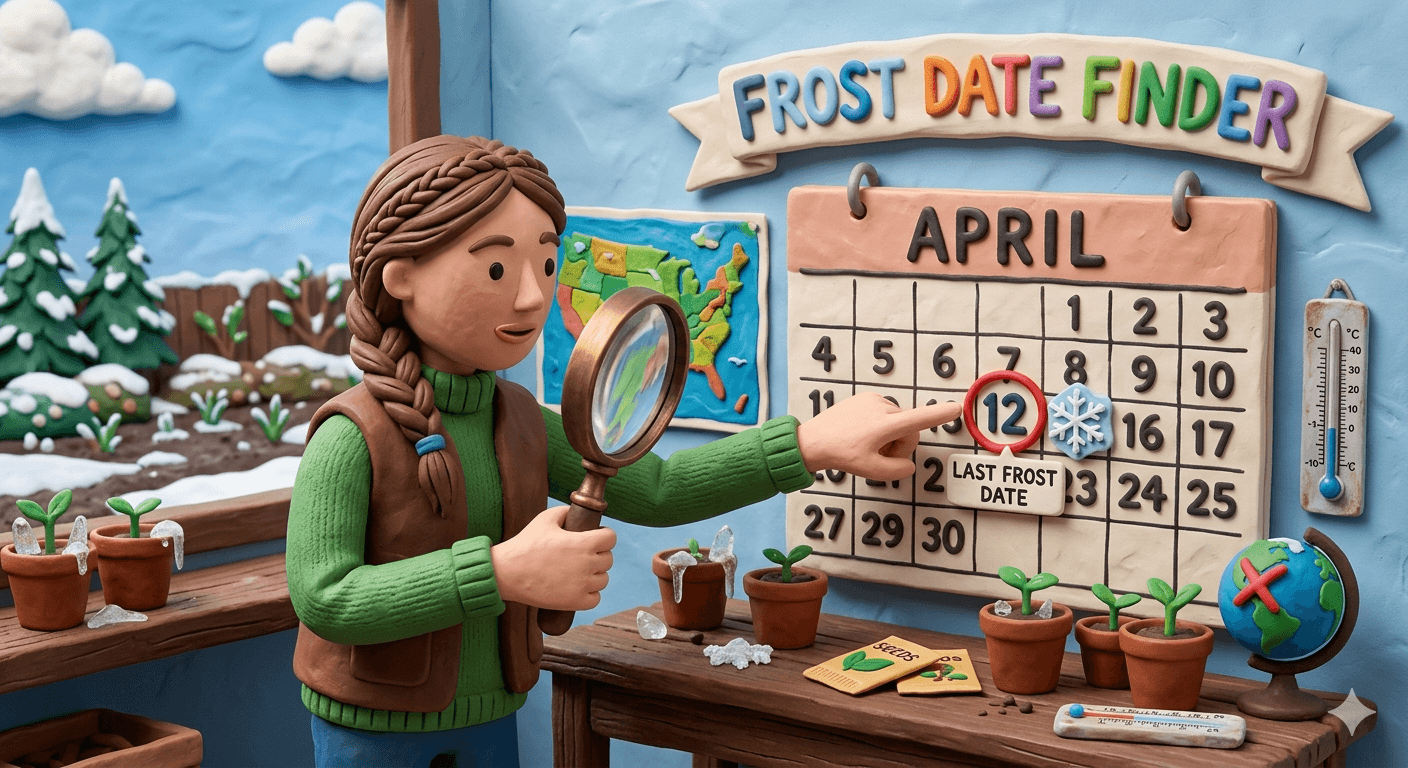
The reason this matters is that the calendar in your head almost certainly does not match the calendar in your yard. A friend two states south plants tomatoes in March. A neighbor up the road waits until June. Both can be right. Frost dates are local, and they cut through general advice with precision. The tool above gives you the numbers that apply to your zip code. The rest of this guide shows you how to put them to work.
If you only do one thing after reading this page, write your two dates on the inside of a cabinet door, on the back of a feed bin lid, or on a small tag wired to the chicken coop. You will reference them more often than you expect.
How to read your frost dates and what the averages really mean
Frost dates are averages built from decades of National Weather Service station data. Your last spring frost is the calendar date by which there is roughly a fifty percent chance that the coldest part of winter has finished. Your first fall frost is the date by which there is roughly a fifty percent chance that the first hard freeze has begun. Half the time the real frost arrives earlier. Half the time it arrives later.
That fifty fifty split is important. If you plant tender crops on your last frost date, you are flipping a coin on whether the night after will kill them. Most experienced homesteaders add a safety buffer of one to two weeks after the official date before they set out tomatoes, peppers, basil, or melons. The same buffer applies to fall, where a careful gardener harvests winter squash a week or two before the official first frost.
You will also see two related but different numbers in old gardening books. A light frost is a temperature of thirty two degrees Fahrenheit or just below. A hard freeze is twenty eight degrees Fahrenheit or colder for several hours. Light frost kills basil and stunts tomatoes. Hard freeze kills almost everything tender and damages many perennials. Frost dates on most tools, including ours, refer to a thirty two degree threshold.
Your USDA hardiness zone is a sibling number, not a replacement for frost dates. The zone is built from average winter low temperatures and helps you choose which perennials and fruit trees will survive your coldest nights. Frost dates tell you when to start the year and when to finish it. You need both numbers for a complete picture, and the tool above gives you both at once.
Building a planting calendar around your last spring frost
Every seed packet you own is written in a code. Phrases like start indoors six weeks before last frost, transplant after danger of frost has passed, and direct sow two weeks before last frost all assume one anchor date. That anchor is your last spring frost. Once you fill in that date, every other instruction becomes a real calendar entry.
A simple way to build your calendar is to start with your last frost date, then count backward by weeks for each crop you want to start indoors. Onions and leeks need about ten to twelve weeks of indoor time. Peppers and eggplant want about eight to ten. Tomatoes prefer six to eight. Cucumbers, squash, and melons only need three to four. Lettuce, spinach, kale, and chard can be started four to six weeks before last frost and transplanted out while the ground is still cool.
For direct sow crops you count forward instead. Carrots, beets, radishes, peas, and most lettuce can go straight into the ground two to four weeks before your last frost as long as the soil is workable. Beans, corn, and squash wait until one to two weeks after the last frost when the soil has warmed. Sweet potatoes wait even longer, usually three to four weeks after last frost.
If you want this calendar built for you, plug your zip code into the planting calendar and you will get every start, transplant, and direct sow date for more than thirty crops. The same tool also generates a printable month view that lives nicely on the inside of a barn door. For a focused look at indoor timing only, the seed starting calendar covers grow light schedules in more detail.
One common mistake is starting tomatoes too early. Six weeks ahead produces a sturdy seedling that hits the ground with vigor. Twelve weeks ahead produces a leggy, root bound plant that sulks for a month before recovering. Trust the count and resist the urge to start everything in January.
The fall garden: counting backward from first frost
The fall garden is where most homesteaders leave food on the table. Spring planting feels obvious because the urge to grow is everywhere. By August the chickens are laying, the freezer is filling, and the idea of starting another round of lettuce feels like extra work. Skip the fall garden and you skip the most reliable salad and brassica window of the year.
The math for fall planting is the mirror image of spring. You take your first fall frost date and count backward by the days to maturity printed on the seed packet. Add about two weeks because plants grow more slowly as the days shorten. That sum gives you the latest date you can sow.
For example, if your first fall frost is October fifteenth and your kale matures in fifty five days, your latest sow date is mid August. Carrots that mature in seventy days need to go in by late July or early August. Garlic, the great fall planting exception, goes in about four to six weeks before the first hard freeze and overwinters in the bed for harvest the following summer.
Fall crops also benefit from light frost in a way spring crops do not. A touch of cold concentrates sugars in carrots, kale, brussels sprouts, and parsnips. Many homesteaders deliberately leave these crops in the ground until after the first frost to sweeten the harvest. Just keep an eye on the forecast so a hard freeze does not catch you with unprotected roots.
If you want exact sow dates for your fall garden, the planting calendar works in both directions. It shows you the spring window and the fall window for every crop, all based on your first and last frost dates.
Frost dates and livestock: breeding, kidding, lambing, broody hens, and pasture turnout
Animals do not read calendars, but their owners do. Frost dates are the single best tool for scheduling births, breedings, hatch dates, and pasture moves. Babies born too early freeze. Babies born too late miss the lush spring grass that mothers need to make milk. The window between those two extremes is short, and your frost dates draw the lines.
For goats, sheep, and cattle, the gold standard is to plan births so that the youngest babies are at least two weeks old by your last spring frost. That gives newborns a forgiving stretch of warm nights and lets mothers transition onto fresh pasture as soon as it greens up. Counting backward by gestation length sets your breeding date. Goats are about one hundred fifty days. Sheep are about one hundred forty seven. Cattle are about two hundred eighty three.
For chickens, ducks, and other poultry, your last spring frost is the earliest reasonable date to move heat lamp ready chicks outside into an unheated brooder shed. Most birds are fully feathered by six weeks of age. Set hatch day six weeks before your last frost and the timing lines up perfectly. The livestock quiz can help you decide which animals fit your space and climate before you start counting hatch dates.
Pasture turnout follows the same rhythm. Grass needs night temperatures consistently above freezing to grow at a useful rate. Putting animals on cold, dormant pasture in early spring tramples it and produces no feed. Waiting until just after your last frost gives the grass a head start and turns those first warm weeks into real forage rather than mud.
At the other end of the year, your first fall frost is the cue to start thinking about winter forage. Pull animals off pasture before the freeze damages the crowns of cool season grasses. Stockpile hay, switch over feed sources, and inspect shelters for drafts. A clean, dry, draft free shelter matters far more than a heated one for most ruminants and poultry.
Season extension: stretching the calendar with cold frames, row cover, greenhouses, and high tunnels
Season extension is the practice of using covered structures to push your growing season earlier in spring and later in fall. The right tool can buy you two extra weeks on the front end and two extra weeks on the back end. That extra month is enough to grow crops your zone would normally rule out, and it pays for the materials in a single year for most homesteads.
A floating row cover is the simplest and cheapest tool. It is a lightweight fabric draped over hoops or directly on plants. It traps a little warmth and blocks light frost, usually buying you about four to six degrees of protection. That is enough to save a tomato seedling from an unexpected late frost in May or to keep kale producing into November.
A cold frame is a low box with a clear lid, usually angled to catch the sun. Cold frames hold heat through the night and turn early spring sun into a head start on lettuce, spinach, and radishes. They also serve as a hardening off station for seedlings moved out of the basement in March.
A greenhouse, heated or unheated, opens up larger possibilities. An unheated greenhouse still keeps the inside about ten to fifteen degrees warmer than outside, which is enough to grow greens through most winters in zones six and warmer. A small wood stove or propane heater extends that further, although fuel costs and ventilation become real factors.
A high tunnel is the homestead workhorse. It is a tall unheated structure with arched ribs and a single layer of greenhouse plastic. High tunnels protect tall crops like tomatoes, peppers, and pole beans, and they push planting dates two to three weeks earlier in spring and two to three weeks later in fall. Many homesteaders find a high tunnel is the single highest return infrastructure they install in their first five years.
Whichever tool you choose, the goal is the same. You are not changing your frost dates. You are creating microclimates inside your homestead that have different frost dates than the open ground. Track both numbers, the outdoor date and the indoor date, on whatever calendar you use.
Infrastructure and water systems: what freezes, what splits, and when to drain
Frost is the most expensive force on a homestead. A single overlooked spigot can split open and flood a basement. A hose left in the garden bed splits and goes in the trash. A neglected stock tank freezes solid and the heater you scramble to buy costs three times retail. Your first fall frost is the alarm bell to start winter prep, and your last spring frost is the all clear to bring it all back online.
About two weeks before your first fall frost, walk the property and make a list. Every garden hose comes off its spigot. Every spigot that is not freeze proof gets shut off at the indoor valve and drained at the outdoor end. Drip irrigation lines get blown out with an air compressor or drained downhill. Rain barrels get tipped and stored upside down or under cover.
About a week before first frost, turn your attention to livestock water. Decide which heated waterers or tank heaters you will use, test them, and make sure their cords are intact. A bad cord on a stock tank heater is a fire risk. Replace any heater that looks tired before you put it in service for another winter.
Inside the house, check insulation around any pipes that run through unheated spaces. Crawl spaces, garages, and exterior walls are the usual culprits. A pipe insulation sleeve costs almost nothing and saves an emergency plumber call in January. If you have a well house, confirm its heater works and that any access doors close tightly.
For total water planning, the water usage calculator helps you size your supply so you are not caught short during winter when frozen creeks and snowed in roads make hauling water a real chore. Plan for at least three days of stored water for animals and household use, more if your area sees regular winter storms.
When your last spring frost arrives, the order reverses. Re install spigots, prime drip lines, refill rain barrels, and unplug tank heaters. Walk every line and look for the small splits that always seem to appear over winter.
Buying land by climate: using frost dates to compare properties before you sign
If you are still searching for your homestead, frost dates are one of the cheapest, fastest filters you can apply to a property. Two parcels that look identical on the map can have growing seasons that differ by a full month. That month decides whether you can grow your own staple crops, raise pastured pork without supplementing grain, or run a market garden as a side business.
Start by looking up the frost dates for the closest zip codes to any property you are considering. Use the tool above for at least three nearby zip codes, because rural addresses often share a zone with a town fifteen miles away that has very different conditions. Look at the spread. If the dates vary widely, you are in a region of strong microclimate variation, and the specific parcel matters more than the regional average.
Elevation is the single biggest microclimate factor. Every thousand feet of elevation gain pushes your last spring frost roughly one to two weeks later and your first fall frost roughly one to two weeks earlier. A property sitting on a ridge at twenty five hundred feet has a meaningfully shorter season than one in the valley below it.
Aspect, the direction a slope faces, is the second biggest. South facing slopes warm faster in spring and hold sun later in fall. North facing slopes stay cool longer. If two parcels are at the same elevation but one faces south and the other faces north, expect a one to two week swing in usable growing season.
Water bodies moderate temperature. A large lake or river slows down both warming in spring and cooling in fall. Cold air pools at the bottom of valleys overnight, so a low spot in a field can frost weeks earlier and later than the rest of the property. Walk the land at dawn during shoulder season if you can. Frost lines are visible on the grass.
For broader budget context as you evaluate parcels, the land cost estimator helps you compare regional pricing. Frost dates plus price plus water access form the three numbers that tell you whether a property is worth a closer look.