What an Indoor Seed Starting Calendar Actually Does
Every seed has a clock that runs in two directions. Forward, it counts the weeks of growth a young plant needs before it can survive outside. Backward, it counts from the moment your soil is safe and warm enough to receive that seedling. Match those two numbers and you transplant exactly the right age plant on exactly the right day. Get them wrong and you end up with leggy seedlings sitting on a heat mat for an extra month, or stunted starts that never catch up.
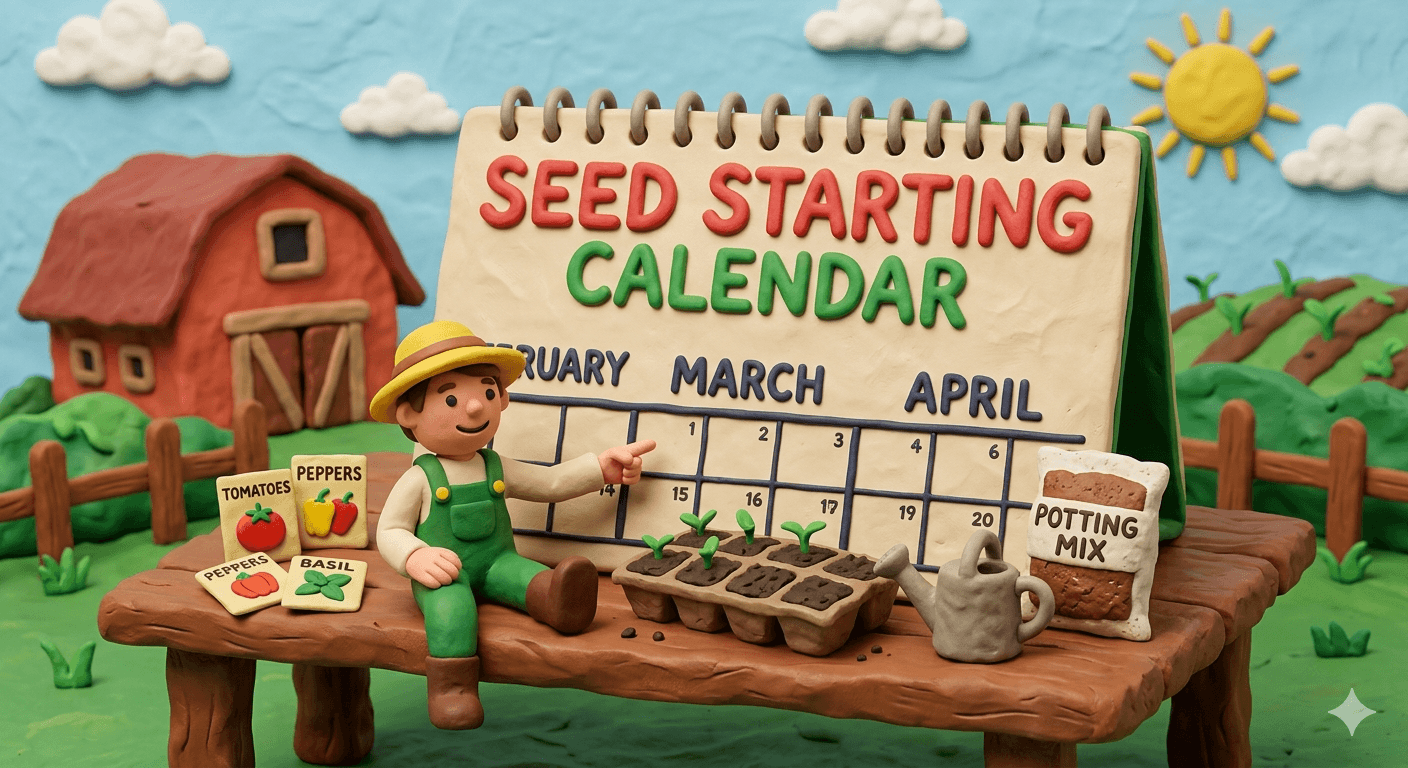
An indoor seed starting calendar does that math for every crop in your garden. The tool above pulls your USDA hardiness zone from your zip code, looks up your average last spring frost, and counts backward from that anchor to find the exact week you should drop tomato seed, pepper seed, broccoli seed, and so on into trays under your lights.
You scan the schedule, mark your calendar, and your indoor season unfolds at a steady pace instead of all at once. Print it and tape it inside your seed starting cabinet door so you cannot lose it.
How to Use the Seed Starting Calendar Above
The tool above takes about ten seconds. Here is the full path.
Step 1. Enter your zip code. The tool looks up your USDA hardiness zone and your average last frost. If you do not have a zip code or you want to plan for a second location, use the manual zone dropdown to pick your zone directly.
Step 2. Scan the schedule. You see a clean list of every crop that benefits from an indoor start in your zone. Each row shows your start indoors date and your move outside date. The dates update automatically based on which zone you selected.
Step 3. Search or filter. Type a plant name into the search box to jump straight to it. Tomatoes, peppers, broccoli, lettuce, kale, cabbage, and most homestead crops are all there.
Step 4. Print your checklist. Hit the Print button and the schedule exports as a printable checklist with checkboxes next to each crop. Tape it inside the door of your seed starting closet and tick each one off the week you sow it.
That is the whole workflow. No spreadsheets, no counting on your fingers, no flipping through almanacs.
Why the Last Frost Date Sets Your Whole Schedule
Every indoor seed starting date is calculated backward from a single anchor: your average last spring frost. Get that anchor right and the entire schedule falls into place. Get it wrong and every other date shifts with it.
What the last frost date really means
Your last frost date is the average day in spring when overnight temperatures in your area finally stay above 32°F. Before that date, a clear cold night can still drop temperatures low enough to kill tender plants. After that date, the soil starts warming and tomatoes, peppers, eggplants, and other heat lovers can safely move outside.
That is why nearly every seed packet uses the phrase “start indoors X weeks before last frost.” The packet author cannot know your zip code, so they describe the schedule in terms of a date you can look up locally.
Why averages are not guarantees
The frost dates baked into this tool are historical averages. That means half the years your real last frost will land before the average and half it will land after. A late cold snap can show up two weeks past your average last frost and burn every tomato you put out that week.
Use the calendar to plan, then watch your local ten day forecast as the date approaches. Keep frost cloth, an old bedsheet, or a stack of cardboard boxes in the shed for the year the weather does not cooperate.
How microclimates shift the date
A south facing slope warms up a week or two earlier than the surrounding land. A city lot ringed with warm pavement can run a full zone hotter than the open country a few miles away. A low spot at the bottom of your yard collects cold air and frosts later in spring and earlier in fall.
Use the tool dates as your starting framework, then adjust by a week in either direction once you have observed your own land for a season. If you want a second opinion on your exact location, double check with our Frost Date Finder.
How to Count Backwards From Your Last Frost
If you ever need to do the math by hand, here are the common windows. The tool above already applies them for you, but it helps to know the pattern so the dates make sense.
Tomatoes, peppers, eggplants, tomatillos. Six to eight weeks before last frost. These are heat lovers with long seasons. They need plenty of time under lights to become the stocky transplants you want.
Broccoli, cabbage, cauliflower, kale, brussels sprouts. Four to six weeks before last frost. These cool season brassicas move out a few weeks before your last frost because they tolerate light frost and prefer cool soil.
Lettuce, spinach, chard, other leafy greens. Two to four weeks before last frost. They are quick to germinate and quick to move out. Many gardeners just direct sow them, but starting indoors gives you a head start in colder zones.
Onions and leeks from seed. Ten to twelve weeks before last frost. These are the earliest seeds you start. They need a long stretch under lights to size up before you transplant.
Cucumbers, squash, melons, pumpkins. Two to three weeks before last frost, if you start them indoors at all. Most gardeners direct sow these once the soil is warm. They grow so fast that an indoor head start is barely worth the trouble unless your season is very short.
If your last frost is May 10 and you are starting tomatoes, count back eight weeks. That puts your indoor sow date around March 15. The tool above does this for every crop in a single screen.
Which Crops Belong Indoors and Which Belong in the Ground
Not every seed wants to start under lights. Some plants resent being transplanted and grow far better when you drop the seed straight into the garden bed.
Crops that need an indoor head start
Tomatoes, peppers, eggplants, tomatillos, ground cherries, and most long season heat lovers do not have time to mature from a direct sown seed in most of the country. Start them indoors and they meet your warm weather already six to eight weeks old.
Brassicas like broccoli, cabbage, cauliflower, kale, and brussels sprouts also do best from an indoor start in spring. They appreciate cool weather but mature faster from a transplant than from seed sown in cold soil.
Onions, leeks, and celery want the longest indoor runway of all the common crops. Get them under lights in late winter for a summer harvest.
Crops that resent transplanting
Root crops will punish you for starting them indoors. Carrots, beets, radishes, turnips, and parsnips form their best roots when the seed is sown right where the plant will live. Disturb the taproot in the seedling stage and you often end up with forked or stunted roots.
Big seeded crops grow so fast in warm soil that there is no point starting them under lights. Beans, peas, corn, cucumbers, summer squash, winter squash, melons, and pumpkins are all happier direct sown after your last frost.
The fence sitters
Lettuce, spinach, arugula, chard, and most leafy greens can go either way. They direct sow easily in cool spring soil, but you can also start a tray indoors for a faster first harvest. Many gardeners do both, staggering successions to keep a steady salad bowl from April through June.
Herbs like basil, parsley, dill, and cilantro can start indoors or direct sow. Basil especially benefits from a head start because it loves heat and hates cold soil.
The Seed Starting Setup That Actually Works
You do not need a greenhouse to grow strong transplants, but a sunny windowsill is rarely enough. The glass filters too much light and seedlings stretch toward it, growing tall and floppy. A real setup costs less than you expect and pays for itself the first season you skip buying nursery transplants.
Light
A basic LED shop light works perfectly. You do not need an expensive purple grow light. Hang the fixture two inches above the top leaves of your seedlings and raise it as they grow. Keep it on for fourteen to sixteen hours a day. A simple plug in timer makes this automatic and removes one more thing you have to remember.
Heat
Heat lovers like tomatoes and peppers germinate fastest in soil between 75°F and 85°F. A waterproof seedling heat mat under your trays speeds germination and improves your success rate dramatically. Remove the heat mat once the seeds have sprouted. Continued bottom heat after germination encourages stretching.
Airflow
A small oscillating fan blowing gently across your trays mimics outdoor wind. The motion stresses the stems just enough to make them grow thicker and stronger. The moving air also keeps the soil surface from staying soggy, which is the single best way to prevent damping off, the fungal disease that mows down whole trays of seedlings overnight.
Soil and trays
Never use dirt from your yard or heavy potting mix. You want a proper seed starting mix, which is a light, sterile blend of peat moss or coco coir, perlite, and vermiculite. The texture lets tiny roots push through easily, and the sterility prevents soil borne disease.
Plastic six packs or soil block trays both work. Soil blocks save you from buying plastic, but they take some practice. Whatever you use, keep the bottoms in a tray with drainage holes and bottom water by filling the lower tray every couple of days. Watering from above can knock seeds out of the soil and spread disease.
Hardening Off: The Step New Gardeners Skip
This is the most common mistake new gardeners make. You baby a tray of seedlings indoors for two months. The temperature was always around 70°F, there was no wind, and the artificial light was gentle. Then on transplant day you carry that tray outside and plant them straight into a windy 55°F afternoon with bright sun. Within hours, the leaves burn pale white. Some recover. Many do not.
You have to harden off your plants. This is a five to seven day transition where you slowly introduce them to outdoor conditions.
Day 1. Set the trays outside in dappled shade, protected from the wind, for just one hour. Bring them back inside.
Day 2. Two hours of morning sun, still protected from strong wind.
Day 3. Three hours of mostly sun.
Day 4. Half a day of sun and gentle wind.
Day 5. A full day outside in sun and wind. Bring them in at night if temperatures will drop below 50°F.
Day 6 to 7. Leave the trays outside overnight as long as no frost is forecast. By the end of the week the plants have built a wax coating on their leaves, thickened their stems, and are ready to be planted in their permanent home.
Skip this step at your own peril. It is the single biggest cause of transplant failure for new gardeners.
The Six Most Common Seed Starting Mistakes
Most failed seedling trays come down to one of six errors. They are easy to avoid once you know to look for them.
1. Starting too early. Excitement gets the better of every gardener at some point. You read the seed packets in January and start tomatoes the next weekend. By April the plants are three feet tall, root bound, and stressed. Trust the dates the calendar gives you. Six to eight weeks before last frost is a window, not a suggestion.
2. Not enough light. Seedlings need direct, bright light from above for fourteen to sixteen hours a day. A south facing window will not deliver that. The result is leggy, pale plants that flop over by week three. Use a shop light hung two inches above the leaves and raise it as the plants grow.
3. Skipping bottom heat. Tomato and pepper seed can take three weeks to germinate in cold soil. With a heat mat under the tray, the same seed sprouts in five to seven days. The mat pays for itself in time saved and germination rate alone.
4. Watering from above. Drenching seedlings with a watering can knocks seeds out of position, compacts the soil surface, and invites damping off. Bottom water instead. Fill the lower tray and let the mix wick moisture up through the drainage holes.
5. Wrong soil. Garden dirt is too heavy and full of weed seeds and fungal spores. Bagged potting soil is too rich and holds too much water. Use a real seed starting mix. It costs a few extra dollars per bag and saves you a lot of dead seedlings.
6. Skipping the harden off. Even a perfect indoor setup produces plants that have never felt wind, direct sun, or temperature swings. Move them straight outside and many will burn or shock. Always allow five to seven days for hardening off before you plant.
Seed Starting by Zone: What Changes Region to Region
Your zone changes the dates but not the logic. Here is the rough shape of indoor sowing in four common bands.
Zones 3 and 4 (cold north)
Your last frost lands in late May or early June, so your indoor season is long. Onions and leeks go under lights in February. Brassicas follow in late February or early March. Tomatoes and peppers start in late March or early April. Plan on running your lights for almost four months. The reward is that nearly every warm season crop has to start indoors here, so the calendar pays off more than anywhere else in the country.
Zones 5 and 6 (mid country)
Last frost falls in late April or mid May. Onions and leeks go indoors in late January or early February. Brassicas in late February. Tomatoes and peppers in mid March. By the time the lights come down in mid May, you have transplants ready for a full summer of harvest.
Zones 7 and 8 (upper south, mid Atlantic, pacific northwest valleys)
Last frost is in late March or early April. Your indoor season is shorter and starts earlier. Onions go under lights in early January. Brassicas in late January. Tomatoes and peppers in early February. Many gardeners here also run a second indoor round in midsummer for fall planted brassicas.
Zones 9 and 10 (deep south, coastal California, southern Texas)
The challenge here is heat. Your cool season crops like broccoli, cabbage, lettuce, and onions grow best in fall and winter, which flips the indoor calendar upside down. Many growers start brassicas indoors in August or September for a winter garden. Tomatoes and peppers often go straight into the ground after a short indoor start, since the soil is warm by February or March in much of this region.
The tool above adjusts the dates automatically for whichever zone you choose. If you also want to plan your full year of planting, transplant, and harvest windows, jump over to our broader Planting Calendar. And if you are still mapping out which beds will hold which crops, our Garden Bed Planner helps you sketch a layout that uses every square foot.
Frequently Asked Questions
How many weeks before last frost should I start seeds?
Do I really need grow lights, or will a sunny window work?
What temperature do seeds actually need to germinate?
Why are my seedlings tall, pale, and floppy?
When is it safe to move seedlings outside?
Can I reuse seed starting mix from last year?
What if I missed the indoor start window?
Written by Cole. Last updated May 2026.