
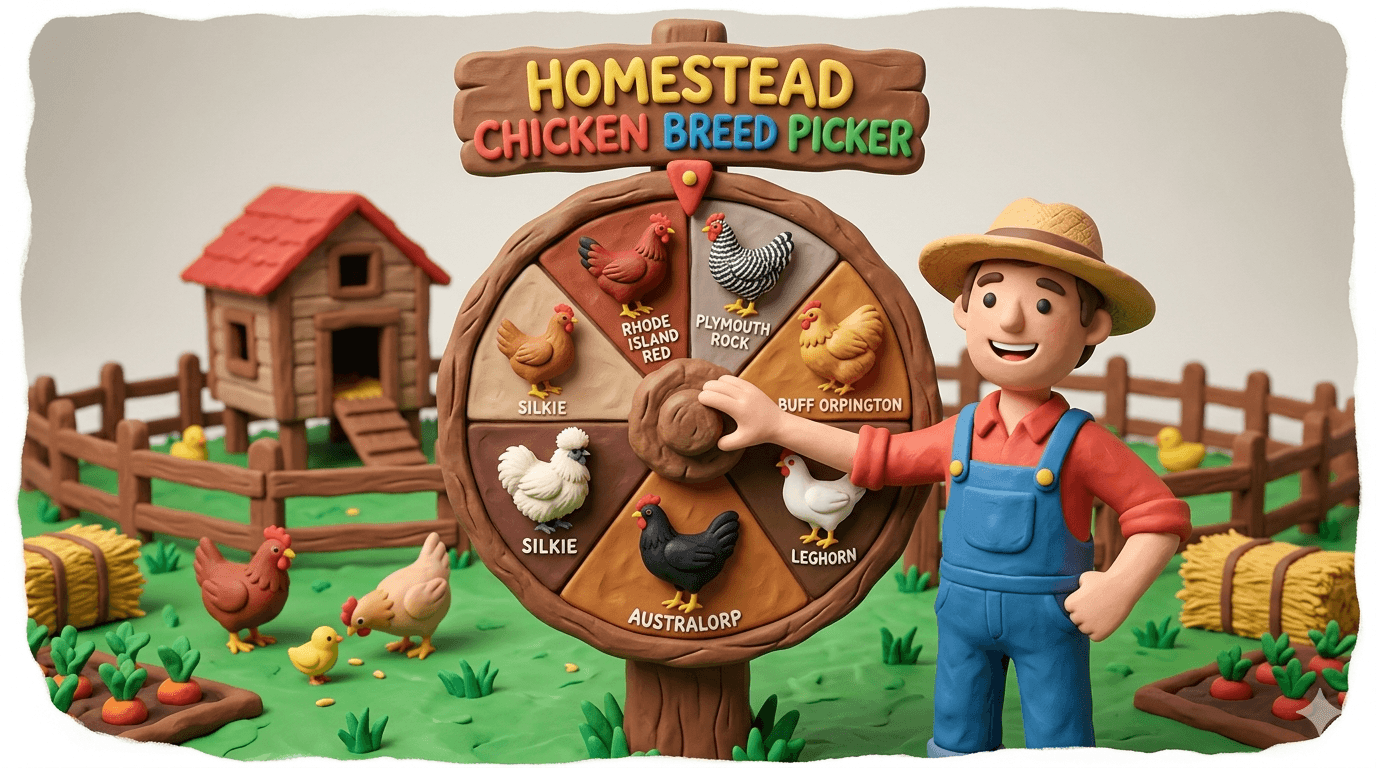
Start with What You Want From Your Flock
The first question to answer is what you want from your chickens. Every breed on the picker above is built around an answer. Pick the wrong answer and the rest of your decisions will fight you for years.
If you want a steady stream of eggs for a small family, look at lay focused breeds like the Leghorn or the ISA Brown. These birds can put 280 to 320 eggs in your basket every year. They are not cuddly, they are not slow, and they will eat their share of feed. They are egg machines.
If you want a freezer full of meat, the Cornish Cross is the standard. It grows to butcher weight in about eight weeks. It does not lay well and most homesteaders raise it as a side flock for a few weeks each summer.
If you want both, choose a dual purpose breed. The Plymouth Rock, Rhode Island Red, Australorp, and Sussex all give you a respectable 200 to 280 eggs a year and a heavy enough body to put a roasting cockerel in the oven. Dual purpose is the homesteader's sweet spot. You are not winning at either game, but you are showing up at both.
If you want ornamentals, breeds like the Polish, Silkie, and Sebright bring color, feathered crests, and personality to the yard. They are pets first and producers second. Children love them, and they make the run more interesting.
Use the Purpose filter at the top of the picker to lock onto your bucket before you start comparing names.
Match the Breed to Your Climate
Chickens look more or less the same to most people. They are not. A bird's body is built for a temperature band, and pushing it outside that band makes for sick chickens, frozen combs, and dead hens in heat waves.
Cold hardy breeds have small combs, dense feathering, and broad, low slung bodies that hold heat. The Wyandotte, Brahma, Buckeye, and Chantecler shrug off winter nights that would put a Leghorn in the ground. Their pea or rose combs barely freeze. Their feet are heavily feathered or short and stocky. If you live where winter dips below zero, start with these names.
Heat tolerant breeds have the opposite shape. Single combs that radiate heat, lean bodies, and lighter feathering. The Leghorn, Easter Egger, and Naked Neck thrive where summers run long and humid. They keep laying when heavy breeds slow down to a stop.
If you live in a region that gets real winter and real summer, look for breeds rated for both. The Australorp and the Plymouth Rock handle wide temperature swings as well as any production bird on the list. The Climate filter on the picker is where to start.
Whatever you choose, your coop and run will need to support the breed you pick. Cold breeds still need a dry, draft free roost. Heat breeds still need deep shade, a constant water supply, and good airflow.
Best Chicken Breeds for Beginners
A first flock is a learning flock. Egg numbers matter less than how forgiving the bird is when you forget something. The breeds that consistently top the beginner list are the Buff Orpington, Plymouth Rock, Sussex, and Australorp. Turn on the Beginner Friendly filter and you will see them clearly.
These breeds share a few qualities. They are calm enough to pick up and check. They go broody at predictable times. They handle a wide temperature band. They are hardy against the common backyard diseases. They keep laying through a normal year without much fuss.
The trade is production. A Leghorn will out lay a Buff Orpington by a hundred eggs a year. But a Leghorn is also flighty, loud, and will fly over a four foot fence if it sees a better view. For a first flock, you want a bird that lets you make mistakes.
Once your second year rolls around and you have the basics down, add a couple of higher production birds. A small mixed flock of four beginner breeds and two Leghorns will hand you plenty of eggs and a steady learning curve.
Egg Color, Egg Size, and Egg Production
The basket on your kitchen counter can tell a story without saying a word. A bowl of plain brown eggs reads as ordinary. A bowl of blue, green, dark chocolate, and speckled cream eggs reads as a small farm.
Brown layers are the workhorses. Rhode Island Reds, ISA Browns, Black Stars, and Buff Orpingtons all lay reliable brown eggs from late winter through fall. Production runs 200 to 300 a year depending on breed and how you feed them.
White layers are the production champions. The Leghorn is the famous one. Most commercial white eggs in the grocery store come from Leghorn descendants. Expect 280 to 320 a year from a strong line.
Blue eggs come from the Ameraucana and the Cream Legbar. Green eggs come from the Easter Egger, which is built around the blue egg gene. Dark chocolate eggs come from the Marans and the Welsummer. The Olive Egger crosses the two to land somewhere in between.
A small flock of six hens that includes one of each color gives you a basket that looks painted. The neighbors will ask. The kids will sort them. You will not regret it.
Production is not fixed. A hen lays best in her first two years and falls off after that. Day length, feed quality, stress, and molt all swing the count. If you want to keep production steady through winter, you can add a coop light on a timer. If you want to give your hens a natural off season, let them rest. The right answer is whichever one fits how you feed your family. For feed targets that match your flock and your laying season, our Feed Cost Calculator is the simplest place to start, and our Feeding Guide covers what to put in the trough at every life stage.
Flock Size, Space, and Mixing Breeds
A common new keeper mistake is buying too many chicks. The rule of thumb for fresh eggs is two to three hens per egg eating member of the household. A family of four wants six to eight laying hens, not twenty.
Space matters more than count. Each standard bird wants at least three to four square feet inside the coop and eight to ten square feet in the run. Crowding birds is the fastest way to start a pecking problem. If you plan to free range during the day, you can run a little tighter on coop space, but never on roost length. Every hen needs eight to ten inches of perch.
Mixing breeds is part of the fun of a homestead flock. A few rules keep the peace. Stick with birds of similar size. Standard breeds and bantams rarely live well together because the bantams get bullied off feed and water. Introduce new birds slowly. Quarantine new arrivals for two weeks, then let the existing flock see them through wire for a week before mingling. Have at least two feed and water stations so a submissive bird always has a second place to drink.
If you plan to keep a rooster, count one rooster per ten hens. More than that and the hens get over mated. Less than that and a single rooster cannot cover the whole flock.
The Five Most Common Breed Selection Mistakes
These mistakes show up over and over in the comments under every chicken video on the internet. None of them are fatal. All of them are avoidable.
1. Picking only for looks. The Polish hen with the giant feather crest is beautiful. She is also nearly blind, easily picked on, and a poor layer. Choose your two top priorities first, then sort the matches by which one you also like to look at.
2. Ignoring your climate. A heavy feathered Brahma will pant herself sick in a Texas July. A bare faced Leghorn will lose her comb to frostbite in a Minnesota January. The picker has a climate filter for a reason.
3. Optimizing for peak egg count when you do not need that many eggs. Three hundred eggs a year per hen means roughly one egg every twenty seven hours. Four high production hens give you over a thousand eggs a year. Most families of four cannot use that many. You will be giving them away or composting them.
4. Buying too many chicks at once. Chicks are cheap. Adult chickens, their coops, their feed, and their footprint are not. Start with six. Learn the rhythm. Add more in year two if you still want more.
5. Forgetting local ordinances. Many towns allow hens but ban roosters. Some cap the flock at six or eight birds. Some require a setback from neighboring property lines. Check your zoning before you order from the hatchery, not after.
How Your Breed Choice Fits Into the Rest of Your Homestead
A flock does not live alone. It plugs into a coop, a feed schedule, a manure pile, a garden, and a year that has seasons. The breed you choose ripples through all of it.
A cold hardy flock needs a coop with good ventilation but no drafts. A heat tolerant flock needs deep shade and a way to keep water cool through July. Either way, the coop you build today is the coop you live with for the next decade. Plan it for the breed you have, not the breed you wish you had.
Feed is the largest ongoing cost in chicken keeping. Heavier dual purpose birds eat more than slim production birds. A Brahma cockerel can eat half again what a Leghorn pullet eats. Estimate your real feed bill before you order, and refine the numbers each season. Our Feed Cost Calculator does most of the math.
A laying flock changes by season. Spring is heavy production. Summer is steady. Fall brings the molt, when birds drop feathers and stop laying for six to eight weeks. Winter slows everyone down. If you understand the rhythm, you can plan your egg sales, your baking schedule, and your replacement chicks around it.
If you are still working out the bigger picture of which animals fit your land, walk through our Complete Chicken Guide and the Raising Baby Chicks primer before you order your first batch. The breed picker tells you who to buy. The guides tell you how to keep them alive.
Frequently Asked Questions
The Buff Orpington and the Plymouth Rock are the two beginner favorites. Both are calm enough to pick up, hardy in a wide range of climates, and reliable layers of 200 to 280 brown eggs a year. The Sussex and the Australorp are close runners up. Any of the four will forgive the small mistakes every new chicken keeper makes.
The Leghorn and the ISA Brown are the top layers in the picker. A healthy first year hen of either breed can put 280 to 320 eggs in the basket per year. Production falls off after the second year, so most commercial flocks rotate hens every two seasons. Backyard keepers can keep their layers longer and accept the slower pace.
Look for breeds with small pea or rose combs, dense feathering, and stocky bodies. The Wyandotte, Brahma, Buckeye, Chantecler, and Australorp all handle subzero nights without much fuss. Combs with tall single points are the part most likely to frostbite, so flat combed breeds win in deep cold.
Lighter, leaner breeds with large single combs radiate heat fastest. The Leghorn, Easter Egger, Naked Neck, and Andalusian all keep laying through hot summers. Provide deep shade, fresh cool water, and good airflow no matter the breed. Heat stress kills more hens in July than predators do.
Dual purpose means a breed is raised for both eggs and meat. Hens lay a respectable 200 to 280 eggs a year, and cockerels grow large enough to put in the freezer. The Plymouth Rock, Rhode Island Red, Sussex, and Australorp are the classic dual purpose names. They are the homesteader's default flock for a reason.
Six is the most common starting point. That gives a family of three or four a steady supply of eggs without the bird math getting out of hand. If you have never kept chickens, six is also a small enough flock that you can learn the rhythm in one season before scaling up. A coop sized for ten lets you add more in year two without rebuilding.
A hen lays her best in years one and two, then falls off about ten to twenty percent each year after that. Most production breeds keep laying meaningfully through year four or five. Dual purpose and heritage breeds can keep laying into year six or seven at a lower rate. Hens that stop laying can stay on for bug control and compost if you want to keep them.
No. Hens lay eggs whether a rooster is in the flock or not. You only need a rooster if you want fertile eggs to hatch chicks. Many municipalities ban roosters because of the noise, so most backyard flocks are hens only. The eggs taste exactly the same.
Written by Cole. Last updated May 2026.