Why Planning by Square Footage Works
Most beginner gardens fail in one of two ways. You plant too much in too little space and watch your crops fight for light, water, and air until disease takes them out. Or you plant too little in too much space and feed the weeds instead of yourself. Both problems come from the same root cause. You guessed instead of measured.
Planning your garden by square footage fixes the guessing. You start with the only fixed number in your garden, the size of your beds, and work outward from there. Once you know how much space each crop needs to thrive, the math is simple. A 4 by 8 raised bed gives you 32 square feet. Sixteen carrots fit in a single square foot. So one square foot of that bed grows a snack, and four square feet grows you a winter pantry.
This method comes from Square Foot Gardening, popularized by Mel Bartholomew in the 1980s. He noticed the long row spacing in commercial farming made no sense for a backyard. Tractors do not drive between rows in a backyard. People do, and people only need a path. By packing crops into 1 foot squares at densities matched to their mature size, a home gardener can harvest up to five times more food from the same footprint as a traditional row garden.
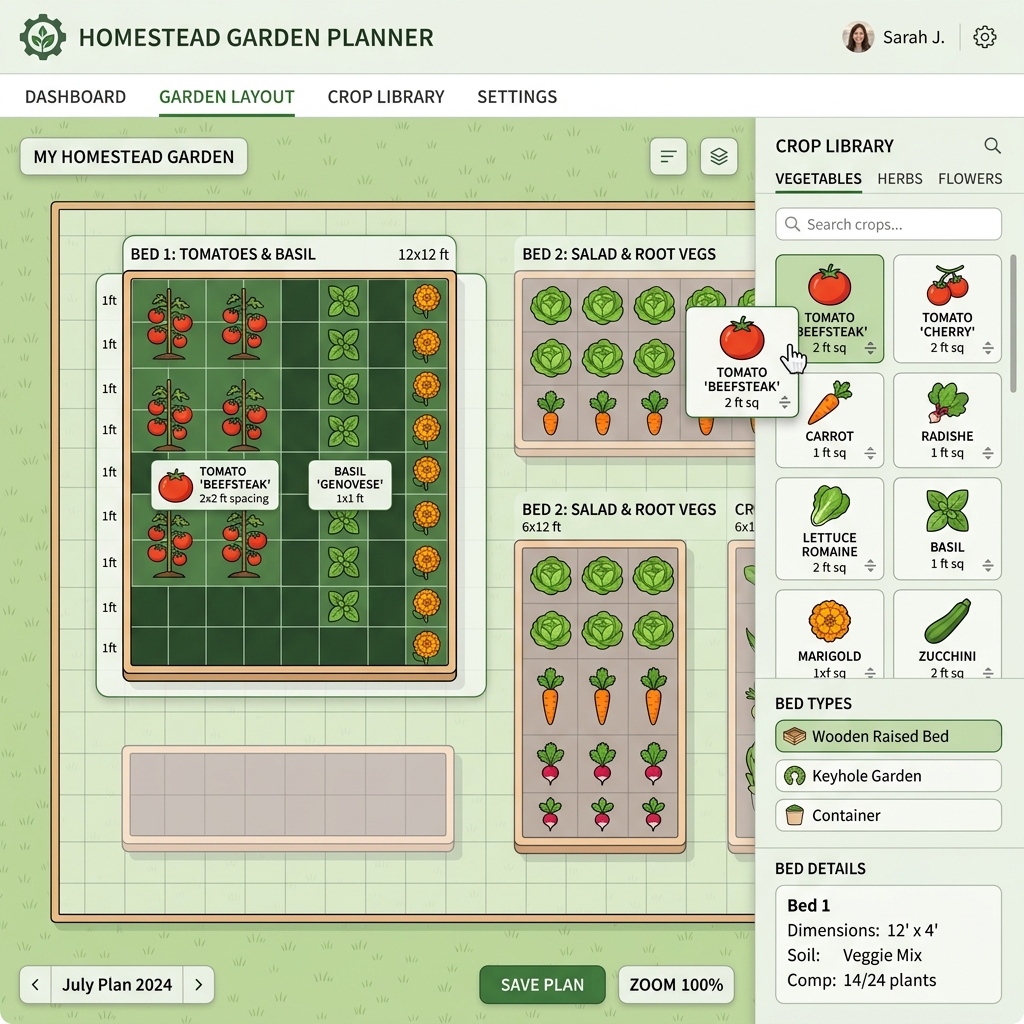
The garden bed planner above is built on these same density rules. You enter your bed dimensions, allocate square footage to each crop you want to grow, and the tool runs the math. You see exact plant counts. You see whether you have over allocated your space. And you see the full plant inventory across every bed in your plan.
How to Use the Garden Bed Planner Above
The tool starts you off with one example bed, a 4 by 8 raised bed pre loaded with tomatoes, carrots, and lettuce. Use it as a sandbox or clear it out and start fresh. Here is the full workflow.
Step 1. Set your bed size. Type the width and length of your first bed into the inputs at the top of the bed card. Stick with feet. Most home raised beds run 3 to 4 feet wide and 4 to 12 feet long. The total square footage updates in the dashboard at the top of the page.
Step 2. Name the bed. Click the bed name and rename it to something you will recognize next spring. "Front Yard Bed" beats "Bed 1" once you have five of them.
Step 3. Add a crop. Click Add Crop to Bed. Pick a crop from the dropdown. Each option shows the density next to the name, so you can see at a glance that lettuce fits 4 plants per square foot while carrots fit 16.
Step 4. Allocate square footage. Type the number of square feet you want to give that crop. The tool calculates plant count instantly. Two square feet of carrots gives you 32 carrots. Four square feet of tomatoes gives you one tomato plant, since tomatoes need 4 square feet of their own.
Step 5. Watch the capacity bar. Each bed shows used versus total square footage. If you over allocate, the bed turns red and the dashboard at the top warns you. Trim a crop or grow a bigger bed.
Step 6. Add more beds. Hit Add Another Raised Bed. Repeat the process. A typical first year homestead garden runs 3 to 5 beds totaling 80 to 200 square feet.
Step 7. Review the planting summary. Scroll to the Total Planting Summary section. You will see the grand total of every plant across every bed. That is your shopping list for seeds and starts.
Step 8. Print it. Hit Print at the top of the dashboard. The plan exports as a clean printout. Tape it on the shed door, hand a copy to whoever helps you plant, or tuck it into your garden journal.
Most people finish their first plan in under ten minutes. If you want to estimate what the lumber, soil, and seeds will cost you, run the totals through our Homestead Budget Calculator next.
Sizing Your First Beds: Width, Length, and Total Square Footage
Before you allocate a single crop, decide how much bed you can actually maintain. Beginners almost always overbuild. A 200 square foot garden takes a real commitment of weeding, watering, and harvesting time. Start small. You can always add another bed next spring.
The 4 foot width rule
Build your beds 4 feet wide or less. The reason is simple reach. The average adult arm can reach about 2 feet comfortably from a standing position. A 4 foot bed lets you work from either long side without ever stepping into the soil. Stepping on garden soil compacts it, crushes the fungal networks that feed your plants, and suffocates roots. Once compacted, soil takes a full season or longer to recover. Keep your shoes off it.
If you build along a wall or fence where you can only reach from one side, drop the width to 2 or 3 feet so you can still touch the back.
How long should a bed be?
Length is flexible. Most home beds run 4, 6, 8, or 12 feet long. The longer the bed, the more square footage you get per dollar of lumber and soil. The shorter the bed, the easier it is to walk around without taking the long way.
Eight feet is the sweet spot for most homesteaders. A 4 by 8 bed gives you 32 square feet, fits a single 8 foot board on each long side with no cuts, and is short enough to walk around quickly.
How much square footage per person?
A common rule of thumb is 100 square feet per person to grow a meaningful portion of fresh produce, or 200 square feet per person to grow enough vegetables to truly cut into your grocery bill. A family of four chasing real food independence wants somewhere in the 600 to 1,000 square foot range.
That number can feel scary on day one. You do not need to hit it your first year. Most homestead gardens add one or two new beds every season for five years before they reach full size. Plan for what you can manage today and let the planner help you scale up next spring.
Crop Spacing by the Square: The 1, 4, 9, and 16 Rule
Every vegetable falls into a density bucket based on how big the mature plant gets. Learn the four main buckets and you can plan any garden in your head.
1 plant per square foot (or fewer)
Large bushy plants need a full square or more. Peppers, broccoli, cabbage, cauliflower, corn, and potatoes all fit at 1 plant per square foot. At maturity, their leaves just touch the edges of the 12 inch square, which is exactly what you want. Touching leaves shade out weeds without crowding each other.
Some plants need even more room. Tomatoes take 4 square feet apiece (a 2 by 2 block) for good airflow and disease prevention. Zucchini and summer squash sprawl across 9 square feet (a 3 by 3 block) unless you trellis them vertically. Cucumbers want 2 square feet per plant on the ground, or you can vine them up a trellis and treat them like a 1 per square crop.
4 plants per square foot
Mid sized leafy crops fit 4 per square. Head lettuce, Swiss chard, kohlrabi, and parsley all hit this density. The 4 plants sit in a 2 by 2 grid inside the square, each plant getting a 6 by 6 inch zone. That is enough room for full heads without overcrowding.
8 or 9 plants per square foot
Many beans, spinaches, and onion family crops thrive in tighter clusters. Bush beans, spinach, large onions, garlic cloves, and peas all fit at 8 or 9 plants per square. These plants grow upright and tall rather than wide, so they share airspace well.
16 plants per square foot
The tightest spacing is for small fast root crops and bunching greens. Carrots, radishes, scallions, and beets all fit at 16 per square (a 4 by 4 grid of 3 inch zones). At this density, thinning is critical. If two carrot seeds sprout next to each other, pinch one off at the soil line. Pulling either one will damage the root of the survivor.
If you want to take your spacing a step further and arrange compatible crops side by side, our companion planting guide shows which crops help each other and which to keep apart.
How Many Plants Will Feed Your Family
Plant count is only half the question. Yield per plant is the other half. Here are realistic seasonal yields for the crops in the planner, assuming healthy conditions and good care.
A single tomato plant gives you 10 to 20 pounds of fruit over a full summer. Five plants will keep a family in fresh tomatoes from July through frost. Ten plants gets you enough to can a year of pasta sauce.
A pepper plant yields 6 to 10 peppers across the season. One square foot of peppers feeds light eaters. A 4 square foot block of four plants gets serious about salsa and stuffed peppers.
A square foot of carrots holds 16 carrots, which is a side dish or two. A 4 square foot block gives you 64 carrots, enough to roast through a cold weekend or stock the cellar.
A square foot of lettuce holds 4 heads. Four square feet, harvested in succession, will keep a salad on the table for two months.
A 4 by 4 foot patch of bush beans (16 square feet at 9 plants per square) gives you 144 plants and roughly 30 pounds of fresh beans. That is enough to eat fresh and can a dozen pints.
A 9 square foot zucchini (one plant) produces 8 to 10 pounds of fruit. One plant is enough for any family. Two plants will bury you in zucchini bread.
A square foot of onions or garlic gives you 9 mature bulbs. Most homestead families plant 30 to 50 square feet of alliums to last the full year.
Use these heuristics as a sanity check after you build your plan. If the planner says you will grow 200 carrots, ask yourself if you actually want to clean and store 200 carrots in October. Adjust before you plant, not after. And once you know what you are growing, line up the planting dates with our seed starting calendar so your transplants are ready when the beds are.
Designing the Layout: Sun, Height, Water, and Reach
Knowing how many plants fit is one thing. Where you put them inside the bed, and how the beds sit relative to each other, is the next thing. Four rules guide every layout decision.
Plant tall crops on the north side
In the Northern Hemisphere, the sun arcs across the southern sky. Anything tall planted on the south edge of your bed casts shade backward across the rest of the bed for most of the day. Put your trellised cucumbers, your corn, your pole beans, and your indeterminate tomatoes on the north side. Put your low growing carrots, lettuce, and radishes on the south side where they catch full sun.
Group crops by water needs
Tomatoes like deep watering twice a week. Lettuce wants light watering every day. Onions need almost no water once established. Mixing crops with wildly different water needs in the same bed forces you to either overwater the dry lovers or underwater the thirsty ones.
Group your tomatoes and peppers in one bed. Put your salad greens and brassicas in another. Save a bed for alliums and root crops that prefer it dry. Drip irrigation becomes simple when each bed runs on the same schedule.
Leave 18 to 24 inches between beds
Beds need paths. Eighteen inches gives you walking room with a hand tool. Twenty four inches lets you push a wheelbarrow through. Anything narrower and you will end up stepping on the soil. Anything wider and you waste yard space.
Keep the 2 foot reach in mind for everything
This applies inside the bed too. Place trellises along the long edge so you can reach into them from one side. Place herbs and frequently picked greens at the edges where you can pinch leaves without stretching. Tuck the slow growing storage crops in the middle of the bed where you only visit them at the end of the season.
Succession Planting: Two or Three Crops From the Same Square
A square foot can grow more than one crop in a season. Most beginners plant in spring and call it done. Experienced gardeners plant a cool crop in spring, a warm crop in summer, and another cool crop in fall, all in the same square. Done well, this doubles or triples your yield from the same footprint.
The basic rhythm is cool, warm, cool. Cool season crops include lettuce, spinach, radishes, peas, broccoli, and cabbage. Warm season crops include tomatoes, peppers, beans, cucumbers, and squash. Cool crops want soil temperatures between 40 and 65 degrees. Warm crops want soil above 65.
Here is a sample 12 month rotation for a single square. In early spring you sow 16 radishes in late February or March and harvest them in April. The square then hosts one pepper plant transplanted in May, harvested July through September. Then in late August you sow 9 spinach plants and harvest them through October and November. That one square has now fed you radishes, peppers, and spinach in a single year. Multiply that across 30 squares and your garden output triples without growing any larger.
The planner above does not track time directly, but you can run separate plans for spring, summer, and fall to see your full year of plant counts. Pair it with our planting calendar to nail down the exact dates for each transition. If you are not sure how long your local growing season runs, check our frost date finder first.
The Most Common Square Footage Planning Mistakes
Almost every beginner trips on one of these. Watch for them and you will save yourself a frustrating season.
1. Allocating every square foot. Leave at least 10 percent of your total square footage unplanted at the start of the season so you can drop in a fall crop, replace a failed transplant, or move something around as you learn what your yard actually does.
2. Ignoring mature plant height. A trellis of pole beans on the south edge will turn your whole bed into shade by July. Always sketch where the sun comes from and place tall crops on the north side of the bed.
3. Putting one crop in every bed. Single crop beds look tidy in March and become disasters in August. A whole bed of zucchini gives you a hundred pounds of fruit in two weeks. A whole bed of lettuce bolts in the heat all at once. Mix your crops so no single failure or glut wipes you out.
4. Forgetting succession plantings. Most cool crops finish by late June, leaving the square empty for three months. Plan a summer crop and a fall crop for every cool spring square so the bed earns its keep all year.
5. Skipping the math on storage crops. Onions, garlic, potatoes, and winter squash need to last until next spring. Calculate how many pounds your family eats per month, multiply by 12, and plant accordingly. Most homesteaders dramatically underplant alliums their first year.
6. Building one giant bed. A single 8 by 16 monster bed sounds efficient until you realize you cannot reach the middle. Two 4 by 8 beds give you the same square footage with no compacted soil and twice the path flexibility.
Frequently Asked Questions
How big should my first garden bed be?
How many plants fit in a 4 by 8 raised bed?
Is square foot gardening better than planting in rows?
Can I plant more densely than the standard square foot numbers?
How deep should a raised bed be for square foot planting?
Do I need a separate bed for each crop?
What if I want to grow in the ground instead of in raised beds?
How do I plan for crop rotation in a square foot bed?
Can the planner handle multiple beds in one yard?
Written by Cole. Last updated May 2026.