What a Homestead Water Usage Calculator Tells You
Water is the only resource on a homestead that nothing else can substitute for. You can swap propane for wood, you can swap eggs for chicken, you can swap one crop for another. You cannot swap anything for water. Knowing your daily, weekly, and yearly demand is the foundation of every other off grid decision you will make.
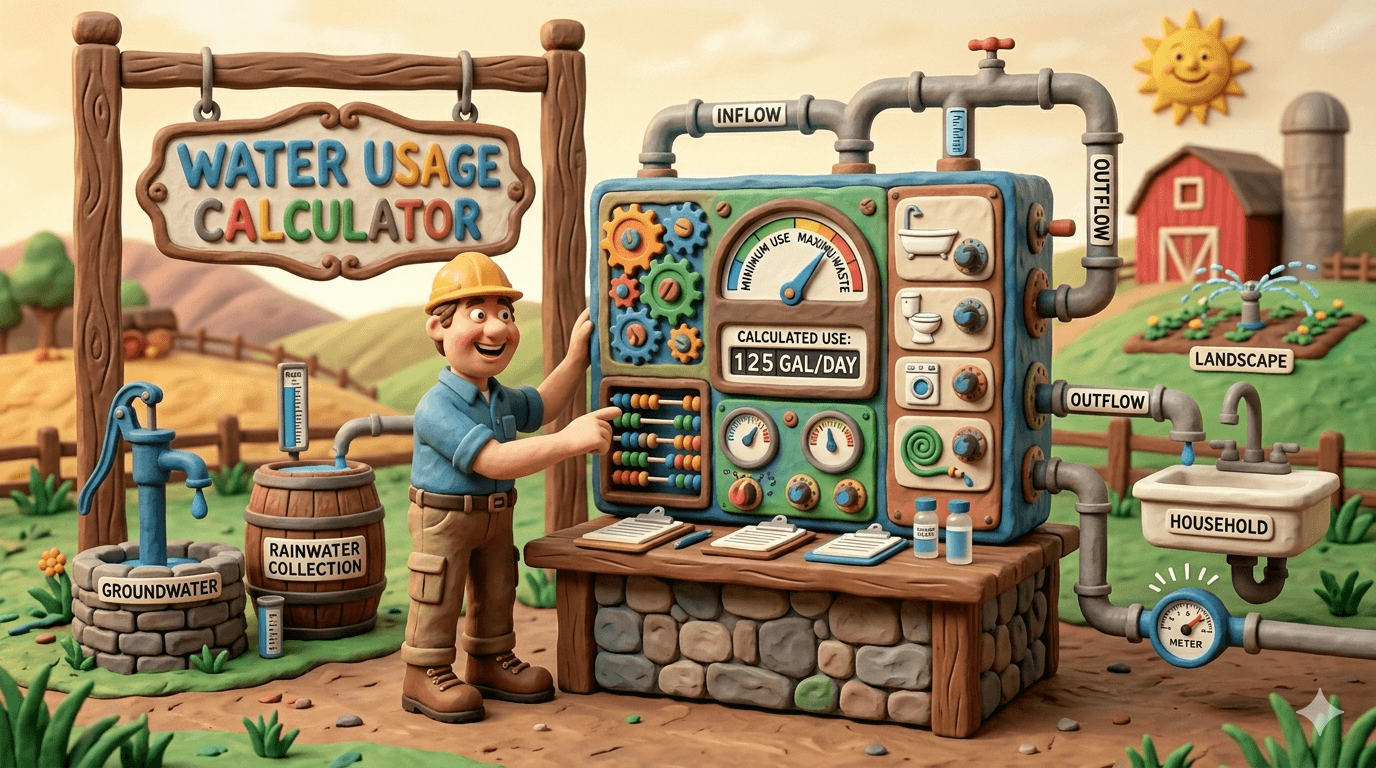
The calculator above turns three simple inputs into the answers you need. It adds your household indoor use to your garden irrigation to your livestock drinking water, then it shows you the total in gallons per day, per week, and per year. The breakdown bars tell you which bucket is the biggest, so you know exactly where conservation will pay off the most.
The single most useful number you walk away with is the daily total. Wells are rated by how many gallons per minute they can produce. Cisterns are sized by how many days of storage you want to carry. Rainwater systems are sized by how many gallons your roof can collect each year. Every one of those numbers ties back to your daily demand.
How to Use the Calculator Above
The whole calculation takes about twenty seconds. Here is the full path from blank inputs to a real number.
Step 1. Enter your household size. Type in the number of people who live full time on the property. Then enter how many gallons per person per day you use indoors. The default is 70, which is the average for an American home with standard fixtures. Drop it to 40 if you have low flow showerheads, low flush toilets, and you do not run the dishwasher every day.
Step 2. Enter your garden footprint. Put your total irrigated square footage in the first box. This is the cultivated area, not your whole yard. In the second box, enter the inches of water per week you apply during the growing season. One inch per week is the floor for most vegetables. Two inches is right for sandy soil or hot climates.
Step 3. Add your livestock. Pick an animal from the dropdown and enter how many you have. Click Add Livestock to add more rows. The tool already has the typical daily intake baked in for chickens, ducks, rabbits, goats and sheep, pigs, cattle, and horses. You can mix and match.
Step 4. Read the breakdown. The right panel shows your daily total in large type. Below it sit your weekly and yearly numbers. The bars at the bottom break the daily total into household, garden, and livestock so you can see exactly where the water is going.
Step 5. Print it. Hit the Print Report button to get a clean one page summary you can take to the well driller, the plumbing inspector, or the back of a notebook in the shed.
Household Indoor Water: The Biggest Bucket
For most homesteads, household indoor water is the largest single category. The average American uses about 70 gallons per person per day inside the house. A family of four sits around 280 gallons a day before anyone waters a tomato or fills a chicken bowl.
That number is the sum of a handful of fixtures. Toilets account for roughly 25 percent of household water. Showers and baths add another 20 percent. Laundry takes 15 to 20 percent. Faucets in the kitchen and bathroom split the rest, with leaks quietly stealing five to ten percent in many homes.
The good news is that household water is also the easiest place to make cuts. A low flow showerhead saves about 20 gallons every shower. A dual flush or composting toilet can cut your toilet water in half or more. Front load washers use about 15 gallons per load instead of 30. Catching cold shower water in a bucket while you wait for hot water saves a couple of gallons every morning, which adds up to a thousand gallons over a year.
If you are designing the house from scratch, you can plan for a target as low as 30 to 40 gallons per person per day. That cuts a four person family from over 100,000 gallons a year down to about 50,000. The savings ripple through every other part of the system. A smaller well, a smaller cistern, a smaller water heater, smaller pipes, smaller everything.
Garden Irrigation: From Inches Per Week to Gallons
Garden water gets confusing because gardeners talk in inches but pumps and wells talk in gallons. The conversion is simple. One inch of water spread over one square foot equals 0.623 gallons. So a 1,000 square foot garden getting one inch of water per week needs 623 gallons that week, or about 89 gallons per day during the growing season.
Most annual vegetables want one to two inches per week, including any rainfall. In a temperate climate with regular summer rain, your irrigation supply might only need to fill the gap. In a hot dry climate with no summer rain, you are supplying the whole amount. The default in the calculator above is 1.5 inches per week, which lands in the middle of the typical range.
How soil type changes the number
Soil holds water differently depending on its texture. Sandy soil drains fast and dries out within a day or two of watering, so it needs more frequent irrigation in smaller amounts. Clay soil holds water for a week or more after a deep soak, so it does better with less frequent but heavier waterings. Loamy soil sits between the two and is the easiest to manage.
If you garden in pure sand, plan for closer to two inches per week split across three or four watering days. If you garden in heavy clay, one inch every five to seven days is plenty during normal weather. Sticky clay actually holds so much water that overwatering is more common than underwatering.
Drip irrigation versus overhead sprinklers
How you deliver water matters as much as how much. Overhead sprinklers lose 20 to 50 percent of the water to evaporation and wind, especially in hot dry weather. Drip irrigation and soaker hoses deliver water directly to the soil at the base of each plant, which raises your effective use to 90 percent or better.
For the same 1,000 square foot garden, drip can cut your weekly water by 30 percent or more compared to sprinklers, while actually growing healthier plants. The leaves stay dry, which reduces fungal disease, and the weeds between rows get nothing to drink.
Why mulch can cut your water bill almost in half
A thick layer of mulch is the single highest return investment in garden water conservation. Two to four inches of straw, wood chips, leaves, or grass clippings on the soil surface blocks evaporation, regulates soil temperature, and smothers weeds that compete for water. Studies and homestead reports both put the savings around 40 to 50 percent.
If your garden math says you need 600 gallons a week, mulching well drops that to around 350. Over a 25 week growing season, you have saved over 6,000 gallons. That is one less month of pumping the well, or a smaller cistern, or both.
Livestock Drinking Water: Sizing for the Herd
Livestock water looks small on a spreadsheet until you stack a few species together. A dozen laying hens drink about a gallon a day total. Add two milking goats and you are at five gallons a day. Add a couple of pigs and a small herd of cattle and you are suddenly looking at 70 to 100 gallons a day of livestock water alone.
Here are the round numbers the calculator uses for moderate weather. Chickens drink about 0.1 gallons per bird per day. Ducks drink about 0.25 gallons per bird. Rabbits drink about 0.1 gallons per rabbit. A goat or sheep drinks about two gallons. A pig drinks about three gallons. A horse drinks about ten gallons. A cow drinks about twelve gallons, and a lactating dairy cow can drink twenty to thirty.
All of these figures roughly double in hot weather. A flock of laying hens that drinks one gallon a day in April can drink two gallons a day in July. Pigs especially are vulnerable to heat and need clean cool water available every hour of the day. When you size storage and pumping for livestock, design for the worst week of summer, not the average.
Feed and water also scale together. If you are working out daily rations for your animals, our Feed Requirements Calculator pairs naturally with this one. The same flock that eats five pounds of feed a day also drinks the gallons listed above, every single day, for the life of the animal.
Peak Demand and Why Average Numbers Lie
The most dangerous number in water planning is the average. Average use across the year hides the moments when everyone needs water at once. Your well, your cistern, and your pump all have to handle the peak, not the average.
Picture a Saturday in July. The garden is on a soak. The washing machine is running. Someone is in the shower. The chickens just emptied their waterer and the pigs flipped theirs over. Each of those alone is a modest draw. Together, they can pull 15 to 20 gallons a minute for ten minutes straight. A well that produces five gallons a minute will run dry mid load, and you find out the hard way that the pump is now sucking air.
The fix is a peak demand buffer. Add 20 to 30 percent on top of your average daily total when you size storage. So if your daily average is 400 gallons, design for 500 to 520. Add a pressure tank big enough to absorb short bursts without cycling the pump. If your well is slow, a 200 to 500 gallon buffer tank between the well and the house turns a sleepy producer into a system that can deliver a fast flow when you ask for it.
Sizing a Well, a Rainwater System, or a Cistern
Once you know your daily total, every infrastructure decision flows from it. Here are the three most common patterns for getting water onto a homestead and how the calculator number plugs in.
Well capacity in gallons per minute
Wells are rated by gallons per minute, which is the rate the formation can recharge the borehole. A typical residential well in good country produces five to fifteen gallons per minute. A weak well might produce one or two. A great well can hit twenty or more.
To check whether a well can support your homestead, multiply gallons per minute by 1,440 minutes in a day. A five gallon per minute well can theoretically deliver 7,200 gallons in a day. In practice, you never pull that much. The yield drops as water level falls during heavy pumping, and you should not run a well dry. A safe rule of thumb is to plan for half the theoretical maximum. So a five gallon per minute well can comfortably support a daily demand of about 3,000 gallons, which is way more than most homesteads need.
If your well produces less than one gallon per minute, you will need a storage tank that fills slowly between draws. The tank lets the well work all day to refill the buffer, and the house pulls from the buffer at a faster rate.
Rainwater catchment supply
Rainwater is free if your roof and gutters are already there. The supply formula is the same conversion factor you saw earlier. One inch of rain falling on one square foot of roof produces 0.623 gallons. Multiply your roof footprint, in square feet, by your annual rainfall in inches. Then multiply by 0.623 to convert. Then multiply by 0.85 to account for losses to splashing, evaporation, and first flush diverters that toss the dirty initial flow.
A 2,000 square foot roof in a 35 inch rainfall region produces about 37,000 gallons of usable water per year. If your homestead uses 100,000 gallons a year, rainwater can cover roughly a third of the load. In a wetter region or with a larger collection surface, you can get to 100 percent.
Cistern sizing for dry seasons
A cistern is just a big buffer that smooths the gap between when water arrives and when you use it. The right size depends on how long your dry season runs and how much you draw during that window.
Take your daily demand and multiply it by the number of days you expect to go without significant rain or pump access. A family using 400 gallons a day in a region with a 90 day dry summer needs at least 36,000 gallons of storage to ride out the season on cistern alone. Most rural cisterns are smaller because the well covers part of the load, but the math still applies. Plan for the longest gap you might face, not the shortest.
Whatever path you choose, water infrastructure is one of the biggest cost lines on a new homestead. If you are still penciling out the total budget, our Homestead Budget Calculator walks you through the major line items so the well, the pump, the tank, and the plumbing do not surprise you in year one.
The Most Common Water Planning Mistakes
Even careful planners trip on the same handful of issues. Run through the list before you finalize numbers and you will avoid the worst of them.
1. Sizing for the average instead of the peak. Average daily numbers are useful for budgeting and pump sizing over the long run. They are useless for the moment everyone needs water at once. Always design storage with at least a 20 to 30 percent buffer.
2. Forgetting the hot weather doubling. Garden water can climb 50 percent in a heat wave. Livestock water can double. A system that works in April can fail in July if you only sized for spring numbers.
3. Ignoring soil type. A garden water budget that works for loam will be too low for sand and too high for clay. Adjust your inches per week to match what your dirt actually does.
4. Skipping the fire reserve. Rural homesteads often have no municipal fire response. A few thousand gallons of dedicated storage, with a hookup the local fire department can use, is one of the smartest investments you can make. It also doubles as a drought buffer.
5. Not metering existing usage. If you already live on the property, install a simple inline water meter for a week. Real numbers beat estimates every time. Most homesteads use either far more or far less than the household occupants assume.
6. Pumping straight from the well to the house. A direct well to house system has no buffer when the pump fails or the power goes out. A pressure tank plus a storage cistern means a power outage at dinnertime does not end your shower.
Frequently Asked Questions
How much water does a typical homestead use per day?
How much water do chickens drink?
How can I reduce my garden water use?
Does this calculator account for rainwater catchment?
Is well capacity the same as daily gallons available?
How much more water do animals drink in hot weather?
What is the difference between daily and peak water demand?
How big a cistern do I actually need?
Written by Cole. Last updated May 2026.