What a Feed Requirements Calculator Actually Does
Every animal eats a predictable amount of feed each day. A laying hen eats about a quarter pound. A pig at finishing weight eats six. A dairy cow eats fifty. Those numbers are well established and they hardly move from one homestead to the next. What changes is the math.
Twelve hens at a quarter pound each is three pounds a day. Multiply by seven for weekly. By thirty for monthly. By three hundred and sixty five for yearly. Add a buck and two does. Add four meat birds you are growing out. Add the pig you bought for the freezer. Suddenly the math is a column of numbers nobody wants to do in their head every time they think about ordering feed.
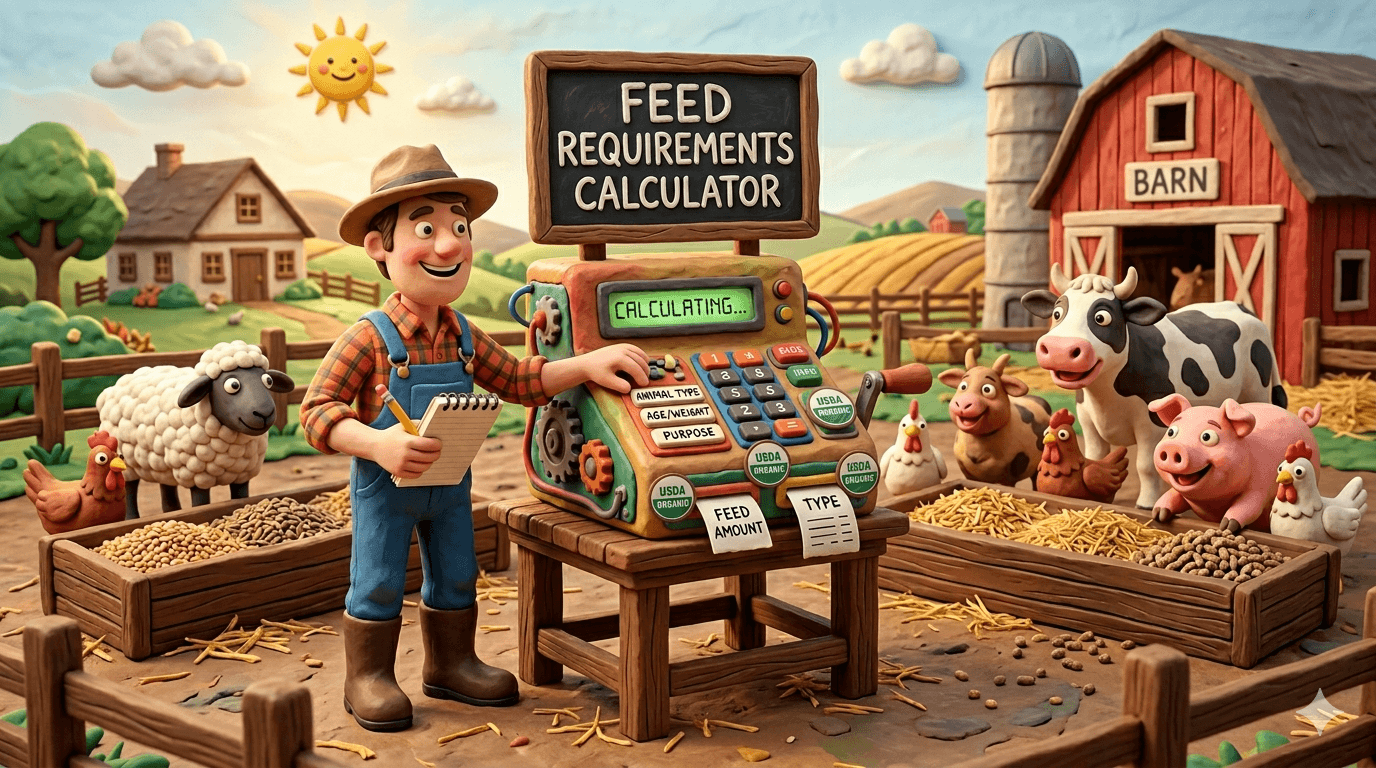
A feed requirements calculator does that math for you. You enter the animals you have. It returns four totals: daily, weekly, monthly, and yearly. You get one clean number for each window, which is exactly what you need to size a feed order, plan storage, or budget for the year.
How to Use the Calculator Above
The whole tool runs in under a minute. Here is the path.
Step 1. Add a group. The calculator starts with ten laying hens already loaded so you can see how the output behaves. Tap the green Add Animal Group button to add another row.
Step 2. Pick the animal type. The dropdown covers the nine most common homestead animals: laying hens, meat birds, ducks, rabbits, miniature goats, standard goats, pigs, beef cattle, and dairy cattle. Each one has a built in daily feed average that reflects healthy adult consumption.
Step 3. Enter the count. Type in how many of that animal you have. The four totals update the moment you change the number.
Step 4. Add more groups for mixed homesteads. Most homesteads run more than one species. Add a row for each. The grid stacks them cleanly so you can read each species on its own and still see the bottom line.
Step 5. Read the numbers. Daily and weekly help you size your feeders and your trip to the store. Monthly is the one bulk delivery drivers ask about. Yearly is what you plug into the homestead budget when you are deciding whether the animals pay for themselves.
That is the whole workflow. No spreadsheets, no guessing, no scribbled napkin math at the feed store.
How Much Feed Each Animal Actually Eats
The defaults in the calculator are real world averages for healthy adult animals on a standard ration. Here is the context behind each one so you can adjust by feel for your own setup.
Laying hens (about a quarter pound per bird per day)
A standard heavy breed hen like an Australorp or a Rhode Island Red eats roughly four ounces of layer feed a day. Bantams eat about half that. Production breeds on full lay can push toward five ounces. Twelve hens come out to three pounds of feed a day, which is about a fifty pound bag every two and a half weeks. Free ranging birds can cut that bagged total by up to a third in summer when pasture is lush, but in winter the bag burn rate climbs right back up because nothing is growing.
Meat birds (about a third of a pound per bird per day)
Cornish Cross broilers are eating machines. They start at almost nothing as chicks and finish at close to half a pound a day in their final week. The third of a pound daily average covers the full eight week grow out cycle. Fifty meat birds need about eight hundred pounds of feed from chick to freezer, which is sixteen fifty pound bags. Slower growing heritage broilers like Freedom Rangers eat slightly less per day but take three weeks longer to finish, so the total feed bill ends up roughly the same.
Ducks (similar to meat birds at about a third of a pound)
Ducks eat more than hens of the same weight because they waste a lot of feed dabbling in water. A laying duck eats roughly a third of a pound a day. Pekin meat ducks eat closer to half a pound during the last few weeks of grow out. Floating feeders and a dry feeding area help cut the waste significantly.
Rabbits (around a quarter pound per adult per day)
An adult New Zealand or Californian breeder rabbit eats about four ounces of pelleted feed a day plus free choice hay. A nursing doe with a full litter can double that as her kits start eating solid food. Growing fryers from weaning to butcher eat closer to three ounces a day. If you are growing meat rabbits, plan on about ten pounds of feed per finished four pound fryer.
Miniature goats (about 1.5 pounds per head per day on top of forage)
Nigerian Dwarves and Pygmies eat about a pound and a half of grain or pelleted ration a day when they are milking or growing. Dry adults can be maintained on much less, sometimes nothing at all, if pasture and good hay are available. The 1.5 pound default is the working number for a small dairy or breeding herd that needs steady nutrition.
Standard goats (around 3 pounds per head per day on top of forage)
A standard sized dairy goat in milk eats about three pounds of grain on top of all the hay and browse she can clean up. Boer meat goats are similar. The grain is the part you actually buy by the bag. Hay is the bigger volume but it is measured by the bale, not the pound, so a calculator like this one keeps the feed math focused on what you scoop into the feeder.
Pigs (roughly 6 pounds per pig per day during finishing)
A weaner pig starts at about a pound and a half of feed a day at forty pounds of body weight. By the time the pig is closing in on butcher weight at two hundred and fifty pounds, daily feed is closer to eight pounds. The six pound average gets you in the right neighborhood for the full grow out. Two pigs raised from weaner to butcher will eat roughly seven hundred pounds of feed each, give or take a hundred depending on breed and pasture access.
Beef cattle (around 24 pounds per head per day across grain plus hay)
A beef steer being finished on a mix of grain and hay eats roughly twenty four pounds of dry matter a day. On full pasture in summer that number can drop to almost zero in purchased feed and rise to the full amount in winter when hay is doing all the work. A homestead family raising one or two beef cattle a year needs to plan on three to five tons of hay through the cold months, which dwarfs anything else on the feed bill.
Dairy cattle (closer to 50 pounds per head per day for a milking cow)
A lactating dairy cow eats about fifty pounds of dry matter a day, split across grain at milking time and hay or pasture the rest of the day. Heavy milkers can push higher. Dry cows eat less, somewhere closer to thirty pounds. If a single family milk cow is on your homestead plan, this is the line item that will reshape your budget more than any other.
Factors That Change How Much Your Animals Eat
The numbers above are good averages. Real consumption shifts based on a handful of factors that every keeper learns to watch for.
Temperature. Cold animals burn calories to stay warm. In a hard winter, every animal on your homestead can eat fifteen to thirty percent more than the summer baseline. Chickens fluff up and pull from the feeder more often. Pigs need extra to hold weight. Cattle need more hay than seems reasonable. The calculator gives you an average across the year, so if you want to plan for the winter peak alone, add about twenty percent to the monthly total.
Forage and pasture quality. Lush green grass and weedy edges can replace a real chunk of bagged feed for grazing animals. Goats on good browse eat far less grain. Pigs on woodlot rotation can knock a third off their bagged ration when acorns and roots are plentiful. Chickens with a real run full of bugs eat noticeably less layer pellet in summer. Bare or overgrazed pasture does the opposite. It looks green but provides almost no calories, and your feed bill goes back up.
Age and production stage. A growing animal eats more relative to body weight than a maintenance adult. A lactating doe or cow eats far more than a dry one. A laying hen on full production eats more than a hen in molt. Match the numbers to where your animal is in its life cycle, not just to its species.
Breed and body size. A Buff Orpington hen eats more than a Leghorn. A Holstein cow eats more than a Jersey. A Berkshire pig eats more than a Tamworth at the same age. Bigger frames need more calories to maintain. If your animals run heavy for their species, bump the daily number up by ten to twenty percent.
Feed quality. A high protein, nutrient dense ration goes further per pound. Cheap fillers do not. Animals will self regulate by eating more of a less nutritious feed to hit the same nutrient target, which means the savings on the bag are often eaten up at the trough. Quality usually wins on a per animal basis.
Seasonal Swings: Why Winter Feed Bills Are Different
The single biggest mistake homesteaders make with feed planning is assuming the same monthly number works in January as it does in July. It does not.
In summer, grazing animals can pull half or more of their calories from pasture. Even chickens cut their bagged feed when bugs are everywhere. Pigs root, goats browse, cattle graze. Your bagged feed bill drops to its lowest point of the year, and it is easy to underestimate what the cold months will demand.
In winter, pasture disappears. Every calorie has to come from a bag, a tote, or a bale. Animals are also burning more calories to stay warm. The combined effect is a feed bill that can double or triple from August to January for the same number of animals. Cattle and goats also shift heavily onto hay, which is bought by the ton and stored in the barn long before you need it.
The calculator above gives you a yearly average. To plan for the winter peak, run two scenarios. Use the calculator total as your summer baseline. Then multiply by about 1.5 to get a realistic winter month. Order or store enough feed by late October to carry you through the worst of it. You do not want to be making weekly trips through a snowstorm because you cut it close.
Buying in Bulk vs Buying by the Bag
Once you know your real monthly number, you can make the smart call between bagged feed and bulk delivery. Each has a sweet spot.
Bagged feed from the local feed store is the right choice for small flocks and herds. A fifty pound bag is easy to handle, easy to store, and easy to swap brands. The downside is the price. Bag prices have crept up steadily, and you pay a premium for the packaging.
Bulk totes in the five hundred to one thousand pound range are the middle ground. Many feed mills will sell custom mixes in totes if you call ahead. You save fifteen to twenty percent compared to bags. You need a place to keep the tote dry, and you need a way to scoop out of it.
Bulk delivery by the ton drops your price the most, but it only makes sense if you can use a ton or two before the feed goes stale. Most mills require a one to three ton minimum order. If your calculator monthly total is over five hundred pounds, bulk starts to pay off. If your monthly total is over a ton, bulk is almost always the right call. You need a bin that seals against rodents and moisture, but the savings cover that bin in a single year.
The number in the monthly box of the calculator is the line that tells you which tier you sit in. Take that number to the feed mill and ask for their bulk price. You may be surprised how often the math says order in bulk.
Storing Feed So You Do Not Waste It
All the savings in the world disappear if rodents or moisture get into your feed. Storage is half the feed game on a working homestead.
Metal cans with tight lids are still the gold standard for small homesteads. Galvanized trash cans hold a fifty pound bag with room to spare. Plastic totes work in a pinch but rats can chew through them in a single night. If you go plastic, set it inside a metal frame or on a hard floor where you can see if rodents have been at it.
Bulk bins for larger operations need to seal against the same enemies. A gravity fed bin in the barn, raised off the ground on a pad, is the gold standard for any homestead pulling a ton or more of feed at a time. Keep the area around it clean and clear of spilled grain so you do not invite trouble.
Rotation matters. Feed loses nutritional value as it ages. Whole grains hold their value for six to nine months in good storage. Pelleted feeds and ground rations start to lose vitamins and oils after about three months. Buy what you will use in that window, and use the oldest stock first.
Humidity is the silent enemy. Bagged feed left on a damp barn floor can mold from the bottom up before you notice. Stack bags on pallets. Keep the storage area dry. If you smell anything sour or musty, do not feed it. Moldy feed can kill chickens fast and make larger animals quite sick.
How a Feed Requirements Calculator Fits Into Your Homestead Plan
Knowing the pounds is the first step. Knowing the dollars is the next one. Once you have your yearly total from the calculator above, plug it straight into our Feed Cost Calculator with your local bag prices to see your true annual feed bill. That number is one of the biggest line items on any homestead, and the two tools together give you the full picture.
If you are still deciding which animals make sense for your space and goals, the Livestock Quiz is a good starting point. It helps you weigh time, space, climate, and feed costs all at once.
Picking specific chicken breeds is its own decision. Layers, dual purpose breeds, and dedicated meat birds all eat different amounts and produce different things. Our Chicken Breed Picker lets you compare twenty five plus breeds by feed conversion, egg color, climate hardiness, and temperament before you order any chicks.
Once feed lands in your real homestead budget, you can see how it stacks up against land payments, infrastructure, garden costs, and equipment. The Homestead Budget Calculator pulls all of those numbers into one place so you can see whether your animals are paying their way.
Feed is rarely just feed. It is the conveyor belt that turns your time and money into eggs, meat, milk, and manure. Get the pounds right and the rest of your plan gets a lot easier to defend.
Frequently Asked Questions
How accurate is a feed requirements calculator?
Do my animals eat more in winter?
Does free ranging really cut feed costs?
How much should I add for waste and spoilage?
How long does bagged feed stay fresh?
Should I switch feed brands to save money?
How do I calculate feed for mixed ages or breeding stock?
What is the difference between feed cost and feed requirements?
Written by Cole. Last updated May 2026.