What “Average Land Price Per Acre” Actually Means
Every land cost number you see online is a regional average. The calculator above uses state averages because the state is the most useful first filter. Move from Texas to Tennessee and your dollar buys roughly half the land. Move from Tennessee to New Jersey and your dollar buys roughly a tenth.
That average hides a wide range, though. Inside any single state, the per acre price can swing 5x or more between counties. A creek bottom field in central Tennessee with paved road frontage is not priced the same as a ridge top parcel down a half mile dirt track. Use the state average to pick a region. Then use county level listings and a local agent to pick a parcel.
The other thing the average leaves out is parcel size. Per acre prices almost always drop as the parcel gets bigger. A 1 acre lot near a small town might sell for $20,000. A 40 acre block twenty minutes farther out can run $4,000 per acre. If you have flexibility on acreage, buying a slightly larger parcel is often the cheapest land you will ever own.
How to Read the Land Cost Estimator Above
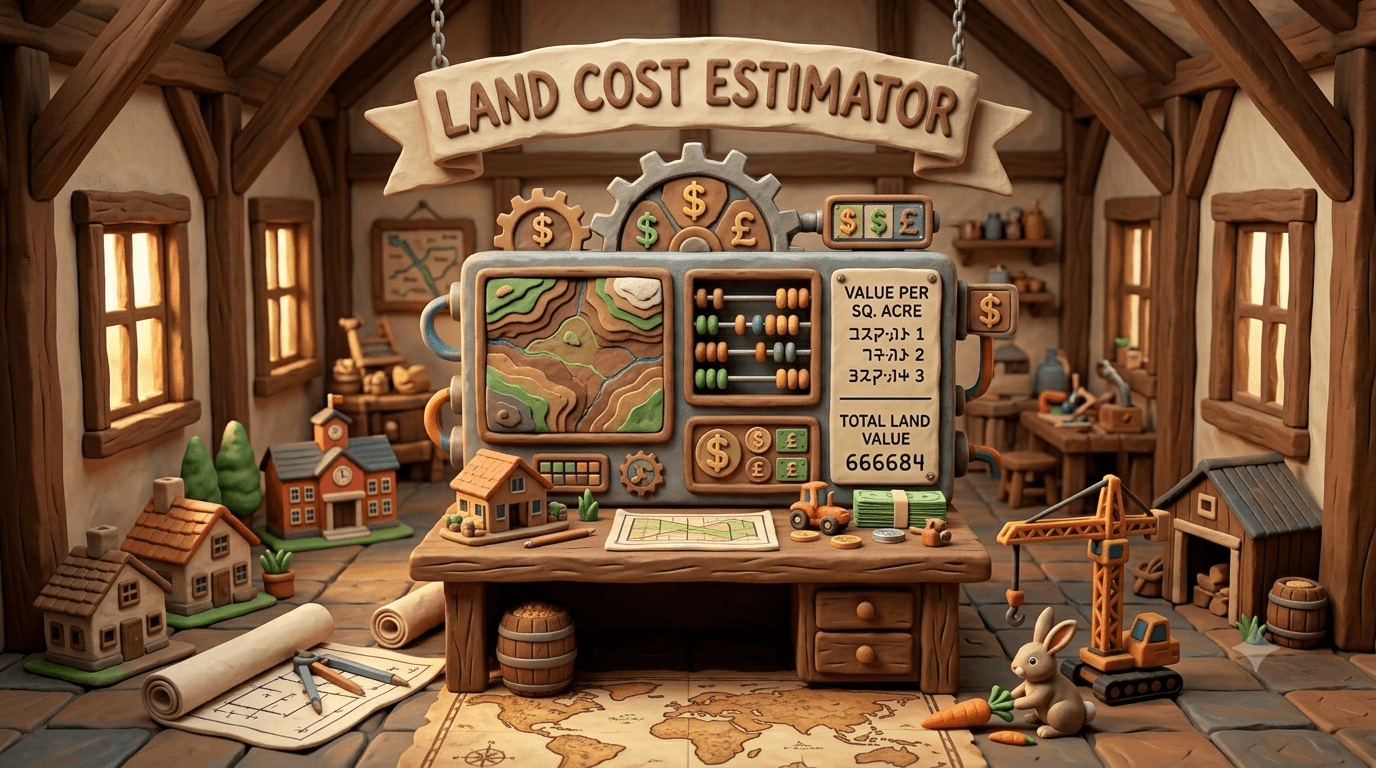
The tool works in three short steps. Here is the full path.
Step 1. Pick the state you are seriously considering. Start with whatever state already has you curious. The dropdown sorts alphabetically. The state average loads instantly under the field. If the number shocks you, that is useful information before you start touring properties.
Step 2. Set realistic acreage. Most first time homesteaders overshoot. You almost never need 40 acres. Try entering 3, 5, and 10 to see how the total shifts. Big jumps in total cost can change which state actually makes sense for your budget.
Step 3. Read both numbers, not just the purchase price. The right hand panel shows the total purchase cost on top and the estimated annual property tax below it. The tax bill is forever. A state with cheap land but high tax rates can quietly cost more over twenty years than a higher priced state with low taxes and a strong agricultural exemption.
Use the estimator as a regional shortlist tool, not a final budget. Plug the numbers into our Homestead Budget Calculator to layer in infrastructure, animals, and the first year of operating costs.
Why Land Prices Vary So Much Within a Single State
Two parcels can sit ten miles apart and price three times differently. Five drivers explain almost every gap.
Road access
Paved county road frontage is the single biggest premium in rural land. A parcel on a paved road can be financed by most banks, gets year round access for emergency vehicles, and saves you the cost of building and maintaining a long driveway. Parcels reached only by a dirt or gravel easement sell at deep discounts. Land that is fully locked off public roads, called landlocked, sells at the steepest discount of all, but you may never resell it without negotiating a permanent easement.
Water access and water rights
Land with a live creek, spring, or reliable shallow well is worth more than dry land. In western states with prior appropriation water law, water rights are bought and sold separately from the land itself and can double a parcel's value. Always ask whether documented water rights convey with the sale. If the answer is no, your homestead just got harder. Check our Water Usage Calculator for an idea of how many gallons you actually need.
Soil and topography
Flat to gently rolling land with good agricultural soil costs more than steep, rocky, or swampy land. Look up the USDA Web Soil Survey for any parcel before you make an offer. It will tell you the soil types, drainage class, and likely productivity for crops and pasture. A pretty mountain lot with shale a foot below grass is not the same investment as a creek bottom with three feet of loam.
Zoning and restrictions
Unrestricted land, sometimes labeled no HOA and no zoning, is the most flexible parcel a homesteader can buy. You can build what you want, raise the animals you want, and run cottage businesses on site. Land inside a subdivision with deed restrictions often forbids livestock, accessory buildings, or short term rentals. Read every recorded covenant before you sign anything.
Standing timber and minerals
Mature merchantable timber adds real value, sometimes thousands of dollars per acre. A recent clearcut reduces value. Mineral rights are a separate question. In some regions, the surface and the minerals were severed decades ago, which means a gas, oil, or coal company can legally come on your land to extract their property. Always ask whether mineral rights are included.
The Hidden Costs Beyond the Sticker Price
The list price is only the start. On raw land, the cost of making the property livable usually equals 30 to 50 percent of the purchase price. Plan for all of it before you make an offer.
Closing costs and title insurance. Budget 2 to 5 percent of the purchase price for closing. This covers title insurance, recording fees, attorney fees, and sometimes a survey.
Survey. If the property does not have a recent recorded survey, get one. A boundary survey typically runs $1,000 to $4,000 depending on acreage and terrain. You want to know exactly where your fence lines go before you build them.
Perc test. A passing perc test, usually $500 to $1,500, confirms the soil can support a septic system. No perc, no house.
Driveway. A simple gravel driveway can run a few thousand dollars. A long driveway on rough terrain with culverts and grading can run $20,000 plus.
Well. A drilled well usually costs $8,000 to $25,000 depending on depth and local geology. Add another $1,500 to $4,000 for the pump and pressure tank.
Septic system. A conventional gravity septic runs $5,000 to $12,000. A mound or aerobic system on poor soils can run $15,000 to $30,000.
Power drop. If grid power is at the road, expect $2,000 to $8,000 to bring it to a homesite. Far off grid? Plan to budget for a full solar setup instead. Our Solar Sizing Calculator can help size that system.
Add those numbers up before you write an offer. Many homesteaders end up paying as much for infrastructure as they did for the land itself.
Property Taxes by Region and the Ag Exemption Most Buyers Miss
Property tax rates vary more than most people realize. Hawaii sits near the bottom at well under half a percent. New Jersey and Illinois sit at the top, above two percent. On a $200,000 parcel, that gap is the difference between $580 and $4,520 a year forever.
The good news is that nearly every state offers some form of agricultural, forestry, or open space exemption that can dramatically lower the bill on rural land. Programs vary by name and threshold:
- Texas calls it 1 d 1 ag valuation. Land in qualifying agricultural use is taxed on its productive value instead of market value, often cutting the bill by 80 percent or more.
- Tennessee uses the Greenbelt program for farm and forest land, which taxes the property at use value.
- California has the Williamson Act, which trades a tax discount for a ten year commitment to keep the land in agriculture.
- Most other states have similar programs called Current Use, Forest Stewardship, Farm Assessment, or Agricultural Use Valuation.
The requirements are real but achievable. Many states only ask for active use plus a modest income threshold, often $500 to $2,500 of farm income a year. Selling eggs, hay, lavender bouquets, or honey at a farmers market can qualify a small homestead. Call the county assessor before you close. Ask what programs they offer, how many acres are required, and what counts as qualifying use in their county.
How Much Land You Actually Need by Homestead Style
More land is not always better. Every extra acre is more fencing, more mowing, more property tax, and more weeds to fight. Match the parcel to the lifestyle you actually want.
Quarter acre to 1 acre: backyard homestead
Plenty of room for intensive vegetable gardens, a small flock of laying hens, a couple of dwarf fruit trees, and rainwater catchment off the roof. Many backyard homesteaders also keep meat rabbits, quail, or a single dairy goat. You can supply a meaningful share of a family's annual food on this footprint if you garden seriously.
1 to 5 acres: the classic small homestead
This is where most family homesteads live. Room for a real orchard, a market garden, larger laying flocks, pigs, dairy goats, and rotational grazing for a couple of sheep. You can grow most of a family's produce and a real share of the meat. Property taxes stay manageable and fencing stays affordable.
5 to 20 acres: full homestead with grazing animals
Enough acreage for a few head of cattle, a flock of sheep, a serious orchard, larger pastures, and woodlots for firewood. This is the band where many homesteaders go all in on grass fed beef or dairy. Plan to spend more time on fencing and pasture management than the people on five acres do.
20 acres and up: working farm scale
Above twenty acres you are starting to operate at a small farm scale. There is room to lease pasture, sell hay, run a herd of beef cattle, or manage timber on a rotation. You also start to need equipment beyond a garden tractor. Buy this much land only if your goals genuinely demand it.
Region by Region: What to Expect in the Major Homesteading Belts
Most American homesteaders end up clustering in a handful of regions. Each one has its own pricing logic and tradeoffs.
Appalachia (eastern Tennessee, western North Carolina, Virginia, West Virginia, Kentucky)
Long growing seasons, plenty of rainfall, good well water, and rolling timbered land. Prices in the classic homestead band, often $4,000 to $8,000 per acre. The downside is steep ground. Buy a parcel with at least a few flat acres for gardens and buildings.
The Ozarks (Missouri, Arkansas)
Some of the most affordable rural land east of the Mississippi. Mild winters, hot summers, abundant springs and small creeks, and unrestricted counties are common. The growing season is long enough for almost any homestead crop.
The Mountain West (Montana, Wyoming, Idaho, parts of Colorado)
Cheap headline prices on big acreage. The catch is water. Many parcels look beautiful and have no documented water right, which limits what you can actually grow or graze. Winters are long and the growing season is short. Read every water right document carefully.
The Pacific Northwest (Oregon, Washington, northern Idaho)
Mild climate, long growing seasons west of the Cascades, and strong markets for direct sales of produce, meat, and value added farm products. Land prices vary widely. Coastal valleys are expensive. Drier eastern slopes are much more affordable.
The Deep South (Mississippi, Alabama, Georgia, Louisiana)
Some of the cheapest land in the country, year round growing seasons, and warm winters. The tradeoffs are humidity, heat, summer pests, and parasite pressure on livestock. Property taxes tend to be low.
The Upper Midwest (Wisconsin, Minnesota, Michigan, Iowa)
Excellent soils, strong farming infrastructure, and long days during the summer growing season. Cold winters and short shoulder seasons. Prices vary, with prime farmland in Iowa pushing into the premium band and cutover timber land in northern Wisconsin staying very affordable. Plan around your frost dates with our Frost Date Finder.
The Six Most Common Land Buying Mistakes Homesteaders Make
Almost every land buying horror story falls into one of these buckets. Avoid them and you avoid most of the pain.
1. Falling in love before checking water. No water, no homestead. Verify the well log, the spring flow, the recorded water right, or the depth of nearby successful wells before you write an offer.
2. Skipping the perc test. If the parcel does not perc, you cannot build a conventional septic system. That alone can kill your plans or add tens of thousands of dollars in alternative system costs.
3. Ignoring the easement and access details. A parcel with no recorded legal access is a parcel you may never be able to reach legally. Verify the deeded access in writing.
4. Underestimating infrastructure. The driveway, well, septic, power drop, and basic fencing can easily total $40,000 to $80,000 on raw land. Factor it in before you sign.
5. Forgetting the property tax bill. Always pull the actual most recent tax bill from the county website. The line on the listing is often the seller's exempted rate, not what you will pay as a new owner.
6. Buying too much acreage. Big parcels look romantic. They also generate big mowing bills, big fencing projects, and big tax bills. Buy the smallest acreage that meets your real goals.
How a Land Budget Fits Into Your Overall Homestead Plan
Land is the foundation but it is only one line on the spreadsheet. A complete homestead budget includes the parcel, the infrastructure to make it livable, the animals and plants you bring on, and the first year of operating expenses before the homestead pays for itself.
A simple rule of thumb is to set aside roughly the same amount you pay for raw land for first year improvements and infrastructure. Buy a $100,000 parcel and plan to spend another $80,000 to $120,000 before you are running a real homestead. If your numbers work on that scale, you can buy with confidence. If they only work when you assume the land is the entire budget, slow down and run the numbers again with our Homestead Budget Calculator.
If you are still early in the journey, our homesteading for beginners guide walks through the full sequence from choosing a region to your first year of harvests and chores.
Land is a generational decision. Take your time, evaluate the region first, evaluate the parcel second, and run every hidden cost before you commit. The right piece of ground will repay you for decades.
Written by Cole. Last updated May 2026.