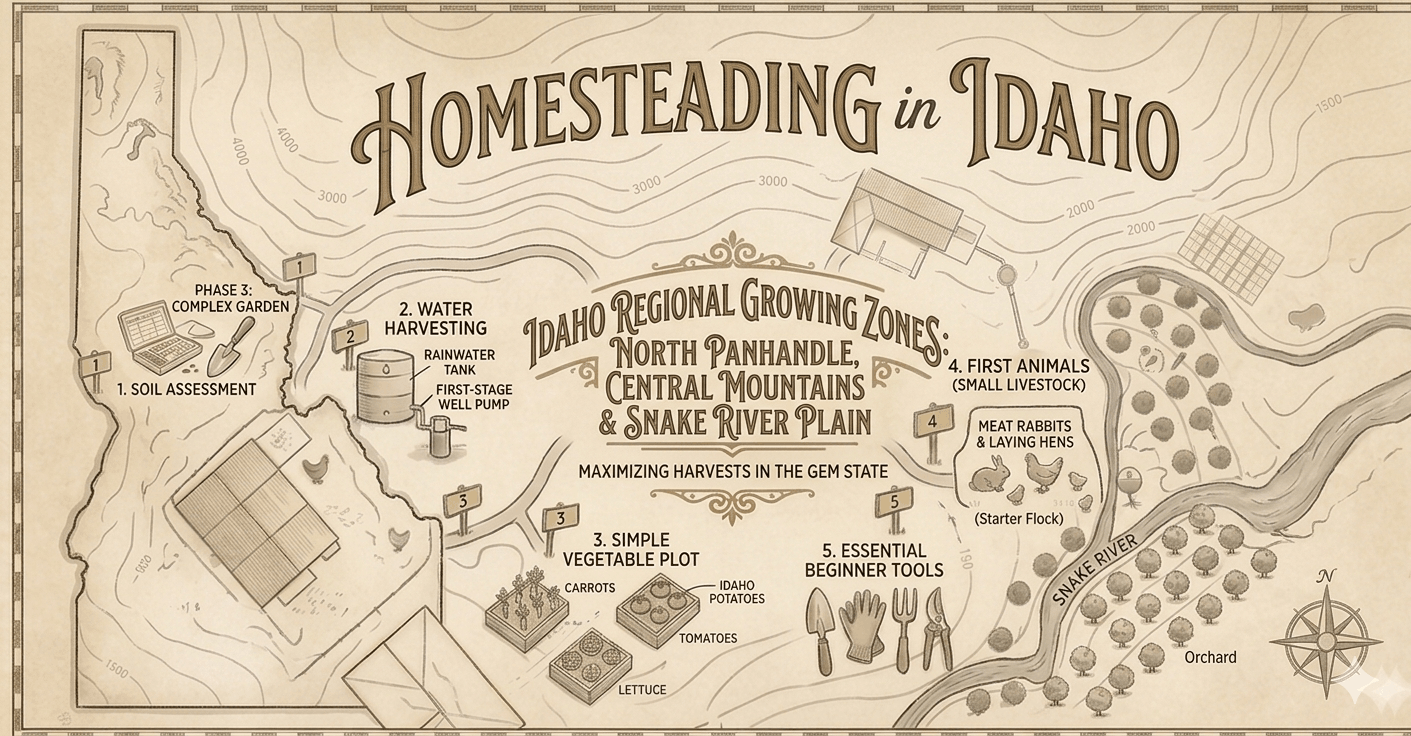
Idaho is quietly becoming one of the most attractive states in the West for homesteaders. Affordable rural land, some of the most permissive food freedom laws in the country, vast open space, clean water, and a fiercely independent culture make it a compelling option for anyone looking to build a self sufficient life.
This guide is written for anyone seriously considering a move to Idaho for homesteading. Whether you are comparing it against other states in our state by state homesteading hub or you have already set your sights on the Gem State, this article covers what you need to know before buying land and getting started.
If you are brand new to homesteading and want to understand the fundamentals first, start with our complete beginner's guide to homesteading. This Idaho guide assumes you already know what homesteading is and are now focused on where to do it.
I come from a family of farmers, and I have spent years applying my clinical research background to studying what makes certain states better than others for homesteading. Idaho does not get the same attention as Tennessee or Texas, but it deserves a serious look. Here is why.
Why Idaho Is One of the Best States for Homesteading
Idaho offers a unique set of advantages that are hard to find in any other western state. These are the six factors that matter most for homesteaders evaluating a relocation.
Idaho Food Freedom Act. Idaho passed one of the most permissive food freedom laws in the country in 2017. It allows direct to consumer sales of nearly all homemade foods, including many items that other states classify as potentially hazardous. If you want to sell what you grow and produce, Idaho gives you more freedom than almost any other state.
Affordable land with water access. The statewide average land price sits around $4,500 per acre, and many rural counties offer productive land with irrigation rights for $2,000 to $4,000 per acre. Unlike much of the arid West, Idaho has substantial river systems, snowmelt fed aquifers, and established irrigation infrastructure that keeps land productive.
Minimal rural building codes. Many rural Idaho counties have no mandatory building codes for residential construction. This gives homesteaders the freedom to build cabins, barns, greenhouses, and alternative structures without navigating a bureaucratic permit process.
Right to Farm protections. Idaho's Right to Farm Act protects established agricultural operations from nuisance lawsuits. If you are farming or ranching on agricultural land, your neighbors cannot shut you down over the normal sounds and smells of agriculture.
Open range heritage. Much of Idaho operates under open range law, which reflects the state's deep ranching culture. The legal framework is built around the assumption that land is used for agriculture, not the other way around. This creates a regulatory environment that favors homesteaders and ranchers over suburban development.
Strong agricultural infrastructure. Idaho is the nation's top potato producer and a major producer of dairy, beef, wheat, and hay. This means feed stores, equipment dealers, veterinarians, and agricultural supply chains are well established even in remote areas.
Note
Idaho's Food Freedom Act is one of the most permissive cottage food laws in the United States. It allows direct sales of nearly all homemade food products to informed end consumers without requiring a license, commercial kitchen, or government inspection. Very few states offer this level of freedom for small food producers.
Land Prices and Where to Buy in Idaho
Land is the foundation of any homestead. Idaho offers a wide range of options, from irrigated valley farmland to remote mountain acreage. The key is matching your goals to the right region.
Statewide Land Price Overview
The statewide average hovers around $4,500 per acre for rural land. For context, here is how Idaho compares to its immediate neighbors:
- Wyoming: approximately $1,500 per acre
- Montana: approximately $2,500 per acre
- Utah: approximately $3,500 per acre
- Oregon: approximately $4,500 per acre
- Washington: approximately $5,500 per acre
Idaho sits in the middle of its neighbors, more affordable than the Pacific Northwest states but above the sparsely populated plains of Wyoming and Montana. The critical factor is that Idaho land often comes with something rare in the West: reliable water access through established irrigation districts.
Best Regions for Homestead Land
The following table breaks down Idaho's major regions for homesteaders. Prices reflect raw or lightly improved rural land, not developed residential lots.
| Region | Typical Price Per Acre | USDA Zones | Terrain | Notes |
|---|---|---|---|---|
| Magic Valley (Twin Falls, Jerome, Cassia, Minidoka) | $2,500 to $5,000 | 5b, 6a | Flat to rolling, irrigated | Agricultural heartland. Established irrigation from the Snake River. Strong farm economy. |
| North Idaho Panhandle (Bonner, Boundary, Benewah, Shoshone) | $3,000 to $6,000 | 5a, 5b, 6a | Forested mountains, valleys | Wetter climate, timber, good for livestock. Growing in popularity. |
| Southwest Idaho (Owyhee, Elmore, Payette, Washington) | $2,000 to $4,000 | 5b, 6a, 6b | High desert, river valleys | Most affordable irrigated land. Remote but productive with water access. |
| Eastern Idaho (Bonneville, Bingham, Power, Oneida) | $2,000 to $4,500 | 4a, 4b, 5a, 5b | High desert plateau, volcanic soil | Cold winters, excellent potato and grain country. Affordable with short growing season. |
| Treasure Valley (Ada, Canyon, Gem) | $8,000 to $20,000+ | 6b, 7a | Valley floor, irrigated | Boise metro area. Longest growing season but generally overpriced for homesteading. |
What to Look for When Buying Idaho Land
Not all cheap land is good land, especially in the arid West. Before making an offer on any Idaho parcel, evaluate the following:
- Water rights. This is the single most important factor for Idaho land. Verify whether the parcel has deeded water rights, access to an irrigation district, or a permitted well. Land without water in Idaho is land without value for homesteading.
- Irrigation infrastructure. Does the property have existing ditches, pivots, or flood irrigation systems? Rebuilding irrigation from scratch is expensive.
- Road access. Many remote Idaho parcels are accessible only by dirt roads that may be impassable in winter or spring mud season. Verify year round access.
- Soil quality. Idaho soils range from rich volcanic loam to rocky desert hardpan. Request a soil survey through the USDA Web Soil Survey or schedule a test through the University of Idaho Extension.
- Elevation and frost risk. Higher elevations mean shorter growing seasons. A property at 5,000 feet will have a significantly different growing window than one at 3,000 feet, even in the same county.
- County building codes. Verify whether the county has adopted building codes before you buy if you plan to build.
- Broadband availability. Rural Idaho coverage is improving with Starlink adoption, but traditional wired internet is still sparse outside of towns.
- Fire risk. Wildfire is a real concern in Idaho, especially in sagebrush and forested areas. Check fire history and defensible space requirements.
For a quick snapshot of Idaho's key stats, visit our Idaho state overview page.
Idaho Homesteading Laws and Regulations
Idaho's legal environment is broadly favorable to homesteaders. The state has a strong tradition of property rights, agricultural freedom, and limited government regulation. However, water law in the West is fundamentally different from eastern states, and understanding it is critical before you buy.
Right to Farm Act
Idaho's Right to Farm Act (Idaho Code 22-4501 through 22-4504) protects agricultural operations from nuisance lawsuits. If your farming or ranching operation has been in existence for one year or more, it cannot be deemed a public or private nuisance due to changes in the surrounding area.
This means if someone builds a subdivision near your existing homestead, they cannot sue you over rooster crowing, manure smells, or equipment noise. The protection applies to any agricultural activity conducted in a reasonable manner consistent with good agricultural practice. It does not protect operations that are negligent or that violate health regulations.
Raw Milk Laws
Idaho is one of the most permissive states in the country for raw milk sales. Raw milk can be sold directly from the farm to consumers, and Idaho also allows retail sales of raw milk in stores. Producers selling raw milk at retail must be licensed by the Idaho State Department of Agriculture and meet regular testing requirements.
Small producers with fewer than three cows or fifteen goats can sell raw milk directly from the farm under more relaxed requirements. All raw milk sold must carry a label stating that it is unpasteurized and has not been inspected.
If you plan to keep dairy animals and sell surplus milk, Idaho's regulatory framework is one of the easiest to navigate in the country.
Cottage Food Laws
The Idaho Food Freedom Act (House Bill 108, signed in 2017) is one of the landmark pieces of food freedom legislation in the United States. It allows the sale of homemade food products directly to informed end consumers without requiring a license, commercial kitchen, inspection, or permit.
Covered products include baked goods, jams, jellies, honey, fermented vegetables, dried herbs, candy, and many other items. Unlike most states, Idaho also allows the sale of some potentially hazardous foods under this law, provided the buyer is an informed end consumer who understands the product was made in a home kitchen.
There is no annual sales cap written into the Food Freedom Act. Sales must be direct to the end consumer. Online sales are permitted for ordering, but the product must be delivered in person.
Zoning and Building Codes
Idaho does not mandate a statewide residential building code. Each county and municipality decides whether to adopt and enforce building codes. The result is significant variation across the state.
Many rural Idaho counties have minimal or no building codes. In these areas, you can build a home, barn, or outbuilding without pulling a permit. This makes Idaho one of the most attractive states for owner builders, tiny home enthusiasts, and anyone who wants to build unconventional structures.
Counties near Boise (Ada and Canyon counties) and larger cities like Coeur d'Alene, Idaho Falls, and Pocatello have adopted the International Building Code and enforce standard permitting processes. If you are buying near an urban center, expect permits, inspections, and setback requirements.
Warning
Building codes in Idaho vary dramatically by county. Many rural counties have no residential building codes at all, while urban counties enforce the International Building Code fully. Always contact the county building department before purchasing land if your building plans are a critical factor in your decision. The difference between neighboring counties can be night and day.
Water Rights
This is the most important legal topic for Idaho homesteaders and the one that differs most dramatically from eastern states. Idaho follows the prior appropriation doctrine, which means "first in time, first in right." All water in Idaho, including surface water and groundwater, belongs to the state. Users must hold a valid water right to legally divert or use water.
Water rights are separate from land ownership. When buying property, verify that the parcel includes deeded water rights or access to an irrigation district. Land without water rights in Idaho is significantly less valuable for agricultural use.
New water rights are obtained through the Idaho Department of Water Resources (IDWR). The application process requires demonstrating a beneficial use for the water (domestic, agricultural, or stock watering). Domestic wells for household use generally require a permit but are routinely approved.
Rainwater harvesting exists in a legal gray area in Idaho. The state has not explicitly prohibited it, but because all water technically belongs to the state under the prior appropriation system, large scale collection without a water right could theoretically be challenged. In practice, small scale rainwater collection for garden and household use is common and unenforced. Cistern systems for home use are widely used in rural areas.
Property Tax and Agricultural Exemptions
Idaho offers two important property tax benefits for homesteaders.
The Homeowner's Exemption reduces the taxable value of your primary residence by 50%, up to a maximum reduction of $125,000 in assessed value. This applies automatically once you file with your county assessor.
More importantly for homesteaders, Idaho allows agricultural land to be assessed at its current use value rather than its speculative market value. To qualify, the land must be actively devoted to agriculture and meet minimum acreage or income thresholds that vary by county. This assessment method can reduce your property tax bill substantially, particularly if your land is near a growing town where market values are climbing.
Tip
Idaho's agricultural land assessment can save homesteaders thousands annually. A 20 acre parcel near a growing town might have a market value of $200,000 but an agricultural use value of $40,000 to $60,000. Combined with the homeowner's exemption on your residence, the total tax savings can exceed $2,000 to $3,000 per year. Apply through your county assessor's office as soon as you qualify.
Livestock Regulations
Idaho is largely an open range state, which is one of the most distinctive aspects of its agricultural law. Under open range law, livestock have the right to roam freely on unfenced land. If you do not want cattle or sheep on your property, the burden is on you to fence them out. This is the opposite of eastern "fence in" states where the livestock owner must contain their animals.
Some Idaho counties have established herd districts that override open range law and place the responsibility on the livestock owner to contain their animals. Check whether your target county operates under open range or herd district rules.
No state permit is required for keeping chickens, goats, sheep, or pigs on agricultural land. Cattle require a brand registered with the Idaho State Brand Board if you plan to sell or transport them. The brand inspection system is a longstanding part of Idaho's ranching heritage.
Idaho requires a certificate of veterinary inspection for livestock brought into the state from out of state. If you are relocating with existing animals, plan this paperwork in advance through the Idaho State Department of Agriculture.
Climate, Growing Zones, and Soil
Idaho's climate is one of the most diverse of any western state. The Snake River Plain, mountain valleys, northern forests, and high desert each create dramatically different growing conditions. Understanding your specific region is essential for success.
USDA Hardiness Zones Across Idaho
Idaho spans USDA zones 3b through 7a, one of the widest ranges of any state. Your growing possibilities depend heavily on elevation and location.
| Region | USDA Zones | Avg Last Frost | Avg First Frost | Growing Season |
|---|---|---|---|---|
| Treasure Valley (Boise area) | 6b, 7a | April 10 to 20 | October 15 to 20 | 6 to 6.5 months |
| Magic Valley (Twin Falls area) | 5b, 6a | May 1 to 15 | September 25 to October 5 | 4.5 to 5 months |
| North Idaho Panhandle | 5a, 5b, 6a | May 1 to 15 | September 20 to October 5 | 4.5 to 5 months |
| Eastern Idaho (Idaho Falls area) | 4a, 4b, 5a | May 15 to June 1 | September 10 to 20 | 3.5 to 4 months |
| Central Mountains | 3b, 4a, 4b | June 1 to 15 | September 1 to 15 | 3 to 3.5 months |
These are averages. Microclimates created by elevation, river valleys, and south facing slopes can shift your actual frost dates by two to three weeks in either direction. Idaho gardeners quickly learn that a south facing slope at 3,500 feet behaves very differently from a north facing slope at the same elevation.
Planting Calendar Tool
Enter your zip code to get a personalized planting schedule based on your USDA zone.
Try it free →Rainfall and Water Availability
Idaho receives 8 to 25 inches of rainfall annually, depending on location. The northern panhandle receives the most moisture (20 to 25 inches), while the Snake River Plain and southern desert receive 8 to 12 inches. This is well below the national average, and supplemental irrigation is not optional for most crop production outside of the panhandle.
The good news is that Idaho has exceptional irrigation infrastructure. The Snake River and its tributaries, combined with the massive Eastern Snake Plain Aquifer, provide water to millions of acres of farmland through canal districts and groundwater wells. When you buy irrigated land in Idaho, you are buying into a water system that has been supporting agriculture for over a century.
For homesteaders, the practical takeaway is this: prioritize water access over everything else when buying land. An affordable 20 acre parcel with irrigation rights is worth far more than a cheap 80 acre parcel of dry sagebrush.
Soil Types by Region
Soil quality varies dramatically across Idaho, and understanding your local soil is one of the most important steps in planning your homestead.
Magic Valley and the Snake River Plain feature volcanic soil that is among the most productive in the West. These deep, well drained loam soils with a pH of 6.5 to 7.5 are the reason Idaho grows more potatoes than any other state. With irrigation, this soil supports an extraordinary range of crops.
North Idaho has primarily forest soils with high organic matter content. These tend to be slightly acidic with a pH of 5.5 to 6.5 and are excellent for root crops, brassicas, and berries. The region's higher rainfall means less dependence on irrigation for many crops.
Eastern Idaho has volcanic and alluvial soils that are generally productive but alkaline (pH 7.0 to 8.0). The high pH can cause nutrient lockout for some crops, particularly iron deficiency. Sulfur amendments and acidifying fertilizers are commonly needed.
Central Mountains have thin, rocky soils at higher elevations. Valley floors are more productive, but growing seasons are severely limited by altitude and cold. These areas are better suited for livestock than row crops.
Regardless of where you buy, get a soil test before planting. The University of Idaho Extension offers soil testing through county offices. Results include pH, nutrient levels, and specific amendment recommendations for your intended crops.
What to Grow on an Idaho Homestead
Idaho's growing conditions vary more within the state than most people expect. The combination of rich volcanic soil, intense summer sunshine (14 to 16 hours of daylight), and cool nights creates excellent conditions for many crops, provided you have water and plan around the shorter season.
Warm Season Crops
The warm season is intense but compressed in Idaho. Hot days and cool nights during summer produce exceptionally flavorful vegetables.
Potatoes are Idaho's signature crop for good reason. The volcanic soil, cool nights, and dry climate produce world class tubers. Yukon Gold, Russet Burbank, and Red Pontiac all perform exceptionally well. Even small gardens can produce a winter's worth of storage potatoes.
Tomatoes require variety selection matched to your zone. In zones 6a and warmer, full season varieties like Early Girl, Celebrity, and Stupice perform well. In colder zones, focus on short season varieties (55 to 65 days) and use season extension techniques like Wall O' Waters and high tunnels.
Peppers grow well in the Treasure Valley and Magic Valley with their warm summers. Hot peppers in particular love Idaho's heat and dry air. In cooler zones, grow peppers in raised beds or containers against a south facing wall.
Squash and pumpkins are excellent Idaho crops. Winter squash varieties like Buttercup, Delicata, and Spaghetti squash mature within Idaho's growing window and store well through the long winter.
Sweet corn thrives in the Magic Valley and Treasure Valley. Short season varieties (60 to 70 days) work in most Idaho zones. The warm days and cool nights produce particularly sweet ears.
Dry beans, peas, and lentils are commercially important Idaho crops and perform equally well in home gardens. They fix nitrogen in the soil and store indefinitely when dried.
Onions are a major Idaho commercial crop. The Treasure Valley in particular produces some of the finest sweet onions in the country. Plant sets or transplants as early as the ground can be worked.
Cool Season Crops
Idaho's cool springs and falls create excellent conditions for cold hardy crops. In fact, some crops perform better in Idaho than in warmer southern states because they do not bolt as quickly.
Lettuce, spinach, and arugula thrive in Idaho's cool spring and fall conditions. Direct sow as early as 4 weeks before the last frost. Succession plant every two weeks for a continuous harvest. Fall plantings often produce the best quality greens.
Broccoli, cabbage, and cauliflower are outstanding fall crops in Idaho. Start transplants indoors in June and set them out in July for harvest before hard freezes arrive. The cool fall temperatures produce tight, sweet heads.
Carrots, beets, turnips, and radishes love Idaho's loose volcanic soil. Root crops often grow straighter and larger in Idaho than in clay heavy soils elsewhere. Plant in spring or late summer for fall harvest.
Garlic is planted in October and harvested the following July. Hardneck varieties are best for Idaho's cold winters and produce flavorful scapes in spring as a bonus harvest. Idaho's dry summer conditions are ideal for curing garlic.
Peas go in the ground as one of the earliest spring plantings. Snow peas, sugar snaps, and shelling peas all produce well. They finish before the worst of summer heat arrives.
Kale and Swiss chard are remarkably cold hardy and can produce from spring through late fall with minimal protection. In mild years, kale can overwinter in zones 5b and warmer.
Fruit Trees and Perennials
Perennial fruit plantings are a long term investment that pays off for decades. Idaho's climate supports a surprising range of fruit crops, particularly in the warmer valleys.
Apples are one of Idaho's best fruit crops. The cold winters provide ample chill hours, and the dry summers reduce disease pressure. Honeycrisp, Gala, Fuji, and Gravenstein all perform well. Zones 5a and warmer are suitable for most varieties.
Cherries thrive in Idaho. The state is a significant commercial cherry producer, particularly in the Emmett and Boise valleys. Bing, Rainier, and Montmorency are reliable producers.
Peaches and apricots grow well in the Treasure Valley (zones 6b and 7a). The main risk is late spring frosts damaging blossoms. Contender and Reliance are cold hardy peach varieties worth considering for zone 5b.
Plums and prunes are well adapted to Idaho's climate. Italian Prune plums are a classic variety that produces reliably in zones 5a and warmer.
Raspberries are exceptionally productive in Idaho. The dry climate reduces fungal disease, and both summer bearing and everbearing varieties produce heavy crops. Heritage and Caroline are popular choices.
Grapes grow well in the Treasure Valley and Magic Valley, where Idaho's wine industry is established. For home use, table grape varieties like Concord, Reliance, and Himrod produce well in zones 5b and warmer.
Haskaps (honeyberries) are an increasingly popular cold hardy berry that thrives in Idaho's colder zones. They produce fruit that tastes like a cross between blueberry and raspberry, ripen before strawberries, and tolerate temperatures down to zone 2.
Herbs and Medicinal Plants
Idaho's dry climate produces intensely flavorful herbs. Basil, oregano, thyme, sage, rosemary, and dill all grow well. Rosemary and lavender can overwinter in zones 6a and warmer with good drainage and winter protection.
Lavender deserves special mention. Idaho's dry summers and alkaline soils are ideal for lavender production, and several Idaho farms have built successful lavender businesses. It is both an ornamental and a marketable crop.
Livestock for Idaho Homesteads
Idaho's ranching heritage runs deep, and the state is well suited for livestock production. The key challenges are cold winters and predator management. Here is what works best.
Chickens
Chickens are the natural starting livestock for most Idaho homesteaders. The primary climate challenge is winter cold, not summer heat. Focus on cold hardy, dual purpose breeds.
Buff Orpingtons are heavy bodied birds with thick feathering that insulates well against Idaho winters. They lay around 250 eggs per year and have a calm temperament suited to family homesteads.
Barred Plymouth Rocks are outstanding cold weather birds. They lay consistently (280 eggs per year) even through Idaho's short winter days with supplemental lighting. They are also excellent foragers during the warmer months.
Wyandottes are specifically bred for cold climates. Their rose combs are resistant to frostbite, which is a real concern in Idaho winters. Silver Laced and Golden Laced varieties lay 200 to 250 eggs per year.
Insulate coops well but maintain ventilation. Frostbite from moisture buildup inside a sealed coop is a bigger threat than cold air in a dry, ventilated one. Use the deep litter method for added warmth through composting action.
Goats
Goats are well suited to Idaho's terrain, particularly for clearing brush and grazing steep or rocky ground that cattle cannot use efficiently.
Nigerian Dwarf goats are ideal for small acreage dairy production. They produce 1 to 2 quarts of high butterfat milk per day and their compact size means lower feed costs through Idaho's long winters.
Alpine goats are a larger dairy breed that originated in mountain climates. They are cold hardy, excellent milk producers, and well adapted to Idaho's terrain and temperature extremes.
Kiko goats are a meat breed prized for parasite resistance and hardiness. They do well on Idaho's rough terrain with minimal management input.
Boer goats are the standard meat breed and widely available in Idaho. They grow quickly on pasture and brush.
The biggest challenge with goats in Idaho is winter management. Goats need dry, draft free shelter with deep bedding during cold months. Idaho's dry cold is actually easier on goats than the humid cold of southeastern states, but wind protection is essential.
Cattle
Cattle are the backbone of Idaho agriculture. The state's vast rangelands and irrigated pastures support both beef and dairy operations at every scale.
Angus are the dominant beef breed in Idaho. They are cold hardy, easy calving, and produce excellent beef on grass or mixed feed. Black Angus are by far the most common and widely available.
Hereford cattle are another excellent choice for Idaho. They are cold tolerant, docile, and efficient grazers. Baldy (Angus/Hereford cross) cattle combine the strengths of both breeds.
Dexter cattle are ideal for small homesteads. These compact dual purpose animals produce both milk and beef on roughly half the pasture of a standard breed. One Dexter cow needs approximately 1.5 to 2 acres of irrigated pasture.
Plan for 2 to 3 acres of irrigated pasture per cow calf pair in Idaho. On non irrigated rangeland, stocking rates drop to 15 to 40 acres per animal unit depending on the region. Hay production or purchase is essential for winter feeding, which can last 4 to 6 months.
Pigs
Pigs can be raised successfully in Idaho with proper winter housing. They are typically raised as spring through fall animals, with processing in late fall before the worst of winter arrives.
Berkshire pigs produce premium pork with excellent marbling. They are a medium sized breed that does well on pasture during the growing season.
Idaho Pasture Pigs (a heritage composite breed) are gaining popularity in the state. They were specifically developed for small farm pasture conditions and have a docile temperament.
Large Black pigs are a heritage pasture breed with a calm temperament and excellent foraging instincts. Their black skin provides natural sun protection.
Pigs need shade in summer and insulated, draft free housing in winter. In Idaho's coldest zones, many homesteaders choose to farrow in spring and process in fall rather than maintaining pigs year round.
Other Livestock Worth Considering
Sheep are historically one of Idaho's most important livestock species. The state has vast public grazing allotments, and sheep are well adapted to Idaho's terrain. Katahdin hair sheep do not require shearing and are increasingly popular with homesteaders.
Honeybees perform well in Idaho. The state's abundant wildflowers, irrigated alfalfa fields, and dry summers create good conditions for colonies. Expect 30 to 50 pounds of surplus honey per hive in a good year. Winter losses can be higher than in warmer states, so plan for insulated hive wraps.
Ducks are excellent homestead animals. Khaki Campbell ducks lay 250 to 300 eggs per year and are outstanding foragers. They handle Idaho's conditions well with access to shelter.
Livestock Quick Reference
| Animal | Min. Acreage | Startup Cost | Annual Feed Cost | Primary Product |
|---|---|---|---|---|
| Chickens (6 hens) | Any | $300 to $600 | $250 to $400 | Eggs, pest control |
| Dairy Goats (2 does) | 0.5 acres | $500 to $1,000 | $500 to $800 | Milk, brush clearing |
| Meat Goats (5 head) | 2 acres | $750 to $1,500 | $400 to $700 | Meat, land clearing |
| Beef Cattle (2 head) | 5 acres (irrigated) | $2,000 to $4,000 | $800 to $1,500 | Beef |
| Pigs (2 feeders) | 0.5 acres | $200 to $500 | $600 to $1,000 | Pork |
| Sheep (4 ewes) | 2 acres | $600 to $1,200 | $400 to $700 | Meat, fiber |
| Honeybees (2 hives) | Any | $500 to $800 | $100 to $200 | Honey, pollination |
Community, Culture, and Resources
Idaho's culture is deeply rooted in agriculture, ranching, and self reliance. This creates a natural fit for homesteaders, but the community and resources available to you will vary by region.
The Homesteading Community in Idaho
Idaho attracts a particular kind of homesteader: independent, resourceful, and comfortable with solitude. The state has seen significant inbound migration over the past decade from people seeking more affordable land, lower regulation, and a more rural lifestyle.
Farmers markets are growing in every region of the state, with the Boise, Moscow, and Sandpoint markets being among the most established. In smaller communities, the agricultural co op model is common, with neighbors sharing equipment, splitting bulk feed orders, and trading labor during busy seasons.
The ranching culture in Idaho means that agricultural knowledge is part of the community fabric. Feed store owners, neighbors, and county agents are generally willing to share advice with newcomers. Respect the local customs, learn the open range rules, and show up ready to work. You will be welcomed.
University of Idaho Extension and Local Resources
The University of Idaho Extension operates offices across the state and is your single most valuable free resource as an Idaho homesteader. Services include:
- Soil testing with detailed amendment recommendations
- Master Gardener certification programs
- Pest and disease identification
- Small farm business planning
- Livestock health clinics and workshops
- 4 H and youth agricultural education programs
The Idaho State Department of Agriculture handles permits for raw milk sales, brand registration, organic certification, and agricultural development programs. Their website provides current regulatory information for food producers.
The Idaho Farm Bureau has local chapters across the state and provides insurance, lobbying representation, and networking opportunities.
Local homesteading communities are active on social media and through in person meetups. The North Idaho and Treasure Valley regions have particularly active groups. Search for your target county plus "homesteading" or "small farm" to find active communities.
Cost of Living Snapshot
Idaho's overall cost of living has risen in recent years due to population growth, but it remains below the national average by roughly 5% to 8%. Rural areas are significantly more affordable than the Boise metro region.
Idaho does have a state income tax with a flat rate of 5.8%, which is a notable difference from no income tax states like Tennessee and Texas. However, the combination of affordable land, low property taxes (especially with agricultural assessment), and lower cost of goods and services still makes Idaho competitive on a total cost basis.
For homesteaders, the meaningful cost advantage lies in land affordability, minimal permitting costs for building, and the Food Freedom Act's removal of barriers to selling homemade products. The state's agricultural infrastructure also means feed, supplies, and services are competitively priced.
How to Get Started: Your First Steps
If Idaho sounds like the right fit, here is a practical action plan to move from research to reality.
-
Define your goals and water needs. Decide what kind of homestead you want and honestly assess your water requirements. A livestock operation needs reliable irrigation. A small garden can get by with well water and rainwater. Your water needs will dictate which regions work for you.
-
Choose a region. Use the land price table above as a starting point. Prioritize parcels with confirmed water rights or irrigation district access. Consider your cold tolerance, as winter temperatures and duration vary dramatically between the Treasure Valley and the Central Mountains.
-
Verify water rights before anything else. Contact the Idaho Department of Water Resources to confirm what water rights are attached to any parcel you are considering. This is non negotiable for Idaho land purchases.
-
Research county level building codes and zoning. Call the county building department directly. Ask about residential permits, septic system requirements, and any restrictions on agricultural structures. In many rural Idaho counties, this will be a very short conversation.
-
Visit in winter. Most people visit Idaho in summer and fall in love. But you will be living through Idaho winters. Spend time in your target area during January or February. Drive the roads after a snowstorm. Understand what you are committing to before you buy.
-
Connect with University of Idaho Extension in your target county. Tell them you are considering homesteading in the area. They can provide county specific information on soil conditions, water availability, growing seasons, and common agricultural challenges.
-
Start small your first season. Establish a garden and learn your microclimate before adding animals. Idaho's short growing season means season extension techniques (high tunnels, cold frames, row cover) are worth investing in early. Add livestock in year two once you have infrastructure and feed sources figured out. Our beginner's guide to homesteading walks through this staged approach in detail.
Tip
Visit your target county in winter before you buy land. Idaho summers are beautiful, but the real test is whether you can handle the cold, the short days, and the road conditions from November through March. A January visit will tell you more about daily life in Idaho than a dozen summer trips.
Frequently Asked Questions
Idaho is one of the best western states for homesteading. It offers affordable rural land with agricultural water access, one of the most permissive food freedom laws in the country, minimal building codes in many rural counties, strong Right to Farm protections, and a deeply rooted agricultural culture. The main challenges are cold winters, shorter growing seasons, and the complexity of western water rights.
The statewide average is roughly $4,500 per acre, but homestead suitable rural land in the Magic Valley, Southwest Idaho, and Eastern Idaho can be found for $2,000 to $5,000 per acre. The critical factor is water access. Land with irrigation rights or a permitted well is worth significantly more than dry land. The Treasure Valley near Boise is the most expensive region at $8,000 to $20,000 or more per acre.
Yes. Idaho is one of the most permissive states for raw milk sales. Raw milk can be sold directly from the farm and also at retail in stores. Producers selling at retail must be licensed by the Idaho State Department of Agriculture. Small producers with fewer than three cows or fifteen goats can sell directly from the farm under more relaxed requirements.
Idaho does not have a mandatory statewide residential building code. Each county decides whether to adopt and enforce building codes. Many rural Idaho counties have no residential building codes, allowing owner builders to construct homes and outbuildings without permits. Counties near Boise and larger cities typically enforce the International Building Code.
Idaho offers a homeowner's exemption that reduces the taxable value of your primary residence by 50%, up to a maximum of $125,000 in assessed value. Additionally, agricultural land can be assessed at its current use value rather than market value, which often reduces property taxes substantially for homesteaders with qualifying acreage.
Idaho's growing season varies dramatically by region. The Treasure Valley near Boise has the longest season at 6 to 6.5 months (mid April to mid October). The Magic Valley and North Idaho average 4.5 to 5 months. Eastern Idaho averages 3.5 to 4 months, and the Central Mountains may have only 3 to 3.5 months of frost free growing. Season extension with high tunnels and cold frames is common and highly effective.
On agricultural or rural zoned land, there are no state level restrictions on keeping chickens. Within city limits, municipal ordinances vary. Many Idaho cities allow small backyard flocks but may restrict the number of birds or prohibit roosters. Always check your local municipal code and any HOA restrictions before purchasing birds.
Rainwater harvesting is not explicitly prohibited in Idaho, and small scale collection for garden and household use is common and unenforced. However, under Idaho's prior appropriation water doctrine, all water technically belongs to the state. Large scale collection systems could theoretically require a water right. For practical homesteading purposes, rain barrels and small cistern systems are widely used without issue.
The Magic Valley near Twin Falls offers the best balance of affordable irrigated land, productive volcanic soil, established agricultural infrastructure, and a manageable growing season. North Idaho appeals to homesteaders who prefer a wetter, more forested environment with longer growing conditions. The Treasure Valley has the mildest climate but higher land prices. The best region depends on your budget, climate tolerance, and homesteading goals.
Yes. Well drilling in Idaho requires a permit from the Idaho Department of Water Resources (IDWR). Domestic wells for household use are routinely approved but must be drilled by a licensed contractor. The permit establishes a water right for the well. In some areas, particularly parts of the Eastern Snake Plain Aquifer, new well permits may face additional scrutiny due to water allocation concerns.

Cole
Founder & Lead Researcher
Cole is the founder of Plan Your Homestead. He works in clinical research and brings a research-first lens to every guide on the site, drawing on a long family line of farmers for grounded, practical perspective.
More in Guides
More articles coming soon. Check back for new guides content.