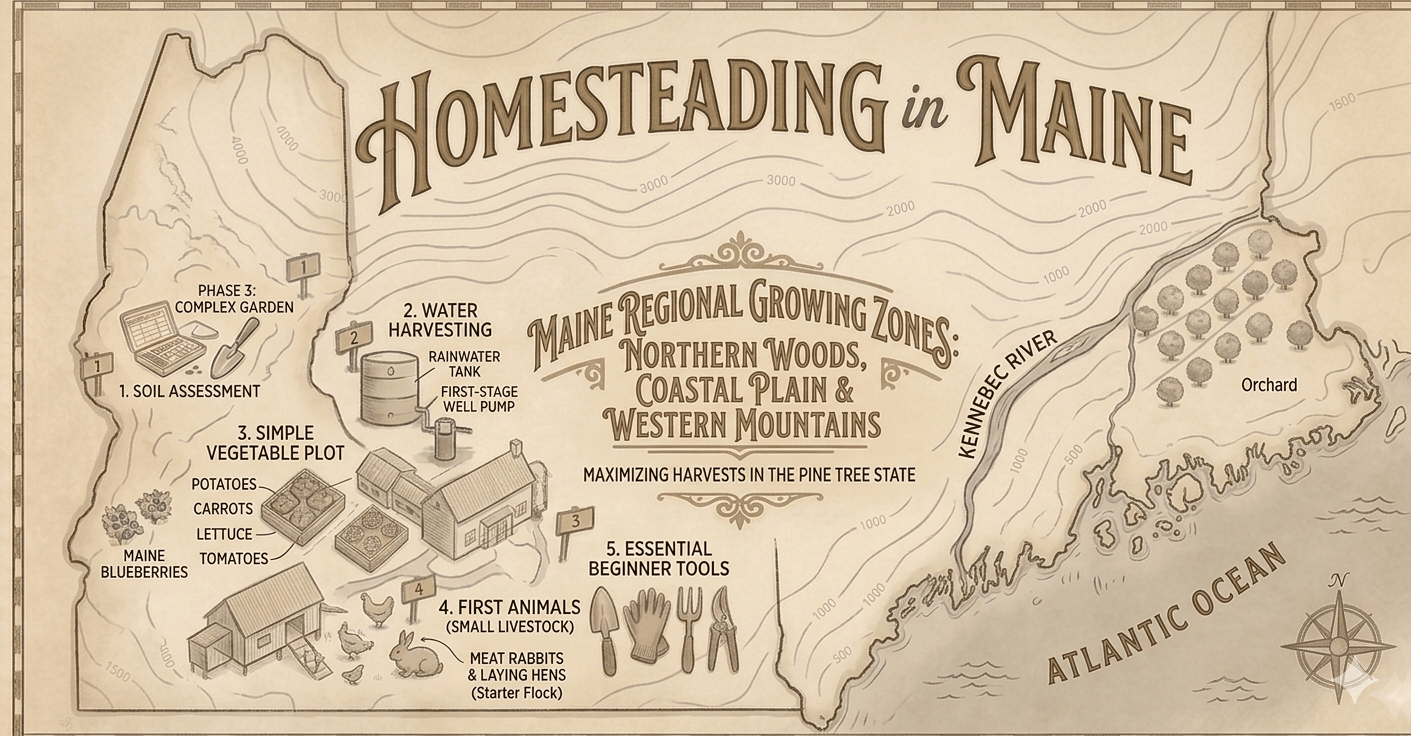
Maine is quietly becoming one of the most compelling states for homesteaders in the Northeast. Affordable rural land, some of the most progressive food freedom laws in the country, abundant water, and a fiercely independent agricultural community make it a serious contender for anyone willing to work within a shorter growing season.
This guide is written for anyone seriously considering a move to Maine for homesteading. Whether you are comparing it against other states in our state by state homesteading hub or you have already narrowed your search to the Pine Tree State, this article covers what you need to know before buying land and breaking ground.
If you are brand new to homesteading and want to understand the fundamentals first, start with our complete beginner's guide to homesteading. This Maine guide assumes you already know what homesteading is and are now focused on where to do it.
I come from a family of farmers, and I have spent years applying my clinical research background to studying what makes certain states better than others for homesteading. Maine is not the obvious pick that Tennessee or Texas might be, but for a certain kind of homesteader, it offers advantages that no southern state can match. Here is why.
Why Maine Is One of the Best States for Homesteading
Maine offers a unique set of advantages that are easy to overlook if you only evaluate states by growing season length. These are the factors that matter most for homesteaders evaluating a relocation to Maine.
Food Sovereignty Law. Maine became the first state in the nation to pass a Food Sovereignty Act in 2017. This groundbreaking law allows individual municipalities to adopt local food sovereignty ordinances that exempt direct producer to consumer sales from state licensing and inspection requirements. Over 100 Maine towns have adopted these ordinances. This means in many communities, you can sell meat, dairy, eggs, baked goods, and produce directly to your neighbors without a state permit.
Affordable land. The statewide average land price sits around $3,500 per acre, making Maine one of the most affordable states east of the Mississippi for rural acreage. Northern and western Maine offer homestead quality parcels for $1,000 to $3,000 per acre. You can buy 20 to 40 acres with a mix of field and forest for what a single acre costs in much of southern New England.
Abundant water. Maine receives 40 to 48 inches of rainfall annually, has over 6,000 lakes and ponds, and sits atop extensive groundwater reserves. Water scarcity is not a concern. Drilled wells are reliable across most of the state, and many properties have springs, streams, or pond frontage.
Building code flexibility. Maine does not mandate a statewide residential building code for all municipalities. The Maine Uniform Building and Energy Code (MUBEC) is only mandatory in towns with populations over 4,000. Many rural towns have minimal or no building code enforcement, giving homesteaders significant freedom in how they build.
Strong agricultural community. Maine has one of the most active local food movements in the country. The Maine Organic Farmers and Gardeners Association (MOFGA) is one of the oldest and largest state organic farming organizations in the nation. Farmers markets, farm to table restaurants, and community supported agriculture programs are woven into the culture.
No sales tax on food. Maine exempts grocery food from its state sales tax. For homesteaders selling at farmers markets or through farm stands, this simplifies transactions and keeps prices competitive.
Note
Maine's Food Sovereignty Act is the first of its kind in the United States. In towns that have adopted local food sovereignty ordinances, producers can sell meat, dairy, eggs, and other farm products directly to consumers without state licensing. Over 100 Maine towns have adopted these ordinances as of 2025.
Land Prices and Where to Buy in Maine
Land is often the largest upfront cost for new homesteaders. Maine is remarkably affordable by Northeast standards, but prices vary dramatically between the southern coast and the northern interior.
Statewide Land Price Overview
The statewide average hovers around $3,500 per acre for unimproved rural land. For context, here is how Maine compares to its immediate neighbors:
- New Hampshire: approximately $6,500 per acre
- Vermont: approximately $5,000 per acre
- Massachusetts: approximately $16,000 per acre
- Connecticut: approximately $14,000 per acre
- New York (upstate): approximately $4,500 per acre
Maine is the most affordable state in New England by a significant margin. The critical factor is the dramatic price gradient from south to north. Land within 30 miles of Portland or the southern coast can rival Massachusetts prices. Land in Aroostook County, three hours north, costs less than rural land in Mississippi.
Best Regions for Homestead Land
The following table breaks down Maine's major regions for homesteaders. Prices reflect raw or lightly improved rural land, not developed residential lots.
| Region | Typical Price Per Acre | USDA Zones | Terrain | Notes |
|---|---|---|---|---|
| Aroostook County (The County) | $800 to $2,500 | 3b, 4a | Rolling farmland, flat river valleys | Most affordable region in the state. Potato country with proven agricultural soil. Long winters. |
| Western Mountains (Oxford, Franklin) | $2,000 to $4,000 | 3b, 4a, 4b | Mountainous, forested | Good timber value, excellent hunting land, shorter growing season at elevation. |
| Central Highlands (Somerset, Piscataquis) | $1,500 to $3,500 | 3b, 4a, 4b | Hilly, heavily forested | Very remote, low population density, minimal regulations. Moosehead Lake region. |
| Midcoast (Knox, Lincoln, Waldo) | $4,000 to $8,000 | 5a, 5b | Rolling hills, coastal influence | Active farming community, longer growing season, strong local food market. |
| Down East (Washington, Hancock) | $2,000 to $5,000 | 4b, 5a | Coastal bluffs, forested interior | Wild blueberry country. Remote but with coastal climate moderation. |
| Southern Maine (York, Cumberland) | $8,000 to $25,000+ | 5b, 6a | Gently rolling | Generally overpriced for homesteading. Near Portland. Consider 60+ minutes inland. |
What to Look for When Buying Maine Land
Not all cheap land is good land. Before making an offer on any Maine parcel, evaluate the following:
- Road access. Is the property accessible via a year round maintained road? Maine's mud season (locally called "the fifth season") from March through April can make unimproved roads impassable.
- Water sources. Does the property have a well, spring, brook, or pond? In northern Maine, drilled wells typically reach water at 100 to 300 feet. Cost runs $15 to $25 per foot.
- Soil quality. Request a soil survey through the USDA Web Soil Survey. Much of Maine has rocky, acidic soil that needs amendment. Aroostook County is the notable exception with deep, fertile agricultural soil.
- Timber value. Many Maine parcels have standing timber worth significant money. A forester can cruise the lot and estimate value. Selective harvesting can offset land purchase costs.
- Slope and aspect. South facing slopes are critical in Maine. They warm earlier in spring, extend the growing season, and provide better drainage. Avoid north facing slopes for garden and orchard sites.
- Municipal building codes. Verify whether the town has adopted MUBEC. In towns under 4,000 residents without adopted codes, you have wide latitude. Always call the town office before purchasing.
- Broadband and cell service. Rural Maine, especially in the northern and western regions, has limited internet options. Starlink has improved this significantly, but verify coverage for your specific area.
- Food sovereignty status. Check whether the town has adopted a local food sovereignty ordinance. This affects what you can sell directly from your homestead.
For a quick snapshot of Maine's key stats, visit our Maine state overview page.
Maine Homesteading Laws and Regulations
Understanding the legal landscape is essential before you commit to a state. Maine is one of the most permissive states in the country for small scale food production and direct sales. The details are worth understanding because they represent real advantages.
Right to Farm Act
Maine's Right to Farm Act (Title 17, Section 2805-A) protects agricultural operations from nuisance complaints. If your farm is operating in accordance with best management practices, neighbors cannot successfully bring nuisance claims against you for typical farming activities including noise, odors, dust, and early morning equipment operation.
The law has been in effect since 1981 and has been strengthened over the years. It covers all commercial agricultural operations and applies statewide. Maine courts have generally interpreted the law favorably for farmers.
Raw Milk Laws
Maine is one of the most permissive states in the country for raw milk sales. Farm gate sales of raw milk are legal with a license from the Maine Department of Agriculture, Conservation and Forestry (DACF). The licensing process involves a farm inspection and regular milk testing.
In towns that have adopted food sovereignty ordinances, raw milk can be sold directly to consumers without a state license. This is a significant advantage that few other states offer. The sale must be a direct transaction between producer and consumer within the municipality.
Maine also allows herd share agreements, where consumers purchase a share of an animal and receive a portion of the milk as a shareholder rather than a buyer. This provides an additional legal pathway for raw milk distribution.
Cottage Food Laws
Maine's cottage food law allows the sale of non potentially hazardous foods made in a home kitchen without a commercial license. Covered products include baked goods, jams, jellies, honey, candy, dried herbs, granola, and similar shelf stable items.
There is no annual sales cap on cottage food in Maine. Products must be sold directly to consumers at farmers markets, farm stands, or from the home. Each product must carry a label with the producer's name, address, and the statement that it was made in a kitchen not subject to inspection.
In food sovereignty towns, the range of products you can sell directly expands significantly beyond the standard cottage food list.
Zoning and Building Codes
Maine's building code situation is one of its strongest advantages for homesteaders. The Maine Uniform Building and Energy Code (MUBEC) is mandatory only for municipalities with populations over 4,000. This means the vast majority of rural Maine towns where homesteaders buy land are not required to enforce state building codes.
Many small towns have no building code enforcement at all. Others have adopted basic ordinances that may cover septic systems and shoreland zoning but leave building construction largely unregulated. Some towns have voluntarily adopted MUBEC or portions of it even though they are not required to do so.
Warning
Building code requirements in Maine vary by municipality, not county. Always call the specific town office before purchasing land. Ask whether they have adopted MUBEC, whether they require building permits, and what their minimum lot size and setback requirements are. A town under 4,000 residents with no adopted codes gives you maximum building flexibility.
The practical result is that in many rural Maine towns, you can build a cabin, barn, greenhouse, or workshop without pulling a building permit. Septic systems are regulated statewide by the Maine Department of Health and Human Services through the Subsurface Wastewater Disposal Rules, so a licensed site evaluator and approved septic design are required regardless of local building codes.
Water Rights
Maine follows the riparian doctrine for surface water. Property owners whose land borders a natural waterbody have the right to make reasonable use of the water for domestic and agricultural purposes. You cannot divert the entire flow or significantly impair downstream users.
Rainwater harvesting is legal and completely unregulated in Maine. There are no permits, no registration, and no limits on collection volume.
Well drilling requires a permit and must be performed by a licensed well driller registered with the Maine Geological Survey. Wells must meet state construction standards. In most of Maine, drilled bedrock wells are the standard water source for rural properties. Typical depth ranges from 100 to 400 feet depending on location.
Property Tax and Agricultural Exemptions
Maine offers several powerful property tax reduction programs for agricultural and forest land.
The Farmland Tax Law (Title 36, Chapter 105, Subchapter 10) allows land that is actively used for farming to be assessed at its current use value rather than fair market value. To qualify, the land must be at least 5 contiguous acres and have generated at least $2,000 in gross farm income (or show evidence of dedicated farming use). The application is filed with the municipal tax assessor.
The Tree Growth Tax Law is one of the most popular programs in Maine. It taxes forested land based on its current use value for timber production rather than development value. Minimum enrollment is 10 acres of forested land managed under a forest management plan. A licensed forester must prepare or approve the plan.
The Open Space Tax Law provides reduced valuation for land preserved as open space, which can include agricultural land that does not qualify under the other programs.
Tip
The Tree Growth Tax Law can dramatically reduce your property tax bill. A 40 acre wooded parcel assessed at $120,000 market value might see its assessment drop to $10,000 to $15,000 under Tree Growth, reducing annual property taxes from $2,000 or more to $200 to $300. Combine this with the Farmland Tax Law on your cleared acreage for maximum savings.
Be aware of penalty provisions. If land is withdrawn from Tree Growth or Farmland classification, the owner must pay a penalty equal to a percentage of the difference between the current use valuation and the fair market value. This discourages speculative enrollment.
Livestock Regulations
Maine is generally permissive for livestock on rural land. No state permit is required for keeping chickens, goats, sheep, pigs, or cattle on agricultural property. The state does require a premises identification number through the Maine DACF Animal Health Division for properties with livestock, which is a simple free registration.
Maine is a fence in state. Livestock owners are responsible for keeping their animals contained. If your animals escape and cause damage, you are liable. Quality fencing is essential, especially given Maine's heavy snow loads that can flatten poorly built fence.
Maine requires a health certificate for livestock brought into the state. Cattle must be tested for tuberculosis and brucellosis. Poultry brought in from out of state require a veterinary certificate and must be from flocks tested for pullorum and avian influenza.
Municipal ordinances may impose additional restrictions within town limits. Most rural agricultural zones have no livestock restrictions beyond the state baseline.
Climate, Growing Zones, and Soil
Maine's climate is its most obvious challenge and, for the right homesteader, one of its hidden strengths. The shorter growing season demands more planning and skill, but it also means fewer pest and disease pressures, less heat stress on livestock, and a genuine four season rhythm that many homesteaders prefer.
USDA Hardiness Zones Across Maine
Maine spans USDA zones 3b through 6a, which is a wider range than most people expect. Coastal areas enjoy significantly milder conditions than the interior.
| Region | USDA Zones | Average Last Frost | Average First Frost | Growing Season |
|---|---|---|---|---|
| Aroostook County | 3b, 4a | May 20 to June 1 | September 10 to 20 | 3.5 to 4 months |
| Western Mountains | 3b, 4a, 4b | May 15 to 25 | September 15 to 25 | 4 to 4.5 months |
| Central Maine | 4a, 4b, 5a | May 10 to 20 | September 20 to 30 | 4 to 5 months |
| Midcoast | 5a, 5b | May 1 to 10 | October 5 to 15 | 5 to 5.5 months |
| Southern Coast | 5b, 6a | April 25 to May 5 | October 10 to 20 | 5.5 to 6 months |
These are averages. Coastal areas benefit from the ocean's thermal mass, which delays frost in fall and moderates extreme cold in winter. Inland valleys can experience frost pockets that shorten the season further. South facing slopes and proximity to large bodies of water create valuable microclimates.
Planting Calendar Tool
Enter your zip code to get a personalized planting schedule based on your USDA zone.
Try it free →Rainfall and Water Availability
Maine receives 40 to 48 inches of rainfall annually, distributed fairly evenly across the calendar. This is well above what most crops require. Summer months (June through August) typically receive 3 to 4 inches per month, which is adequate for most garden crops without supplemental irrigation.
Snow is a significant factor. Northern Maine receives 80 to 110 inches of snow annually. Southern and coastal areas receive 50 to 70 inches. The snowpack serves as a slow release moisture source in spring, recharging soil moisture and groundwater.
Maine's abundance of surface water is remarkable. The state has over 6,000 lakes and ponds, 32,000 miles of rivers and streams, and extensive wetland systems. Many rural properties have direct access to surface water for livestock and irrigation.
Soil Types by Region
Understanding Maine's soils is critical because they vary dramatically and most require some amendment for productive gardening.
Aroostook County is the exception to Maine's rocky reputation. The Caribou and Mapleton soil series found here are deep, well drained, loamy soils formed from glacial till over limestone. These are the soils that made Aroostook County one of the largest potato producing regions in the country. pH ranges from 5.5 to 6.5, which is workable for most crops with modest liming.
Coastal and Midcoast regions have a mix of sandy loams and clay loams with pH values of 5.0 to 6.0. These soils are generally productive with organic matter additions and regular liming. The moderating ocean influence benefits both soil biology and growing conditions.
Central and Western Maine features thin, rocky, acidic soils with pH values of 4.5 to 5.5. Glacial activity left behind boulders, cobbles, and gravel mixed into the soil profile. These soils need significant amendment for vegetable production but are naturally excellent for blueberries, potatoes, and other acid tolerant crops. Building raised beds with imported compost is a common strategy.
Regardless of where you buy, get a soil test before planting. The University of Maine Cooperative Extension offers soil testing through the Maine Soil Testing Service for $15 to $20 per sample. Results include pH, nutrient levels, organic matter content, and specific amendment recommendations.
What to Grow on a Maine Homestead
Maine's growing season is shorter than southern states, but the long summer days (15 to 16 hours of daylight in June) and cool nights create conditions that many crops actually prefer. The key is choosing the right varieties and using season extension techniques.
Warm Season Crops
Warm season crops require planning in Maine. Start seeds indoors and use season extension tools like cold frames, row covers, and high tunnels to stretch the season at both ends.
Tomatoes are absolutely possible in Maine with the right approach. Choose short season varieties like Stupice, Glacier, Sub Arctic Plenty, and New Girl. Start seeds indoors 6 to 8 weeks before last frost and transplant into warm soil. A simple high tunnel or greenhouse dramatically increases tomato yields in Maine.
Squash and pumpkins do well across most of Maine. Winter squash varieties like Butternut, Delicata, and Kabocha need 85 to 100 frost free days and store for months in a root cellar.
Beans (both snap and dry) are reliable warm season producers. Maine has a long history of dry bean production. Jacob's Cattle, Yellow Eye, and Soldier beans are traditional Maine varieties.
Cucumbers produce well in Maine's summers. Choose early maturing varieties. Row covers in early season help establish plants quickly.
Corn is viable in zones 4b and warmer with short season varieties. Painted Mountain and Abenaki are cold tolerant varieties developed for northern climates. Sweet corn varieties like Bodacious and Temptation mature in 70 to 75 days.
Peppers are the most challenging warm season crop in Maine. Hot peppers need a greenhouse or high tunnel in most of the state. Sweet peppers can produce outdoors in zones 5a and warmer with row cover protection in spring and fall.
Cool Season Crops
Cool season crops are where Maine gardens truly excel. The state's cool summers and long fall season create ideal conditions for crops that bolt or turn bitter in southern heat.
Kale is practically Maine's state vegetable. It thrives in the cool temperatures and actually improves in flavor after light frost. Lacinato, Red Russian, and Winterbor are all excellent choices. With minimal protection, kale can produce well into December and sometimes through the entire winter.
Lettuce, spinach, and arugula grow better in Maine than in most of the country. The cool summers prevent bolting, giving you continuous harvests from spring through fall. Succession plant every two to three weeks for steady supply.
Broccoli, cabbage, and Brussels sprouts are exceptional fall crops in Maine. Brussels sprouts in particular benefit from frost, which converts starches to sugars and improves flavor. Start transplants in June for fall harvest.
Carrots, beets, turnips, and parsnips thrive in Maine's soil and climate. Carrots stored in the ground under heavy mulch can be harvested through the winter. Parsnips are famously sweeter after hard frost.
Garlic is a perfect Maine crop. Plant hardneck varieties (Music, German Extra Hardy, Chesnok Red) in October. They overwinter under snow and are harvested the following July. Maine grown garlic has a devoted following at farmers markets.
Peas go in the ground as early as the soil can be worked in spring, sometimes as early as late March in southern Maine. They produce a fast spring harvest before summer heat arrives.
Fruit Trees and Perennials
Maine's perennial fruit options are outstanding, particularly for cold hardy species that develop complex flavors in the northern climate.
Apples are Maine's premier tree fruit. The state has a centuries old apple growing tradition. Maine's cold winters provide the chill hours that apples require, and the cool summers produce fruit with exceptional flavor and storage quality. Honeycrisp, Liberty, Cortland, Macoun, and McIntosh all thrive here. Zones 4b through 6a are ideal.
Blueberries are Maine's signature crop. The state produces over 99% of the nation's wild (lowbush) blueberries. Cultivated highbush varieties also perform exceptionally well in Maine's acidic soils. No other state offers better natural conditions for blueberry production. A single established planting can produce berries for decades with minimal inputs.
Pears do well in zones 4b and warmer. Flemish Beauty, Luscious, and Harrow Sweet are reliable producers. Asian pears can succeed in zones 5a and warmer.
Plums are underrated in Maine. Mount Royal, Toka, and Superior are cold hardy varieties that produce reliably in zones 4a and warmer.
Raspberries are prolific across the entire state. Both summer bearing (Latham, Boyne) and fall bearing (Heritage, Caroline) varieties perform well. Maine's cool nights produce exceptionally flavored berries.
Strawberries thrive in Maine. Earliglow, Jewel, and Cabot are proven performers. The cool climate extends the harvest season compared to southern states.
Rhubarb is practically indestructible in Maine. It is one of the first crops to emerge in spring and produces for decades once established. Valentine and Canada Red are popular varieties.
Herbs and Medicinal Plants
Maine's climate supports a strong herb garden during the growing season. Basil, dill, cilantro, parsley, chives, thyme, and oregano all produce well. Perennial herbs like thyme, oregano, and chives overwinter reliably. Rosemary must be brought indoors in winter.
Elderberry grows wild and cultivated throughout Maine. The berries are used for syrups, tinctures, and preserves, and represent a growing market crop.
Ginseng can be cultivated in Maine's shaded woodland conditions, though it requires patience. The crop takes 5 to 7 years from seed to harvest. Wild ginseng harvest is regulated by the Maine DACF and requires a permit.
Livestock for Maine Homesteads
Maine's climate favors cold hardy livestock breeds. The long winters require more planning for shelter, feed storage, and water systems than southern states, but the cool summers mean far less heat stress on animals.
Chickens
Chickens are the most common livestock on Maine homesteads. The primary climate challenge is winter cold, not summer heat. Choose breeds with small combs (less prone to frostbite) and heavy feathering.
Chanteclers are the gold standard cold weather breed. Developed in Canada specifically for northern climates, they have cushion combs and small wattles that resist frostbite. They lay well through winter with supplemental lighting and are a true dual purpose bird.
Buckeyes are hardy, active foragers with small pea combs. They lay around 200 eggs per year and handle cold weather without issue. They are one of the few American breeds developed entirely by a woman, Nettie Metcalf of Ohio.
Plymouth Rocks (Barred and White) are reliable dual purpose birds that handle Maine winters well. Expect 250 to 280 eggs per year. They are calm and easy to manage.
Wyandottes are a classic cold weather breed with rose combs that resist frostbite. Silver Laced and Golden Laced are the most common varieties. They lay around 200 eggs per year.
A well insulated but ventilated coop is essential. Maine winters regularly drop below zero, and prolonged cold snaps in January and February can reach minus 20 to minus 30 in northern areas. Keep water from freezing with heated bases or frequent changes. Supplemental lighting (14 hours total light) maintains egg production through the short winter days.
Goats
Goats are well suited to Maine homesteads, especially for clearing brushy land and producing dairy on small acreage.
Nigerian Dwarf goats are excellent for small Maine homesteads. They produce 1 to 2 quarts of high butterfat milk daily, require less feed and shelter space than full sized breeds, and handle cold weather well with proper shelter.
LaMancha goats are known for their calm temperament and cold hardiness. Their tiny ears are actually an advantage in cold climates as they resist frostbite. They produce good volumes of milk.
Oberhasli goats are a hardy Swiss breed well suited to northern climates. They are quiet, easy keepers, and produce solid milk volume.
Kiko and Boer crosses work well for meat production. Select animals from northern breeders who have selected for cold tolerance.
The biggest management challenge for goats in Maine is not cold but rather internal parasites during the warm, wet months. Rotational grazing and regular fecal testing are essential from May through October. In winter, goats need a dry, draft free shelter with deep bedding. They handle cold far better than wet.
Cattle
Cattle are viable on Maine homesteads with adequate pasture. Maine's cool season grasses support 4 to 6 months of grazing with hay supplementation through winter.
Highland cattle are arguably the ideal Maine breed. Their long shaggy coats provide natural insulation, they browse brush and rough forage efficiently, and they are extremely cold hardy. They thrive on marginal land that would not support conventional breeds.
Belted Galloways (Belties) have a strong following in Maine. They are mid sized, cold hardy, and produce excellent grass fed beef. Their double coat provides superior winter insulation.
Dexter cattle are a small heritage breed that works well on homesteads with limited acreage. They are dual purpose (milk and beef) and need only 1.5 to 2 acres per animal.
Plan for 2 to 3 acres per standard cow calf pair in Maine. You will need to put up enough hay for 5 to 6 months of winter feeding. Round bale storage and a reliable hay supply are critical infrastructure.
Pigs
Pigs do well on Maine homesteads, particularly in woodland silvopasture systems during the warm months.
Tamworth pigs are one of the best choices for Maine. They are cold hardy, excellent foragers, and produce lean bacon and pork. Their reddish brown color provides some sun protection during summer.
Berkshire pigs produce premium marbled pork and handle cold weather with proper shelter. They are a medium sized breed that finishes well on pasture and supplemental grain.
Large Black pigs are a heritage pasture breed with a docile temperament and cold tolerance. Their black skin protects against sunburn during summer months.
All pigs need shelter from wind and precipitation in winter. A three sided shelter with deep straw bedding works well. During winter, pigs can be kept in smaller paddocks or in barns with outdoor access. The warm season from May through October is ideal for pasture and woodland rotation.
Other Livestock Worth Considering
Sheep have a long history in Maine and are arguably the best match for the climate. Icelandic sheep are triple purpose animals producing wool, meat, and milk. They are supremely cold hardy, excellent foragers, and thrive on rough pasture. Romney and Border Leicester are other cold hardy breeds popular with Maine fiber farmers.
Honeybees do well in Maine with proper winter management. The nectar flow from May through September supports colony growth and honey production. Expect 30 to 50 pounds of surplus honey per hive in a good year. Overwintering losses run higher than in southern states, so plan for replacement costs.
Ducks are excellent for Maine homesteads. Khaki Campbell and Welsh Harlequin ducks lay 250 to 300 eggs per year and handle cold and wet conditions better than chickens. Their pest control abilities are valuable in the garden.
Livestock Quick Reference
| Animal | Min. Acreage | Startup Cost | Annual Feed Cost | Primary Product |
|---|---|---|---|---|
| Chickens (6 hens) | Any | $300 to $600 | $250 to $400 | Eggs, pest control |
| Dairy Goats (2 does) | 0.5 acres | $500 to $1,000 | $500 to $800 | Milk, brush clearing |
| Sheep (4 ewes) | 1 acre | $600 to $1,200 | $400 to $700 | Wool, meat, milk |
| Beef Cattle (2 head) | 5 acres | $2,000 to $4,000 | $800 to $1,500 | Beef |
| Pigs (2 feeders) | 0.5 acres | $200 to $500 | $700 to $1,200 | Pork |
| Honeybees (2 hives) | Any | $500 to $800 | $100 to $200 | Honey, pollination |
Community, Culture, and Resources
A homestead does not exist in isolation. Maine's agricultural community and support infrastructure are among the strongest in the Northeast, and they can make the difference between a struggling first year and a successful one.
The Homesteading Community in Maine
Maine has a deep agricultural heritage that stretches back centuries, and the modern homesteading and small farm movement has added a new energy to that tradition. The state has an unusually high concentration of young farmers and back to the land homesteaders, many of whom arrived in the last 10 to 15 years.
Farmers markets thrive across the state, even in small towns. Many operate from May through October, and some in larger towns run year round. The direct to consumer food culture in Maine is stronger than in almost any other state.
The Maine Organic Farmers and Gardeners Association (MOFGA), founded in 1971, is one of the oldest and most influential organic farming organizations in the country. MOFGA hosts the annual Common Ground Country Fair, a three day event each September that draws over 60,000 people and serves as the cultural center of Maine's agricultural community. Membership in MOFGA provides access to workshops, apprenticeship programs, and networking opportunities that are invaluable for new homesteaders.
The culture of mutual aid is strong in rural Maine. Neighbors share equipment, swap labor during haying season, and trade surplus produce and livestock products. This kind of community is not something you can buy, but it is something Maine offers in abundance.
University of Maine Cooperative Extension and Local Resources
The University of Maine Cooperative Extension operates offices across the state and is your single most valuable free resource as a Maine homesteader. Services include:
- Soil testing ($15 to $20 per sample with detailed amendment recommendations)
- Pest and disease identification
- Master Gardener certification programs
- 4 H programs for families with children
- Livestock management workshops
- Small farm business planning and financial guidance
The Maine Department of Agriculture, Conservation and Forestry (DACF) handles licensing for dairy, meat, and poultry sales, and administers the state's agricultural development programs. Their website provides guidance on food sovereignty ordinances, raw milk licensing, and organic certification.
The Maine Farmland Trust works to protect farmland from development and connect new farmers with available land. Their FarmLink program matches aspiring farmers with landowners, which is an excellent resource if you are looking for land or a farm to transition into.
Cost of Living Snapshot
Maine's overall cost of living runs close to the national average, with southern Maine trending above average and northern Maine well below. For homesteaders, the meaningful calculation is not the overall cost of living but the specific costs that matter most.
Land is cheap, especially in the northern half of the state. Property taxes are moderate and dramatically reduced under the Tree Growth and Farmland tax programs. There is no sales tax on food. Heating costs are the one area where Maine is more expensive than southern states. Firewood is the most common and affordable heating fuel for rural homesteads, at roughly $250 to $350 per cord.
The combination of affordable land, multiple tax reduction programs, strong direct sales opportunities through farmers markets and food sovereignty, and a low cost rural lifestyle makes Maine financially competitive with many states that have longer growing seasons.
How to Get Started: Your First Steps
If Maine sounds like the right fit, here is a practical action plan to move from research to reality.
-
Define your goals and budget. Decide what kind of homestead you want (food garden, livestock operation, full self sufficiency) and set a realistic land and infrastructure budget. Factor in heating infrastructure costs, which are more significant in Maine than in southern states.
-
Choose a region. Use the land price table above as a starting point. Consider your cold tolerance, proximity to services, growing season needs, and whether you want coastal moderation or interior affordability.
-
Research municipal regulations. Call the town office directly. Ask about building permits, septic requirements, minimum lot sizes, and whether the town has adopted a food sovereignty ordinance. Maine regulates at the town level, not the county level.
-
Visit before buying. Spend time in Maine during winter, not just summer. Drive the towns that interest you. Visit in January or February to experience the full reality of Maine winter before committing. Talk to MOFGA members, farmers market vendors, and Cooperative Extension agents.
-
Connect with MOFGA and UMaine Extension. Attend a MOFGA workshop or the Common Ground Country Fair. Contact the Extension office in your target area. These organizations can connect you with experienced homesteaders who will share practical, region specific advice.
-
Invest in season extension from year one. Build or buy at least one cold frame and plan for a high tunnel within the first two years. Season extension is not optional in Maine. It is what separates a four month garden from a nine or ten month one.
-
Start small your first season. Focus on cool season crops and root vegetables that are forgiving of timing mistakes. Add livestock in year two once you have shelter, fencing, and hay storage in place. Our beginner's guide to homesteading walks through this staged approach in detail.
Tip
Visit your target town during mud season (March to April) and during a January cold snap before buying land. If you can embrace those two experiences, you will thrive in Maine. If they give you serious pause, consider a milder state. Maine rewards those who prepare for winter and penalizes those who do not.
Frequently Asked Questions
Maine is an excellent state for homesteading if you are prepared for a shorter growing season and cold winters. It offers some of the most affordable rural land in the Northeast, the nation's first Food Sovereignty Act allowing direct producer to consumer sales, no mandatory statewide building code for small towns, abundant water, and one of the strongest agricultural communities in the country. The growing season is shorter than southern states, but season extension techniques and cold hardy crop selection can extend productive gardening to nine months or more.
The statewide average is roughly $3,500 per acre, making Maine the most affordable state in New England. Aroostook County in the far north offers homestead quality land for $800 to $2,500 per acre. Central and western Maine parcels run $1,500 to $4,000 per acre. Midcoast areas with active farming communities are $4,000 to $8,000 per acre. Southern Maine near Portland is significantly more expensive at $8,000 to $25,000 or more per acre.
Yes. Maine allows raw milk sales from the farm with a license from the Department of Agriculture, Conservation and Forestry. In towns that have adopted food sovereignty ordinances (over 100 towns as of 2025), raw milk can be sold directly to consumers without a state license. Herd share agreements are also legal, providing an additional pathway for raw milk distribution.
Maine does not mandate a statewide building code for all municipalities. The Maine Uniform Building and Energy Code (MUBEC) is only mandatory for towns with populations over 4,000. Most rural towns where homesteaders buy land either have no building code or have minimal local ordinances. Septic systems are regulated statewide regardless of local building codes. Always check with the specific town office before purchasing land.
Maine offers a general Homestead Exemption that reduces the assessed value of a primary residence by $25,000. More significantly for homesteaders, the Tree Growth Tax Law reduces property taxes on forested land by 75% to 90%, and the Farmland Tax Law provides similar reductions for actively farmed land. Combining these programs can reduce a homesteader's property tax bill dramatically.
Maine's frost free growing season ranges from about 3.5 months in Aroostook County to 6 months along the southern coast. With season extension techniques like cold frames, row covers, and high tunnels, productive growing can stretch to 9 or 10 months. The long summer days (15 to 16 hours of daylight in June) partially compensate for the shorter season by accelerating crop growth.
On rural agricultural land, there are no state level restrictions on keeping chickens. Within town limits, municipal ordinances may apply but are generally permissive in rural Maine. Choose cold hardy breeds with small combs to prevent frostbite in Maine's winters. Heated waterers and a well insulated, ventilated coop are essential winter infrastructure.
Yes. Rainwater harvesting is legal and completely unregulated in Maine. There are no permits required and no limits on collection volume. Maine's 40 to 48 inches of annual rainfall provides ample collection opportunity.
The best region depends on your priorities. Aroostook County offers the cheapest land and proven agricultural soil but has the harshest winters. The Midcoast region (Knox, Lincoln, Waldo counties) has the strongest farming community and moderate climate but higher land prices. Central Maine (Somerset, Piscataquis) balances affordability with accessibility. The Down East coast combines affordable land with ocean moderated climate. Southern Maine has the mildest climate but the highest prices.
Yes. Well drilling in Maine requires a permit and must be performed by a licensed well driller registered with the Maine Geological Survey. Wells must meet state construction standards. In most of Maine, drilled bedrock wells are standard. Typical depth ranges from 100 to 400 feet, costing $15 to $25 per foot for drilling plus pump and casing costs.

Cole
Founder & Lead Researcher
Cole is the founder of Plan Your Homestead. He works in clinical research and brings a research-first lens to every guide on the site, drawing on a long family line of farmers for grounded, practical perspective.
More in Guides
More articles coming soon. Check back for new guides content.