
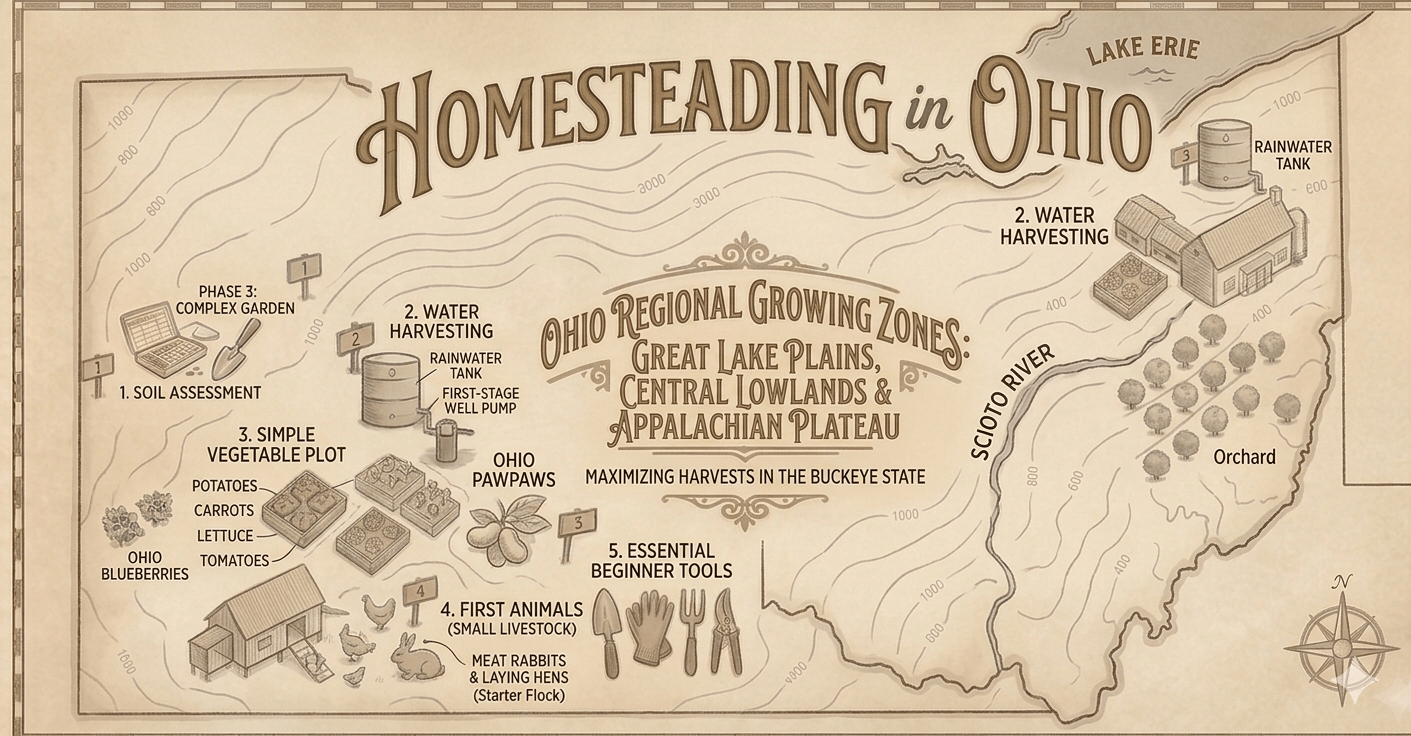
Ohio is one of the most underrated states in the homesteading world. Rich glacial soils, a six month growing season, 38 to 42 inches of annual rainfall, a strong Right to Farm law, and some of the deepest agricultural roots in the Midwest make it a serious contender for anyone looking to build a self sufficient life. It also happens to sit within a day's drive of half the US population, which matters if you plan to sell at farmers markets or direct to consumers.
This guide is written for anyone seriously considering a move to Ohio for homesteading. Whether you are comparing it against other states in our state by state homesteading hub or you have already narrowed your search to the Buckeye State, this article covers what you need to know before buying land and breaking ground.
If you are brand new to homesteading and want to understand the fundamentals first, start with our complete beginner's guide to homesteading. This Ohio guide assumes you already know what homesteading is and are now focused on where to do it.
I come from a family of farmers, and I have spent years applying my clinical research background to studying what makes certain states better than others for homesteading. Ohio does not get the attention that states like Tennessee or Texas receive, but the data tells a compelling story. Here is why.
Why Ohio Is One of the Best States for Homesteading
Ohio offers a combination of practical advantages that many flashier states cannot match. These are the five factors that matter most for homesteaders evaluating a relocation.
Right to Farm Law. Ohio Revised Code Chapter 929 protects agricultural operations from nuisance lawsuits. If your farm follows Generally Accepted Agricultural Practices (GAAPs) established by the Ohio Department of Agriculture, neighbors cannot successfully sue you for odors, noise, dust, or other normal farming activities. This protection applies statewide and has real teeth.
Some of the richest farmland in the country. Western and central Ohio sit on deep glacial till soils that rank among the most productive agricultural ground in North America. This is not marginal land you have to fight with. The soil wants to grow things.
Affordable rural land with regional options. The statewide average land price is around $7,500 per acre, but the Appalachian foothills of southeast Ohio offer homestead quality parcels for $2,000 to $4,000 per acre. You can find genuine variety, from flat prairie farmland to wooded hill country, within a single state.
Abundant rainfall and water resources. Ohio receives 38 to 42 inches of rainfall annually, well distributed across the growing season. The state is rich in creeks, springs, rivers, and groundwater. Water scarcity is simply not a factor here.
Deep agricultural heritage and community. Ohio has one of the largest Amish populations in the country, concentrated in Holmes, Wayne, and Tuscarawas counties. The small farm culture in these communities is living proof that traditional homesteading works in this climate. Farmers markets, feed stores, and agricultural supply networks are well established across the state.
Note
Ohio is home to the largest Amish community in the world. The agricultural knowledge, infrastructure, and supply networks built by these communities over generations create an unmatched support system for new homesteaders in the surrounding counties.
Land Prices and Where to Buy in Ohio
Land is often the largest upfront cost for new homesteaders. Ohio offers a wide range of options, from premium flat farmland in the west to affordable hill country in the southeast.
Statewide Land Price Overview
The statewide average hovers around $7,500 per acre for unimproved rural land. For context, here is how Ohio compares to its immediate neighbors:
- Indiana: approximately $7,000 per acre
- Pennsylvania: approximately $7,000 per acre
- Kentucky: approximately $4,800 per acre
- West Virginia: approximately $3,200 per acre
- Michigan: approximately $7,000 per acre
Ohio sits in the middle of its neighbors, but the real story is internal variation. Flat, tillable farmland in western Ohio commands $8,000 to $15,000 per acre because row crop farmers compete for it. Hilly, wooded land in the southeast sells for a fraction of that.
Best Regions for Homestead Land
The following table breaks down Ohio's major regions for homesteaders. Prices reflect raw or lightly improved rural land, not developed residential lots.
| Region | Typical Price Per Acre | USDA Zones | Terrain | Notes |
|---|---|---|---|---|
| Southeast Appalachian Foothills (Vinton, Meigs, Monroe, Morgan) | $2,000 to $4,000 | 6a, 6b | Hilly, wooded | Most affordable region. Beautiful land but steeper terrain requires careful site selection. |
| East Central (Coshocton, Guernsey, Tuscarawas, Harrison) | $3,000 to $5,500 | 5b, 6a | Rolling hills | Near Amish country. Good balance of price and agricultural infrastructure. |
| South Central (Ross, Pike, Highland, Adams) | $3,500 to $6,000 | 6a, 6b | Rolling to hilly | Longer growing season in the south. Mixed farm and forest land. |
| Northwest (Putnam, Van Wert, Paulding, Defiance) | $7,000 to $12,000 | 5b, 6a | Flat | Premium farmland with deep, rich soil. Best for row crops but expensive. |
| Near Columbus, Cleveland, or Cincinnati | $10,000 to $25,000+ | Varies | Varies | Generally overpriced for homesteading. Consider 45+ minutes from metro centers. |
What to Look for When Buying Ohio Land
Not all cheap land is good land. Before making an offer on any Ohio parcel, evaluate the following:
- Road access. Is the property accessible via a year round maintained road? Some southeast Ohio properties sit on unmaintained township roads that become difficult in winter and spring mud season.
- Water sources. Does the property have a creek, spring, or existing well? Ohio has excellent groundwater in most regions, but well depth and flow rates vary.
- Soil quality and drainage. Request a soil survey through the USDA Web Soil Survey or schedule a test through OSU Extension. Heavy clay soils in parts of Ohio need drainage tile or raised beds for productive gardening.
- Timber value. Wooded parcels in southeast Ohio may have standing hardwood timber worth several thousand dollars. This can offset land purchase costs if you plan to selectively harvest.
- Slope and aspect. South facing slopes warm earlier in spring and drain better. Steep grades above 15% are difficult to farm and expensive to build on. This is especially important in the hilly southeast.
- Township zoning. Ohio uses township level zoning in many areas. Check with the township trustees about agricultural use, building requirements, and any restrictions before purchasing.
- Broadband availability. If you work remotely, verify internet service before purchasing. Rural Ohio coverage is improving through state broadband expansion programs but remains inconsistent in some areas.
For a quick snapshot of Ohio's key stats, visit our Ohio state overview page.
Ohio Homesteading Laws and Regulations
Understanding the legal landscape is essential before you commit to a state. Ohio is broadly favorable to homesteaders, with strong agricultural protections and relatively permissive rural regulations. The details vary at the township and county level.
Right to Farm Act
Ohio's Right to Farm Law (ORC Chapter 929) protects agricultural operations that follow Generally Accepted Agricultural Practices from nuisance lawsuits. The Ohio Department of Agriculture publishes GAAPs for various types of farming, and as long as your operation conforms to these standards, you have strong legal protection against complaints from neighbors about noise, odors, dust, or other routine farming activities.
The law also includes protections for operations located in areas that have been rezoned from agricultural to residential use. If your farm predates the rezoning, you retain the right to continue farming.
Raw Milk Laws
Ohio permits the sale of raw milk directly from the farm under specific conditions. The producer must operate under a valid license from the Ohio Department of Agriculture. All sales must occur on the farm premises. The customer must travel to the farm to pick up the milk.
Ohio does not permit raw milk sales at farmers markets, retail stores, or through delivery. Herd shares (where the consumer purchases a share of the animal and receives milk as a shareholder) operate in a legal gray area. Some Ohio farmers use this model, but it does not have explicit statutory protection.
Raw milk goat's milk follows the same rules as cow's milk. If you plan to keep dairy animals and sell surplus milk, get licensed through the Department of Agriculture before your first sale.
Cottage Food Laws
Ohio's Cottage Food Law (ORC 3715.024) allows home based food producers to sell certain homemade foods directly to consumers without a commercial kitchen license. Covered products include baked goods, candy, jams, jellies, honey, granola, dried pasta, and other non potentially hazardous items.
The annual sales cap is $75,000. Sales must be direct to the end consumer at venues like farmers markets, farm stands, fairs, or from your home. You cannot sell cottage food products in retail stores or through wholesale channels. Each product must include a label with your name, address, the product name, ingredients, and the statement "This Product is Home Produced."
Zoning and Building Codes
Ohio's building code situation is more favorable for homesteaders than many people expect. The Ohio Building Code (based on the International Building Code) applies statewide, but single family, two family, and three family residential construction in unincorporated areas is exempt from the state code unless the county or township has adopted its own building code.
In practice, many rural Ohio townships have no local building code enforcement. In these areas, you can build homes, barns, and agricultural structures without pulling a permit. Septic systems are the main exception. All counties require Health Department approval for septic installations.
Some counties, particularly those near metro areas, have adopted local building codes and require permits for residential construction. Always check with the county building department and township trustees before purchasing land if you plan to build unconventional structures.
Warning
Building code enforcement in Ohio varies by township and county. Many rural townships in southeast and east central Ohio have no building code enforcement for residential construction, while counties near Columbus, Cleveland, and Cincinnati typically require permits and inspections. Always contact the county building department and township trustees before purchasing land.
Water Rights
Ohio follows the riparian doctrine for surface water rights. If your property borders a natural stream, river, or lake, you have the right to make reasonable use of that water for domestic and agricultural purposes. You cannot divert the entire flow or substantially harm downstream users.
Rainwater harvesting is legal and unregulated in Ohio. There are no permits required and no limits on collection volume. You can install cisterns, rain barrels, and collection systems without any regulatory hurdles.
Well drilling requires a permit from the Ohio Department of Natural Resources (ODNR). The process is straightforward. All wells must be drilled by a registered contractor and meet state construction standards. Well depths in Ohio typically range from 50 to 200 feet depending on the region, with shallower wells common in areas with limestone bedrock.
Property Tax and the CAUV Program
Ohio's Current Agricultural Use Value (CAUV) program is one of the most significant financial benefits available to Ohio homesteaders. It taxes qualifying agricultural land based on its productive agricultural value rather than its market value.
To qualify, your land must meet one of these criteria: at least 10 acres devoted to commercial agricultural use in the preceding three years, or a smaller parcel generating at least $2,500 in gross annual agricultural income. Forest land of 10 or more acres managed under a forest management plan also qualifies.
Tip
The CAUV program can dramatically reduce your property tax burden. A 20 acre parcel with a market value of $150,000 might be assessed at $15,000 to $30,000 under CAUV, reducing your annual property tax bill from roughly $2,500 to $300 to $600. Apply through your county auditor's office. The application deadline is the first Monday in March.
One important note: if land is removed from the CAUV program, the owner owes recoupment charges equal to the tax savings from the previous three years. Plan to keep your agricultural use designation active.
Livestock Regulations
Ohio is generally permissive for keeping livestock on agricultural land. No state permit is required for chickens, goats, pigs, or sheep on agriculturally zoned property. Cattle require a premises identification number through USDA, which is a simple free registration.
Ohio operates as a fence in state. Livestock owners are responsible for containing their animals. If your cattle, goats, or pigs escape and damage a neighbor's property, you are liable. Quality fencing is a non negotiable investment from day one.
Ohio requires a Certificate of Veterinary Inspection (CVI) for livestock brought into the state. If you are purchasing breeding stock from out of state, the animals must be examined by an accredited veterinarian within 30 days of entry. This is a standard disease prevention measure.
Municipal livestock ordinances vary within city limits. Many Ohio cities allow small backyard flocks of hens but restrict or prohibit roosters. Always check municipal ordinances and any HOA restrictions if buying within incorporated areas.
Climate, Growing Zones, and Soil
Ohio's climate is one of its practical strengths for homesteaders. The state sits in a humid continental zone with four distinct seasons, cold but manageable winters, warm summers, and consistent precipitation. Conditions vary between the Lake Erie shore and the Ohio River valley.
USDA Hardiness Zones Across Ohio
Ohio spans USDA zones 5b through 6b, which means you can grow a wide range of temperate crops, from cold hardy apples and garlic to heat loving tomatoes and peppers during the summer months.
| Region | USDA Zones | Average Last Frost | Average First Frost | Growing Season |
|---|---|---|---|---|
| Northeast (Lake Erie shore) | 6a, 6b | April 20 to May 1 | October 15 to 25 | 5.5 to 6 months |
| Northwest | 5b, 6a | April 25 to May 10 | October 5 to 15 | 5 to 5.5 months |
| Central Ohio | 5b, 6a | April 25 to May 5 | October 10 to 20 | 5.5 to 6 months |
| Southwest (Ohio River Valley) | 6a, 6b | April 15 to 25 | October 20 to 30 | 6 to 6.5 months |
| Southeast (Appalachian Foothills) | 6a, 6b | April 20 to May 1 | October 10 to 20 | 5.5 to 6 months |
The Lake Erie shore benefits from a lake effect that moderates temperatures in both directions. This creates a longer frost free season than inland areas at the same latitude and is why the Lake Erie Islands and Ashtabula County support commercial grape and fruit production.
Planting Calendar Tool
Enter your zip code to get a personalized planting schedule based on your USDA zone.
Try it free →Rainfall and Water Availability
Ohio receives 38 to 42 inches of rainfall annually. This is well above the minimum needed for rain fed agriculture and distributed fairly evenly across the growing season. June through August can bring occasional dry spells, but prolonged drought is uncommon.
The southern and eastern portions of the state tend to receive slightly more rainfall than the northwest. For most homesteaders, supplemental irrigation is only needed for high value crops during midsummer dry periods. A simple drip irrigation system for the garden is good insurance, but you will not face the water challenges that homesteaders in the western states deal with.
Ohio is also rich in groundwater. Most of the state has reliable aquifers at reasonable drilling depths. Surface water is abundant, with creeks and springs common on rural properties throughout the eastern half of the state.
Soil Types by Region
Soil quality is one of Ohio's greatest assets, and understanding regional differences will help you choose the right property.
Western Ohio sits on deep glacial till deposited during the last ice age. These soils are among the most fertile in North America, with a natural pH of 6.0 to 7.0 and excellent nutrient content. The flat terrain and heavy clay component mean drainage can be an issue. Most productive western Ohio farmland has underground drainage tile installed. For a homestead garden, raised beds or permanent raised rows can solve drainage problems on a smaller scale.
Central Ohio has a mix of glacial and alluvial soils. The quality is generally good, with moderate fertility and reasonable drainage. The Columbus metro area has pushed land prices up, but once you get 30 to 45 minutes out, you find solid agricultural land.
Southeast Ohio has the most variable soils. The Appalachian foothills feature a mix of acidic clay and shale derived soils with a pH of 5.0 to 6.0. Valley bottoms along creeks tend to have deeper, more fertile deposits, while ridgetops and slopes have thinner, rockier soil. These acidic soils are naturally excellent for blueberries, potatoes, and other acid loving crops. Lime amendments will be needed for most vegetables.
Northeast Ohio combines lake plain soils near Erie with glacial till further south. The lake plain soils are heavy clay and can be challenging to work, but they are fertile once properly managed.
Regardless of where you buy, get a soil test before planting. Ohio State University Extension offers soil testing through county offices for $15 to $25. The results include pH, nutrient levels, organic matter content, and specific amendment recommendations for your intended crops.
What to Grow on an Ohio Homestead
Ohio's combination of fertile soil, adequate rainfall, and a six month growing season supports a wide variety of food crops. The state has a long history of market gardening and truck farming that proves what works here.
Warm Season Crops
The warm season is the productive heart of an Ohio food garden. These crops go in after your last frost date and produce through summer into early fall.
Tomatoes are Ohio's signature garden crop. The state consistently ranks in the top five nationally for fresh market tomato production. Both hybrid and heirloom varieties thrive here. Early Girl, Better Boy, and Brandywine are popular choices. Plant after all danger of frost has passed (typically mid May) and expect harvests from July through September.
Sweet corn is a Midwest staple that performs beautifully in Ohio's rich soil. Plant successive rounds two weeks apart from mid May through mid June for a continuous harvest.
Peppers of all types do well in Ohio summers. Sweet bells, jalapenos, cayenne, and banana peppers are reliable producers. Start seeds indoors 8 to 10 weeks before your last frost date.
Summer squash and zucchini are among the easiest crops for beginners. Direct sow after the last frost and expect prolific production within 50 days.
Green beans (both bush and pole varieties) are workhouse crops for Ohio gardens. They produce heavily and freeze or can well for winter stores.
Cucumbers, melons, pumpkins, and winter squash all produce reliably. Ohio's fall pumpkin season is a significant agricultural event, and many small farms supplement income through u pick pumpkin patches.
Sweet potatoes are viable in southern Ohio (zones 6a and 6b) with at least 90 frost free days. Beauregard and Covington are reliable varieties. Use black plastic mulch to warm the soil for best results.
Cool Season Crops
Ohio's spring and fall shoulder seasons are ideal for cool weather crops, extending your productive growing window well beyond the warm months.
Lettuce, spinach, and kale can be planted 4 to 6 weeks before your last frost in spring and again in late August for a fall harvest. With simple row cover or cold frame protection, leafy greens can produce into December and resume in early March.
Broccoli, cabbage, and cauliflower are excellent fall crops. Start transplants indoors in late June and set them out in early August for harvest in October and November.
Carrots, radishes, turnips, and beets perform best as spring or fall crops. Ohio summers are too hot for quality root vegetable production.
Garlic is planted in October and harvested the following July. It overwinters reliably in all of Ohio's zones. Hardneck varieties are the clear choice for Ohio's climate, producing larger cloves and the prized garlic scapes in late spring.
Potatoes go in the ground in late March to mid April, making them one of the earliest crops you can plant. Ohio's soils grow excellent potatoes. Yukon Gold, Kennebec, and Red Pontiac are proven performers.
Peas (both English and sugar snap) go in the ground as early as late March. They produce a fast spring harvest before the summer heat arrives.
Fruit Trees and Perennials
Perennial fruit plantings are a long term investment that pays dividends for decades. Ohio's climate supports an impressive range.
Apples are Ohio's premier fruit crop. The state has a long history of commercial and homestead apple production. Zones 5b through 6b provide excellent chill hours for most varieties. Honeycrisp, Gala, Fuji, Enterprise, and GoldRush are all strong performers. Enterprise and GoldRush were developed at Ohio State and offer excellent disease resistance.
Peaches grow well in southern Ohio (zones 6a and 6b), particularly along the Ohio River valley where the moderating effect of the river reduces late frost risk. Redhaven, Contender, and Reliance are cold hardy varieties suitable for Ohio.
Blueberries thrive in the acidic soils of eastern and southeastern Ohio without major amendment. Highbush varieties are the right choice for all Ohio zones. Plant at least three varieties for cross pollination and extended harvest.
Grapes have a long history in Ohio, particularly along the Lake Erie shore where the lake effect creates a microclimate ideal for viticulture. Concord grapes are the classic backyard variety. Wine grapes like Chambourcin and Traminette also do well.
Pears are well suited to Ohio. Bartlett, Moonglow, and Kieffer are reliable producers. Pears tolerate heavy clay soils better than most fruit trees.
Blackberries and raspberries are prolific across the state. Thornless varieties like Triple Crown and Chester simplify harvesting. Black raspberries are practically a weed in parts of Ohio, growing wild along fencerows and woodland edges.
Pawpaws are native to Ohio and grow wild throughout the southern half of the state. They produce a tropical flavored custard like fruit in September and require almost zero maintenance once established. Ohio even hosts the annual Ohio Pawpaw Festival in Albany.
Herbs and Medicinal Plants
Ohio's climate supports robust herb production. Basil, rosemary, thyme, oregano, sage, dill, and mint all grow well during the warm season. Rosemary and some other Mediterranean herbs are not reliably winter hardy in Ohio and should be treated as annuals or brought indoors.
Elderberry grows wild throughout Ohio and can be cultivated for berry production. The berries are used for syrups, tinctures, wines, and preserves.
Ginseng grows wild in Ohio's eastern hardwood forests and can be cultivated in shaded woodland conditions. Ohio regulates wild ginseng harvest through ODNR. Harvesting is only allowed from September 1 through December 31, and only plants with at least three prongs of five leaflets may be taken. A dealer license is required for commercial sales.
Livestock for Ohio Homesteads
Ohio's climate, abundant pasture potential, and strong agricultural infrastructure make it well suited for a variety of livestock. The primary climate challenge is cold winters rather than summer heat.
Chickens
Chickens are the natural first livestock for most Ohio homesteaders. The biggest climate challenge is winter cold and wet conditions. Focus on breeds that handle cold, damp weather.
Buff Orpingtons are a dual purpose breed with excellent cold hardiness. Their heavy body and dense feathering handle Ohio winters well. They lay around 250 eggs per year and are calm enough for families with children.
Barred Plymouth Rocks are hardy, consistent layers (280 eggs per year) and excellent foragers. They are one of the oldest American breeds and were developed for exactly this kind of climate.
Rhode Island Reds are the workhouse of backyard flocks. Expect 250 to 300 eggs per year. They are cold hardy and disease resistant.
Wyandottes deserve special mention for Ohio. Their rose comb is less susceptible to frostbite than single comb breeds, which is a real advantage during Ohio winters. Silver Laced Wyandottes lay approximately 200 eggs per year and are strikingly beautiful birds.
Provide a dry, draft free coop with good ventilation during winter. Moisture, not cold, is the primary killer of chickens in Ohio winters. A well ventilated coop with deep litter bedding will keep your flock healthy through January and February.
Goats
Goats are excellent for Ohio homesteads, particularly for managing brushy or hilly land that is not suitable for row cropping.
Nigerian Dwarf goats are ideal for small acreage dairy production. They produce 1 to 2 quarts of high butterfat milk per day and are remarkably cold hardy for their size. Their smaller frame means lower feed costs and less space required.
Nubian goats are a larger dairy breed known for high butterfat milk. They can be sensitive to extreme cold due to their long, pendulous ears, so provide shelter during the worst winter weather.
Kiko goats are a meat breed prized for parasite resistance and hardiness. They thrive on rough terrain and require minimal management compared to other meat breeds.
Boer goats are the standard meat breed. They grow quickly and have been widely adopted across Ohio for commercial meat production.
The biggest management challenge with goats in Ohio is internal parasites during the warm, wet months. Barber pole worm thrives in Ohio's humid summers. Rotational grazing is essential. Move goats to fresh pasture every 3 to 5 days and never let pasture height drop below 4 inches.
Cattle
Cattle are viable on 5 or more acres of improved pasture in Ohio. The state's rainfall supports strong cool season pasture growth with fescue, orchard grass, timothy, and clover providing 7 to 8 months of grazing.
Dexter cattle are a small heritage breed ideal for homesteads. They are true dual purpose animals (milk and beef) and require roughly half the pasture of standard breeds. One Dexter cow needs approximately 1.5 to 2 acres.
Angus are the mainstream beef breed and widely available in Ohio. They are cold hardy, easy to handle, and produce consistently good beef on grass.
Hereford cattle are another strong choice for Ohio. They are docile, efficient grazers, and handle the winter weather without issue. Polled Herefords are especially popular with small operations.
Plan for 2 to 3 acres per standard cow calf pair in Ohio. The state's pasture carrying capacity is strong compared to rangeland states where 10 to 40 acres per animal unit is the norm.
Pigs
Pigs are well suited to Ohio and have deep roots in the state. Cincinnati was once called "Porkopolis" for its dominance in pork processing.
Berkshire pigs produce premium pork with excellent marbling. They are a medium sized breed that does well on pasture and handles Ohio's climate in all seasons.
Large Black pigs are a heritage pasture breed with a docile temperament. Their black skin provides natural sun protection in summer, and their hardy constitution handles winter well with adequate shelter.
American Guinea Hogs are a heritage breed that excels on small homesteads. They are smaller than commercial breeds (150 to 250 pounds at maturity), excellent foragers, and easy keepers. They are outstanding for woodland silvopasture systems.
Pigs need shade and a wallow during summer, and dry, wind protected shelter during winter. Ohio's cold wet winters require more robust pig housing than warmer states. A three sided shelter with deep straw bedding works well for most heritage breeds.
Other Livestock Worth Considering
Sheep deserve prominent mention for Ohio. The state has a long sheep farming tradition, and Ohio consistently ranks in the top ten nationally for sheep production. Katahdin hair sheep are the low maintenance choice for homesteaders since they do not require shearing. Dorset sheep are a dual purpose option for those interested in both meat and wool.
Honeybees thrive in Ohio. The nectar flow from April through September supports healthy colonies. Expect 30 to 60 pounds of surplus honey per hive in a good year. Ohio's spring tree blooms (black locust, tulip poplar, basswood) are major honey sources.
Ducks are outstanding for Ohio homesteads. Khaki Campbell ducks lay 250 to 300 eggs per year and are excellent foragers in wet conditions. They handle Ohio's climate better than chickens in many respects, particularly in the wet spring months.
Livestock Quick Reference
| Animal | Min. Acreage | Startup Cost | Annual Feed Cost | Primary Product |
|---|---|---|---|---|
| Chickens (6 hens) | Any | $300 to $600 | $200 to $350 | Eggs, pest control |
| Dairy Goats (2 does) | 0.5 acres | $500 to $1,000 | $400 to $700 | Milk, brush clearing |
| Meat Goats (5 head) | 2 acres | $750 to $1,500 | $300 to $600 | Meat, land clearing |
| Beef Cattle (2 head) | 5 acres | $2,000 to $4,000 | $600 to $1,200 | Beef |
| Pigs (2 feeders) | 0.5 acres | $200 to $500 | $600 to $1,000 | Pork |
| Sheep (5 head) | 2 acres | $750 to $1,500 | $400 to $700 | Meat, wool |
| Honeybees (2 hives) | Any | $500 to $800 | $100 to $200 | Honey, pollination |
Community, Culture, and Resources
A homestead does not exist in isolation. The community and support infrastructure around you can make or break your experience, especially in the early years. Ohio has deep agricultural roots that create a strong foundation for newcomers.
The Homesteading Community in Ohio
Ohio has one of the strongest small farm cultures in the Midwest. The USDA Census of Agriculture counts over 75,000 farms in the state, and the average farm size is well below the national average. This density of small operations means feed stores, equipment dealers, and agricultural services are widely available.
The Amish and Mennonite communities in Holmes, Wayne, Tuscarawas, Geauga, and Ashtabula counties provide a living model of productive small scale agriculture. Many Amish farmers sell breeding stock, raw milk, produce, and handcrafted goods. Their presence supports a network of harness shops, feed mills, sawmills, and agricultural supply stores that benefit all homesteaders in the region.
Farmers markets are thriving across Ohio. The state has hundreds of active markets, and many operate year round in larger communities. They serve as both income opportunities and social hubs.
Ohio also has an active network of homesteading and small farm groups, both online and in person. County agricultural societies, which organize the county fairs, are an excellent entry point into local farming communities. Ohio's county fair tradition is among the strongest in the nation and serves as a gathering point for agricultural knowledge sharing.
Ohio State University Extension and Other Resources
Ohio State University Extension (OSU Extension) operates offices in all 88 Ohio counties. This is your single most valuable free resource as an Ohio homesteader. Services include:
- Soil testing ($15 to $25 per sample with detailed amendment recommendations)
- Pest and disease identification
- Master Gardener certification programs
- 4 H programs for families with children
- Livestock health clinics and vaccination programs
- Small Farm Program workshops and field days
- Beginning farmer training programs
The Ohio Farm Bureau is the state's largest farm organization with local chapters in every county. Membership provides access to insurance, advocacy, and networking events.
The Ohio Department of Agriculture handles permits for raw milk sales, meat processing licensing, organic certification, and market development programs. They also maintain the GAAP standards that underpin the Right to Farm law.
USDA Farm Service Agency (FSA) offices in Ohio can connect new farmers with beginning farmer loans, conservation programs, and crop insurance. The Beginning Farmer and Rancher Development Program is worth investigating if you are purchasing your first agricultural property.
Cost of Living Snapshot
Ohio's overall cost of living runs approximately 10% to 15% below the national average, though this varies by region. Rural southeast and east central Ohio are among the most affordable areas in the eastern United States.
Ohio does have a state income tax, but rates are moderate. The current structure is a graduated rate topping out at 3.5% for income above $100,000. For most homesteaders with mixed farm and off farm income, the effective rate will be lower.
Property taxes vary by county but average around $1,500 to $2,000 per $100,000 of assessed value before CAUV reduction. With the CAUV agricultural exemption applied, the effective rate on farmland drops dramatically.
For homesteaders, the meaningful cost advantage lies in the combination of affordable rural land, strong CAUV tax savings, and below average cost of living. These factors together can save a family several thousand dollars per year compared to homesteading in higher cost northeastern or western states.
How to Get Started: Your First Steps
If Ohio sounds like the right fit, here is a practical action plan to move from research to reality.
-
Define your goals and budget. Decide what kind of homestead you want (food garden only, livestock operation, full self sufficiency) and set a realistic land and infrastructure budget. Be honest about your income situation for the first two years.
-
Choose a region. Use the land price table above as a starting point. Consider your climate preferences, proximity to family or employment, and whether you want flat productive farmland or affordable hill country.
-
Research township zoning and county building codes. Call the county building department and township trustees directly. Ask about agricultural zoning, building permits, septic system requirements, minimum lot sizes, and any restrictions on agricultural structures. This single round of phone calls can save you months of frustration.
-
Visit before buying. Spend at least a week driving the counties that interest you. Visit the land in person. Check road conditions after rain and during spring thaw. Talk to local feed stores, farmers market vendors, and OSU Extension agents. If you are looking in Amish country, visit the local auction barns and produce auctions to see the agricultural economy firsthand.
-
Connect with OSU Extension in your target county. Schedule a visit or phone call. Tell them you are considering homesteading in the area. They can provide county specific information on soil conditions, water availability, and common agricultural challenges.
-
Apply for CAUV as soon as you qualify. The application deadline is the first Monday in March. Getting your land into the CAUV program early saves you money from year one.
-
Start small your first season. Get your garden established before adding animals. Plant a test garden to learn your soil, your microclimate, and your own work capacity. Add chickens or goats in year two once you have a rhythm and basic infrastructure in place. Our beginner's guide to homesteading walks through this staged approach in detail.
Tip
Before you buy land, visit the township trustees and county courthouse. Ask about zoning, building permits, septic regulations, and CAUV eligibility. Thirty minutes of research at the local level can save you months of frustration and thousands of dollars. Ohio's township level governance means two properties ten miles apart can have very different rules.
Frequently Asked Questions
Ohio is an excellent state for homesteading. It combines some of the richest farmland in the country, a six month growing season, 38 to 42 inches of annual rainfall, strong Right to Farm protections, affordable rural land in the southeast, the CAUV agricultural tax program, and a deeply rooted agricultural community anchored by one of the largest Amish populations in the world. The state also benefits from OSU Extension offices in all 88 counties.
The statewide average is roughly $7,500 per acre, but homestead suitable rural land in southeast Ohio counties like Vinton, Meigs, Monroe, and Morgan can be found for $2,000 to $4,000 per acre. East central Ohio near Amish country runs $3,000 to $5,500 per acre. Flat, tillable farmland in western Ohio commands $7,000 to $12,000 per acre. Prices increase significantly within 30 miles of Columbus, Cleveland, or Cincinnati.
Yes. Ohio permits the sale of raw milk directly from the farm. The producer must hold a valid license from the Ohio Department of Agriculture, and all sales must occur on the farm premises. The customer must travel to the farm to purchase the milk. Retail store sales, delivery, and farmers market sales of raw milk are not permitted.
The Ohio Building Code applies to commercial and multi-family construction statewide, but single family residential construction in unincorporated areas is exempt unless the county or township has adopted its own building code. Many rural Ohio townships have no building code enforcement for residential construction. Septic system installation always requires county Health Department approval regardless of other code requirements.
Ohio offers the Current Agricultural Use Value (CAUV) program, which taxes qualifying agricultural land at its productive use value rather than market value. This typically reduces property tax by 70% to 90% on farmland. Qualifying requires at least 10 acres devoted to commercial agricultural use, or a smaller parcel generating at least $2,500 in gross annual agricultural income. Ohio also offers a separate Homestead Exemption for owner-occupied residences, reducing up to $25,000 in assessed value for qualifying homeowners.
Ohio's growing season ranges from about 5 months in the northwest interior to 6.5 months in the southwest Ohio River valley. The statewide average last frost falls between April 15 and May 10 depending on location, and the first frost typically arrives between October 5 and October 30. The Lake Erie shore and Ohio River valley have the longest frost free seasons due to the moderating effect of the water.
On agriculturally zoned rural land in unincorporated townships, there are no state level restrictions on keeping chickens. Within city limits, municipal ordinances vary. Many Ohio cities allow small backyard flocks of hens but restrict or prohibit roosters. Always check your local municipal code and any HOA restrictions before purchasing birds.
Yes. Rainwater harvesting is legal and completely unregulated in Ohio. There are no permits required and no limits on collection volume. You can install rain barrels, cisterns, and large scale collection systems without any regulatory hurdles.
Southeast Ohio (the Appalachian foothills) offers the best balance of affordable land, minimal building code enforcement, and beautiful wooded terrain. East central Ohio near Amish country provides affordable land plus the strongest agricultural support infrastructure in the state. Southwest Ohio has the longest growing season. Western Ohio has the richest soil. The best region depends on your priorities, budget, and whether you value cheap land, productive soil, or community support.
Yes. Well drilling in Ohio requires a permit from the Ohio Department of Natural Resources (ODNR). The process is straightforward. All wells must be drilled by a registered contractor and meet state construction standards. Well depths vary by region, typically ranging from 50 to 200 feet, with costs averaging $5,000 to $15,000 depending on depth and geology.

Cole
Founder & Lead Researcher
Cole is the founder of Plan Your Homestead. He works in clinical research and brings a research-first lens to every guide on the site, drawing on a long family line of farmers for grounded, practical perspective.
More in Guides
More articles coming soon. Check back for new guides content.