
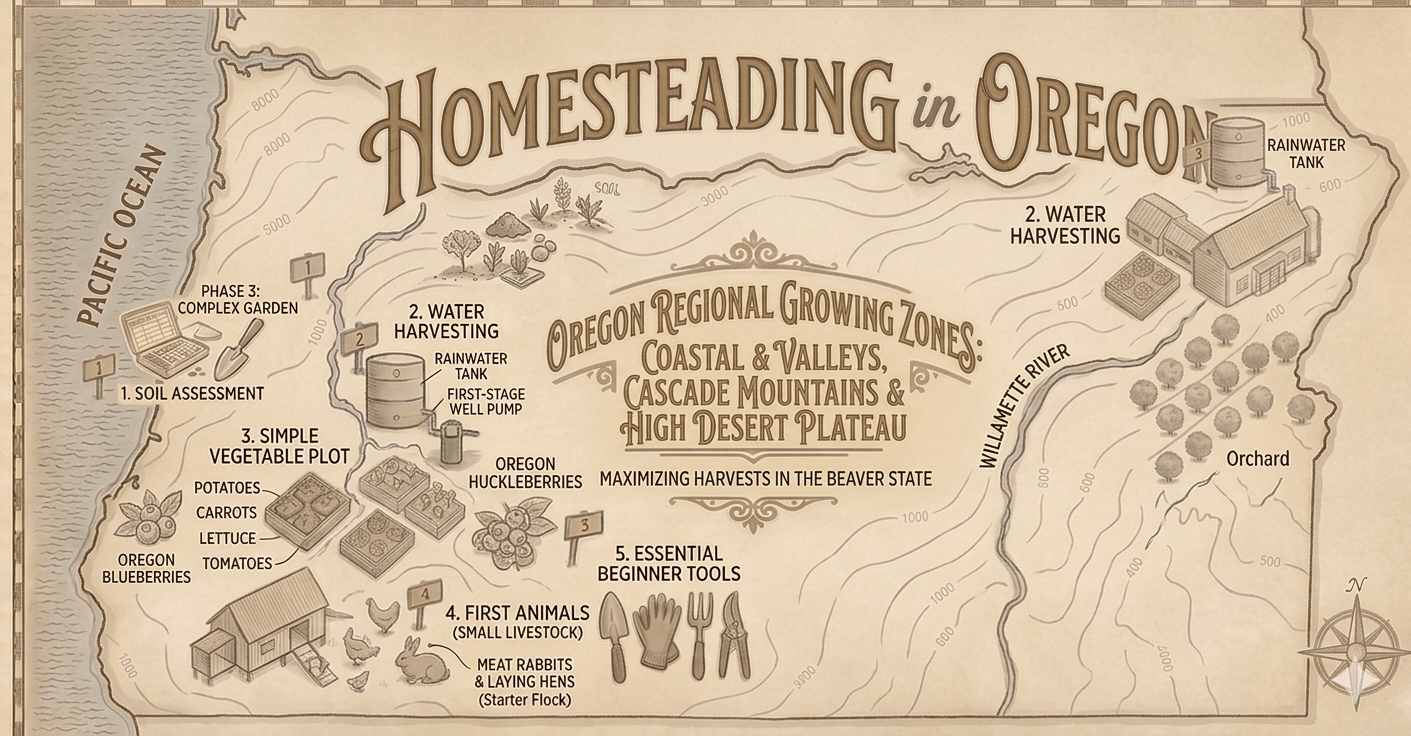
Oregon is a state of extremes that attracts homesteaders for very different reasons depending on which side of the Cascade Range they settle. The wet, mild Willamette Valley produces some of the most diverse crops in North America. The high desert east of the Cascades offers vast, affordable acreage and wide open skies. In between, you will find microclimates, volcanic soil, old growth timber, and a culture that has valued self reliance for generations.
This guide is written for anyone seriously considering a move to Oregon for homesteading. Whether you are comparing it against other states in our state by state homesteading hub or you have already zeroed in on the Beaver State, this article covers what you need to know before buying land and breaking ground.
If you are brand new to homesteading and want to understand the fundamentals first, start with our complete beginner's guide to homesteading. This Oregon guide assumes you already know what homesteading is and are now focused on where to do it.
I come from a family of farmers, and I have spent years applying my clinical research background to studying what makes certain states better than others for homesteading. Oregon is a uniquely compelling option, but only if you match the right region to your goals. Here is why.
Why Oregon Is One of the Best States for Homesteading
Oregon offers a set of advantages that few other states can match. The diversity of climate, the strength of agricultural protections, and the depth of the local food culture make it a standout destination. These are the factors that matter most.
Right to Farm Act. Oregon's Right to Farm law (ORS 30.930 through 30.947) protects agricultural operations on land zoned for farm use from nuisance lawsuits. If you are conducting normal farming practices on qualifying land, neighbors cannot take legal action against you for dust, noise, odors, or other byproducts of legitimate agriculture. Oregon's version is notably strong because it ties directly to the state's land use planning system, which prioritizes farmland preservation.
No state sales tax. Oregon is one of only five states with no sales tax whatsoever. Every piece of fencing, every bag of feed, every tool, and every building material you buy costs exactly the listed price. For homesteaders who are constantly purchasing supplies and infrastructure, this adds up to meaningful savings over time. Oregon does have a state income tax, but the absence of sales tax is a daily financial advantage.
Exceptional agricultural diversity. Oregon produces over 220 commercially grown crops, more than almost any other state. The Willamette Valley alone grows hazelnuts, berries, wine grapes, hops, grass seed, nursery stock, and dozens of vegetable crops. Southern Oregon supports orchards and warm season crops. Eastern Oregon runs large scale livestock operations. Whatever you want to grow or raise, there is likely a region in Oregon suited to it.
Strong land use protections. Oregon's statewide land use planning system, established in 1973 under Senate Bill 100, created Exclusive Farm Use (EFU) zoning that permanently protects agricultural land from development. This means your rural farmland neighbors are unlikely to be replaced by subdivisions. It also means land in EFU zones is taxed at farm use value, which keeps property taxes low.
Water abundance in western Oregon. The western third of the state receives 40 to 80 inches of rainfall annually. Rivers, creeks, and springs are plentiful. For homesteaders in the Willamette Valley, Coast Range, or Southern Oregon, water scarcity is rarely a concern during the growing season.
Deep local food culture. Oregon has one of the strongest farmers market networks in the country. Portland alone has over a dozen weekly markets. The state's farm to table culture creates robust demand for locally produced food, which benefits homesteaders who sell surplus at market.
Note
Oregon has no state sales tax. Every purchase of fencing, feed, seed, tools, and building materials costs exactly the listed price. For homesteaders constantly investing in infrastructure and supplies, this is one of the most practical financial advantages any state can offer.
Land Prices and Where to Buy in Oregon
Oregon's land market is sharply divided by geography. Western Oregon, particularly the Willamette Valley and areas near Portland, commands premium prices. Eastern Oregon offers some of the cheapest rural land in the western United States. Choosing the right region is the single most important financial decision you will make.
Statewide Land Price Overview
The statewide average hovers around $4,500 per acre for unimproved rural land. For context, here is how Oregon compares to its immediate neighbors:
- Washington: approximately $5,500 per acre
- Idaho: approximately $3,200 per acre
- California: approximately $12,000 per acre
- Nevada: approximately $2,500 per acre
Oregon sits in the middle of the Pacific Northwest range. The critical factor is the enormous variation within the state. Land within 30 miles of Portland or Bend can exceed $20,000 per acre. Land in remote eastern Oregon counties can be found for under $1,000 per acre.
Best Regions for Homestead Land
The following table breaks down Oregon's major regions for homesteaders. Prices reflect raw or lightly improved rural land, not developed residential lots.
| Region | Typical Price Per Acre | USDA Zones | Terrain | Notes |
|---|---|---|---|---|
| Southern Oregon (Josephine, Jackson, Douglas) | $4,000 to $8,000 | 7a, 7b, 8a | Valleys and foothills | Warm, dry summers. Excellent for orchards, grapes, and warm season crops. Rogue Valley is the heart of this region. |
| South Willamette Valley (Lane, Linn, Benton) | $6,000 to $12,000 | 8a, 8b | Flat valley floor, foothills | Prime agricultural land. Mild climate, fertile soil, strong markets. Higher prices reflect quality. |
| Central Oregon Foothills (Jefferson, Crook, Deschutes) | $2,000 to $5,000 | 5b, 6a, 6b | High desert, juniper woodland | Drier climate requires irrigation. Affordable land, growing communities. Bend area is expensive. |
| Northeast Oregon (Union, Wallowa, Baker, Grant) | $1,000 to $3,000 | 4b, 5a, 5b | Mountain valleys, rangeland | Cheapest land in the state. Harsh winters, short growing seasons. Strong ranching culture. |
| Southeast Oregon (Harney, Lake, Malheur) | $500 to $2,000 | 5a, 5b, 6a | High desert, sagebrush | Extremely remote and affordable. Very dry, requires well or irrigation rights. Large parcels available. |
| Portland Metro and North Willamette | $15,000 to $30,000+ | 8b, 9a | Flat to rolling | Generally overpriced for homesteading. Consider 60+ minutes from Portland. |
What to Look for When Buying Oregon Land
Oregon's land use system adds unique considerations that other states do not have. Before making an offer on any Oregon parcel, evaluate the following:
- Zoning designation. Check whether the property is zoned EFU (Exclusive Farm Use), forest, or rural residential. EFU land has the lowest taxes but restricts non farm dwellings and commercial activity. Understand what you can and cannot build before you buy.
- Water rights. Oregon's water law is complex. Verify whether the property has existing water rights, a permitted well, or access to an irrigation district. Do not assume you can use surface water without a right.
- Road access. Many rural Oregon properties are accessed via forest service roads or unimproved county roads. Verify year round access, especially in areas with heavy snow or mud.
- Soil quality and type. Request a soil survey through the USDA Web Soil Survey or schedule a test through OSU Extension. Volcanic soils in central Oregon behave very differently from valley floor alluvium in the Willamette.
- Wildfire risk. Oregon has experienced significant wildfire activity in recent years. Check the Oregon Department of Forestry wildfire risk maps for your target property. Defensible space and fire resistant building materials are essential in many areas.
- Timber value. Wooded parcels may have standing timber worth significant money. This can offset land costs if you plan to selectively harvest, but it also creates forest management responsibilities.
- Broadband availability. If you work remotely, verify internet service before purchasing. Rural Oregon connectivity ranges from excellent (near towns) to nonexistent (remote eastern counties).
For a quick snapshot of Oregon's key stats, visit our Oregon state overview page.
Oregon Homesteading Laws and Regulations
Oregon's legal landscape is a mix of strong agricultural protections and a more structured regulatory environment than you will find in many southern or mountain west states. The state values farmland preservation and food freedom, but it also has a statewide building code and a complex water rights system. Here is what you need to know.
Right to Farm Act
Oregon's Right to Farm Act (ORS 30.930 through 30.947) protects farming and forest practices on land zoned for farm or forest use. The law prevents local governments from enacting ordinances that would unreasonably restrict accepted farming practices. It also shields farmers from nuisance lawsuits by neighboring property owners.
The protection is tied to the land's zoning classification. If your property is in an EFU zone and you are conducting standard agricultural operations, you have strong legal protection. The law does not cover operations that violate health, safety, or environmental regulations, and it does not apply to land zoned residential.
Raw Milk Laws
Oregon allows the sale of raw milk directly from the farm to the consumer. Producers must obtain a raw milk producer license from the Oregon Department of Agriculture (ODA). Licensed producers can sell raw cow, goat, or sheep milk on the farm premises.
Oregon also allows incidental raw milk sales without a license if the producer has three or fewer lactating cows, nine or fewer lactating goats, or nine or fewer lactating sheep. These small scale producers can sell directly from the farm without ODA licensing, though they must meet basic sanitation standards.
Retail sales of raw milk in stores are not permitted. Delivery and online sales for shipment are not allowed. But Oregon's tiered system gives small homestead dairy operations a relatively easy path to legal sales.
Cottage Food Laws
Oregon's cottage food program allows homesteaders to sell certain homemade foods directly to consumers without a commercial kitchen license. Covered products include baked goods, candy, jams, jellies, fruit butter, dried fruits, granola, popcorn, and other non potentially hazardous items.
Sales must be direct to the consumer at venues like farmers markets, farm stands, or community events. Each product must be labeled with the producer's name, address, ingredients, and the statement that the product was made in a home kitchen not inspected by ODA. There is no annual sales cap on cottage food in Oregon, which is more permissive than many states.
Oregon also has a separate Farm Direct Marketing program that allows farmers to sell value added products like jams, pickles, and fermented foods made from ingredients they grow. This expands what a homesteader can legally sell beyond the standard cottage food list.
Zoning and Building Codes
Oregon has a statewide building code administered by the Oregon Building Codes Division. Unlike Tennessee or Idaho, there is no patchwork of county by county adoption. The Oregon Structural Specialty Code applies throughout the state.
However, enforcement varies. Within city limits and urban growth boundaries, codes are strictly enforced. In rural areas, especially in eastern Oregon counties, enforcement may be less rigorous. Some rural counties have limited inspection staff, which can mean longer timelines but also less scrutiny for simple agricultural structures.
Agricultural buildings on EFU zoned land are generally exempt from the residential building code. Barns, equipment sheds, livestock shelters, and similar farm structures typically do not require building permits. Dwellings, however, always require a permit regardless of zoning.
Warning
Oregon enforces a statewide building code for all residential structures, including those on rural and EFU zoned land. Agricultural buildings like barns and equipment sheds are generally exempt, but any structure intended for human habitation requires a permit and inspections. Contact your county building department before purchasing land if you plan to build an unconventional dwelling such as a tiny home, yurt, or shipping container house.
Water Rights
This is the most complex area of Oregon law for homesteaders. Oregon follows the prior appropriation doctrine, meaning water rights are allocated on a "first in time, first in right" basis. The Oregon Water Resources Department (OWRD) administers all water rights in the state.
You cannot simply pump water from a stream or divert a creek because it runs through your property. Surface water use requires a water right permit, and new permits can be difficult to obtain in many basins where water is fully allocated.
Rainwater harvesting is legal in Oregon. A 2009 law specifically authorized the collection of rainwater from rooftop surfaces without a permit. You can collect and store as much rooftop runoff as you want for any use, including irrigation, livestock watering, and non potable household use.
Well drilling requires a permit from OWRD. Domestic wells (serving one to three households) are exempt from the water rights permitting process but still require a well construction permit. The well must be drilled by a licensed contractor. Most rural properties in Oregon rely on wells for household water, and drilling costs vary widely depending on depth and geology.
Tip
When buying Oregon land, verify water rights before anything else. A property with an existing water right or a permitted well is dramatically more valuable than one without. Check the OWRD water rights database online or call their office to confirm what rights are attached to any parcel you are considering.
Property Tax and Agricultural Exemptions
Oregon's land use system provides substantial property tax relief for agricultural land through special assessment under ORS 308A. Land zoned EFU is automatically assessed at its farm use value rather than its market value. This is not a program you apply for; it is a function of the zoning itself.
The difference is significant. A 20 acre EFU parcel with a market value of $200,000 might be assessed at $20,000 to $40,000 for tax purposes, resulting in property taxes of $300 to $600 per year instead of $2,000 to $4,000.
Oregon also offers a farm use special assessment for qualifying agricultural land outside EFU zones. To qualify, the land must be used for farm purposes and meet minimum income thresholds ($6,500 gross income for parcels of 6.5 acres or more, or $1,300 for parcels under 6.5 acres in the Willamette Valley and surrounding counties).
One important caveat: if land is removed from special assessment (disqualified due to a change in use), the owner owes back taxes covering the difference between farm use and market value assessment for the previous five to ten years, depending on the program.
Livestock Regulations
Oregon requires a premises identification number for livestock through the Oregon Department of Agriculture. This is a free registration that tracks where animals are kept in the state. It is a simple process and not a permitting hurdle.
Oregon's fence law varies by county. Western Oregon counties are generally fence in jurisdictions, meaning livestock owners must contain their animals. Many eastern Oregon counties operate under open range rules, where livestock can roam freely and landowners who do not want animals on their property must fence them out. Check your specific county before purchasing land, as this affects both your fencing costs and your liability.
Branding is regulated through the Oregon Department of Agriculture for cattle and horses. If you plan to run cattle, registering a brand is straightforward and inexpensive.
Oregon does not require state permits for keeping chickens, goats, sheep, or pigs on agricultural land. County level restrictions may apply in urban areas or rural residential zones. On EFU zoned land, livestock is an accepted farm use with no special permitting requirements.
Climate, Growing Zones, and Soil
Oregon's climate is its most distinctive feature and its most important consideration for homesteaders. The Cascade Range splits the state into two fundamentally different climate zones. Western Oregon is maritime, with mild temperatures, wet winters, and dry summers. Eastern Oregon is continental, with harsh winters, hot summers, and low annual rainfall. Choosing the right region is everything.
USDA Hardiness Zones Across Oregon
Oregon spans USDA zones 4b through 9a, one of the widest ranges of any state. This means you can grow cold hardy crops suited to Montana or mild climate crops suited to northern California, depending on where you settle.
| Region | USDA Zones | Avg Last Frost | Avg First Frost | Growing Season |
|---|---|---|---|---|
| Willamette Valley | 8a, 8b, 9a | March 15 to April 1 | October 25 to November 10 | 7 to 8 months |
| Southern Oregon (Rogue Valley) | 7a, 7b, 8a | April 1 to 15 | October 15 to 25 | 6.5 to 7 months |
| Oregon Coast | 8b, 9a | March 10 to 25 | November 5 to 20 | 7.5 to 8.5 months |
| Central Oregon (Bend, Redmond) | 5b, 6a, 6b | May 15 to June 1 | September 15 to 30 | 3.5 to 4.5 months |
| Northeast Oregon (La Grande, Enterprise) | 4b, 5a, 5b | May 10 to 25 | September 20 to October 5 | 4 to 5 months |
| Southeast Oregon (Burns, Lakeview) | 5a, 5b, 6a | May 20 to June 5 | September 10 to 25 | 3.5 to 4 months |
These are averages. Oregon's complex topography creates microclimates everywhere. A south facing slope in a river valley can be a full zone warmer than a nearby ridgetop. Track conditions on your specific property before making major planting commitments.
Planting Calendar Tool
Enter your zip code to get a personalized planting schedule based on your USDA zone.
Try it free →Rainfall and Water Availability
Rainfall in Oregon varies more dramatically than in almost any other state. The Oregon Coast and Coast Range receive 60 to 100 inches annually. The Willamette Valley gets 40 to 50 inches. Central Oregon around Bend receives 10 to 15 inches. Parts of southeastern Oregon see as little as 6 to 8 inches per year.
In western Oregon, the challenge is not lack of water but managing excess moisture. The rainy season runs from October through May, and summers are notably dry from July through September. Most western Oregon homesteaders need irrigation during the summer dry season, even though total annual rainfall is high.
In eastern Oregon, irrigation is essential for any serious crop production. Properties with access to irrigation district water or senior water rights are far more productive than those relying solely on rainfall. Dryland farming is possible in some areas but limits crop selection significantly.
Soil Types by Region
Oregon has remarkable soil diversity, shaped by volcanic activity, glaciation, and wind deposition.
Willamette Valley soils are primarily deep alluvial deposits with excellent fertility. The valley floor features Willamette, Woodburn, and Amity series soils with a pH of 5.5 to 6.5. These are among the most productive agricultural soils in the Pacific Northwest. They drain well, hold nutrients, and support virtually any crop suited to the climate.
Southern Oregon soils in the Rogue Valley are a mix of decomposed granite, clay loam, and alluvial deposits with a pH of 5.5 to 7.0. The valley floor is fertile and well drained. Hillside soils tend to be thinner and rockier but excellent for wine grapes and drought adapted crops.
Central and Eastern Oregon soils are predominantly volcanic in origin, including pumice, ash, and basalt derived clays. pH ranges from 6.0 to 8.0. These soils can be highly productive with irrigation but are often nutrient poor and require amendments. The volcanic soils drain extremely well, sometimes too well for crops that need consistent moisture.
Regardless of where you buy, get a soil test before planting. The Oregon State University Extension Service offers soil testing through county offices for $20 to $30. Results include pH, nutrient levels, organic matter content, and amendment recommendations for your intended crops.
What to Grow on an Oregon Homestead
Oregon's agricultural diversity is one of its greatest strengths. The state grows over 220 commercial crops, and homesteaders benefit from this depth of local knowledge and infrastructure. What you can grow depends heavily on which region you choose.
Warm Season Crops
Western Oregon's dry summers with long daylight hours produce exceptional warm season crops, even though the season starts later than in southeastern states.
Tomatoes perform well in the Willamette Valley and Southern Oregon, especially in warm microclimates. The dry summer air reduces disease pressure compared to humid states. Early Girl, Stupice, and Siletz are popular short season varieties for western Oregon. Southern Oregon growers can succeed with a wider range of varieties including larger heirloom types.
Peppers of all types thrive in Southern Oregon and warm spots in the Willamette Valley. Sweet bells need the warmest locations or season extension. Hot peppers like jalapenos and cayenne are more forgiving.
Winter squash and pumpkins are a Pacific Northwest staple. The long, warm days of August and September produce excellent curing conditions. Butternut, delicata, and acorn squash store well through Oregon's mild winters.
Dry beans are perfectly suited to Oregon's dry summer climate. Cannellini, black, pinto, and heirloom varieties all produce well. The dry harvest season means beans can cure on the vine without rot.
Corn produces well in the Willamette Valley and Southern Oregon. The key is choosing appropriate varieties for your growing season length. Early maturing sweet corn varieties are reliable in zones 8a and warmer.
Cucumbers, melons, summer squash, and eggplant all produce in western Oregon with appropriate variety selection. In central and eastern Oregon, warm season crops require season extension techniques like hoop houses, row covers, or greenhouses for reliable production.
Cool Season Crops
This is where Oregon truly excels. The mild, wet winters and cool springs create ideal conditions for an extended cool season harvest that rivals any state in the country.
Lettuce, spinach, kale, and chard grow almost year round in western Oregon. With minimal protection, leafy greens can produce from September through May, giving you a harvest window that overlaps with both fall and spring plantings. Many western Oregon homesteaders grow greens through the winter in unheated hoop houses.
Broccoli, cabbage, cauliflower, and Brussels sprouts are premier Oregon crops. The cool, mild conditions produce sweeter, more tender brassicas than hot climate states can achieve. Fall planted starts often produce through December and into January.
Carrots, beets, turnips, and radishes can be planted in early spring and again in late summer for fall and winter harvest. Root vegetables stored in the ground under mulch will hold through Oregon's mild western winters.
Garlic is planted in October and harvested the following July. Oregon's climate is ideal for both softneck and hardneck varieties. The Willamette Valley in particular produces outstanding garlic.
Peas and fava beans go in the ground as early as February in western Oregon. Fava beans are especially well adapted and can even be planted in fall for an early spring harvest in zones 8 and warmer.
Fruit Trees and Perennials
Oregon is one of the top fruit producing states in the nation, and homesteaders benefit from the same conditions that support the commercial industry.
Pears are Oregon's signature tree fruit. The Rogue Valley and Hood River regions produce world class pears commercially, and homestead trees perform just as well. Bartlett, Comice, Bosc, and Anjou are all excellent choices.
Apples grow throughout western Oregon and in irrigated areas of central Oregon. The maritime climate supports a wide range of varieties. Gravenstein, Jonagold, Honeycrisp, and Liberty are popular choices. Disease resistant varieties are worth prioritizing in Oregon's wet climate.
Hazelnuts are almost exclusively an Oregon crop in the United States. The Willamette Valley produces 99% of the nation's hazelnuts. Homesteaders can plant hazelnut trees as both a food source and a long term income crop. Trees begin producing in 3 to 5 years and reach full production by year 10.
Blueberries thrive in Oregon's naturally acidic soils, particularly in the Willamette Valley. Both highbush and rabbiteye varieties perform well. The commercial blueberry industry in Oregon is substantial, which means local knowledge and plant sources are readily available.
Grapes grow exceptionally well in Southern Oregon and the Willamette Valley. Table grapes, wine grapes, and juice grapes all produce reliably. Oregon's wine industry is world renowned, and the same conditions that grow Pinot Noir grapes support excellent table grape production.
Figs are surprisingly productive in zones 8a and warmer in western Oregon. Desert King and Lattarula (Italian Honey) are the most reliable varieties. Figs need a sheltered, south facing location and may need winter protection in borderline areas.
Blackberries and raspberries grow so well in western Oregon that blackberries are considered invasive. Cultivated varieties like Triple Crown, Marion (the famous marionberry, developed in Oregon), and Meeker raspberries produce prolifically.
Herbs and Medicinal Plants
Oregon's diverse climates support a wide range of herbs. Basil, cilantro, dill, and parsley grow well as summer annuals. Rosemary, thyme, oregano, sage, and lavender are reliably perennial in western Oregon and thrive in the dry summer conditions.
Lavender deserves special mention. Oregon's Willamette Valley and Southern Oregon have growing conditions similar to Provence, and commercial lavender farms are increasingly common. Homestead lavender production for value added products like sachets, essential oil, and dried bundles can be a profitable sideline.
Oregon grape is a native plant with medicinal uses that grows wild throughout the state. Harvesting is unregulated on private property but regulated on public lands.
Livestock for Oregon Homesteads
Oregon's mild western climate and extensive rangelands in the east make it well suited for a range of livestock. The state has a particularly strong tradition of sheep and cattle ranching. Here is what works best.
Chickens
Chickens are the natural starting point for Oregon homesteaders. In western Oregon, the primary challenge is managing moisture rather than extreme heat or cold. Dry, well ventilated coops are essential.
Buff Orpingtons are an excellent choice for Oregon. They are cold hardy, handle wet conditions reasonably well, and lay approximately 250 eggs per year. Their calm temperament makes them a good fit for small homesteads.
Barred Plymouth Rocks are hardy, reliable layers (280 eggs per year), and excellent foragers. They handle Oregon's cool, damp winters without issue.
Ameraucanas lay blue and green eggs, are cold hardy, and are active foragers. They do well in Oregon's free range conditions and add egg color variety to your basket.
Welsummers are worth considering for Oregon. They are excellent foragers, lay beautiful dark brown speckled eggs, and handle wet and cold weather well.
Provide dry, well ventilated housing and ensure runs have good drainage. In western Oregon, the enemy is persistent dampness, not temperature extremes. Deep litter management in the coop and covered run areas will keep your flock healthier through the rainy months.
Goats
Goats are well suited to Oregon homesteads, especially on hilly or brushy terrain. Oregon has an active goat community for both dairy and meat production.
Nigerian Dwarf goats are ideal for small acreage dairy production. They produce 1 to 2 quarts of high butterfat milk per day and require less space and feed than full sized breeds.
Nubian goats are a popular dairy breed in Oregon. Their heat tolerance is less relevant here than in southern states, but their high butterfat milk and friendly personalities make them a favorite.
Kiko goats are an excellent meat breed for Oregon. They are parasite resistant and low maintenance, which matters in Oregon's wet climate where internal parasites thrive.
Boer goats are the standard meat breed and perform well on Oregon pasture.
The biggest goat management challenge in western Oregon is the same as everywhere with humid climates: internal parasites. The wet conditions promote barber pole worm and other gastrointestinal parasites. Rotational grazing on well drained pasture is essential. Move goats every 3 to 5 days and avoid grazing pasture below 4 inches. In eastern Oregon, the drier conditions reduce parasite pressure significantly.
Cattle
Oregon has a long cattle ranching tradition, and the state supports both eastern rangeland operations and western Oregon pasture based systems.
Dexter cattle are an ideal homestead breed. They are small, dual purpose (milk and beef), and require approximately 1.5 to 2 acres per cow calf pair on improved western Oregon pasture.
Red Devon cattle produce excellent grass fed beef and finish well on pasture alone. They are well adapted to Oregon's conditions and have a growing following among small scale producers.
Angus cattle are widely available and the standard beef breed in Oregon. They are hardy, easy to handle, and produce consistently good beef on pasture.
Western Oregon pasture can support 1.5 to 2.5 acres per cow calf pair, thanks to the long growing season for grass and excellent rainfall. Eastern Oregon rangeland requires 10 to 40 acres per animal unit depending on conditions. The difference is enormous, so your region choice directly impacts carrying capacity.
Oregon's pasture grasses include perennial ryegrass, orchard grass, tall fescue, and white clover. The wet, mild winters allow for 9 to 10 months of grazing in western Oregon with minimal hay feeding.
Pigs
Pigs do well on Oregon homesteads, and the state's extensive forested land makes silvopasture systems particularly attractive.
American Guinea Hogs are a heritage breed that excels on small homesteads. They are smaller than commercial breeds (150 to 250 pounds at maturity), excellent foragers, and perform well in woodland pasture systems.
Berkshire pigs produce premium pork with excellent marbling. They are a medium sized breed that does well on Oregon pasture and in forest settings.
Large Black pigs are a heritage pasture breed with a docile temperament. Their black skin provides sun protection during Oregon's sunny summer months.
Oregon's wet winters mean pig housing needs excellent drainage. Mud management is the primary challenge for pig keeping in western Oregon. Rotational paddocks with good drainage and dry shelter areas are essential. Eastern Oregon's drier conditions simplify pig management but require more attention to water access and summer shade.
Other Livestock Worth Considering
Sheep deserve special attention in Oregon. The state has one of the strongest sheep industries in the country. Katahdin hair sheep eliminate the shearing requirement and are excellent for meat production on pasture. East Friesian and Lacaune sheep are popular dairy breeds in Oregon's growing artisan cheese community.
Honeybees thrive in Oregon. The long nectar flow from native wildflowers, clover, blackberry, and orchard crops supports strong colonies. Expect 30 to 60 pounds of surplus honey per hive in a good year in western Oregon.
Ducks are arguably better suited to western Oregon than chickens. Khaki Campbell ducks lay 250 to 300 eggs per year and genuinely enjoy the wet conditions that stress chickens. They are outstanding slug and pest foragers in garden systems.
Livestock Quick Reference
| Animal | Min. Acreage | Startup Cost | Annual Feed Cost | Primary Product |
|---|---|---|---|---|
| Chickens (6 hens) | Any | $300 to $600 | $200 to $350 | Eggs, pest control |
| Dairy Goats (2 does) | 0.5 acres | $500 to $1,000 | $400 to $700 | Milk, brush clearing |
| Meat Goats (5 head) | 2 acres | $750 to $1,500 | $300 to $600 | Meat, land clearing |
| Beef Cattle (2 head) | 4 acres | $2,000 to $4,000 | $400 to $900 | Beef |
| Pigs (2 feeders) | 0.5 acres | $200 to $500 | $600 to $1,000 | Pork |
| Sheep (5 ewes) | 2 acres | $750 to $1,500 | $300 to $600 | Meat, wool, dairy |
| Honeybees (2 hives) | Any | $500 to $800 | $100 to $200 | Honey, pollination |
Community, Culture, and Resources
Oregon has a deeply rooted agricultural identity and one of the most active local food movements in the country. The community and infrastructure available to homesteaders here is exceptional.
The Homesteading Community in Oregon
Oregon has a long history of attracting self reliant, back to the land settlers. From the Oregon Trail pioneers to the 1970s back to the land movement to today's modern homesteaders, the state has consistently drawn people who want to live closer to the land.
Farmers markets are a cornerstone of Oregon culture. The state has over 130 active markets, many operating year round. They serve as both income opportunities and community gathering points. The demand for locally produced food in Oregon is strong and growing, which benefits homesteaders who sell surplus.
The culture of mutual aid and community supported agriculture runs deep. Community Supported Agriculture (CSA) programs are widespread, and cooperative models for shared equipment, processing facilities, and marketing are common. Oregon homesteaders are rarely isolated; the network is there if you seek it out.
Oregon State University Extension Service and Local Resources
The Oregon State University (OSU) Extension Service is one of the most active and well funded extension programs in the country. It operates offices in every county and provides extensive resources for homesteaders and small farmers:
- Soil testing ($20 to $30 per sample with detailed amendment recommendations)
- Master Gardener certification programs with strong volunteer networks
- Small Farms program specifically designed for new and small scale producers
- Pest and disease identification and integrated pest management guidance
- 4 H programs for families with children
- Livestock health resources and pasture management workshops
The Oregon Department of Agriculture handles permits for raw milk sales, organic certification, and market development. Their Farm Direct Marketing program is particularly useful for homesteaders selling value added products.
The Oregon Small Farm News newsletter and the OSU Small Farms website are excellent free resources for ongoing education. Oregon also has active chapters of organizations like the Oregon Farm Bureau, Friends of Family Farmers, and Rogue Farm Corps (which offers farmer training programs).
Cost of Living Snapshot
Oregon's overall cost of living runs approximately 5% to 10% above the national average, driven primarily by housing costs in the Portland metro area. Rural Oregon is significantly more affordable, with cost of living near or below the national average in most eastern and southern counties.
The absence of sales tax is a daily advantage that partially offsets the state income tax burden. Oregon's state income tax rate is among the higher in the country (4.75% to 9.9%), but homesteaders with modest cash income and significant self produced food often have relatively low taxable income.
For homesteaders, the meaningful financial advantages are the combination of EFU tax assessment on agricultural land, no sales tax on all purchases, and the generally affordable land prices outside of the Willamette Valley core and Portland metro area.
How to Get Started: Your First Steps
If Oregon sounds like the right fit, here is a practical action plan to move from research to reality.
-
Define your goals and budget. Decide what kind of homestead you want and be clear about your climate preferences. A five acre food production homestead in the Willamette Valley is a fundamentally different project than a 40 acre ranch in eastern Oregon. Set a realistic land and infrastructure budget.
-
Choose a region. Use the land price table above and the climate data to narrow your search. Western Oregon offers easier gardening and milder conditions. Eastern Oregon offers more affordable land and more space. Southern Oregon splits the difference with warm summers and moderate prices.
-
Research water rights and zoning. This is more critical in Oregon than in most states. Verify that any property you consider has adequate water access (existing water right, permitted well, or irrigation district membership) and that the zoning allows your intended use.
-
Visit before buying. Spend at least a week in your target region. Visit in the rainy season (November through March) if you are considering western Oregon, so you experience the reality of the wet months. In eastern Oregon, visit in both summer and winter to understand the temperature extremes.
-
Connect with OSU Extension in your target county. Schedule a visit or phone call. Tell them you are considering homesteading in the area. They can provide county specific information on soil, water, climate challenges, and local agricultural opportunities.
-
Understand fire risk. If your target property is in the wildland urban interface, learn about defensible space requirements and fire resistant construction. This is not optional in much of rural Oregon.
-
Start small your first season. Get your garden established before adding animals. Oregon's climate rewards observation. Spend your first year learning your microclimate, your soil, and the rhythm of the wet and dry seasons. Add livestock in year two once you have infrastructure in place. Our beginner's guide to homesteading walks through this staged approach in detail.
Tip
Before you buy land in Oregon, visit the county planning department and verify the zoning, water rights status, and any building restrictions. In Oregon, the zoning designation (EFU, forest, rural residential) determines almost everything about what you can build and how your land will be taxed. Thirty minutes of research at the county level can save you months of frustration and thousands of dollars.
Frequently Asked Questions
Oregon is an excellent state for homesteading, especially in western and southern regions. It offers exceptional agricultural diversity (over 220 commercial crops), no state sales tax, strong Right to Farm protections, and one of the most active local food cultures in the country. The Willamette Valley has some of the most productive farmland in the Pacific Northwest. Eastern Oregon offers very affordable land but requires irrigation and has harsher winters.
The statewide average is roughly $4,500 per acre, but prices vary enormously. Southern Oregon and central Oregon foothills range from $2,000 to $8,000 per acre. Northeast Oregon offers land for $1,000 to $3,000 per acre. Southeast Oregon can be found for under $1,000 per acre in remote areas. The Willamette Valley runs $6,000 to $12,000 per acre for quality farmland, and areas near Portland exceed $15,000.
Yes. Oregon allows raw milk sales directly from the farm to the consumer. Producers with more than three lactating cows or nine lactating goats or sheep need a raw milk producer license from the Oregon Department of Agriculture. Smaller operations can sell without a license. Retail store sales and delivery are not permitted.
Oregon enforces a statewide building code for all residential structures, regardless of location. Agricultural buildings like barns and equipment sheds on EFU zoned land are generally exempt. Any structure intended for human habitation requires a building permit and inspections. Enforcement rigor varies by county, with remote eastern Oregon counties sometimes having less intensive inspection schedules.
Oregon does not have a traditional homestead tax exemption. However, land zoned Exclusive Farm Use (EFU) is automatically assessed at farm use value rather than market value, which typically reduces property taxes by 70% to 90%. Land outside EFU zones can qualify for farm use special assessment if it meets minimum agricultural income thresholds. These programs provide substantial tax savings for homesteaders.
Oregon's growing season varies dramatically by region. The Willamette Valley enjoys 7 to 8 frost free months (March through October or November). Southern Oregon has 6.5 to 7 months. The Oregon Coast has the mildest conditions with 7.5 to 8.5 months. Central and eastern Oregon have much shorter seasons of 3.5 to 5 months, with last frosts as late as June in some areas.
On EFU zoned agricultural land, there are no state level restrictions on keeping chickens. Within city limits, municipal ordinances vary. Most Oregon cities allow small backyard flocks but may restrict flock size or prohibit roosters. On rural and agricultural land, chickens are an accepted farm use with no special permits required.
Yes. Oregon legalized rooftop rainwater harvesting in 2009. You can collect and store as much rainwater as you want from rooftop surfaces without a permit. The water can be used for irrigation, livestock, and non potable household purposes. Collecting water from other surfaces (like ponds or streams) requires a water right.
The best region depends on your priorities. The south Willamette Valley and Southern Oregon (Rogue Valley) offer the best combination of mild climate, fertile soil, and strong local markets, though land prices are moderate. Central Oregon offers affordable land with a drier climate that requires irrigation. Eastern Oregon has the cheapest land and most space but harsh winters and short growing seasons. For most food production focused homesteaders, Southern Oregon offers the best overall balance.
Yes. Well drilling in Oregon requires a well construction permit from the Oregon Water Resources Department (OWRD). Domestic wells serving one to three households are exempt from the water rights process but still need the construction permit. The well must be drilled by a licensed contractor. Permit fees are modest, and the process is routine for most rural properties.

Cole
Founder & Lead Researcher
Cole is the founder of Plan Your Homestead. He works in clinical research and brings a research-first lens to every guide on the site, drawing on a long family line of farmers for grounded, practical perspective.
More in Guides
More articles coming soon. Check back for new guides content.