Laws are not the fun part of homesteading. They are the part most people skip. They are also the part that decides whether your dream of a backyard flock, a market garden, or a few dairy goats actually gets to grow into something real. So let us walk through them together. Slowly. Plainly. Without scary fine print.
The good news is that most of the rules are simpler than they look. Most of them are public. Most of them can be confirmed with a phone call or a fifteen minute search on a county website. You do not need a lawyer to start a homestead. You just need to know which questions to ask, in which order, before you spend money you cannot get back.
This guide gives you the national picture. We will cover federal, state, and local layers. We will translate the jargon. Where state details matter, we will point you to the state by state homesteading hub so you can pull the specifics for your patch of the country. By the time you finish reading, you will know how to research any property, any town, any plan, in a single afternoon. That is a powerful place to start from.
Take a breath. None of this is as scary as it sounds.
Why a Couple of Hours Now Saves a Whole Season Later
Picture the homesteader who orders six chicks in March, builds a coop in April, and gets a letter from the city in May saying the coop sits four feet too close to the property line. Now they need to move it. Or take it down. Or apply for a variance and wait six weeks. The chicks are growing. The coop is heavy. The mood is sour.
Now picture a different homesteader. Same plan. Same six chicks. But before any of it, they spent one quiet evening on the county website. They learned that hens are allowed, roosters are not, and coops must sit at least ten feet from the property line. They built once. They built right. The chicks moved into a finished home with no drama.
That is the whole pitch for this guide. A few hours of reading saves you a season of regret. The rules are not there to crush your plans. They are there to help neighbors live next to each other peacefully. Once you understand them, they stop feeling like obstacles and start feeling like a checklist.
The Three Layers That Govern Every Homestead
There are three layers of law that touch a homestead. They stack on top of each other like a cake. You have to look at all three.
Federal law. This layer is small for most homesteaders. The federal government cares about a few specific things. The Food Safety Modernization Act covers larger produce operations. The USDA inspects meat that crosses state lines or is sold commercially. The EPA regulates wetlands and certain water features. Unless you are running a meaningful business, federal rules will rarely affect your day to day life.
State law. This layer is where many of the most important rules live. State law decides whether you can sell raw milk. It sets the rules for cottage food businesses. It defines water rights, right to farm protections, and homeschool freedoms. State law also creates the building code that your county adopts, with or without local additions. Two states next door to each other can feel like two different countries for a homesteader. Always check yours first.
Local law. This is the layer most beginners forget. Your county, township, or city writes the zoning rules. They decide how many chickens you can keep on a quarter acre. They decide whether goats are allowed at all. They set setbacks for buildings, rules for septic systems, fences, and noise. Local law is also the layer most likely to change every few years as new councils take office.
You do not need to memorize any of this. You just need to remember the order. Federal sets the floor. State writes most of the rules that matter for food and water. Local controls what you build and what animals you keep. When you research a property, walk those three layers from the top down.
Right to Farm Laws
Almost every state has some form of right to farm law. These laws protect existing farms and homesteads from nuisance lawsuits. The classic example is the new neighbor who moves out to the country, then sues the rooster across the road for crowing too early. Right to farm laws make those suits much harder to win.
Here is what right to farm typically does for you.
- It protects normal agricultural activity from nuisance claims.
- It often protects the smell of livestock and the noise of farm machinery.
- It can shield you from later changes in zoning if your operation existed first.
- It sometimes provides a path to a quick dismissal of frivolous complaints.
Here is what right to farm usually does not do.
- It does not override zoning. If chickens are banned in your city, right to farm will not let you keep them.
- It does not protect new operations against pre existing residential neighbors who have stronger claims.
- It rarely covers commercial activity that exceeds what counts as agriculture in the state's definition.
There is one trap worth knowing. Many right to farm protections rely on prior agricultural use. If the land was farmed before homes nearby were built, you usually have strong protection. If you are starting fresh in a residential pocket, the law may not help you as much. When you tour a property, ask about the agricultural history of the parcel.
For state by state details on right to farm protections, raw milk laws, and other rules, the state by state homesteading hub lays out specifics for every state in the country.
Zoning Basics for Homesteaders
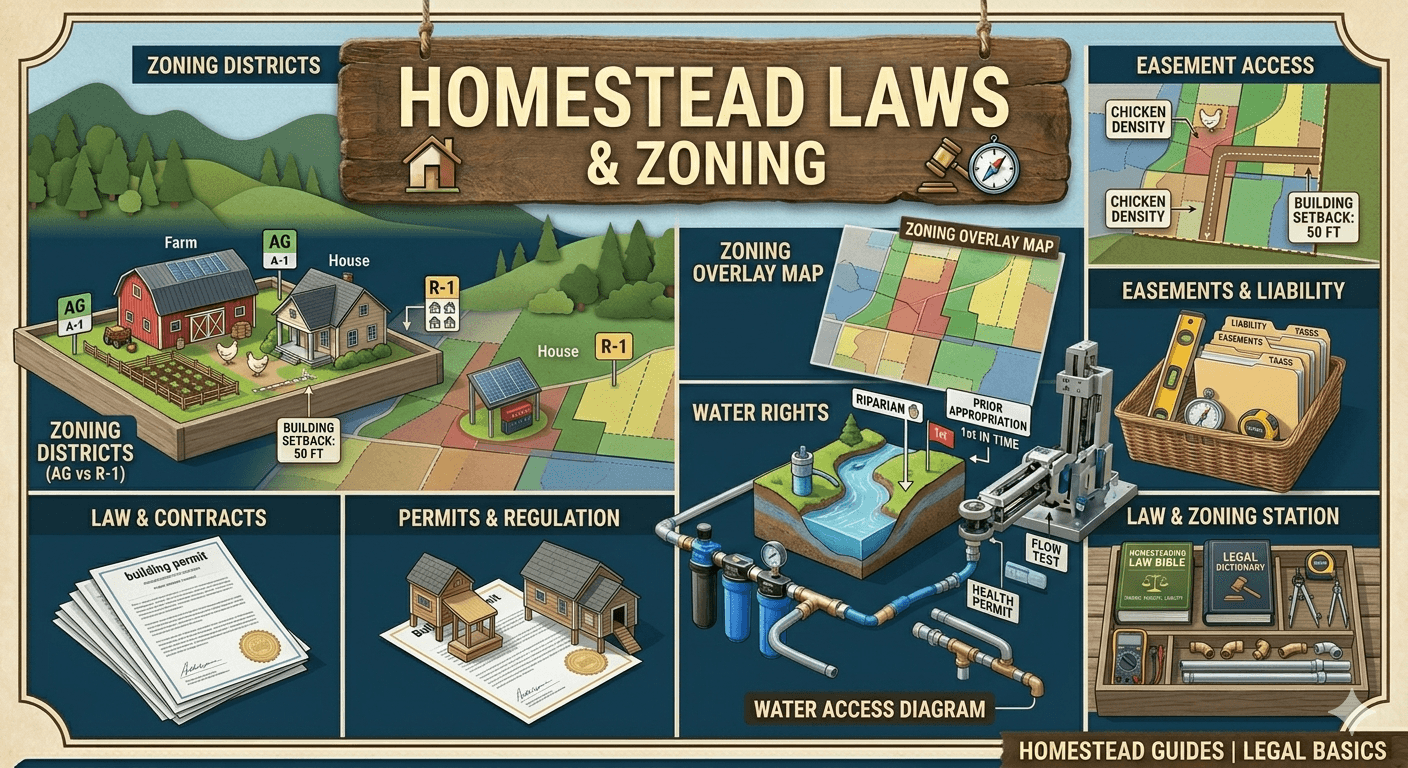
Zoning is the local rulebook that decides what you are allowed to do on a piece of land. Every parcel falls into a district. Each district has its own list of allowed and prohibited uses. Reading the zoning map and the use table is one of the most useful skills a new homesteader can learn.
Most homesteading questions live inside one of these common district types.
| District | Usually Allows | What to Watch For |
|---|---|---|
| Agricultural (A or AG) | Crops, most livestock, barns, farm sales | Minimum acreage rules, restrictions on retail traffic |
| Rural Residential (RR) | Homes on larger lots, limited livestock, gardens | Animal counts per acre, setbacks for outbuildings |
| Residential (R) | Homes, gardens, sometimes a few hens | Bans on roosters, bans on goats, coop size limits |
| Mixed Use (MU) | Homes, small businesses, sometimes urban farms | Rules vary widely, always check the table |
| Conservation (C) | Limited building, protected ecosystems | Heavy restrictions on grading, fencing, and clearing |
Two ideas inside zoning matter more than the rest.
Accessory uses. An accessory use is something you do on the side of your main use. A vegetable garden is an accessory use to a home. A small chicken coop often is too. Even when livestock is not listed in the use table, an accessory clause can quietly allow a few hens. Read the zoning ordinance for the words "accessory" and "incidental." That is where small homestead activities often live.
Note
A quick definition. A use table is the chart in your zoning ordinance that lists every allowed activity for every district. It will say things like "Permitted," "Conditional," or "Not Permitted." Find it once and you can answer most of your questions in five minutes.
Conditional use permits. When something is not allowed by right, it is sometimes allowed with a permit. You apply, the planning board reviews, neighbors get notified, and a public meeting is held. This sounds intimidating, and it is mostly not. People apply for conditional use permits every week to keep small flocks, run home bakeries, or build a barn on a smaller lot. Show up prepared, with a clean plan and friendly intent, and you will be fine more often than not.
If your dream does not match your district, do not give up. Look for a different parcel. Or apply for the permit. Or ask the zoning office whether a small adjustment to your plan moves you into the allowed column.
HOAs and Deed Restrictions
If you live in a planned community, your HOA covenants may be stricter than any government rule. Covenants run with the deed. They follow the property no matter who owns it. You agreed to them when you bought the home, even if you did not read them.
Common HOA bans include the following.
- Visible chicken coops, even when the city allows hens.
- Front yard vegetable gardens.
- Clotheslines and outdoor compost bins.
- Detached outbuildings over a certain size.
- Bee hives, fruit trees in front yards, and rainwater barrels.
The first thing to do in an HOA neighborhood is pull the covenant document. It will be a PDF, often dozens of pages. Search it for the words chicken, livestock, garden, fence, shed, and structure. You will know within twenty minutes whether your homestead plan is realistic.
Tip
If a covenant blocks something small, you can often request a variance from the HOA architectural committee. Bring a clean drawing. Mention specific safeguards like a closed coop, no roosters, and a tidy enclosure. Many HOAs say yes to a small flock when the request is calm and clear.
Deed restrictions are similar in spirit. They are private rules attached to the land by a previous owner or developer. They show up in the deed itself. Always read your deed before closing. A title company can help you flag any restrictions before you sign.
Building Codes and the Agricultural Exemption
Building codes set the rules for safe construction. Foundations. Framing. Wiring. Plumbing. They keep buildings from falling down on people. That is a good thing, even when the paperwork feels heavy.
The basic flow looks like this.
- You decide what to build.
- You check whether a permit is required.
- If yes, you submit drawings and pay a fee.
- An inspector checks the work at key stages.
- You receive approval and a final certificate.
For a homestead, two situations come up most often.
Small structures usually do not need permits. Many counties allow sheds and chicken coops under a certain footprint, often around 120 to 200 square feet, with no permit required. The rule changes by county. Always confirm.
Agricultural buildings often have an exemption. This is one of the friendliest parts of homestead law. Many states exempt true farm buildings from the residential building code. The exemption usually requires the parcel to be in agricultural use and the structure to serve that use. Barns, hay sheds, livestock shelters, and equipment buildings often qualify. Living quarters do not.
The agricultural exemption is powerful, but it is not a free pass. You still need to meet setbacks and zoning rules. You still need a safe structure. And many counties require a simple notice or affidavit even when no full permit is needed.
If your project is small and simple, the path is easy. If it is large or has wiring, plumbing, or living space, get a permit. Permits look like work, but they also protect you when you sell the property later. A house with all permits in order is worth more and closes faster.
Water Rights, Wells, and Rainwater
Water is the part of homestead law that surprises new arrivals from out of state. The rules are deeply regional. Two systems dominate.
Riparian rights. Common in eastern states. If a stream or pond touches your land, you have a reasonable right to use the water that flows by. You cannot drain the stream. You cannot harm downstream users. But basic use for animals and crops is usually fine.
Prior appropriation. Common in western states. The water on your land is not automatically yours. Older claims have priority. If your neighbor filed a water right in 1908, their claim may outrank yours, even if the stream literally runs through your property. Out west, the phrase you will hear is "first in time, first in right."
If you are buying land in a prior appropriation state, ask whether the property has water rights attached. A parcel with rights is worth far more than a parcel without. The seller should be able to provide a copy of the water right document or point you to the state engineer's records.
Wells. Most rural homesteads run on a well. Drilling a new well usually requires a permit. The state often sets minimum distances from septic systems, livestock yards, and property lines. Existing wells should come with a well log showing depth, casing, and yield. Read the log before you buy.
Rainwater harvesting. Capturing rain off your roof is allowed in most of the country, often with reasonable limits. A handful of states have specific rules about volume or use. Colorado and Utah were once strict and have since loosened their rules. Always confirm the current limits in your state before sizing a big system.
For state by state water rules, the state by state homesteading hub covers riparian and prior appropriation states, well permit basics, and rainwater capture rules.
Septic, Setbacks, and Site Plans
Most rural homesteads use a septic system. Septic affects everything that touches the ground around your home. It even affects where you can put your chicken coop.
Three concepts matter here.
Perc test. Before installing a septic system, the soil is tested for percolation. If the soil drains too slowly, the site may not pass. Always confirm a property has a passing perc test or get one done before closing on raw land.
Setbacks. A setback is the minimum distance between a structure and a feature like a property line, a stream, or a well. A coop too close to a stream may be banned for water quality reasons. A barn too close to the line may need to be moved. Setbacks vary by zoning district and by feature. Pull the numbers from your county before you place anything.
Site plans. A site plan is a simple drawing of your parcel showing buildings, the well, the septic, and key distances. Many counties require one for a permit. You can sketch your own. Graph paper and a tape measure go a long way. Drawing your plan helps you see conflicts before you build.
These details ripple into every other plan. A new coop has to fit. An orchard cannot sit on top of the leach field. A pond needs to honor the wetland buffer. None of it is hard to plan around once you know where the lines are.
Livestock Rules at the Local Level
Livestock rules are the part of zoning that varies the most from one town to the next. Two homesteaders ten miles apart can live under wildly different rules. So this is the section where local research pays off the fastest.
Common local livestock rules include the following.
- Animal counts per acre. A typical rule might allow four hens on a half acre, with more allowed at larger acreages.
- Rooster bans. Many cities allow hens but ban roosters because of noise.
- Species lists. Some towns allow goats. Others ban them. Many allow rabbits with no limits at all.
- Slaughter rules. On farm slaughter for personal use is usually fine. Slaughter for sale is heavily regulated.
- Livestock guardian dogs. Most rural areas allow them. Some towns treat them as ordinary dogs and limit barking at night.
- Fence and herd districts. In open range states, the burden is sometimes on you to fence livestock out, not in. Always check whether your county is open or closed range.
If you have a specific animal in mind, search the zoning ordinance for that word. Then call the zoning office to confirm what you read. A friendly five minute call can save weeks of confusion.
Cottage Food Laws
Cottage food laws let home cooks sell certain foods made in a home kitchen. Almost every state has one. The details vary, but the spirit is the same. Low risk foods like baked goods, jams, granola, and dry mixes are usually allowed. High risk foods like meats, dairy, and acidified canned goods usually are not.
Common cottage food rules include the following.
- A list of allowed and prohibited products.
- A sales cap, sometimes annual, sometimes none.
- Required labeling that names the maker, lists ingredients, and notes that the food was made in a home kitchen.
- Limits on where you can sell. Many states allow farmers markets and direct sales. Some allow online sales. Some require pickup only.
Cottage food rules are one of the friendliest parts of homestead law. They were written to give small producers a starting point. If you have ever wanted to sell jam at the farmers market or bread to your neighbors, your state probably has a path. Look up the program by name. Common names include Cottage Food Law, Home Bakery Law, Food Freedom Act, and Homemade Food Act.
For cottage food rules in your state, the state by state homesteading hub breaks down what you can sell, where, and at what scale.
Raw Milk and Dairy Rules
Few homestead topics span a wider legal range than raw milk. Some states allow retail sales in grocery stores. Some allow on farm sales only. Some allow herd shares. Some ban raw milk completely. Two states next door to each other can feel like two different planets for a dairy homesteader.
Here is the basic spectrum.
- Retail legal. A small group of states allow raw milk in stores. California, Maine, Pennsylvania, and a few others fall here.
- On farm only. Many states allow direct sales from the farm where the milk was produced.
- Herd share legal. A buyer becomes a partial owner of an animal and pays a boarding fee. The milk is not technically sold. Several states use this model.
- Banned. A handful of states prohibit raw milk sales of any kind, sometimes with narrow goat milk exceptions.
If raw milk is part of your dream, this is one of the first laws to look up. Plan around the rule rather than against it. The dairy goat or family cow is still a wonderful project even when sales are limited to your own household.
Selling Eggs, Honey, and Produce
Selling small amounts of farm food is one of the gentlest ways to grow into a side income. Each product has its own light layer of rules.
Eggs. Most states allow on farm sales of small egg quantities with no license. Once you reach a threshold, often somewhere between 30 and 250 dozen per week, a license and graded labeling start to apply. A roadside stand or a few cartons sold to neighbors usually fits inside the casual rule.
Honey. Honey is one of the easiest products to sell. A label with your name, address, and net weight is often all you need. Some states require a small license once you exceed a sales cap. Many do not.
Produce. Fresh produce sold at small scale is often exempt from federal produce safety rules. The thresholds are generous. Once you grow into a real wholesale operation, the rules tighten, and that is the moment to call your state department of agriculture.
These are not heavy rules. They are friendly enough that most homesteaders cross the threshold long before they trip a regulation. Start small. Track your sales. Add steps as you grow.
Mineral, Timber, and Air Rights
A piece of land is not always a single thing. It is a stack of rights that can be split apart. When you buy a property, you may not be buying every right that comes with it.
Mineral rights. The right to extract oil, gas, coal, or other minerals from beneath the surface. In some states, these rights are commonly severed from the surface. A previous owner may still hold them. In oil and gas regions, this matters. A mineral owner can sometimes drill on the surface to reach what they own below.
Timber rights. The right to harvest standing timber. Less common to be severed, but possible. Always confirm before you buy a wooded parcel.
Water rights. Already covered above. Out west, water rights are often separate from the land.
Air rights. In dense urban areas this matters. For most homesteaders it does not.
Warning
Severed mineral rights are one of the most common surprises in rural land sales. Always ask the seller in writing whether mineral rights are included. A title search will show the answer. If the rights are severed, ask who owns them and whether any active leases exist.
How to Research a Property in One Afternoon
Here is the part where everything we covered turns into action. Use this checklist before you buy any property, sign any lease, or break any ground. It is designed to fit inside one quiet afternoon.
- Find the parcel ID. Search the property address on your county GIS site. Note the parcel number, acreage, and tax map.
- Look up the zoning district. Find the zoning code for the parcel. Cross reference it with the zoning ordinance use table.
- Read the use table. Note allowed, conditional, and prohibited uses. Search for the words livestock, accessory, agricultural, and home occupation.
- Pull the deed. Search the county recorder for the most recent deed. Read every restriction. Note any easements.
- Pull the covenants. If there is an HOA, find and read the full covenant document. Search for chicken, garden, fence, shed, and structure.
- Check building setbacks. Note the minimum distance from property lines, streams, wells, and septic.
- Check the water situation. Is there a well log? A water right? A pond? A wetland? Confirm with the seller and the state if needed.
- Confirm right to farm coverage. Look up your state's right to farm law. Ask whether the parcel has prior agricultural use.
- Look up cottage food rules. If you ever plan to sell food, confirm the program in your state.
- Call the zoning office. A short, friendly call answers what the websites cannot. Ask the planner you reach to confirm what you found.
That is it. Ten steps. Most of them are free. Most of them take ten minutes each. By the end, you will know more about your land than 90 percent of buyers do at closing. That knowledge translates directly into better decisions about money, animals, and timing.
The homework you do here also feeds your budget. A property that allows your full plan saves you the cost of legal fights later. If you want a deeper dive into stretching every dollar, our homesteading on a budget guide walks through the same idea from the money side.
Working With Your Local Officials
Local officials are people. They like helpful, prepared homesteaders. They get tired of rude callers who arrive ready to argue. A good first interaction can shape the rest of your time in a county.
A few small habits make a big difference.
- Ask for the zoning administrator or planner by title.
- State the parcel address and what you want to do, in one short sentence.
- Ask which section of the ordinance applies, and write down the citation.
- Thank them by name. Take notes. Keep a small log of every call.
- Follow up in writing for anything important. An email creates a record.
Most planners are glad to help a curious resident plan a project the right way. Many have suggestions you would never find on your own. They know which clauses are flexible, which are strict, and which are about to change. A friendly relationship at the zoning office is one of the most valuable assets a homesteader can build.
You Have More Freedom Than You Think
If you have read this far, you already know more about homestead law than the average new arrival. Most of it is not scary. Most of it is a list of doors, with most of the doors open. Your job is to find the right doors for your plan, and to walk through them in the right order.
Plan for your real life. Buy land that fits the plan. Talk to your county before you build. Read your deed and your covenants. Pick the program that lets you sell what you grow. None of this is glamorous. All of it pays off.
If you are ready to take the next step, our step by step guide to starting a homestead walks through the practical setup, and the homesteading for beginners pillar guide covers the bigger picture. The laws are the map. Now go walk the land.
You can do this. We are glad you are here.
Frequently Asked Questions
Most cities allow a small flock of hens, often four to eight, with limits on coop size and setbacks from property lines. Roosters are often banned because of noise. Always confirm by searching your city zoning ordinance for the word chicken, then call the zoning office to verify what you find.
Right to farm is a state law that protects existing agricultural operations from nuisance lawsuits. It usually shields farms from complaints about smell, noise, and dust, as long as the operation follows accepted practices. It does not override local zoning, so a banned activity stays banned even with right to farm in place.
Most counties allow small coops under a certain size, often around 120 to 200 square feet, with no permit. Larger coops, or coops with electricity or plumbing, may need a permit. Even when no permit is required, you must still follow setbacks and zoning rules, so always confirm with your local office before you build.
Most states allow small scale on farm egg sales with no license, often up to a threshold of 30 to 250 dozen per week. You usually need to label cartons with your name, address, and a date. Once you exceed the casual threshold, a graded license and refrigeration rules begin to apply.
Raw milk laws vary widely. Some states allow retail sales in grocery stores. Some allow only on farm sales. Some allow herd shares where buyers own a portion of the animal. A handful of states ban raw milk sales completely. Look up your state's specific rule before planning a dairy project.
There is no single best answer, but states with permissive food freedom laws, friendly right to farm protections, and relaxed building codes tend to be easiest. Idaho, Wyoming, Tennessee, Missouri, and Maine often rank well. The right state for you depends on climate, family ties, and budget. The state by state hub helps you compare.
In most of the country, capturing rainwater off your roof is allowed with no permit, especially for personal garden use. A few states have rules about total capture volume or specific uses. Colorado and Utah, once strict, have loosened their rules. Confirm the current limit in your state before installing a large system.
An agricultural exemption is a state or county rule that frees true farm buildings from parts of the residential building code. Barns, livestock shelters, hay sheds, and similar structures often qualify when the parcel is in agricultural use. The exemption rarely covers homes or living quarters, and you still must follow zoning and setback rules.

Cole
Founder & Lead Researcher
Cole is the founder of Plan Your Homestead. He works in clinical research and brings a research-first lens to every guide on the site, drawing on a long family line of farmers for grounded, practical perspective.
More in Guides
More articles coming soon. Check back for new guides content.