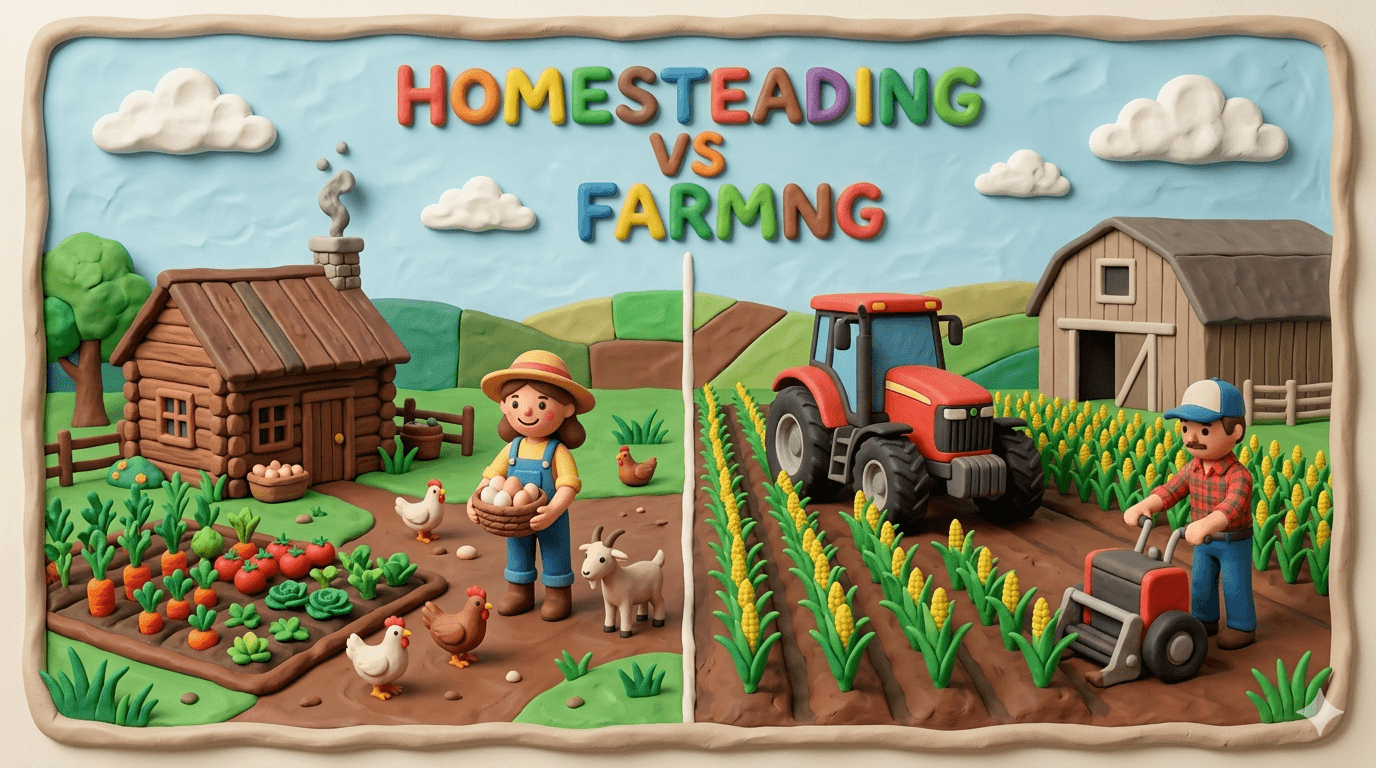
Most people use the words homesteading and farming like they mean the same thing. They do not. They overlap, they share tools, and they share a love of land and animals. But they are built around two very different goals.
A homestead is a way of life. A farm is a business. That single sentence is the cleanest answer you will find anywhere. The rest of this guide unpacks what that actually means in practice, and how to figure out which path fits the life you want.
Whether you are dreaming about a few raised beds in the backyard or a hundred acres of pasture, you owe yourself an honest look at the difference before you buy a single chicken. The wrong label will cost you time, money, and a lot of energy. The right one will save you all three.
Homesteading vs Farming at a Glance
Here is the short version, side by side. Read this once, then we will dig into each row in detail.
| Factor | Homesteading | Farming |
|---|---|---|
| Primary goal | Feed and supply your own household | Produce food or fiber to sell at a profit |
| Income model | Optional side income, usually small | Income is the whole point |
| Typical scale | A windowsill to about 10 acres | 10 acres to thousands of acres |
| Crop and animal mix | Diverse, a little of everything | Specialized, one or two main products |
| Time commitment | Fits around a regular job | Often a full time job by itself |
| Equipment | Hand tools, small electric, occasional small tractor | Tractors, implements, sometimes commercial gear |
| Tax treatment | Personal hobby in most cases | Business with Schedule F filing and possible ag exemptions |
| Lifestyle vibe | Slow, seasonal, family centered | Operational, commercial, market driven |
That table will make a lot more sense once you understand what each side is trying to do. Let us start with definitions, because the modern picture of both has shifted in the last decade.
What Homesteading Really Means
Homesteading is the practice of producing more of what your household needs with your own hands. That is the whole definition. It is not about acreage. It is not about going off grid. It is not about wearing flannel. It is about shifting your day to day life toward making, growing, raising, and preserving instead of buying.
A homestead can sit on a quarter acre suburban lot. It can sit on a balcony in Brooklyn. It can sit on 40 acres in rural Kentucky. Size does not define it. Intent does.
If you grow tomatoes in raised beds, can salsa in August, and keep four hens for eggs, you are homesteading. If you bake your own sourdough every weekend and ferment a jar of sauerkraut every month, you are homesteading. If you tap the maple in your front yard and reduce sap into syrup on the kitchen stove, you are absolutely homesteading.
The goal is not to opt out of the modern economy. It is to lean less on it. Most homesteaders still hold regular jobs. Many live in cities or suburbs. Almost none are fully self sufficient, and almost none want to be. Self sufficiency is a direction, not a finish line.
For a deeper look at how to begin, our homesteading for beginners guide walks through the early decisions that matter most.
What Farming Really Means
Farming is the practice of producing food, fiber, or other agricultural goods to sell. That is the cleanest line you can draw. The output is meant for the market, not the kitchen.
The USDA actually has a formal definition. Any operation that produces and sells (or normally would have sold) at least $1,000 of agricultural products in a year counts as a farm. That threshold is low on purpose. It captures everything from a backyard egg seller to a commercial dairy.
But selling a few dozen eggs at the farm gate does not make you a farmer in any practical sense. Real farming means the operation is built around revenue. You plant what sells. You raise what pays. You measure success in dollars per acre, pounds per bird, or yield per row.
Farms also tend to specialize. A dairy farm runs cows. A row crop farm runs corn and soybeans. A market garden runs vegetables for restaurants and farmers markets. Specialization is what makes a farm efficient enough to compete on price and supply on a schedule.
Farming is a real business. That means business plans, market research, insurance, and often loans. It also means the tax code treats you differently, which we will get to in a minute.
The Seven Core Differences
Now let us slow down and look at where homesteading and farming actually diverge. These seven differences are the ones that matter when you are deciding which path to walk.
Goal: Lifestyle vs Livelihood
This is the single biggest split. Homesteading is a lifestyle. Farming is a livelihood.
A homesteader measures success in pantry jars, garden harvests, and skills learned. A farmer measures success in revenue, margins, and reliable customers. Both can love their land and their animals deeply. But when a hard decision comes, the homesteader asks what fits our family. The farmer asks what pays the mortgage.
This shapes everything else. It shapes what you plant, how much you plant, how you spend your weekends, and how you feel when something goes wrong.
Scale: Backyard to Acreage
Most homesteads sit on less land than people imagine. A serious backyard homestead can run on a quarter acre. A small rural homestead usually lives on 1 to 5 acres. A larger homestead might stretch to 10 acres or so.
Farms generally start where homesteads end. A small market vegetable farm might run on 2 to 5 acres of intensive production, but the average American farm is around 450 acres. Commercial row crop farms run thousands.
Scale is not a moral category. Bigger is not better. But it changes the math on equipment, labor, and what kind of help you need.
Income: Optional vs Essential
A homesteader may sell extra eggs to neighbors, trade jam for honey at the swap, or run a small Etsy shop for handmade soap. That income is real, but it is gravy. The household does not depend on it.
A farmer needs the income. The whole operation is structured to produce a sellable surplus. That changes the planting plan, the animal choices, the storage system, and the calendar. A farm without revenue is just an expensive hobby in the wrong tax bracket.
If you want to keep things relaxed and personal, stay on the homestead side of the line. If you are excited by the idea of running a small business outdoors, farming may be a better fit.
Crop and Animal Mix: Diverse vs Specialized
Walk onto a healthy homestead and you will see a little bit of everything. A vegetable garden. Some berry bushes. A few fruit trees. A small flock of hens. Maybe a beehive. Maybe a couple of meat rabbits. Maybe two dairy goats. The point is variety. Diversity feeds the household and spreads the risk if one project flops.
Walk onto a farm and you will usually see focus. Apples and only apples. Beef cattle and only beef cattle. Hydroponic lettuce and only hydroponic lettuce. Specialization is what allows the operation to compete on volume, quality, and price.
You can run a diversified small farm, and many wonderful ones exist. But every successful farmer has thought hard about which products carry the operation and which ones are side gigs.
Equipment and Infrastructure
Homesteaders mostly use hand tools, small electric tools, and occasionally a small tractor or walk behind tiller. A wheelbarrow, a good shovel, a sharp pair of pruners, and a chest freezer will get you remarkably far.
Farms run on bigger gear. Tractors with implements. Bale wagons. Refrigerated trucks for market garden produce. Commercial chicken pluckers. Walk in coolers. The capital costs add up fast, and equipment loans are often part of the picture.
This is one place the budget gap shows up most clearly. A homestead can be built for a few hundred to a few thousand dollars. A farm often takes tens or hundreds of thousands to get started, even at small scale.
Taxes, Zoning, and Legal Status
This is the part most people get wrong, and the part with the most expensive consequences if you guess.
A homestead is treated as personal use in most states. You do not file a Schedule F. You do not collect sales tax on what you eat yourself. You do not need a business license. You may face HOA rules, zoning rules on livestock counts, and limits on what you can sell from the property, but the basic activity is treated as a private hobby.
A farm is treated as a business. You file Schedule F (or Schedule C in some cases). You may qualify for an agricultural exemption that lowers your property taxes, sometimes substantially. You need to track income and expenses. You may need licenses, food safety inspections, and liability insurance depending on what you sell.
Rules vary wildly between states and even between counties. Our homesteading laws and zoning guide covers the national overview, and our state by state hub breaks down the local details for all 50 states.
Day to Day Rhythm
A homesteader works in seasons. Plant in spring. Tend in summer. Harvest and preserve in fall. Rest, plan, and read in winter. The rhythm is slow, repetitive, and shaped by weather.
A farmer works in seasons too, but layered on top is a market schedule. Wholesale orders. Restaurant accounts. Saturday market loads. Delivery routes. Payroll if there are employees. The pace is faster and the calendar is fuller.
Neither is harder than the other in absolute terms. But the homesteader can take a Saturday off when the kids have a soccer game. The farmer with a market stand cannot.
Can You Do Both?
Yes. In fact, many people do, and the path from homestead to small farm is one of the most natural transitions in this whole world.
Plenty of homesteaders sell a little of what they grow. A dozen eggs to a neighbor. A jar of honey at the swap meet. A few pounds of garlic to the local restaurant. Cottage food laws in most states allow you to sell home produced jams, baked goods, and certain other items without a commercial kitchen, up to a yearly cap.
That is a homestead with a tiny side income. It is not a farm yet. The household is still the priority.
Some folks scale further. They open a U-pick patch on weekends. They sell broiler chickens by the cooler. They run a herd share for raw milk. They grow into farmers slowly, one product at a time, while the homestead foundation stays in place.
Other folks stay homesteaders forever and never sell a thing. That is a perfectly valid life. The point is that the line between the two is a slider, not a switch. You can move along it as your goals change.
Tip
If you are not sure where to start, start as a homesteader. The skills, the infrastructure, and the seasonal rhythm transfer directly to farming if you ever want to scale. Going the other way (starting as a farmer and trying to dial back to a quiet homestead later) is much harder, because by then you usually have debt, contracts, and customers depending on you.
How to Decide Which Path Fits You
Sit with these questions before you commit to either label. Write the answers down. Be honest. The answers will steer you better than any article ever could.
- What is your primary motivation? Is it lower grocery bills and a more hands on life, or is it income from the land?
- How much time per week can you realistically commit during the growing season? A homestead can run on 5 to 10 hours a week. A small farm rarely runs on less than 30.
- Do you want customers? Farms have customers. Homesteads do not. Some people love that part. Others find it draining.
- How much capital can you put in up front? A modest homestead starts under a thousand dollars. A small farm usually needs at least 20 to 50 thousand to launch even at small scale.
- Are you comfortable with the paperwork side of running a business? Schedule F filings, sales tax tracking, food safety inspections, and insurance are part of the farming life.
- What is your appetite for risk? Farming income depends on weather, markets, and timing. Homesteading has setbacks too, but they hit your dinner table, not your mortgage.
- Do you want flexibility? Homesteaders can take a weekend off. Farmers with livestock or a market stand often cannot.
- What does your family actually want? This one matters more than people admit. A spouse who is not on board with farming will resent the schedule. A spouse who loves the homesteading lifestyle will protect it for decades.
If most of your answers point toward lifestyle, flexibility, and small scale, you are a homesteader at heart. If they point toward income, scale, and running an operation, you are leaning toward farming. Our livestock quiz is a fun way to start narrowing what kind of animals fit either path.
If You Choose Homesteading, Start Here
If the homesteading path feels right, here is the order most experienced homesteaders recommend for your first year or two.
- Plant a garden. Even one bed. The garden teaches you about your soil, climate, and pace. Our vegetable gardening for beginners guide covers what to grow and how.
- Add chickens once your garden rhythm is steady. A small flock of four to six hens is the easiest first livestock for almost everyone. Our chicken hub walks through coop design, feeding, and breed selection.
- Learn one preservation method per season. Water bath canning is the friendliest place to start. Our canning for beginners guide gives you everything you need.
- Plan your budget honestly. A first year homestead usually runs between $500 and $5,000 depending on scale. Our homesteading on a budget guide shows how to keep it lean.
- Pick a step by step starter plan. Our how to start homesteading guide lays out the early decisions in order so you do not feel overwhelmed.
You do not need to do all of this at once. Pick one. Get good at it. Add the next.
If You Choose Farming, Start Here
If you are pointed toward farming, the early steps look very different. The work is more about planning and paperwork in the first year than it is about planting.
- Write a real business plan. Define what you will sell, who will buy it, and at what price. The USDA Farm Service Agency has free templates online and local advisors who will read your draft for free.
- Research your market before you plant or buy animals. Visit the farmers markets you want to sell at. Talk to chefs at the restaurants you want to supply. Find out what prices the wholesalers actually pay. Demand is not the same everywhere.
- Register the business and apply for an agricultural exemption. Both happen at the state and county level. The ag exemption can drop your property taxes substantially, but it usually requires proof of agricultural use and a minimum amount of acreage or income.
- Get insured. Liability insurance for farm operations is non negotiable, especially if customers will set foot on your land or eat what you produce.
- Start small and scale on demand. A common rookie mistake is planting five acres of vegetables before you have buyers. Plant half an acre. Sell every pound. Then expand.
A small farm is a real business. Treat the first year as a research and planning year, not a planting year, and you will save yourself from the most expensive mistakes.
Warning
Do not register as a farm just to get the tax break. Many counties require you to prove ongoing agricultural use to keep an ag exemption, and they can claw back the savings (sometimes for several years) if you stop qualifying. The penalty for losing an exemption can run into the thousands. Only file as a farm when you are genuinely operating as one.
A Quick Word on Taxes and Legal Status
This section is a friendly overview, not legal or tax advice. Your state, county, and personal situation matter a lot, so check with a local accountant before you make moves with real dollars at stake.
A few terms worth knowing:
Hobby farm. This is not a formal IRS category, but it is shorthand for a small operation that produces some agricultural income but does not really aim to turn a profit. The IRS may treat hobby income as taxable but not allow you to deduct losses against other income. If you intend to make money from your land, you want to be a farm, not a hobby.
Schedule F. This is the IRS form farmers use to report farm income and expenses. If you file a Schedule F and show genuine profit motive, you can deduct legitimate farm expenses (feed, seed, fuel, depreciation on equipment) against farm income, and in many cases against other income too.
Agricultural exemption. A state and local property tax break for land used in agricultural production. Rules vary by state. Some require a minimum acreage. Some require a minimum income. Some require a written agricultural plan. Texas, Florida, and California each handle this very differently, so check your state.
Cottage food law. A state law that allows you to sell certain home produced foods (typically baked goods, jams, jellies, dry mixes, some pickles) without a commercial kitchen. There is usually a yearly sales cap and a labeling requirement. Cottage food laws are how most homesteaders test the waters of selling without becoming a full farm.
Right to farm laws. State laws that protect agricultural operations from nuisance complaints brought by neighbors. These mostly apply to working farms, not casual homesteads.
For a closer look at the legal landscape, our homesteading laws and zoning guide covers the topic in depth.
Final Take
Homesteading and farming are cousins, not twins. They share land, animals, and skills, but they answer two different questions.
Homesteading asks: how can my household live more of its own life? Farming asks: how can this land support my household financially?
Both are honorable. Both are deeply rewarding. Both will teach you more about yourself than any office job ever did. But they are not interchangeable, and treating one like the other is the fastest way to burn out.
If you are starting out, lean toward homesteading. Build the skills. Learn the seasons. Get your hands dirty and your pantry full. If a farming dream lives inside that and grows louder over the years, you will already have the foundation to scale up.
Pick the path that fits the life you actually want, not the one in the highlight reels. Then start small, this season, with one project. The land does not care which label you use. It only cares that you show up.
Frequently Asked Questions
Not by default. A homestead is a household focused operation, while a farm is a business that sells agricultural products. The USDA technically defines a farm as any place that produces and sells at least $1,000 of agricultural goods per year, so a homestead can become a farm in legal terms once it crosses that threshold. But many homesteads stay private and never sell a thing.
Homesteading is a lifestyle aimed at producing more of what your household needs. Farming is a business aimed at producing agricultural goods to sell at a profit. Homesteads are usually smaller, more diverse, and run as a side activity. Farms are usually larger, more specialized, and structured around revenue.
Yes, in modest ways. Many homesteaders sell extra eggs, jam, honey, or handmade goods. Cottage food laws in most states allow small home based food sales without a commercial kitchen. The income is real but usually small. Once income becomes the primary goal, the homestead is functionally becoming a farm.
It depends entirely on what you grow. A market vegetable farm can run on 2 to 5 acres of intensive production. A pastured beef operation usually needs at least 20 to 40 acres for a small herd. Row crop farming typically needs hundreds of acres to be viable. The USDA $1,000 sales threshold for farm status has nothing to do with acreage.
Generally no, not on food you grow and consume yourself. There is no federal tax on personal use produce, eggs, or meat. If you sell what you grow, you owe income tax on the sales, and possibly sales tax depending on the state and product. Once sales become regular and profit driven, the IRS expects you to file as a farm business.
The IRS treats an operation as a farm when it produces agricultural products with a real intent to make a profit. You file a Schedule F to report farm income and expenses. The $1,000 USDA threshold is a separate definition for census and statistical purposes. State agricultural exemptions for property tax usually have their own rules, often requiring minimum acreage and proof of ongoing agricultural use.
Yes, and many do. The transition is gradual. Most homesteaders who become farmers start by selling small surplus, then a few products, then enough to need a business license, and eventually file as a farm with the IRS. The infrastructure and skills built on the homestead transfer directly. Going the other way is much harder, because farms have customers, contracts, and often debt that pull you forward whether you are ready or not.
Yes, dramatically. A meaningful first year homestead can be built for $500 to $5,000 depending on scale. A small farm usually requires at least $20,000 to $50,000 to launch even at modest scale, and commercial farms run into the hundreds of thousands or millions. Homesteading scales to whatever budget you have. Farming requires the capital to compete on volume and quality from day one.

Cole
Founder & Lead Researcher
Cole is the founder of Plan Your Homestead. He works in clinical research and brings a research-first lens to every guide on the site, drawing on a long family line of farmers for grounded, practical perspective.
More in Guides
More articles coming soon. Check back for new guides content.