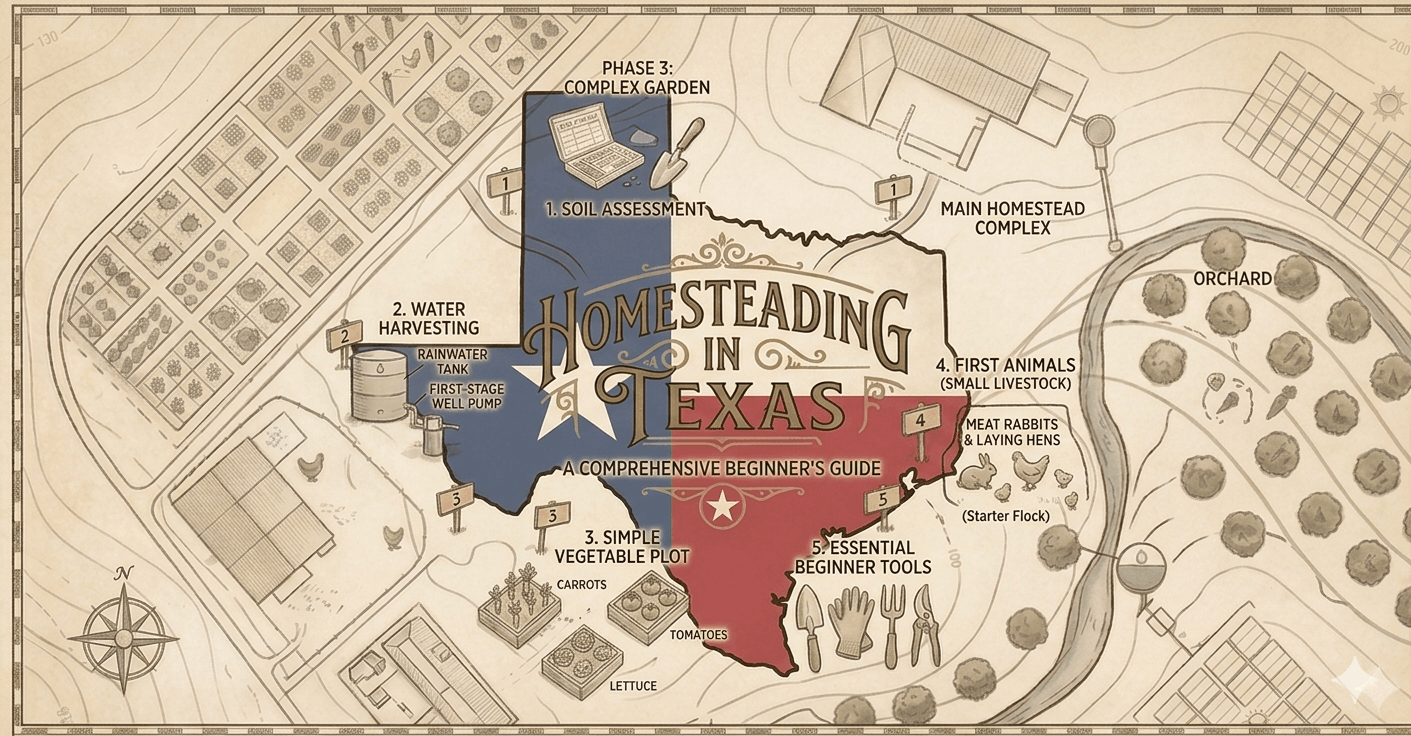
Texas is the state that comes up in nearly every homesteading conversation, and the reasons are hard to argue with. Massive tracts of affordable rural land, no state income tax, a growing season that can stretch past nine months in the south, strong agricultural protections, and a deeply independent culture that respects your right to use your land as you see fit. It is the largest state in the contiguous U.S., and that size means you can find almost any climate, terrain, and price point within its borders.
This guide is written for anyone seriously considering a move to Texas for homesteading. Whether you are comparing it against other states in our state by state homesteading hub or you have already set your sights on the Lone Star State, this article covers what you need to know before buying land and breaking ground.
If you are brand new to homesteading and want to understand the fundamentals first, start with our complete beginner's guide to homesteading. This Texas guide assumes you already know what homesteading is and are now focused on where to do it.
I come from a family of farmers, and I have spent years applying my clinical research background to studying what makes certain states better than others for homesteading. Texas ranks at the top of that analysis for several compelling reasons. Here is why.
Why Texas Is One of the Best States for Homesteading
Texas offers a combination of advantages that few states can match. The sheer size of the state means more options, and the political and cultural landscape heavily favors agricultural self sufficiency. These are the six factors that matter most for homesteaders evaluating a relocation.
Right to Farm Act. Texas law (Agriculture Code Chapter 251) protects agricultural operations from nuisance lawsuits. If you are conducting legitimate farming or ranching on agricultural land, neighbors cannot sue you over the normal sights, sounds, and smells of your operation. This is one of the broadest right to farm protections in the country.
No state income tax. Texas does not tax individual income at the state level. For homesteaders who supplement farm income with off farm work, sell products at farmers markets, or run a cottage food business, this is a significant financial advantage that adds up year after year.
Affordable rural land. The statewide average land price sits around $4,000 per acre, but many rural counties in West Texas, the Rolling Plains, and East Texas offer parcels for $1,500 to $3,500 per acre. That is substantially cheaper than most states with comparable growing seasons.
Exceptionally long growing season. Texas spans USDA zones 6b through 10a. In South Texas, the growing season exceeds 300 days. Even in the Panhandle, you get a solid six months. For food production, this range is unmatched by any state east of California.
Agricultural tax exemptions. Texas offers one of the most valuable agricultural appraisal programs in the country. Qualifying land is taxed on its productive agricultural value rather than market value, which can reduce property taxes by 80% to 95%. This alone saves thousands of dollars annually.
Independent culture. Texas has a long history of respecting property rights and individual freedom. Rural communities are deeply rooted in ranching and farming traditions. You will find a strong network of feed stores, livestock auctions, farmers markets, and neighbors who understand the homesteading life.
Note
Texas has no state income tax on any form of personal income. Combined with the agricultural property tax exemption, which can reduce land taxes by 80% to 95%, the total tax burden for homesteaders in Texas is among the lowest in the nation.
Land Prices and Where to Buy in Texas
Land is the foundation of any homestead, and Texas delivers more options per dollar than almost any other state. The key is understanding how dramatically prices vary across the state's 254 counties.
Statewide Land Price Overview
The statewide average hovers around $4,000 per acre for unimproved rural land. For context, here is how Texas compares to its immediate neighbors:
- Oklahoma: approximately $3,200 per acre
- Arkansas: approximately $3,800 per acre
- Louisiana: approximately $4,200 per acre
- New Mexico: approximately $1,500 per acre
- Kansas: approximately $2,700 per acre
Texas sits in the middle of its neighbors, but the critical factor is regional variation within the state. Land near Austin, Dallas, San Antonio, or Houston can exceed $15,000 to $40,000 per acre. Land in rural counties two hours or more from a metro center drops to a fraction of that.
Best Regions for Homestead Land
The following table breaks down Texas's major regions for homesteaders. Prices reflect raw or lightly improved rural land, not developed residential lots.
| Region | Typical Price Per Acre | USDA Zones | Terrain | Notes |
|---|---|---|---|---|
| East Texas Piney Woods (Nacogdoches, Cherokee, Anderson, Houston) | $2,500 to $5,000 | 8a, 8b | Rolling hills, pine and hardwood forest | Best rainfall in the state (45-55 inches). Affordable with timber value. |
| Rolling Plains (Haskell, Stonewall, Knox, Throckmorton) | $1,500 to $3,000 | 7a, 7b | Gently rolling grassland | Some of the cheapest land in the state. Low population density. |
| Central Texas Hill Country (Mason, Llano, Gillespie, Kimble) | $4,000 to $8,000 | 8a, 8b | Rocky limestone hills | Beautiful terrain but rocky soil. Spring-fed creeks are common. |
| South Texas Brush Country (Webb, Duval, Jim Hogg, Zapata) | $1,500 to $3,500 | 9a, 9b | Flat to rolling brush | Longest growing season. Very hot summers. Water can be scarce. |
| Blackland Prairie (Navarro, Limestone, Falls, Milam) | $3,500 to $6,000 | 8a, 8b | Flat to gently rolling | Some of the best agricultural soil in Texas. Rich black clay. |
| Near Austin, Dallas, Houston, or San Antonio | $10,000 to $40,000+ | Varies | Varies | Generally overpriced for homesteading. Consider 60+ minutes from metro centers. |
What to Look for When Buying Texas Land
Texas is a massive state with enormous variation in conditions. Before making an offer on any parcel, evaluate the following:
- Water availability. This is the single most important factor in Texas. Does the property have a well, spring, creek, or stock tank? What is the water table depth? In West Texas, wells may need to go 300 to 600 feet deep. In East Texas, 100 to 200 feet is common.
- Road access. Verify the property has legal access via a public road or a deeded easement. Many large Texas parcels are landlocked behind neighboring ranches.
- Soil quality. Request a soil survey through the USDA Web Soil Survey or schedule a test through Texas A&M AgriLife Extension. The Blackland Prairie has phenomenal soil. West Texas caliche and Hill Country limestone require significantly more amendment.
- Mineral rights. In Texas, surface rights and mineral rights are often severed. Confirm whether mineral rights convey with the sale. If they do not, a third party may have the right to drill on your property.
- Fencing condition. Texas is historically a fence out state in many counties, meaning you are responsible for fencing livestock out of your property, not your neighbor's responsibility to fence theirs in. Verify the stock law status in your county.
- County building codes. Many rural Texas counties have no building codes at all. Others have adopted codes selectively. This is covered in detail in the laws section below.
- Broadband and utilities. If you work remotely, verify internet service before purchasing. Rural Texas coverage is expanding through state broadband initiatives, but gaps remain in many counties.
- Flood zones. Parts of Central and East Texas are prone to flash flooding. Check FEMA flood maps before buying land near creeks or rivers.
For a quick snapshot of Texas's key stats, visit our Texas state overview page.
Texas Homesteading Laws and Regulations
Understanding the legal landscape is essential before committing to a state. Texas is broadly one of the most favorable states in the country for homesteaders, but the details vary by county. State laws set the baseline, and county governments add their own layers.
Right to Farm Act
Texas's Right to Farm Act (Agriculture Code Chapter 251) protects agricultural operations from nuisance lawsuits. The law shields farming and ranching activities that have been in operation for at least one year from being declared a nuisance by neighboring property owners or local governments.
The protection covers noise from equipment, odors from livestock operations, dust from field work, and other normal consequences of agricultural production. The law does not protect operations that are negligent, conducted in violation of applicable laws, or that contaminate water supplies.
Texas also has strong eminent domain protections for agricultural land. Recent legislative changes have strengthened landowner rights in pipeline and utility condemnation proceedings, which is relevant for rural property owners.
Raw Milk Laws
Texas permits the sale of raw milk directly from the farm to the consumer. This is a farm gate sales model. The producer must hold a Grade A Raw for Retail Milk Permit from the Texas Department of State Health Services (DSHS). All sales must take place at the farm.
Delivery to customers, retail store sales, and online ordering for shipment are not permitted. The producer's facility must meet Grade A standards, and regular testing is required. Goat milk and cow milk are both covered under this permit.
Texas is more permissive than many neighboring states. Louisiana, for example, prohibits all raw milk sales. If you plan to keep dairy goats or a family milk cow and sell surplus, Texas law allows it with the proper permit.
Cottage Food Laws
The Texas Cottage Food Law (Health and Safety Code Chapter 437) allows homesteaders to sell homemade food products directly to consumers without a commercial kitchen license or food handler's permit. Covered products include baked goods, candy, coated and uncoated nuts, dried fruits, honey, jams, jellies, preserves, fruit butters, dried herbs, and other non potentially hazardous foods.
There is no annual sales cap for Texas cottage food operations, which makes Texas one of the most permissive cottage food states in the country. Sales must be direct to the consumer and can occur at farmers markets, farm stands, fairs, or from your home. You cannot sell cottage food through retail stores, online for shipment, or through third party delivery services.
Each product must be labeled with the producer's name, address, and the statement "This food is made in a home kitchen and is not inspected by the Department of State Health Services or a local health department."
Zoning and Building Codes
Texas does not have a statewide residential building code. Each county decides whether to adopt building codes, and the variation across 254 counties is enormous.
The majority of rural Texas counties have no building codes whatsoever. In these counties, you can build a home, barn, workshop, or any other structure without pulling a permit or scheduling an inspection. This is one of the most significant advantages Texas offers to homesteaders who want to build unconventional structures like earthships, shipping container homes, tiny houses, or off grid cabins.
Some counties have adopted limited codes covering only electrical, plumbing, or septic systems. A smaller number of counties near metro areas have adopted the International Building Code and require permits and inspections.
Cities within Texas enforce their own building codes, and these tend to be comprehensive. If you are buying within city limits or within a city's extraterritorial jurisdiction (ETJ), expect permit requirements.
Warning
Building codes in Texas vary dramatically across 254 counties. Many rural counties have zero building codes, while cities and their extraterritorial jurisdictions enforce the International Building Code. Always contact the county courthouse and any nearby city planning department before purchasing land if you plan to build an unconventional structure.
Water Rights
Texas follows a dual doctrine for water rights, combining elements of both riparian and prior appropriation systems. Surface water is owned by the state and allocated through permits issued by the Texas Commission on Environmental Quality (TCEQ). Landowners along a waterway have limited riparian rights for domestic and livestock use, but any significant diversion or impoundment of surface water requires a state permit.
Groundwater in Texas follows the rule of capture, which means landowners own the water beneath their property and can pump it without a state permit in most areas. However, many regions now have Groundwater Conservation Districts (GCDs) that regulate pumping through local permits. Check whether your target county has a GCD and what their rules require.
Rainwater harvesting is legal and actively encouraged in Texas. State law (Tax Code Section 151.355) exempts rainwater harvesting equipment from sales tax. Some municipalities offer rebates for rainwater collection systems. There are no limits on how much you can collect.
Well drilling for domestic and livestock use generally does not require a state permit, but you must comply with any local GCD rules. Wells must be drilled by a licensed driller and meet Texas Department of Licensing and Regulation construction standards.
Agricultural Tax Exemption (1-d-1 Appraisal)
Texas's agricultural appraisal program, commonly called the ag exemption (technically a special valuation under Tax Code Chapter 23, Subchapter D), is one of the most powerful financial tools available to homesteaders. It allows qualifying agricultural land to be taxed based on its productive capacity rather than its market value.
The savings are dramatic. A property with a market value of $200,000 might have an agricultural use value of $15,000 to $25,000. Your property taxes are calculated on the lower use value, which typically reduces the tax bill by 80% to 95%.
To qualify, the land must have been used for agriculture for five of the preceding seven years (or meet the wildlife management use criteria). There is no strict minimum acreage set by the state, but county appraisal districts typically require 10 to 20 acres depending on the agricultural use. Common qualifying uses include cattle grazing, hay production, beekeeping (often qualifying on as few as 5 to 20 acres), crop production, and timber.
Tip
The Texas ag exemption is enormously valuable. A 20 acre property valued at $200,000 might have an annual property tax bill of $300 to $600 under agricultural appraisal, compared to $4,000 to $5,000 at full market value. Beekeeping is one of the easiest ways to qualify on smaller acreage. Many counties accept 5 to 20 acres with beehives as qualifying agricultural use. Apply through your county appraisal district office.
One important caveat: if your land is removed from agricultural appraisal (for example, if you convert it to non agricultural use), you will owe rollback taxes covering the difference between market value and agricultural value for the previous five years, plus 7% annual interest.
Livestock Regulations
Texas is one of the most permissive states in the country for keeping livestock. No state permit is required for chickens, goats, pigs, sheep, or cattle on agricultural property. Cattle and other livestock sold across state lines need a health certificate from a licensed veterinarian, but this is standard nationwide.
Texas has a complex fence law history. The state was historically a fence out or open range state. Many counties have since adopted stock laws that require livestock owners to contain their animals. The status varies county by county. In stock law counties, if your livestock escape and cause damage, you are liable. In open range counties, it is the crop grower's responsibility to fence animals out. Verify your county's status before purchasing land.
Texas law (Agriculture Code Section 143.102) allows a property owner to kill a dog caught in the act of attacking or about to attack livestock, domestic animals, or fowl. This is similar to protections in many other agricultural states.
Municipal livestock ordinances apply within city limits. Many Texas cities allow small backyard flocks of hens but may prohibit roosters or limit flock size. Always check city ordinances and any HOA restrictions if buying within incorporated areas.
Climate, Growing Zones, and Soil
Texas spans a wider range of climates than any other state in the contiguous U.S. From the humid piney woods of the east to the arid deserts of the west, and from the cold winters of the Panhandle to the subtropical warmth of the Rio Grande Valley, your experience as a homesteader will vary enormously depending on where in Texas you settle.
USDA Hardiness Zones Across Texas
Texas spans USDA zones 6b through 10a, which means you can grow everything from cold hardy pecans and apples in the Panhandle to citrus and tropical fruits in the Rio Grande Valley.
| Region | USDA Zones | Average Last Frost | Average First Frost | Growing Season |
|---|---|---|---|---|
| Texas Panhandle | 6b, 7a | April 15 to April 25 | October 15 to 25 | 5.5 to 6 months |
| North Texas / DFW Region | 7b, 8a | March 15 to March 25 | November 10 to 20 | 7.5 to 8 months |
| East Texas Piney Woods | 8a, 8b | March 10 to March 20 | November 15 to 25 | 8 to 8.5 months |
| Central Texas / Hill Country | 8a, 8b | March 5 to March 15 | November 20 to 30 | 8.5 to 9 months |
| South Texas / Rio Grande Valley | 9a, 9b, 10a | February 1 to February 15 | December 15 to 30 | 10 to 11 months |
These are averages. Microclimates created by elevation, proximity to the Gulf Coast, and urban heat islands can shift your actual frost dates by one to three weeks in either direction. The best approach is to track conditions on your specific property for the first year before making major planting commitments.
Planting Calendar Tool
Enter your zip code to get a personalized planting schedule based on your USDA zone.
Try it free →Rainfall and Water Availability
Rainfall in Texas varies more dramatically than in almost any other state. East Texas receives 45 to 55 inches annually, which is comparable to Tennessee or the Carolinas. Central Texas gets 30 to 35 inches. West Texas and the Trans Pecos receive as little as 8 to 12 inches, making irrigation essential for any crop production.
For homesteaders in East and Central Texas, supplemental irrigation is recommended for high value crops during the hot summer months but is not strictly necessary for all gardening. A drip irrigation system is a wise investment regardless of region.
In West Texas, water is the defining constraint. Without a reliable well or surface water source, productive homesteading is extremely difficult. Factor water infrastructure costs into your land budget if you are considering anything west of I-35.
Texas has an abundance of surface water in the eastern half of the state. Creeks, rivers, and stock tanks are common on rural properties. The western half relies heavily on groundwater from the Ogallala Aquifer and other formations, some of which are declining.
Soil Types by Region
Soil quality varies enormously across Texas, and understanding your local soil is one of the most important steps in planning your homestead.
Blackland Prairie (a band running from Dallas south through San Antonio) has deep, rich black clay soil with a pH of 7.0 to 8.5. This is some of the most productive agricultural soil in the United States. It is excellent for row crops, pasture, and hay. The clay can be challenging to work when wet but is extraordinarily fertile.
East Texas has primarily sandy loam and clay loam soils with a pH of 5.0 to 6.5. These soils are naturally acidic, which is excellent for blueberries, sweet potatoes, and other acid loving crops. The sandy texture provides good drainage but may need more frequent fertilization.
Hill Country and Central Texas sit on limestone bedrock with thin, rocky soils. The pH runs 7.5 to 8.5, which is quite alkaline. Raised beds with imported soil mix are common for vegetable production. Native and adapted plants like prickly pear, pecans, and figs do well in native soil.
South Texas features a mix of sandy loam and clay soils. The pH is typically 7.0 to 8.0. With irrigation, this region can produce citrus, vegetables, and tropical crops year round.
West Texas soils are predominantly caliche and desert sand with high pH (7.5 to 8.5) and low organic matter. Significant amendment is required for productive gardening.
Regardless of where you buy, get a soil test before planting. Texas A&M AgriLife Extension offers soil testing through county offices for $12 to $15. The results include pH, nutrient levels, and specific amendment recommendations for your intended crops.
What to Grow on a Texas Homestead
Texas's enormous range of climates and growing zones means the crop list is exceptionally long. What you can grow depends heavily on where in the state you are. Here is what performs best across the major regions.
Warm Season Crops
The warm season is the powerhouse of Texas food production. These crops go in after your last frost date and produce through the long, hot summer.
Tomatoes are the centerpiece of Texas gardens. The key is timing. In most of Texas, tomatoes produce best in spring (April through June) and again in fall (September through November). Midsummer heat above 95 degrees causes blossom drop, so the harvest window is different than in northern states. Heat tolerant varieties like Celebrity, Heatmaster, and Solar Fire perform best.
Peppers of all types thrive in Texas heat. Sweet bells, jalapenos, serranos, habaneros, and anchos all produce abundantly. Texas is the birthplace of serious chile culture, and peppers are arguably the most reliable warm season crop across the entire state.
Okra is tailor made for Texas summers. It loves heat and produces prolifically from June through October in most regions. Clemson Spineless and Burgundy are popular varieties.
Southern peas (black eyed peas, cream peas, purple hull peas) are a Texas staple crop. They fix nitrogen in the soil, tolerate heat and drought, and produce a high protein food with minimal inputs. Plant after the soil warms in May.
Sweet potatoes perform beautifully across East, Central, and South Texas. They need loose, well drained soil and at least 90 to 120 frost free days. Slips go in the ground in late April or May with harvest in September or October.
Melons of all types excel in Texas. Watermelons, cantaloupes, and honeydews love the long, hot days. The sandy soils of East Texas are particularly well suited for melon production.
Corn, squash, cucumbers, eggplant, and green beans all produce reliably. Succession planting every two to three weeks extends the harvest window.
Cool Season Crops
Texas's mild winters, particularly in zones 8a and warmer, support a robust fall and winter garden that northern homesteaders can only dream of.
Lettuce, spinach, kale, and Swiss chard can be planted in September for fall harvest and again in February for spring. In South Texas, these crops produce through the entire winter without protection. In Central and North Texas, simple row covers extend production into January.
Broccoli, cabbage, and cauliflower are excellent fall and winter crops in Texas. Start transplants indoors in August and set them out in September for harvest from November through January.
Carrots, radishes, turnips, and beets perform best as fall crops. September plantings produce through the winter in most of the state.
Garlic is planted in October and harvested the following May or June. Softneck varieties are best for zones 8a and warmer. Hardneck varieties work in the Panhandle (zones 6b and 7a). Texas growers can also succeed with elephant garlic and shallots.
Onions are a signature Texas crop. The famous 1015 sweet onion was developed by Texas A&M specifically for Texas growing conditions. Plant short day onion varieties in October through November for a spring harvest.
Fruit Trees and Perennials
Perennial fruit plantings are a long term investment that pays dividends for decades. Texas supports an impressive range depending on your region.
Pecans are the state tree and the most iconic Texas nut crop. They grow well across the southern two thirds of the state in zones 7b through 9b. Mature trees can produce 50 to 100 pounds of nuts annually. Desirable, Pawnee, and Caddo are popular improved varieties.
Peaches do exceptionally well in the Hill Country and East Texas. The Fredericksburg area is famous for peach production. Harvests run from May through August depending on variety. Elberta, Redhaven, and Loring are reliable producers.
Figs thrive across Central and South Texas (zones 8a through 10a). They are low maintenance, heat tolerant, and incredibly productive. Celeste, Brown Turkey, and Texas Everbearing are the most reliable varieties. Figs can produce two crops per year in warm zones.
Citrus is viable in the Rio Grande Valley (zones 9b and 10a) and along the Gulf Coast with winter protection. Ruby Red grapefruit, Meyer lemons, satsuma mandarins, and kumquats are all commercially grown in South Texas.
Blackberries are prolific across East and Central Texas. Thornless varieties like Natchez and Ouachita simplify harvesting and produce heavily.
Muscadine grapes grow exceptionally well in East Texas. They are disease resistant, heat tolerant, and can produce 30 to 50 pounds per vine at maturity. Carlos and Noble are reliable varieties for juice, wine, and fresh eating.
Pomegranates are well adapted to Central and South Texas. Wonderful is the standard variety. They tolerate heat, drought, and alkaline soil.
Jujubes (Chinese dates) are an underutilized fruit tree that is perfectly suited to Texas conditions. They tolerate extreme heat, drought, alkaline soil, and poor conditions. Li and Lang are popular varieties that produce sweet, date like fruit.
Herbs and Medicinal Plants
Texas's diverse climate supports robust herb production. Basil, rosemary, thyme, oregano, sage, and mint all grow well. Rosemary is reliably perennial in zones 8a and warmer and can grow into large landscape shrubs.
Elderberry grows well in East Texas and can be cultivated for berry production. The berries are used for syrups, tinctures, and preserves.
Aloe vera is a useful medicinal plant that thrives as a landscape perennial in zones 9a and warmer. In cooler zones, grow it in containers and bring it indoors for winter.
Livestock for Texas Homesteads
Texas is cattle country, but the state's range of climates supports virtually every type of livestock. Heat management is the primary challenge across most of the state. Here is what works best and what to expect.
Chickens
Chickens are the natural first livestock for Texas homesteaders. Summer heat is the biggest threat, not winter cold. Focus on breeds that handle high temperatures well.
Black Australorps are excellent heat tolerant layers that produce 250 to 300 eggs per year. Their dark feathers do not seem to hinder them in heat as long as shade is available.
Rhode Island Reds are the workhorse of Texas backyard flocks. They are heat tolerant, disease resistant, and consistent layers (250 to 300 eggs per year).
Easter Eggers are hardy, heat tolerant birds that lay colorful eggs. They are excellent foragers and handle Texas conditions well.
White Leghorns are the top production layer (280 to 320 eggs per year) and handle heat better than most breeds due to their smaller body size and large combs that dissipate heat.
Provide ample shade, excellent coop ventilation, and cool water from May through September. Heat stress is the primary killer of chickens in Texas. Consider misters or frozen water bottles in the coop during triple digit days.
Goats
Goats are excellent for Texas homesteads, especially on brushy, rocky, or hilly land that is not suited for row crops. Texas is the largest goat producing state in the country.
Spanish goats are a heritage breed that has adapted to Texas conditions over centuries. They are extremely hardy, heat tolerant, drought resistant, and thrive on browse that other breeds ignore. Excellent for meat and land clearing.
Boer goats are the standard meat breed and widely available throughout Texas. They grow quickly and produce well on pasture and browse.
Nubian goats are a popular dairy breed known for heat tolerance and high butterfat milk. Their large, floppy ears help regulate body temperature.
Kiko goats are a meat breed prized for parasite resistance and low maintenance. They originated in New Zealand and adapt well to Texas's rough terrain.
The biggest management challenge with goats in Texas is internal parasites, particularly in the humid eastern half of the state. Barber pole worms thrive in warm, moist conditions. Rotational grazing, FAMACHA scoring, and targeted deworming are essential. In the drier western half, parasite pressure is significantly lower.
Cattle
Cattle are the backbone of Texas agriculture. The state supports more cattle than any other, and for good reason. Pasture quality varies dramatically by region, so match your stocking rate to your rainfall.
Beefmaster cattle were developed in Texas specifically for heat tolerance, hardiness, and beef production. They are a Brahman cross that thrives in southern and central Texas heat.
Hereford cattle are hardy, efficient grazers that do well across most of Texas. They are widely available at auction and easy to manage.
Dexter cattle are a small heritage breed ideal for homesteads with limited acreage. They are true dual purpose animals (milk and beef) and require roughly half the pasture of standard breeds. One Dexter cow needs approximately 2 to 3 acres in central Texas.
In East Texas with 45 or more inches of rainfall, plan for 2 to 3 acres per cow calf pair. In Central Texas with 30 to 35 inches, plan for 5 to 8 acres. In West Texas with under 20 inches, 25 to 50 acres per animal unit is common. These numbers reflect how dramatically water drives carrying capacity.
Pigs
Pigs are well suited to Texas, particularly in the eastern half where shade and water are more abundant. Heat management is critical.
American Guinea Hogs are a heritage breed that excels on small homesteads. They are smaller than commercial breeds (150 to 250 pounds at maturity), excellent foragers, and easy keepers. They tolerate Texas heat better than many larger breeds.
Berkshire pigs produce premium pork with excellent marbling. They do well on pasture and handle moderate heat.
Red Wattle pigs are a heritage breed with strong Texas roots. They are heat tolerant, excellent foragers, and thrive in pasture and silvopasture systems. Their large wattles and red coloring are distinctive.
All pigs need deep shade, a wallow or misting system, and unlimited fresh water during summer. Texas heat from June through September can be lethal for pigs without adequate cooling. Plan shade structures before bringing pigs home.
Other Livestock Worth Considering
Honeybees thrive in Texas. The state is one of the top honey producing states in the country. The nectar flow runs from February through November in most regions, supporting strong colony development and surplus honey. Expect 40 to 80 pounds of surplus honey per hive in a good year. Bees can also qualify your land for the agricultural tax exemption on relatively small acreage.
Katahdin hair sheep are an excellent choice for Texas homesteaders who want sheep without the shearing requirement. They are heat tolerant, parasite resistant relative to wool breeds, and produce lean lamb on pasture.
Ducks are underrated homestead animals. Khaki Campbell ducks lay 250 to 300 eggs per year and are outstanding slug and pest foragers. They handle East Texas humidity well.
Heritage turkeys like Bourbon Reds and Narragansetts are a natural fit for Texas homesteads with space. They are excellent foragers and produce premium Thanksgiving birds.
Livestock Quick Reference
| Animal | Min. Acreage | Startup Cost | Annual Feed Cost | Primary Product |
|---|---|---|---|---|
| Chickens (6 hens) | Any | $300 to $600 | $200 to $350 | Eggs, pest control |
| Dairy Goats (2 does) | 0.5 acres | $500 to $1,200 | $400 to $700 | Milk, brush clearing |
| Meat Goats (5 head) | 2 acres | $750 to $1,500 | $300 to $600 | Meat, land clearing |
| Beef Cattle (2 head) | 5 to 15 acres | $2,500 to $5,000 | $600 to $1,200 | Beef |
| Pigs (2 feeders) | 0.5 acres | $200 to $500 | $600 to $1,000 | Pork |
| Honeybees (2 hives) | Any | $500 to $800 | $100 to $200 | Honey, pollination, ag exemption |
Community, Culture, and Resources
A homestead does not exist in isolation. The community and support infrastructure around you matter enormously, especially in the early years. Texas excels in this area due to its deep agricultural roots and enormous network of support organizations.
The Homesteading Community in Texas
Texas has more farms and ranches than any other state in the country, with approximately 248,000 operations according to the USDA Census of Agriculture. Ranching and farming are woven into the cultural identity of the state. Your neighbors in rural Texas are likely to understand and respect your way of life.
Farmers markets are thriving across the state, from large urban markets in Austin, Dallas, and Houston to small town weekend markets in communities across the Hill Country and East Texas. They serve as both income opportunities and social hubs for the homesteading and small farm community.
The culture of self reliance runs deep in rural Texas. Feed stores, livestock auctions, tractor supply dealers, and agricultural co ops are plentiful and serve as informal community gathering points. The tradition of neighbor helping neighbor, sharing equipment, and trading knowledge is alive and well.
Texas A&M AgriLife Extension and Other Resources
Texas A&M AgriLife Extension is the state's land grant university extension program and your single most valuable free resource as a Texas homesteader. AgriLife operates offices in all 254 Texas counties. Services include:
- Soil testing ($12 to $15 per sample with detailed amendment recommendations)
- Pest and disease identification
- Master Gardener certification programs
- 4 H programs for families with children
- Livestock health clinics and vaccination programs
- Small farm and ranch management workshops
- Water conservation and irrigation planning
The Texas Farm Bureau is the state's largest agricultural organization with local chapters across the state. Membership provides access to insurance, lobbying representation, and networking events.
The Texas Department of Agriculture handles permits, organic certification, Go Texan marketing programs, and rural economic development. Their website is a useful starting point for understanding regulatory requirements and available grant programs for small farms.
Local homesteading communities gather through Facebook groups, agricultural co ops, and informal meetups. Search for your target county plus "homesteading" or "small farm" to find active groups.
Cost of Living Snapshot
Texas's overall cost of living runs approximately 5% to 10% below the national average, depending on the region. Rural areas are significantly cheaper than the state's major metro areas. Combined with the absence of state income tax, homesteaders retain more of their income than they would in most other states.
Grocery prices are near the national average. Utility costs are moderate, though electricity can spike during peak summer cooling months. Healthcare costs are comparable to the national average, with regional hospitals accessible in most parts of the state. Rural West Texas has the most limited healthcare access.
For homesteaders, the meaningful cost advantage lies in the combination of affordable rural land, dramatically lower property taxes under the ag exemption, and no state income tax. These three factors together can save a family $5,000 to $15,000 per year compared to homesteading in a state with income taxes and without comparable agricultural property tax programs.
How to Get Started: Your First Steps
If Texas sounds like the right fit, here is a practical action plan to move from research to reality.
-
Define your goals and budget. Decide what kind of homestead you want (food garden, livestock operation, full self sufficiency) and set a realistic land and infrastructure budget. Be honest about your income situation for the first two years.
-
Choose a region. Texas is enormous, and conditions vary dramatically. Use the land price table above as a starting point. Consider rainfall, temperature extremes, proximity to employment, and water availability. East Texas is the most forgiving for beginners. Central Texas offers the best balance. West Texas and South Texas require more experience and water infrastructure.
-
Research county level building codes and stock laws. Call the county courthouse directly. Ask about residential permits, septic system requirements, minimum lot sizes, and whether the county operates under stock law or open range. This single phone call can save you months of frustration.
-
Investigate water before everything else. In Texas, water determines what is possible. Get a well log for the area, talk to neighbors about their well depth and water quality, and check whether a Groundwater Conservation District regulates your area. Budget $8,000 to $15,000 for a new well if the property does not already have one.
-
Visit before buying. Spend at least a week driving the counties that interest you. Visit the land in person during both dry and wet conditions if possible. Talk to local feed stores, farmers market vendors, and AgriLife Extension agents. Check the roads after rain. The feel of a community is something you cannot evaluate from a real estate listing.
-
Confirm mineral rights and ag exemption status. Before closing, verify what rights convey with the sale. Also ask the county appraisal district whether the property currently has an agricultural appraisal and what is required to maintain it.
-
Start small your first season. Get your garden established before adding animals. Plant a test garden to learn your soil, your microclimate, and your own work capacity. Add chickens or goats in year two once you have infrastructure in place. Our beginner's guide to homesteading walks through this staged approach in detail.
Tip
Before you buy Texas land, investigate water availability first. Call neighbors, check well logs with the Texas Water Development Board, and ask the county about Groundwater Conservation District rules. In Texas, water is the single factor that determines whether a property can support a homestead or not.
Frequently Asked Questions
Texas is one of the best states for homesteading in the country. It combines affordable rural land, a growing season that can exceed nine months in southern regions, no state income tax, one of the most valuable agricultural tax exemptions in the nation, strong Right to Farm protections, no statewide building code (with many rural counties having zero building codes), and a deeply rooted ranching and farming culture. The main consideration is water availability, which varies dramatically by region.
The statewide average is roughly $4,000 per acre, but homestead suitable rural land in the Rolling Plains, East Texas, and South Texas brush country can be found for $1,500 to $3,500 per acre. Prices increase significantly within an hour of Austin, Dallas, Houston, or San Antonio. East Texas and the Blackland Prairie offer the best combination of affordable land, good soil, and adequate rainfall for homesteading.
Yes. Texas permits the sale of raw milk directly from the farm to the consumer. The producer must hold a Grade A Raw for Retail Milk Permit from the Texas Department of State Health Services, and all sales must occur at the farm. Delivery, retail store sales, and online ordering are not permitted.
Texas does not have a statewide residential building code. Each of the 254 counties decides whether to adopt building codes. The majority of rural counties have no building codes at all, meaning you can build without permits or inspections. Counties near metro areas and cities within their extraterritorial jurisdictions tend to enforce the International Building Code. Always verify with the county courthouse before purchasing.
Texas offers two key property tax benefits. First, the agricultural appraisal (commonly called the ag exemption) taxes qualifying land based on productive agricultural value rather than market value, typically reducing property taxes by 80% to 95%. Second, the general homestead exemption reduces the taxable value of your primary residence by $100,000 for school district taxes, plus additional exemptions from other taxing entities.
Texas's growing season varies enormously by region. The Panhandle offers about 5.5 to 6 months, North Texas gets 7.5 to 8 months, Central and East Texas get 8 to 9 months, and the Rio Grande Valley enjoys 10 to 11 months of frost free growing. The statewide average last frost is around March 5, and the first frost typically arrives around November 25, but these vary by several weeks depending on your specific location.
On agricultural or rural zoned land, there are no state level restrictions on keeping chickens in Texas. Within city limits, municipal ordinances vary. Many Texas cities allow small backyard flocks of hens but may prohibit roosters or cap flock size. Always check your local municipal code and any HOA restrictions before purchasing birds.
Yes. Rainwater harvesting is legal and actively encouraged in Texas. State law exempts rainwater harvesting equipment from sales tax, and some municipalities offer rebates for collection systems. There are no permits required and no limits on how much you can collect. Texas is one of the most supportive states in the country for rainwater harvesting.
East Texas offers the best balance for most homesteaders: affordable land, 45 to 55 inches of annual rainfall, good soil, timber value, and an eight month growing season. Central Texas and the Blackland Prairie offer excellent soil and a slightly longer season but less rainfall. The Hill Country is beautiful but has rocky soil and higher land prices. South Texas has the longest growing season but extreme heat and water challenges. The best region depends on your priorities, budget, and willingness to manage water infrastructure.
Texas does not require a state level permit for domestic and livestock water wells in most cases. However, many areas are governed by Groundwater Conservation Districts (GCDs) that may require local permits and set pumping limits. Wells must be drilled by a licensed driller and meet Texas Department of Licensing and Regulation construction standards. Check whether your target county has a GCD before purchasing land.