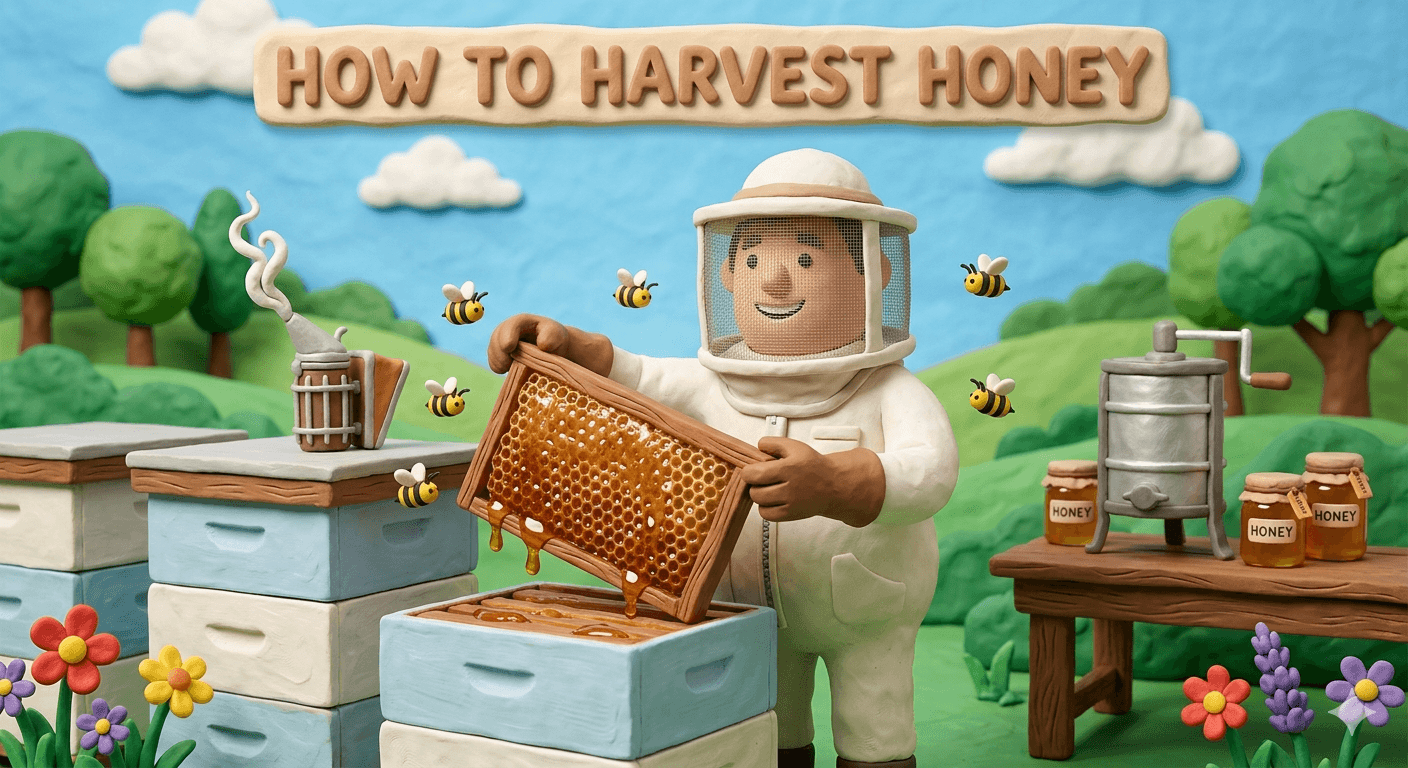
The first honey harvest is the day every new beekeeper has been waiting for. You crack open a super, lift a frame heavy with capped honey, and realize the bees actually pulled it off. That moment is worth the whole year of inspections, mite tests, and worried evenings checking the weather.
This guide walks you through the entire honey harvest from start to finish. When honey is ready, how to pull supers without wrecking the colony, how to uncap and extract, how to strain and bottle, and how to render the wax for candles and salves. You will also see realistic yields by year and the mistakes that cost beginners gallons every season.
If you are still mapping out the broader bee year, our bees seasonal management guide covers the full calendar, and the raising bees for beginners pillar guide covers everything from hive setup through your first winter.
When Is Honey Ready to Harvest?
Capped wax is the green light. When the bees finish ripening nectar into honey, they cover each cell with a thin white wax cap. Capped honey holds at the right water content. Uncapped honey is still too wet, ferments easily, and ruins a batch.
The rule most beekeepers follow is the 80 percent rule. A frame is harvest ready when at least 80 percent of the cells on both sides are capped. A few uncapped cells along the edges are fine. A frame that is mostly uncapped goes back in the hive for another week or two.
If you want a precise check, a refractometer reads the water content of honey in seconds. Aim for 18.6 percent or lower. Above that and the honey can ferment in storage. Refractometers run $30 to $50 and pay for themselves the first time you almost pull a wet super.
There is also the old school shake test. Hold a frame horizontally over the hive and give it one firm shake. If a spray of nectar flies out, it is still too wet. If nothing drips, the honey is ready.
Tip
The main nectar flow in most of the United States ends in late July or early August. Plan your harvest for the two to three weeks right after the flow ends. The honey is fully cured, the bees have not yet started eating into stores, and the days are still warm enough to work outdoors.
The Year One Rule: Leave It All
Here is the hardest piece of advice in beekeeping. In your first year, leave the honey for the bees.
Year one colonies are still building. They are drawing fresh comb, raising winter bees, and storing every drop they can get for the cold months. A strong first year hive might produce 10 to 20 pounds of true surplus by August. Most veteran beekeepers will tell you to leave even that.
Warning
A light hive in October is a dead hive in February. A standard Langstroth needs 60 to 80 pounds of stored honey to overwinter in most of the United States. Northern climates need 80 to 100 pounds. Pull honey only if your bees clearly have more than they need for winter.
Year two and beyond is where the real harvest lives. By the second summer, a healthy hive has full drawn comb in every box and the foragers can focus entirely on filling supers. That is when you can expect 30 to 60 pounds of surplus honey per hive in a normal year, and 80 to 100 pounds in a great location with a strong queen.
The patience pays off. Year two and year three colonies that were left alone in year one are the most productive hives on most homesteads.
Gear You Need for Harvest Day
You do not need a commercial setup. A basic backyard harvest needs only a handful of pieces, and many of them you can borrow from a local bee club.
The honest minimum kit looks like this.
Bee suit, veil, and gloves. The bees know you are robbing them. Suit up fully, even if you usually inspect in a tee shirt.
Smoker and fuel. A good puff of cool smoke calms the colony and gives you a working window.
Hive tool. For prying frames loose from propolis.
Bee brush or fume board. To clear bees off the frames before you carry them inside.
An empty super or covered tote. To hold the pulled frames as you work. Cover it. Otherwise robbing bees will follow you home.
Uncapping knife or capping scratcher. A heated knife slices wax cleanly. A scratcher is cheaper and works on uneven comb.
Extractor. A two frame hand crank extractor runs $150 to $300. Most local bee clubs loan extractors for free during harvest season. Borrow first, buy later.
Double sieve or strainer. Removes wax bits and bee parts from the honey.
Food grade bucket with honey gate. Holds the extracted honey while you fill jars. A 5 gallon bucket holds about 60 pounds of honey.
Jars and lids. Pint, half pint, and quart mason jars all work. Sanitize them in the dishwasher on hot before use.
Heated bottling tank (optional). A 50 watt warming jacket keeps honey flowing if your kitchen is cool.
A reasonable starter kit lands around $400 if you buy everything new. Borrowing the extractor from a bee club cuts that in half.
Pulling Supers From the Hive
This is the loudest part of harvest day. The bees know what you are doing, and they are not thrilled.
Pick a warm, dry day with foragers actively flying. Hot days mean the bees are outside the hive, not stacked on the honey frames. Cool or rainy days mean the bees stay home, and pulling frames turns into a fight.
You have three good ways to clear bees off the supers before you carry them away.
Fume Board With Bee Repellent
A fume board is a flat board with absorbent felt on the underside. You spray a small amount of bee repellent like Bee Quick or Bee Go on the felt, then set the board on top of the honey super. Within five minutes the bees move down into the brood box to escape the smell. You then lift the cleared super and walk it inside.
This is the fastest method for a multi super harvest. Bee Quick smells like almond extract and is non toxic. Bee Go works faster but smells aggressive.
Bee Escape Board
An escape board has a one way exit. You set it between the brood box and the honey super in the evening. Overnight, the bees in the super walk down through the escape and cannot get back. By morning the super is nearly empty and you can lift it cleanly.
Escape boards are the gentlest option but need a 24 hour lead time. They also stop working if you have brood or a queen in the super.
Bee Brush
A soft bristled bee brush sweeps bees off one frame at a time. You pull a frame, brush the bees back into the hive, drop the frame in a covered tote, and repeat. This is the most hands on method and the only one that works in a small harvest of just a few frames.
Whichever method you pick, move fast and keep your supers covered. Open honey in an apiary triggers a robbing frenzy in minutes.
Tip
Use a wheelbarrow or hand truck. A full medium super weighs 35 to 50 pounds. A full deep weighs 60 to 80 pounds. Carrying them across the yard in heat is a back injury waiting to happen.
Uncapping the Comb
Once your supers are inside the house or garage, the messy fun begins. Set up over a capping tank, a sheet pan, or even a clean five gallon bucket with a screen across the top to catch the wax.
You have two tools for the job.
Hot uncapping knife. An electric knife with a thermostat warms a blade to about 200 degrees Fahrenheit. You slide the knife under the wax caps in one smooth motion and the caps slough off. Works best on level, fully drawn comb.
Capping scratcher or fork. Looks like a hair pick with thin metal tines. You drag it across the capped cells to scratch them open. Slower than a knife but works on uneven or hand drawn comb where a knife cannot reach.
Most beekeepers use both. Run the knife where the comb is level, then come back with the scratcher to open the low spots and corners.
Save every scrap of cappings wax. Cappings wax is the cleanest beeswax you will ever harvest. We will come back to it in the wax section.
Extracting the Honey
A honey extractor is a spinning drum that pulls honey out of uncapped frames by centrifugal force. Frames go in, the drum spins, and honey flings out against the wall and runs to the bottom.
There are two common styles.
Tangential extractor. Holds two to four frames flat against the inside of the drum. You spin one side, then flip the frames and spin the other side. Cheaper and fine for a small harvest.
Radial extractor. Holds six to twenty frames pointing outward like spokes on a wheel. Both sides spin at once. Faster, gentler on comb, and better for a multi hive harvest.
For your first harvest, borrow a club extractor. Hand crank is fine for a single hive. Spin for about 30 seconds, slow and steady, then build up speed. Spinning too hard on the first pass blows out fresh comb.
Drain the extractor into a clean food grade bucket through a double sieve. The sieve catches wax bits, propolis chunks, and the occasional bee leg. Honey that goes through a double sieve is bottle ready.
Straining, Settling, and Bottling
After extraction, your honey is full of micro air bubbles and tiny wax fragments. You want to let it settle before you fill jars.
Pour the strained honey into a food grade bucket with a honey gate at the bottom. Cover the top loosely with a clean dish towel. Let it sit for 24 hours in a warm room. The bubbles and remaining wax bits float to the top in a creamy foam layer. Skim that off and feed it back to the bees as a treat.
The cleared honey below is ready for jars. Open the honey gate, fill each jar to within a half inch of the top, wipe the rim clean with a damp cloth, and screw on the lid. No water bath canning needed. Raw honey is its own preservative thanks to natural acidity and low water content.
Store jars in a cool, dark cupboard. Properly bottled honey lasts decades. Honey jars found in Egyptian tombs are still edible.
Tip
Save a clean jar for yourself on harvest day. Slice a fresh slab of comb, set it in the jar, then pour raw honey on top. Cut comb honey is a delicacy you cannot buy in stores and the gift everyone fights over.
Rendering and Saving the Wax
Cappings wax is the cleanest, lightest colored beeswax on the planet. Do not throw it out.
Here is the simple kitchen method.
- Collect all the cappings in a large bowl. Let any clinging honey drain off into a separate jar. You can rinse the cappings in warm water if you want, then let them dry.
- Set up a double boiler. A large pot of simmering water with a smaller heat safe bowl floating on top works fine. Never melt beeswax directly on a burner. It is flammable above 400 degrees Fahrenheit.
- Add the cappings to the inner bowl. They melt at around 145 degrees Fahrenheit into a clear golden liquid.
- Pour the molten wax through a cheesecloth lined funnel into a clean container. The cheesecloth catches any remaining bits of debris.
- Let the wax harden in the container, then pop it out as a clean block.
Beeswax has more uses than you can believe. Hand poured candles. Lip balm. Hand salve. Beeswax food wraps. Furniture polish. Leather conditioner. Even bowstring wax for archery.
A pound of raw beeswax is worth about $8 to $15. Worked into candles or balms it sells for $30 to $50 a pound. Save every scrap.
Yields to Expect by Year and Climate
The honey question every new beekeeper asks is the same. How much will I actually get?
Here is the honest math, averaged across thousands of backyard hives in the United States.
| Year | Realistic Surplus per Hive | Best Case |
|---|---|---|
| Year 1 | 0 to 10 pounds (often leave it all) | 20 pounds in a perfect spring |
| Year 2 | 30 to 50 pounds | 70 pounds in a great location |
| Year 3 plus | 40 to 60 pounds | 80 to 100 pounds with a strong queen |
Five pounds of honey roughly equals one gallon by volume. So a typical 40 pound second year harvest fills eight gallons of jars. A great 80 pound third year harvest fills sixteen.
Climate also matters. Southern hives with long nectar flows often pull two harvests a year, one in late spring and one in fall, totaling 60 to 100 pounds. Northern hives usually pull one big harvest in late summer of 30 to 60 pounds. Mountain hives at altitude often run lighter at 20 to 40 pounds due to shorter flowering windows.
Forage quality is the biggest variable beyond your control. A hive surrounded by clover, locust, basswood, and goldenrod outproduces a hive in a corn and soy desert two to one, no matter how good your management is.
Cleaning Up and Returning Wet Supers
After extraction, your supers and frames are still sticky with residual honey. You have two options.
Open feed it back to the bees. Set the wet supers out 50 to 100 feet from the hive on a warm afternoon. The bees clean them within a day. Make sure they are far enough from the hive that the cleanup does not trigger robbing.
Stack them above the inner cover. Put the wet supers right back on top of the hive above the inner cover. The colony moves the residual honey down into the brood boxes for storage. This is the cleanest method and adds a few extra pounds to winter stores.
Once the supers are dry, store the frames in a freezer for 24 hours to kill any wax moth eggs. Then stack the supers in a cool dry place with a few mothballs nearby, or in heavy plastic bags, until next spring.
Common Honey Harvest Mistakes
These are the misses that cost beginners gallons every year.
- Harvesting too early. Uncapped frames are too wet. The honey ferments in storage and the whole batch is ruined.
- Leaving the hive light for winter. Pulling honey the bees needed is the single most common cause of winter colony death.
- Working in front of an open super. Robbing bees from other colonies smell open honey from a quarter mile away. Always cover pulled supers.
- Using the wrong containers. Galvanized buckets, painted tins, and copper pots react with honey and contaminate the batch. Food grade plastic or stainless steel only.
- Overheating the honey. Honey above 110 degrees Fahrenheit starts losing flavor and enzymatic value. Keep extractors and bottling tanks gentle.
- Filtering too aggressively. A super fine filter strips pollen and natural texture. A double mesh sieve is plenty.
- Storing in warm sunlight. Heat and light slowly degrade honey. Cool, dark, sealed.
- Forgetting to label. Date and apiary location on every jar. Six months from now you will be glad you did.
- Throwing out the cappings wax. That is the highest value byproduct of the harvest.
- Going it alone. A bee club neighbor with a borrowed extractor and a free afternoon can save you a thousand dollars and ten hours.
Frequently Asked Questions
Pull supers in the two to three weeks right after the main nectar flow ends, usually late July or early August in most of the United States. The honey is fully ripened and capped, and the bees have not yet started eating into their stores. Southern climates often allow a second harvest in fall. A frame is harvest ready when at least 80 percent of the cells are capped with wax.
Look for capped wax cells. Bees cap honey only when the water content is below about 18.6 percent, which is the safe storage threshold. A frame with 80 percent or more of its cells capped is ready. If you want a precise check, use a refractometer to test water content. A frame that is mostly uncapped should go back in the hive for another week or two to finish curing.
Most beekeepers do not. Year one colonies need every drop of honey to overwinter. A strong first year hive may produce 10 to 20 pounds of true surplus, but most experienced beekeepers still recommend leaving it all. The bees that drew that comb and ripened that honey are the same bees who will keep the cluster alive in February. Wait for year two for your first real harvest.
A second year hive in good forage produces 30 to 60 pounds of surplus honey in a typical season. A great location with a strong queen pushes that toward 80 to 100 pounds. Five pounds of honey is roughly one gallon by volume. Year one yields are far lower, often zero after you leave enough for winter.
Not always. Crush and strain works fine for a small harvest. You scrape the comb off the frames into a bowl, mash it through a colander or cheesecloth, and let the honey drip into a clean container overnight. It is slower and destroys the comb, but it works without any equipment. For a multi frame harvest, borrow an extractor from a local bee club. Most clubs loan extractors for free during harvest season.
Three good options. A fume board with bee repellent like Bee Quick clears a super in five minutes. A bee escape board placed between the brood box and the super clears it overnight in 24 hours. A soft bristled bee brush sweeps bees off frame by frame for a small harvest. All three work. Pick the one that fits your harvest size and timing.
Cool, dark, and sealed. A pantry cupboard or basement shelf away from direct sunlight is ideal. Sealed jars of raw honey last decades. If your honey crystallizes, it has not gone bad. Just warm the jar in a hot water bath at around 100 degrees Fahrenheit and it returns to liquid. Never microwave honey. Microwaving destroys flavor and beneficial enzymes.
Crystallization is natural. Raw honey with high glucose content (like clover or canola) crystallizes within weeks. Honeys with high fructose (like tupelo or sage) stay liquid for years. Crystallized honey is just as edible and still raw. Warm the closed jar in a hot water bath at 100 degrees Fahrenheit for an hour to return it to liquid form, or eat it crystallized on toast.
In most states yes, with limits. Cottage food laws in most states allow you to sell raw honey at farmers markets, roadside stands, and direct to consumers as long as you label correctly. Labels need your name, address, the word honey, net weight, and often the words "not for resale." Selling to grocery stores or restaurants usually triggers commercial food rules. Check your state agriculture department for specifics.
Indefinitely if stored properly. Honey is one of the only foods that does not spoil. Archeologists have found edible honey in Egyptian tombs over 3,000 years old. The low water content and natural acidity prevent bacterial growth. Keep your jars sealed, cool, and dark and they will outlast you. Crystallization is the only thing that happens over time and it does not affect safety or flavor.
Bringing It All Together
A first honey harvest is one of those weekends that changes how you see your homestead. You walk out to the apiary as a beekeeper and walk back to the kitchen with eight gallons of liquid gold the bees made from your neighborhood. There is nothing else on a homestead that turns sunshine and clover into jars of food while you sleep.
The key moves are simple. Wait for capped frames. Leave year one honey for the bees. Pull supers in the two weeks after the nectar flow ends. Uncap with care, extract gently, strain twice, and bottle in clean jars. Save the cappings wax. Return the wet supers to the bees. Then sit down at the kitchen table with a jar still warm from the extractor and taste a year of patient observation.
For the bigger beekeeping picture, see our raising bees for beginners pillar guide. For the year round calendar that gets you to a great harvest, our bees seasonal management guide walks through every month. For the hive style that yields the most honey, see our bee hive types comparison. When you are ready to plan the rest of your homestead, browse the full animals hub.

Cole
Founder & Lead Researcher
Cole is the founder of Plan Your Homestead. He works in clinical research and brings a research-first lens to every guide on the site, drawing on a long family line of farmers for grounded, practical perspective.
More in Animals
More articles coming soon. Check back for new animals content.