A single bad night will teach you everything you need to know about predator-proofing. One forgotten latch, one inch of gap under a wall, one cheap chicken wire panel, and you can lose every bird in a single visit. Most beginners learn this the hard way.
The good news is that a predator-proof coop is not complicated. It is not even expensive. It is a short list of design choices that, once you get them right, will protect your flock for years. The mistakes are predictable. The fixes are well known. And almost every total flock loss in your first year traces back to one of seven missing features.
This guide walks through every common chicken predator and how it attacks. It covers the seven essential features that turn an ordinary coop into a fortress. It explains the lock up routine that catches what your hardware misses. And it ends with the budget reality, because predator-proofing is the cheapest insurance policy you will ever buy.
If you are still picking your first birds, our top 10 beginner chicken breeds guide covers that part. This one is about the box that keeps them alive.
Know Your Enemy: The Predators You Are Building Against
You cannot defend against an attacker you do not understand. Every region has a slightly different cast of characters, but most American homesteads deal with the same handful. Here is who is hunting your flock and how they get in.
Raccoons
Raccoons are the smartest and most patient predator most chicken keepers ever face. They have hands. They can open simple latches, slide bolts, and even some carabiners. They will reach through chicken wire and pull a hen apart piece by piece without ever getting inside the coop. They are also persistent. A raccoon that finds a flock will come back every night for weeks until it gets one.
Foxes and Coyotes
Foxes and coyotes hunt by digging and by daylight. A fox will scout a coop for days, then dig under the wall in a single quiet hour. Coyotes prefer to grab a free range bird in broad daylight and disappear over the fence. Both will revisit a successful kill site for as long as you keep restocking it.
Hawks and Owls
Hawks hunt during the day. Owls hunt at night. Both will take a chicken from an open run faster than you can react. Hawks favor dawn and dusk and will often perch nearby for hours waiting for a single bird to wander away from cover. Owls are silent and lethal, and they prefer perches above an unroofed run.
Snakes
Snakes do not usually take adult hens, but they take chicks and eggs steadily. A four foot rat snake can squeeze through a half inch gap and clean out a brood box overnight. If you have eggs disappearing without any sign of breakage and your hens look fine, you have a snake.
Weasels and Minks
Weasels are the most underestimated predator in the country. A full grown weasel can fit through a one inch hole. Once inside, it will kill every bird in the coop for sport, drink the blood, and leave the bodies. A single weasel attack often takes out an entire flock in one night.
Opossums and Skunks
Opossums and skunks are opportunists. They will not usually challenge an adult hen, but they will eat eggs, kill chicks, and pick off any sick or injured bird in the flock. They get in through the same gaps that let snakes in.
Domestic Dogs
This is the predator most new keepers refuse to plan for, and it is the one that kills the most backyard chickens by a wide margin. Your neighbor's friendly lab does not know your hens are not toys. A loose dog can kill ten birds in five minutes. A predator-proof coop has to keep dogs out of the run, not just keep raccoons out of the coop.
The 7 Essential Features of a Predator-Proof Coop
Every feature on this list solves at least one of the attacks above. Skip any of them and you have left a door open for one specific predator. Hit all seven and you will have a flock that wakes up every morning for years.
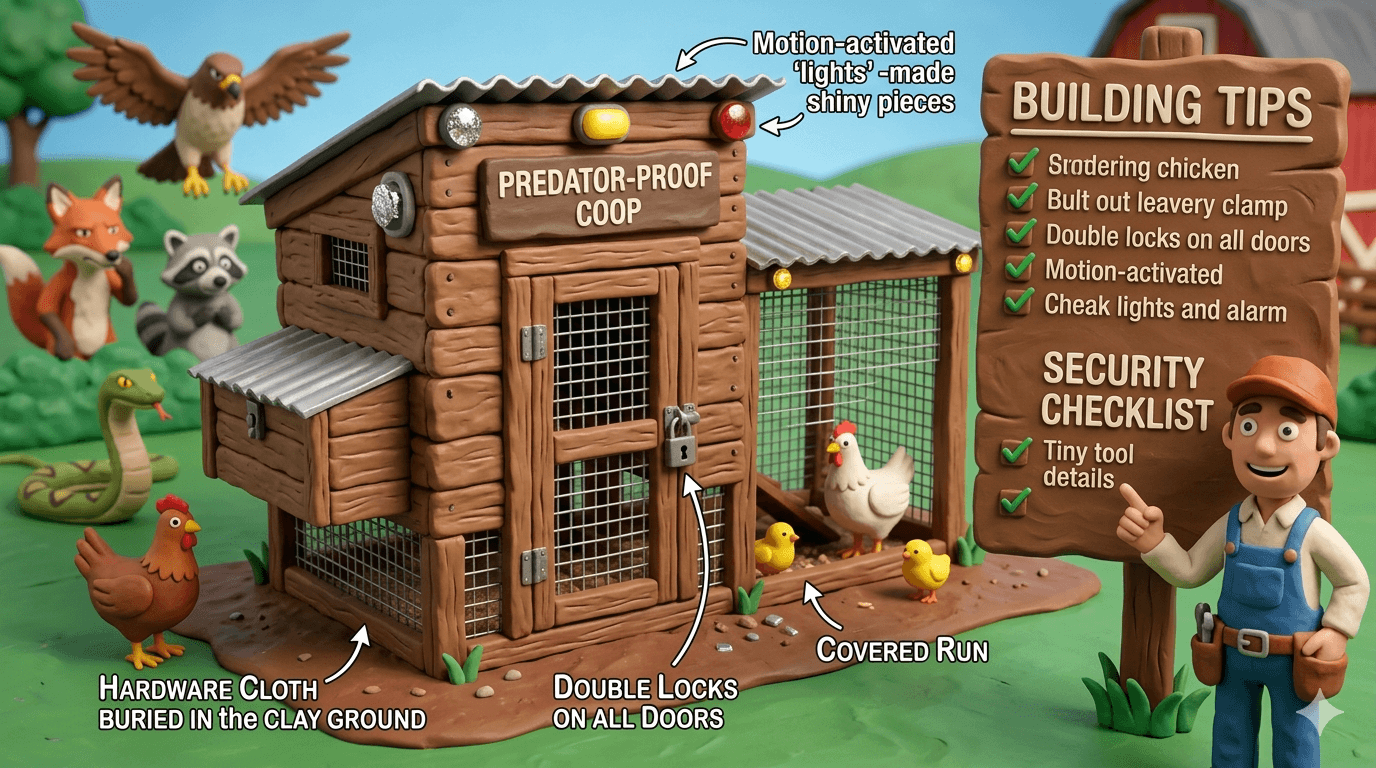
1. Hardware Cloth, Never Chicken Wire
Chicken wire keeps chickens in. It does not keep predators out. A raccoon can rip a chicken wire panel open with its hands. A determined dog can chew through it. A weasel walks through the gaps without slowing down.
Use half inch galvanized hardware cloth, 19 gauge or heavier, on every opening in the coop and run. That includes vents, windows, gable ends, and the entire run if it is wire walled. Half inch is non negotiable for keeping out weasels and snakes. One inch openings let too much through.
When you attach hardware cloth, screw it down with a fender washer over each screw. A staple gun is not enough. A raccoon can pull stapled hardware cloth off a frame in a few minutes. Washers spread the load and turn each screw into a permanent fastener.
Warning
If you remember nothing else from this article, remember this. Chicken wire is not a predator barrier. If your existing coop is wrapped in chicken wire, you do not have a predator proof coop. Replace it before you bring birds home.
2. A Buried Apron or Skirt
Foxes dig. Coyotes dig. Dogs dig. Even raccoons will dig under a wall if the soil is soft. A coop with no underground defense is a coop with a predictable failure mode.
You have two good options. The first is a buried L shape apron. Dig a trench 12 inches deep against the outside of every coop and run wall. Bend a strip of hardware cloth into an L. The vertical leg attaches to the wall, the horizontal leg sits on the bottom of the trench facing outward. Backfill the trench. When a predator tries to dig, it hits wire and quits.
The second option is a flat surface skirt. Lay a 24 inch wide strip of hardware cloth flat on the ground around the entire perimeter, attached at the wall and pinned down with landscape staples. Cover it with a few inches of mulch or sod. The strip stops digging the same way the buried apron does, with less digging on your part.
Either approach works. The buried apron is cleaner and lasts longer. The flat skirt is faster to install. Skip both and you will lose birds within a year.
3. A Solid Roof on the Run
An open topped run is an invitation. Hawks will hunt it. Owls will hunt it. Raccoons will climb the walls and drop in. A roof on the run is the single most underrated feature in beginner coops, and the easiest to add later.
For permanent runs, hardware cloth stretched across the top works fine and lets in light and rain. For longer runs or runs over six feet wide, run rafters across the top and cover them with metal roofing or polycarbonate panels. A solid roof also keeps the run dry, which keeps the bedding healthy and the birds happier.
If you cannot fully roof your run, at least string aviary netting across the top. It is not predator proof against a determined raccoon, but it stops every hawk and owl in your area from taking the easy shot.
4. Predator-Proof Latches
Every door, vent, and nesting box hatch needs a two step latch. A simple slide bolt or hook and eye is a raccoon puzzle, not a lock. Raccoons have figured out single action latches for decades.
The standard solution is a slide bolt with a carabiner clipped through the hole. The bolt slides. The carabiner holds the bolt in place. A raccoon can solve one but not both. Spring loaded snap clips, padlocks, or barrel bolts with secondary pins all work the same way. The key is that opening the door requires two distinct motions a raccoon cannot string together.
Apply this rule everywhere. The pop door, the human door, the egg collection hatch, the cleanout door, every removable vent panel. A predator finds the weakest latch on the coop and works on it every night. Make every latch the same kind of strong.
Tip
Test your own latches at night by feel, with one hand, in the dark. If you can open it with one hand in 30 seconds, a raccoon can open it in less. The carabiner test is fast and free.
5. No Gaps Larger Than 1/2 Inch
A predator-proof coop has no gaps wider than half an inch anywhere on the structure. That is the measurement that keeps weasels, snakes, and rodents out. Most homemade coops fail this test in three or four predictable spots.
Walk your coop with a ruler and inspect these places. The ridge cap where the roof meets the walls. Vent openings, especially the soffit vents under the eaves. Gaps where wood shrinks at the corners. Pop door tracks. Egg box hatches. The seams where two sheets of plywood meet. Any spot where a board has warped or pulled away from a frame.
Every gap larger than half an inch gets covered with hardware cloth or sealed with caulk and a wood patch. Vents stay open for airflow but get hardware cloth on the inside. Soffits get blocked with foam and screened over. The goal is a coop where a half inch dowel cannot find a single point of entry.
This is also the test that stops mice and rats. Rodents will not take a hen, but they will eat your feed, contaminate the water, and attract every snake within a quarter mile. A mouse proof coop is a snake proof coop.
6. Elevation or Solid Flooring
Coops built directly on bare dirt are coops with a built in tunnel. Even with a buried apron, persistent predators will eventually find the soft spot. The fix is to take the dirt out of the equation entirely.
You have two paths. The first is to elevate the coop on legs at least 12 inches off the ground. The space underneath becomes a covered run, the chickens see anything that approaches, and predators have nowhere to dig that leads inside. Elevation also keeps the coop floor dry, which extends its lifespan by years.
The second path is a solid floor. Pour a concrete pad and build the coop directly on it. Lay treated plywood with a vinyl liner over a wood frame. Either way, the floor is something a predator cannot dig through. A solid floor turns the coop into a sealed box with two openings, the human door and the chicken door, both of which you control.
Avoid building a ground level coop on dirt with no apron and no floor. That is the most common predator failure in homemade coops, and it always ends the same way.
7. An Automatic Door, Set to Dawn and Dusk
The biggest predator threat to your flock is not raccoons or foxes. It is you. Every chicken keeper forgets to lock the coop eventually. One late dinner, one weekend trip, one busy evening, and the door stays open all night. That is when the loss happens.
An automatic chicken door solves the problem permanently. The good ones use a light sensor or a programmable timer to close at dusk and open at dawn. Once installed, you never think about it again. The door closes when the chickens are roosting and opens when they are ready to come down.
Brands like Run Chicken, Omlet, and ChickenGuard all make solid units in the 100 to 250 dollar range. Battery powered models work without wiring. The cost of one door is roughly the cost of three good laying hens. The math works the first time you forget to lock up.
If you cannot afford an automatic door yet, set a phone alarm for sunset every single day. A manual lock up routine works as long as you never miss a night. Almost no one never misses a night.
The Lock-Up Routine That Saves Flocks
Hardware is half the job. The other half is what you do every night.
Predators hunt in two windows, dusk to midnight and a few hours before dawn. Your hens are roosting and helpless during both. The lock up routine exists to make sure the coop is sealed and the run is checked during those two windows.
Walk to the coop after the sun sets. Confirm every hen is on the roost. Latch the pop door, even if you have an automatic door, as a backup. Walk the perimeter of the run and look for fresh dig marks against the apron. Listen for a minute. A coop with a predator already inside or watching from a tree will give you obvious clues if you stand still.
In the morning, do the reverse walk. Look for tracks in soft ground around the run. Check the hardware cloth for fresh tear marks. Predators that fail at night come back the next night, and the second attempt is always better planned. Catching the first attempt buys you a day to fix the weakness.
Warning
A coop is only as safe as its weakest hour. The hardware protects you from raccoons. The routine protects you from yourself. Skip the nightly walk for two weeks and a predator will figure out your schedule before you do.
Common Mistakes That Defeat a Good Coop
Almost every total flock loss comes from one of these mistakes. Most of them are easy to fix in an afternoon.
1. Trusting chicken wire because it is cheap. Chicken wire is the single most common predator failure in homemade coops. It costs you 15 dollars to save and a flock to learn. Use hardware cloth.
2. Latches a raccoon can solve in under a minute. Hook and eye, single slide bolt, twist toggle. All of them are puzzles a raccoon enjoys. Add a carabiner or replace with a real two step lock.
3. Forgetting to predator-proof the run. A locked coop with an open run still loses birds. Raccoons will reach through, hawks will swoop in, dogs will jump the fence. The run is part of the coop, not separate from it.
4. Leaving feed out overnight. Spilled grain attracts mice. Mice attract snakes and weasels. The predator that came for the feed always comes back for the hens. Pull the feeder into the coop or a sealed bin every night.
5. Skipping the apron because the soil looks hard. Soil is never as hard as you think, and a determined fox does not care. The apron takes one weekend to install. Without it, every coop is a digging puzzle.
6. Free ranging without daytime cover from hawks. A wide open lawn is a hawk hunting ground. If you free range, give the flock dense bushes, low trees, or built shelters every 30 feet. A hen that can dive to cover survives a hawk pass. A hen on open grass does not.
7. Building once and never inspecting again. Wood shrinks. Screws back out. Hardware cloth corrodes. A coop that was predator proof in May is not necessarily predator proof in October. Walk it once a month with a ruler in your hand.
Avoid these seven and your coop will protect a flock for as long as the wood holds up.
Materials Checklist and Rough Budget
Predator-proofing a 6 by 8 foot coop and a 10 by 10 foot run runs around 400 to 600 dollars in materials. That is a rounding error against the cost of replacing a flock.
| Item | Specification | Approximate Cost |
|---|---|---|
| Hardware cloth roll | 1/2 inch, 19 gauge, 4 ft x 50 ft | 130 to 180 dollars |
| Fender washers | Box of 100, #8 size | 8 to 12 dollars |
| Two step latches | Slide bolt with carabiner, x4 | 20 to 30 dollars |
| Automatic chicken door | Light sensor or timer, battery | 100 to 250 dollars |
| Buried apron material | Hardware cloth, landscape staples | 40 to 60 dollars |
| Run roofing | Metal panels or hardware cloth | 80 to 200 dollars |
You will save the most money by buying hardware cloth in a single large roll instead of small panels, and by skipping the run roof if you already have aviary netting on hand.
Tip
Spend more on the hardware cloth, the latches, and the automatic door. Spend less on lumber, paint, and the cute features. Predators do not care what color the coop is. They care whether the door is locked and whether the wire holds.
You Have a Plan, Now Build the Box
A predator-proof coop is not a luxury. It is the floor underneath everything else you do with chickens. Pick the wrong breed and you have a slightly less productive flock. Skip the buried apron and you have no flock at all.
The seven features on this list cover almost every common attack. Hardware cloth instead of chicken wire. A buried apron or skirt around every wall. A solid roof on the run. Two step latches on every door. No gaps over half an inch. Solid flooring or elevation. An automatic door for the night you forget. Pair them with a 60 second walk every evening and your flock will outlive most of the coops it lives in.
If you are still planning the rest of your chicken setup, our complete beginner chicken guide covers feed, water, brooding, and the daily care routine. If you have not picked your birds yet, the chicken breed picker sorts the best breeds for your climate in under a minute.
Chicken Breed Picker
Answer a few questions and we'll recommend the best chicken breeds for your homestead.
Try it free →The predator-proof coop is the cheapest insurance you will ever buy on a homestead. Spend the weekend now. Sleep through the night for years.
Frequently Asked Questions
No. Chicken wire is designed to keep chickens in, not to keep predators out. Raccoons can rip it open with their hands, dogs can chew through it, and weasels and snakes walk straight through the gaps. Use half inch galvanized hardware cloth, 19 gauge or heavier, on every opening in the coop and run. The cost difference is small and the protection difference is the entire flock.
Bury hardware cloth at least 12 inches deep around the perimeter of the coop and run. Bend it into an L shape with the vertical leg against the wall and the horizontal leg facing outward along the bottom of the trench. The L stops foxes, coyotes, and dogs from digging under. If digging a trench is hard, lay a 24 inch wide flat skirt of hardware cloth on the ground instead, pinned with landscape staples and covered with mulch.
The best deterrent is a properly built coop, not a gadget. Solar predator lights, motion sprinklers, and noise makers all work for a few days, but predators learn quickly that nothing actually attacks them. The combination of hardware cloth, two step latches, a buried apron, a solid run roof, and an automatic door will outperform any deterrent device on the market. Build the coop right and the deterrents become unnecessary.
Yes, automatic doors are one of the highest impact upgrades you can make. A light sensor or timer closes the door at dusk and opens it at dawn, which removes the single most common cause of flock loss, the keeper who forgot to lock up. Brands like Run Chicken, Omlet, and ChickenGuard all make reliable units in the 100 to 250 dollar range. Battery powered models do not require wiring. The door pays for itself the first night you would have forgotten.
Weasels and minks are the most likely culprits when bodies are left behind, often with the heads or necks injured. Raccoons usually take a hen apart at the coop wall and leave wings or feathers. Owls take the whole bird and leave nothing. Foxes and coyotes carry the bird off entirely. The pattern of what is missing and what remains is usually enough to identify the predator and decide what part of the coop needs reinforcing.
Three things stop raccoons. First, replace any chicken wire with half inch hardware cloth screwed down with fender washers. Second, put a two step latch on every door, vent, and hatch, like a slide bolt with a carabiner clipped through it. Third, roof the run so they cannot climb in from above. Raccoons are smart and patient, but they cannot beat hardware cloth, real latches, and a closed run.
Cover the run with hardware cloth panels, metal roofing, or aviary netting. An open topped run is the easiest hawk hunting ground in your yard. If you free range, plant dense bushes, low trees, or build simple shelters every 30 feet so hens can dive to cover. A hen that can reach cover in three seconds survives most hawk passes. A hen on open grass does not.
Welded wire is stronger than chicken wire but not equal to hardware cloth. Most welded wire panels have one inch by two inch openings, which let weasels, small snakes, and rodents through, and let raccoons reach inside. Welded wire is fine as a structural layer for the run frame, but the predator barrier on top of it should still be half inch hardware cloth. Use both together if you want maximum strength and full protection.
Yes, foxes dig efficiently and they will dig under any coop wall that sits on bare dirt. A fox can excavate a usable hole under a wall in less than an hour. The fix is a buried L shape apron 12 inches deep along every wall, or a flat 24 inch hardware cloth skirt pinned to the ground around the perimeter. Either approach makes digging fail, and a fox that fails twice almost always moves on to easier targets.
Use half inch hardware cloth on every opening to keep weasels and minks out. A full grown weasel can squeeze through a one inch hole, so anything larger than half inch is not weasel proof. Inspect the entire coop with a ruler and seal every gap that is over half an inch wide, including soffit vents, ridge caps, pop door tracks, and the seams where boards meet. Weasels find one weak spot and clean out a flock in one night, so the inspection has to be thorough.

Cole
Founder & Lead Researcher
Cole is the founder of Plan Your Homestead. He works in clinical research and brings a research-first lens to every guide on the site, drawing on a long family line of farmers for grounded, practical perspective.
More in Animals
More articles coming soon. Check back for new animals content.