
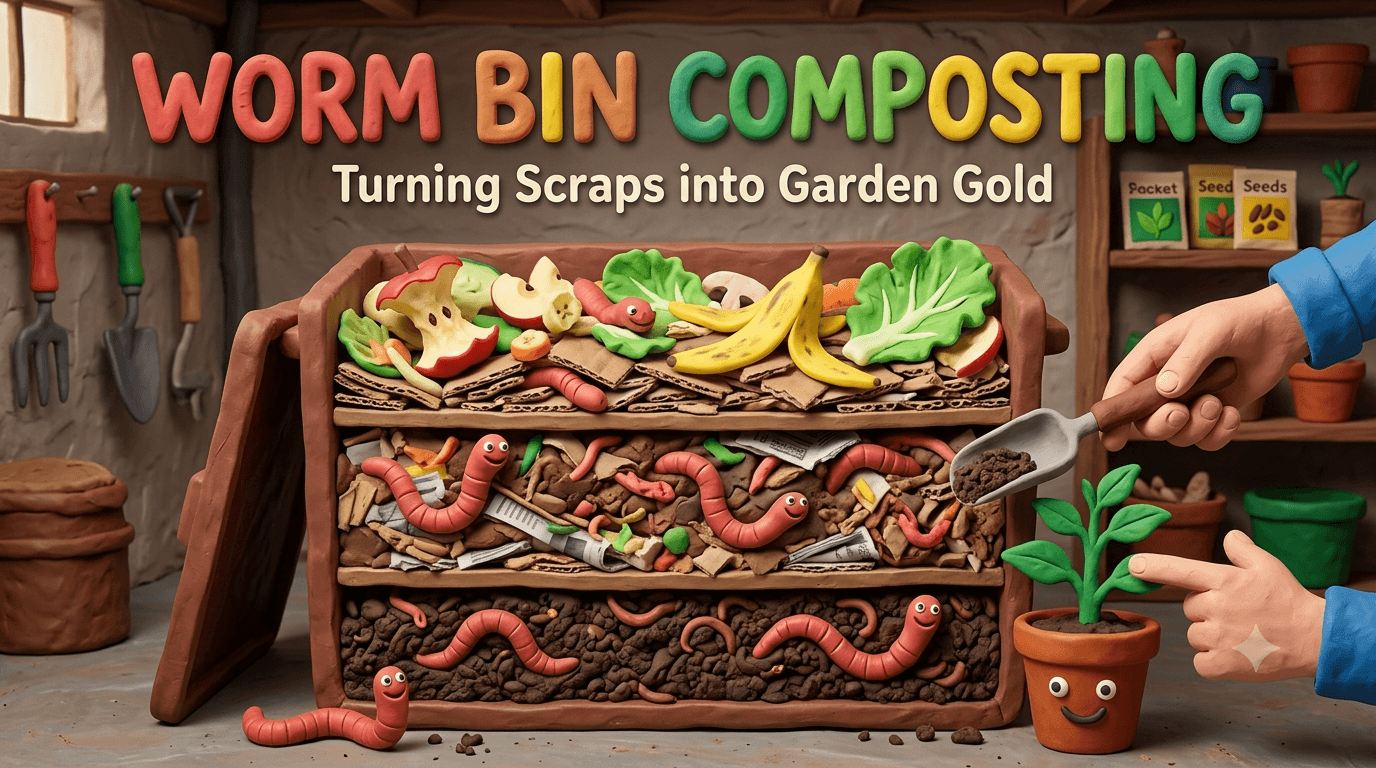
A coffee can of kitchen scraps. A handful of worms. A plastic tote in the corner of your garage. That is all it takes to turn the peels and cores you already throw away into some of the richest soil food on earth.
Worm bin composting, also called vermicomposting, is the fastest, cleanest way to compost when you do not have room for a big outdoor pile. It works indoors, it does not stink when you run it right, and the finished castings outperform almost any bagged fertilizer at the garden store. Best of all, you can build a worm bin in an afternoon for the price of a pizza.
This guide walks you through the whole thing in plain language. You will learn what worm composting is and why the castings are so good, how the main bin types compare, which worms to buy, and how to build a simple stacked tote bin step by step. We will cover bedding, feeding, moisture, harvesting, and the handful of mistakes that trip up new worm keepers. Grab a coffee and let us dig in.
What Worm Bin Composting Is
Worm bin composting is the art of letting worms eat your food scraps. You give them a dark, moist home and a steady supply of fruit and vegetable waste. They eat it, and what comes out the other end is worm castings, a dark crumbly material that gardeners call black gold.
This is different from a regular compost pile. A pile like our three bin compost system relies on heat and microbes to break material down over months. A worm bin runs cool and quiet, powered by the worms themselves. It is smaller, faster for kitchen scraps, and it fits where an outdoor pile never could, like a basement, a garage, or a balcony.
The payoff is the castings. Worm castings are loaded with plant ready nutrients, beneficial microbes, and natural growth compounds. They will not burn your plants the way raw fertilizer can. A handful mixed into a seed start or scratched around a tomato gives roots a gentle, lasting boost. Many growers swear a worm bin makes the single best soil amendment you can produce at home.
You also get a second product called worm tea, the liquid that drains out the bottom of the bin. Diluted with water, it makes a quick liquid feed for houseplants and seedlings.
Worm Bin Types Compared
There is no single best worm bin. The right one depends on your space, your budget, and how hands on you want to be. Here are the four designs most home composters choose from.
Single Tote Bin
A single tote bin is one plastic storage tote with air holes and drainage holes. It is the cheapest and simplest bin you can make.
- Pros. Dirt cheap. Takes ten minutes to build. Uses a tote you may already own. Great for a first try.
- Cons. Harvesting means sorting worms out of the finished castings by hand. No easy way to separate fresh food from finished material.
- Best for. Beginners testing the waters and anyone on the tightest budget.
Stacked Tray System
A stacked tray system uses two or more nesting totes or trays. Worms migrate up through holes into fresh food above, leaving finished castings below.
- Pros. Easy harvesting, since worms move themselves out of the finished tray. Compact footprint. Good airflow. Room to expand by adding trays.
- Cons. A little more work to build than a single tote. Slightly higher cost for the extra bins.
- Best for. Most home composters. This is the sweet spot of cost, ease, and tidiness, and it is the build we walk through below.
Continuous Flow Through
A flow through bin is a tall container with a grid or mesh bottom. You feed from the top and harvest finished castings from the bottom, so the worms stay in the middle and never get disturbed.
- Pros. The least disturbance for the worms. Harvest without sorting. Handles large volumes. Long lived setup.
- Cons. Bigger and taller. Costs more to build or buy. Overkill for a small kitchen.
- Best for. High volume households and serious gardeners who want a permanent, hands off system.
Wood Box Bin
A wood box bin is a simple wooden crate, often built from cedar or untreated lumber. It breathes well and looks at home in a shed or on a porch.
- Pros. Breathable wood keeps moisture in balance. Looks great. Easy to build any size you like. Naturally insulating.
- Cons. Wood eventually rots from the constant moisture. Heavier and harder to move. No built in drainage unless you add it.
- Best for. Woodworkers and anyone who wants a good looking bin for a porch, mudroom, or shed.
Tip
If this is your first worm bin and you want the best balance of cost, tidiness, and easy harvesting, build a stacked two tote system. It costs about the same as a single tote but lets the worms separate themselves from the finished castings for you. That is the build we cover step by step below.
Choosing Your Worms
Not just any worm will do. Garden earthworms and night crawlers are burrowers that want deep soil, and they will die in a shallow bin. You need composting worms that live and feed near the surface.
The standard pick is the red wiggler, known by the scientific name Eisenia fetida. Red wigglers are the workhorse of vermicomposting. They eat fast, breed fast, tolerate a wide range of conditions, and thrive in the crowded, shallow world of a bin. If you buy one kind of worm, buy these.
A second good option is the European nightcrawler, a larger cousin that also works in bins and doubles as fishing bait. Some keepers run both. For pure composting, red wigglers are hard to beat.
How many should you buy? A common starting point is one pound of worms, which is roughly a thousand worms. One pound can process about half a pound of food scraps a day once the colony settles in. Worms double their numbers every few months in good conditions, so a small starter batch grows into a full bin on its own. Buy from a reputable worm farm or a gardening neighbor rather than digging them from the yard, since yard worms are almost never the right kind.
Tools You Will Need
Most of these live in a typical home already.
- Cordless drill
- A 1/4 inch drill bit for air holes
- A 1/16 inch or 3/32 inch bit for drainage holes
- A marker for laying out hole spots
- Scissors or a utility knife
- A spray bottle for moistening bedding
- Work gloves if you like to keep your hands clean
That is the whole list. A worm bin is one of the most forgiving DIY projects you will ever build.
Materials List and Cost Breakdown
Costs are approximate, based on average United States prices in 2026, for a stacked two tote worm bin. The thrifty column assumes you reuse totes and bedding you already have on hand.
| Item | Quantity | New Cost | Thrifty Cost |
|---|---|---|---|
| Opaque plastic storage totes, 10 to 18 gallon | 3 | $30 to $45 | $0 to $15 |
| One matching lid | 1 | included | $0 |
| Red wiggler worms, 1 lb | 1 | $35 to $50 | $0 if gifted |
| Bedding, shredded cardboard and newspaper | a grocery bag | $0 | $0 |
| Handful of garden soil or finished compost | 1 to 2 cups | $0 | $0 |
| Bricks or small blocks to lift the trays | 4 | $0 to $5 | $0 |
| Build total with new materials | ~$80 | ||
| Build total thrifty | ~$15 |
Choose opaque totes, not clear ones. Worms hate light, and an opaque bin keeps their home dark and calm. Totes in the 10 to 18 gallon range are easy to handle and the right depth for surface feeders.
Step by Step Build Instructions
Plan on about an hour. Work somewhere you can vacuum up plastic shavings afterward.
Step 1: Gather Three Totes and One Lid
You need three totes of the same size that nest inside one another, plus a single lid. Two totes become the working trays where the worms live. The third tote stays solid as a reservoir to catch the liquid that drains out the bottom.
Step 2: Drill the Air Holes
Take the two working totes. Using the 1/4 inch bit, drill a row of air holes around the upper sides of each tote, spaced about two inches apart. Drill another set of holes in the lid. Worms breathe, and good airflow is what keeps a bin fresh instead of foul.
Step 3: Drill the Drainage and Migration Holes
In the bottom of the two working totes, drill a grid of the smaller 1/16 or 3/32 inch holes, spaced about two inches apart. These holes let liquid drain down and let worms migrate up between trays. Keep them small enough that bedding does not fall through too freely. Leave the third reservoir tote with no holes at all.
Step 4: Nest the Totes
Set the solid reservoir tote on the floor. Place four bricks or blocks inside it, near the corners, to lift the next tote off the bottom. Rest one working tote on those bricks. The gap underneath catches the worm tea that drains down. Keep the second working tote and the lid aside for now. You will add the second tray later, once the first one fills up.
Step 5: You Are Ready to Move In
That is the whole build. One reservoir on the bottom, one working tray sitting above it on bricks, and a spare tray and lid waiting in the wings. Now it is time to make the bedding.
Setting Up the Bedding
Bedding is the worms' home and their backup food. It needs to be carbon rich, damp, and fluffy so air can move through it.
Tear cardboard and newspaper into strips, or run them through a shredder. Avoid glossy printed inserts and stick to plain paper and brown cardboard. Fill your working tray about two thirds full of the loose, shredded bedding.
Now wet it down. Mist the bedding with your spray bottle, then fluff and mist again, until it feels like a wrung out sponge. It should be damp to the touch but not dripping. Squeeze a handful and only a drop or two should come out.
Mix in a couple of handfuls of garden soil or finished compost. The grit helps the worms digest, and the soil brings in the microbes that kick start the whole process. Gently add your worms on top, set the lid on, and leave them in a dim, quiet spot for a day to settle in before you feed them.
Feeding Your Worms
Worms eat about half their weight in food each day once they are established. Start slow. Bury a small handful of scraps in one corner under the bedding, then wait until it is mostly gone before you add more. Burying food keeps flies and smells away. Each time you feed, tuck the scraps into a different corner so you rotate around the bin.
Good foods to feed:
- Fruit and vegetable scraps and peels
- Coffee grounds and paper filters
- Crushed eggshells, which add grit and calcium
- Tea leaves and plain tea bags
- Stale bread, plain pasta, and grains in small amounts
Foods to keep out:
- Meat, fish, and bones
- Dairy, cheese, and butter
- Oily or greasy food
- Large amounts of citrus, onion, and garlic
- Salty, spicy, or heavily processed food
- Pet waste
Warning
Meat, dairy, and oily food are the fastest way to turn a sweet smelling bin into a stinking one. They rot instead of feeding the worms, draw flies and pests, and can sour the whole tray. Keep them out and stick to plant scraps, coffee, and eggshells. A healthy worm bin smells like fresh forest soil, never like garbage.
Chop scraps small to help the worms work faster, and never dump in more than they can handle. When in doubt, feed less. An underfed bin is happy. An overfed bin turns to rotting mush.
Maintaining Moisture, Temperature, and Airflow
A worm bin is low maintenance, but three things keep it thriving.
Moisture is the big one. The bedding should always feel like a wrung out sponge. If it dries out, mist it. If it gets soggy and starts to smell, add a handful of dry shredded cardboard to soak up the excess and open up airflow. Soggy bedding starves the worms of air, and that is the root of most bin problems.
Temperature matters too. Red wigglers are happiest between about 55 and 80 degrees Fahrenheit, the same comfort range as a house. They survive cooler and warmer, but they slow down and can die in a freeze or in baking heat. A garage, basement, or mudroom usually holds the right range year round. Move the bin out of direct sun and away from a freezing wall.
Airflow ties it together. Those air holes you drilled let the worms breathe and keep the bin from going sour. Give the bedding a gentle fluff with a hand fork now and then to keep it from packing down. A bin that breathes well almost never smells.
Harvesting Worm Castings
After two to three months, your first tray fills with dark, crumbly castings and the food disappears almost as fast as you add it. Now you harvest. There are two easy ways.
The stacked tray method is the whole reason we built nesting totes. Once the bottom tray is full of finished castings, set your second prepared tray right on top of the castings and start feeding in the new tray instead. Over the next couple of weeks the worms migrate up through the holes to follow the fresh food. When most of them have moved up, lift off the top tray and the bottom one is nearly pure castings, ready to use.
The dump and sort method works for a single tote. Tip the contents onto a tarp under a bright light and shape it into a few cone shaped piles. Worms hate light, so they burrow to the center of each pile. Scrape the castings off the outside of each cone, wait a few minutes, and scrape again, until you are left with a wriggling ball of worms to return to fresh bedding.
Either way, you end up with a bucket of finished castings and a colony ready to start the cycle again. Do not drain or harvest the worm tea and let it sit, since fresh is best. Use it within a day or two.
Using Castings in the Garden
Worm castings are gentle and concentrated, so a little goes a long way. Here are the best ways to put them to work.
- Seed starting. Mix castings into your seed start at about one part castings to four parts mix for a strong, gentle launch.
- Transplanting. Drop a handful into each planting hole when you set out seedlings.
- Top dressing. Scratch a thin layer around the base of established plants and water it in.
- Potting soil booster. Blend castings into container mix at roughly ten to twenty percent by volume.
- Worm tea. Dilute the drained liquid with water until it looks like weak tea, then water it onto plants.
Castings shine in a raised bed, where the rich soil stays put for your plants to use. If you have not built one yet, our raised garden bed plans pair perfectly with a steady supply of homemade castings.
Common Mistakes to Avoid
A few traps catch nearly every new worm keeper. Sidestep these and your bin will run for years.
- Overfeeding. The number one killer. Uneaten food rots, smells, and sours the bin. Feed less and wait.
- A soggy bin. Too much moisture and too little air go hand in hand. Add dry bedding and fluff it up.
- Wrong worms. Yard worms and night crawlers will not survive a shallow bin. Buy red wigglers.
- The wrong foods. Meat, dairy, and oil bring stink and pests. Stick to plant scraps and coffee.
- A clear bin in the light. Worms need dark. Use opaque totes and keep the lid on.
- Letting it freeze or cook. Keep the bin in the 55 to 80 degree comfort range, out of sun and frost.
- Impatience. A new bin takes a few weeks to hit its stride. Give the colony time to grow.
Frequently Asked Questions
Frequently Asked Questions
A healthy worm bin does not smell bad at all. It smells like fresh forest soil. Bad smells almost always mean one of three things, too much food rotting before the worms can eat it, bedding that is too wet and starved of air, or the wrong foods like meat and dairy. Fix those and the smell clears up fast. Feed less, add dry shredded cardboard to soak up moisture, and stick to plant scraps, coffee, and eggshells.
One pound of red wigglers, which is roughly a thousand worms, is the standard starting amount for a home bin. One pound can process about half a pound of food scraps a day once the colony settles in. You can start with less and let them multiply, since worms double their numbers every few months in good conditions. Buy from a worm farm or a gardening friend rather than digging them from your yard.
Red wigglers, known by the scientific name Eisenia fetida, are the best choice for almost every home worm bin. They are surface feeders that thrive in the shallow, crowded conditions of a bin, eat fast, and breed quickly. European nightcrawlers also work and double as fishing bait. Avoid garden earthworms and night crawlers from the yard, since those are deep burrowers that will not survive a bin.
Most bins produce their first harvest of finished castings in about two to three months. The timeline depends on how many worms you started with, how warm the bin is, and how much you feed. A warm bin with a full pound of worms works faster. You will know it is ready when the material is dark and crumbly, the original bedding is gone, and you can no longer make out the food scraps you added.
Yes, and indoors is one of the best places for one. A worm bin does not smell when you manage it right, takes up little space, and holds a steady temperature inside. A basement, garage, mudroom, or even a kitchen corner all work well. Keep the bin out of direct sun and away from freezing walls, and the worms will be comfortable in the same range you are, roughly 55 to 80 degrees Fahrenheit.
Feed fruit and vegetable scraps, coffee grounds, crushed eggshells, tea leaves, and small amounts of bread or grains. Avoid meat, dairy, oily food, pet waste, and large amounts of citrus, onion, and garlic. Bury a small handful in one corner and wait until it is mostly gone before feeding again, usually every few days to a week. Chop scraps small and always feed less than you think, since overfeeding is the most common mistake.
Worm tea is the liquid that drains out the bottom of the bin into the reservoir tote. It is rich in nutrients and microbes. Dilute it with water until it looks like weak tea, then water it onto houseplants, seedlings, and garden beds for a quick gentle feed. Use it fresh within a day or two rather than letting it sit. Drain the reservoir regularly so liquid never backs up into the worms.
The easiest way is the stacked tray method. When the bottom tray is full of castings, set a fresh tray of bedding and food on top, and the worms migrate up through the holes to follow the food, leaving nearly pure castings below. For a single bin, use the dump and sort method, tip everything onto a tarp under bright light, shape it into cones, and scrape castings off the outside as the worms burrow down to escape the light.
Ready to Start Your Worm Bin?
That is the full picture. You know what worm composting is and why the castings are so valuable, you know how the bin types compare, which worms to buy, and exactly how to build and run a simple stacked tote bin. A worm bin is one of the smallest projects on the homestead, yet it quietly turns your kitchen waste into the best soil food you can make.
Once your bin is humming, put those castings to work. Build a place for them with our raised garden bed plans, or scale up your composting with a three bin compost system for yard and garden waste.
For more weekend projects, browse the full DIY hub.
Happy composting, and happy worm wrangling.

Cole
Founder & Lead Researcher
Cole is the founder of Plan Your Homestead. He works in clinical research and brings a research-first lens to every guide on the site, drawing on a long family line of farmers for grounded, practical perspective.
More in DIY
More articles coming soon. Check back for new diy content.