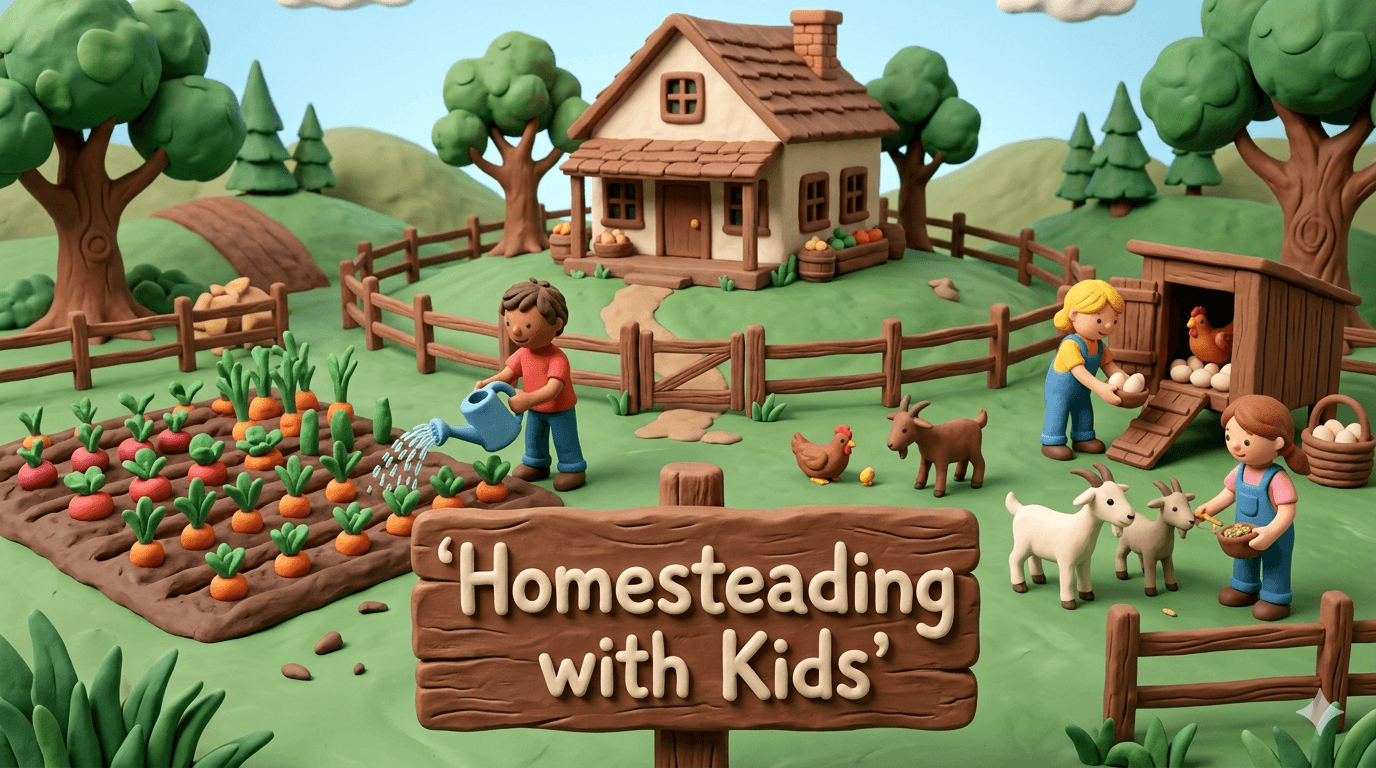
You did not start a homestead just for yourself. You started it because you want your kids to grow up with dirt under their fingernails, a tomato warm from the vine, and the quiet pride that comes from feeding the chickens before breakfast. You want them to know where food comes from. You want them outside.
The good news is that kids belong on a homestead. They were practically built for it. The harder news is that homesteading with kids looks nothing like the photos. It is slower, louder, muddier, and more interrupted than you imagined. That is fine. That is the whole point.
This guide walks through what kids can actually do at every age, the projects that hold their attention, the safety rules that matter, and how to keep all of this feeling like a life worth living instead of a list of chores. If you are brand new to all of this, our homesteading for beginners guide covers the foundations. This guide picks up from there and folds in the kids.
Why Kids Belong on a Homestead
Kids learn through their hands. A child who plants a seed and watches it become lunch understands food in a way no textbook can match. A child who cracks a fresh egg into a bowl knows where eggs come from for the rest of their life. None of this requires a curriculum. It just requires letting them be near the work.
A homestead also gives kids real responsibility, which is rare in modern childhood. The chickens need water whether anyone feels like it or not. The tomatoes need staking before they fall over. The compost needs turning. Kids who carry real weight, even small amounts of it, grow into adults who can handle real things. That confidence is hard to manufacture any other way.
There is also the simple matter of being outside. Sun on the face, wind through the trees, mud on the boots. Kids who grow up moving through weather and seasons sleep better, eat better, and tend to be calmer. You do not need a study to confirm this. You just need to watch your kids after an hour in the garden compared to an hour on a tablet.
What Changes When Kids Are in the Mix
Homesteading with kids is homesteading at half speed. A task that takes you twenty minutes alone takes an hour with a curious four year old. The garden bed gets weeded eventually, but it also gets stomped, and three earthworms get rescued, and a beetle gets named. This is the work. The slowness is the work.
You also have to plan for the mess. Kids spill the feed bucket. They drop eggs. They water the same plant for ten minutes and ignore the rest of the row. None of this is failure. It is the cost of teaching, and the cost is reasonable.
Your safety standards rise. Sharp tools live in a different place. The pond gets a fence. The pesticide cabinet gets a lock, or you stop using pesticides entirely (a good idea anyway, and one our homesteading on a budget guide makes a strong case for).
Finally, your expectations have to flex. Some days the kids are into it. Some days they want to read a book on the porch and ignore the broccoli. Both are allowed. The long game is that they grow up around this work and absorb it. The short game is just showing up together.
Age by Age: What Kids Can Actually Do
Every kid is different, so treat these as starting points rather than rules. The pattern is the same at every age. Give them real work. Stay close. Let them succeed at small things before stacking on the bigger ones.
Toddlers (Ages 2 to 4)
Toddlers cannot do much, but they can do more than most adults give them credit for. They love repetition. They love to carry things. They love water.
- Drop seeds into a pre dug furrow.
- Carry a small basket of weeds to the compost.
- Fill a watering can (small one) and water a single plant.
- Toss kitchen scraps into the chicken run.
- Collect eggs with a hand on yours.
Teaching moment: name everything. The plant, the bug, the tool, the color of the dirt. Vocabulary explodes at this age, and the homestead is a free language lab.
Early Elementary (Ages 5 to 7)
This is the magic age for homesteading. Kids are competent enough to follow a simple instruction and young enough to find every part of it fascinating.
- Plant transplants in dug holes.
- Pull weeds (after you show them the difference).
- Refill chicken waterers and feeders.
- Gather eggs alone and bring them to the kitchen.
- Pick ripe produce by color and feel.
- Help wash and sort the harvest.
Teaching moment: counting, sorting, and patterns. Eggs go in cartons of twelve. Tomatoes get sorted by ripeness. Beans get counted into the colander. Math hides everywhere.
Older Kids (Ages 8 to 11)
Older kids can take ownership of a project from start to finish. Give them a corner of the garden, a small flock, or one preservation skill, and let them run it.
- Manage a 4 by 4 raised bed of their choosing.
- Take full responsibility for daily chicken chores.
- Use hand tools (trowel, pruners, hand rake) with supervision.
- Help build trellises, beds, and simple structures.
- Mix and turn the compost pile.
- Help with basic food preservation, like washing jars or packing pickles.
Teaching moment: cause and effect. Forgot to water? The lettuce wilts. Forgot to close the coop? You learn about predators the hard way (hopefully not too hard). Lessons stick when consequences are real.
Tweens and Teens (12+)
Tweens and teens can do almost anything an adult can, and many of them want responsibility more than they want to admit. The trick is treating their work as real, not as a chore chart.
- Run a section of the garden as their own, including planning what to grow.
- Take full responsibility for a small animal operation (rabbits, ducks, a few hens).
- Operate a string trimmer, push mower, or basic power tools after proper training.
- Help with seasonal heavy work like building, fencing, and firewood.
- Sell extra produce, eggs, or baked goods at a farm stand or to neighbors.
- Cook a full meal from the homestead once a week.
Teaching moment: ownership and economics. A teen who runs a small egg business learns pricing, customer service, feed costs, and profit margins faster than any classroom would teach them.
The First Five Projects to Try Together
If you are not sure where to start, start here. These five projects are forgiving, fast enough to hold a kid's attention, and rewarding enough to keep them coming back.
- Radish patch. Radishes germinate in days and harvest in about a month. Kids see results before they lose interest. Plant a short row, water it together, and pull the first one as a family.
- Cherry tomatoes in a pot. One large pot, one cherry tomato plant, one sunny spot. Cherry tomatoes produce all summer and kids will eat them straight off the vine. This works on a balcony just as well as a back forty, which our urban homesteading guide covers in detail.
- A small herb bed. Basil, parsley, chives, and mint. Easy to grow, smells incredible, and gives kids a way to contribute to dinner every night. Send them out to grab a handful of basil for the pasta and watch what happens.
- Three backyard hens. A starter flock is the gateway animal of family homesteading. Daily eggs, daily chores, daily entertainment. Read our backyard chickens guide before you build the coop.
- Simple fermenting. Sauerkraut from a single head of cabbage, or quick refrigerator pickles from a cucumber harvest. Kids love the magic of food changing on the counter. Bonus: they will eat what they made.
For the garden projects, our starting a garden guide has the full beginner walkthrough.
Planting Calendar Tool
Enter your zip code to get a personalized planting schedule based on your USDA zone.
Try it free →Animals Kids Can Help Care For
Animals are usually the part of homesteading kids fall in love with first. They are also the part with the highest stakes. Pick the right ones for your family and the right ones for your kid.
Chickens are the obvious first animal. They are friendly enough, hardy, and a small flock is a manageable amount of work. Most kids over five can handle daily chores with a little supervision.
Rabbits are a great fit for slightly older kids who want a more hands on relationship. They are quiet, clean, and meet kids halfway in the calm department. Be honest with yourself about whether your rabbits are pets or production animals before you start, because that decision shapes everything.
Ducks are messier than chickens but more entertaining. Kids tend to adore them. They need water to splash in, which means more cleanup, but the egg quality is worth it.
Goats are not a starter animal. They are smart, social, and constantly looking for ways to escape. Older kids can absolutely help, but the adults need to be ready to lead. Start with chickens, get a season under your belt, and then think about goats.
Bees belong on a homestead, but they are an adult lead project. Kids can watch from a safe distance, help with extracting honey indoors, and learn the basics of pollination. Suit them up and bring them close only when you know they will stay calm.
Safety Without Hovering
Homesteads have hazards. Pretending they do not is how kids get hurt. The goal is not to bubble wrap your kids. The goal is to teach them how to move through real risk safely, which is a skill they will use for life.
The big categories of homestead risk for kids:
- Tools. Sharp things, heavy things, hot things. Store them out of reach until kids are trained to use them.
- Water. Ponds, stock tanks, rain barrels, even five gallon buckets can drown a small child. Cover, fence, or empty.
- Animals. Even friendly animals can knock a kid down or peck at a face. Teach approach and retreat from day one.
- Heat and sun. Hats, water, shade, breaks. Heat exhaustion sneaks up fast on small bodies.
- Chemicals. Pesticides, fertilizers, bleach, cleaning products. Lock them up or do not have them around at all.
- Equipment. Tractors, mowers, trimmers, chainsaws. Kids are nowhere near them when running. No exceptions.
Warning
The non negotiables in our family: no kid ever rides on a tractor or mower, no kid is alone near open water, and no kid handles power equipment until a parent has trained them and watched them use it correctly three times. Pick your version of these rules and never bend them.
Tip
Confidence comes from doing real work safely. The first time your seven year old gathers eggs alone, walks them to the kitchen, and washes them up, you will see something shift in how they carry themselves. Look for those moments and let them happen.
Teaching Moments Hidden in Chores
The best lessons on a homestead are not lessons. They are conversations that happen while your hands are busy.
Compost is biology class. Every time you turn the pile together, you are teaching decomposition, microbes, heat, and the nitrogen cycle. You do not have to use those words. You just have to notice the steam in the morning and ask why.
The egg basket is math class. Counting, sorting, fractions when you split a dozen, division when three hens lay eight eggs in two days. Kids absorb numbers when the numbers matter.
The garden is a weather station. Why did the lettuce bolt? Why did the tomatoes split after the rain? Why does the basil love July and the kale love October? Kids who learn to read weather and seasons grow up with a body sense most adults have lost.
The barn is a life and death lesson. Animals are born on a homestead. Animals die on a homestead. Hard things happen, and kids who walk through those moments with steady adults learn that life and death are part of the same circle. This is one of the deepest gifts a homestead gives a child, and it cannot be faked.
When Kids Lose Interest (and Why That Is Fine)
Your kid will, at some point, want nothing to do with the homestead. They will want to be inside. They will want to watch a show. They will declare gardening boring and chickens stupid. This is normal. It is not a failure of your parenting or your homestead.
The long view matters more than any single Saturday. A kid who grew up around chickens, even one who currently rolls their eyes at them, knows how to keep a flock. They will remember it when they need it. Skills laid down in childhood do not evaporate. They wait.
In the short term, give them outs. Let a project end without guilt. Let them quit the garden bed they took on in April when July gets too hot. Let them choose what they want to be involved in next season. Forced work breeds resentment, and resentment is the one thing that will turn a kid permanently away from this life.
The kids who stay involved are the kids who feel ownership. Hand them choices, not assignments, whenever you can.
Homesteading with Kids in a Small Space
You do not need acreage to give your kids this life. A balcony, a fire escape, a kitchen counter, a small backyard. All of it counts. Kids do not measure a homestead in square feet. They measure it in whether they got to plant something, water something, harvest something, and eat something they grew.
If you live in an apartment or on a small lot, your projects look different but the lessons are the same. Microgreens on the windowsill. Herbs in a railing planter. A worm bin under the sink. Quail in a corner of the yard if your zoning allows it. Our urban homesteading guide walks through every option in detail.
The kids will not know the difference. They will just know they have a thing growing that they take care of, and that is enough.
A Sample Saturday Morning on a Family Homestead
Picture this. You are up at six thirty with coffee. By seven, the older kids are at the coop opening up, checking water, scattering scratch. The youngest is still in pajamas at the kitchen window, pointing at the rooster. By seven thirty, breakfast is on the table, with eggs gathered the night before and toast from a loaf you baked Wednesday. By eight, everyone is in the garden. The big kids are weeding their own beds. The middle one is hunting tomato hornworms with a chopstick. The youngest is filling a watering can over and over and dumping it on a single zucchini plant. You are pruning tomatoes and answering a steady stream of questions about why bees only sting once, what worms eat, and whether you can have ice cream for lunch.
By ten, the heat starts to build. Everyone heads in for cold water and a snack. Two kids declare they are done. One goes back out to keep weeding. Nobody is mad about any of it. The garden got an hour of attention. The chickens got fed. Eggs got gathered. A child learned that hornworms have a horn. That is a successful Saturday. That is a homestead with kids.
Frequently Asked Questions
At what age can my child start helping on the homestead? As soon as they can walk. Toddlers cannot do real work, but they can be near the work, carry small things, and learn what every tool is called. The earlier they grow up around chores, the more those chores feel like normal life instead of a special project.
What if my kid is afraid of the chickens? Totally normal. Start small. Let them watch from outside the run. Let them feed scratch through the fence. Let them help carry the egg basket without going inside. Most kids warm up to chickens within a few weeks. Forcing a scared kid into the coop usually makes the fear last longer.
How do I keep my kids interested when the work gets boring? Rotate their projects with the seasons. Let them choose what to grow next year. Give them ownership of one thing that is fully theirs. Boredom is a sign the work feels imposed. Choice is the cure.
Are there homesteading projects we can do if we live in a city? Yes, and plenty of them. Container gardens, balcony herbs, indoor microgreens, sourdough starters, fermenting, composting in a worm bin, even a small flock of quail in some cities. Our urban homesteading guide covers all of it.
Should I make homesteading mandatory for my kids? Some baseline of help, yes. The chickens still need water whether anyone feels like it. But the bigger picture should always be a choice. Mandatory work breeds resentment. Shared work, real responsibility, and the freedom to take on more or less as they grow builds kids who actually love this life.
My kid wants to raise an animal for meat. How do I handle that conversation? Honestly. Talk about it before you start, not after. Let your kid know what the animal is for from day one. Many homestead kids handle this beautifully when adults treat it as normal, respectful, and part of how a family eats. If your kid struggles with it, that is information too, and it is okay to keep that animal as a layer or pet instead.
What if I am new to homesteading myself? Then you are learning together, and that is one of the best parts. Your kids do not need an expert. They need a parent who is curious, patient, and willing to look things up. Start with our homesteading for beginners guide and grow your skills alongside them.
How much time per week does this realistically take? With kids in the mix, plan on three to six hours a week for a small starter setup (a small garden plus a few chickens). It scales up from there. The good news is that most of those hours are time you would have spent together anyway.
The Short Version
You started this so your kids could grow up with dirt under their fingernails. They will. Some days will be magical and some days will be a mess. Both count. The skills, the confidence, and the quiet sense of being part of something real will stay with them long after they leave home. Hand them a watering can, point at the row, and let the rest happen.

Cole
Founder & Lead Researcher
Cole is the founder of Plan Your Homestead. He works in clinical research and brings a research-first lens to every guide on the site, drawing on a long family line of farmers for grounded, practical perspective.
More in Family
More articles coming soon. Check back for new family content.