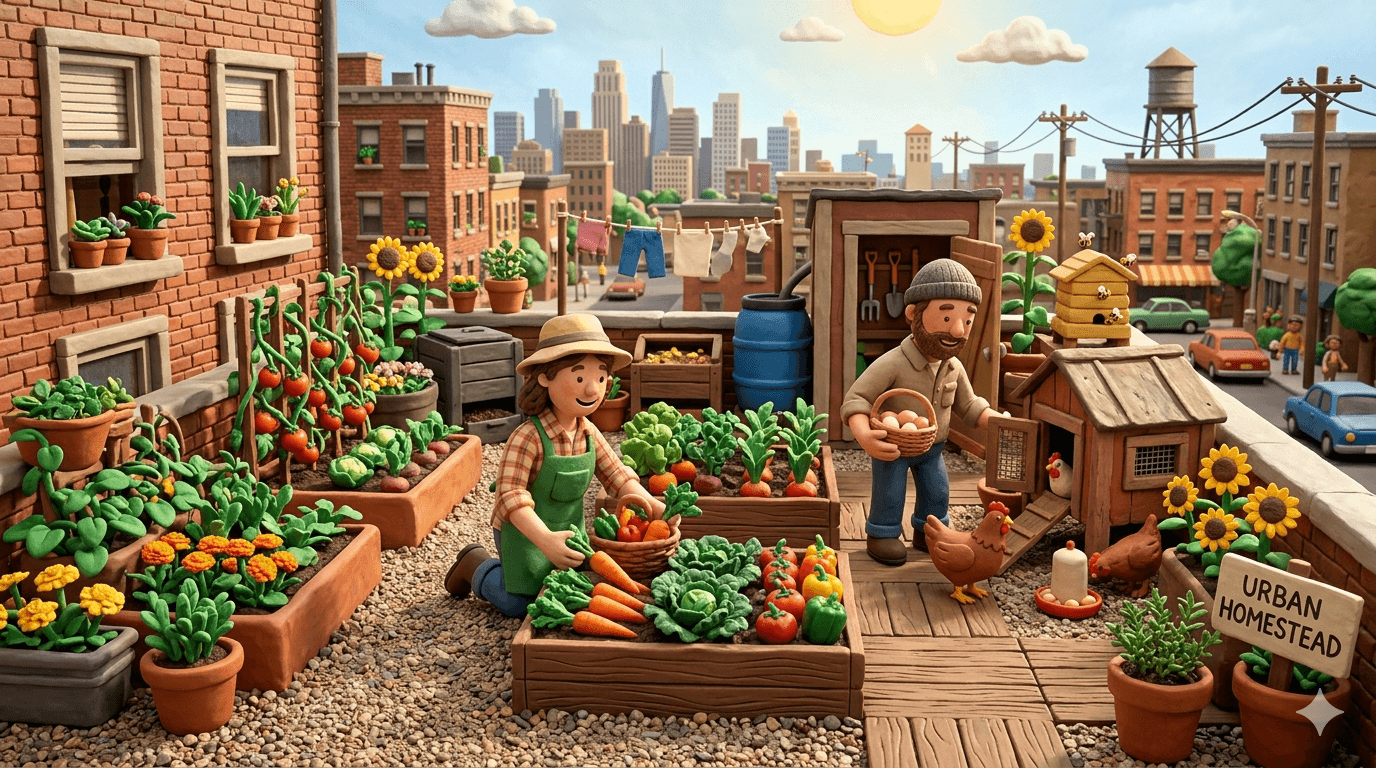
You do not need a farm to homestead. You do not need an acre. You do not even need a yard. If you have a kitchen counter, a sunny window, or a six foot balcony, you have enough to start.
Urban homesteading is the practice of producing more of what your household uses, in whatever space you happen to live. It is a mindset first and a set of practices second. The mindset says I can grow this, I can make this, I can preserve this, instead of buying it. The practices fit into a 700 square foot apartment as easily as they fit into a suburban lot.
This guide is for the apartment dweller, the condo owner, the renter who is not allowed to dig up the lawn, and the city resident who has read about homesteading and assumed it was for someone else with land. It is not. The skills, the savings, and the sense of doing something real with your hands are all available to you right now, with the space you already have.
What Urban Homesteading Actually Is
Urban homesteading is the modern, small space version of an old idea. The original homesteaders pursued self sufficiency on land they were granted by the government. Today's urban homesteader pursues self sufficiency on a balcony, a fire escape, a kitchen counter, or a 30 foot patch of suburban yard.
The activities are the same. Growing food. Cooking from scratch. Preserving what you grow. Reducing waste. Making things instead of buying them. Keeping small animals where allowed. Saving money. Building skills.
The setting is just smaller. A balcony garden grows the same lettuce as a market garden. A countertop fermenter makes the same sauerkraut as a barn. A windowsill of basil tastes like a field of basil, just in smaller quantity.
Nobody becomes fully self sufficient on a balcony. That is not the point. The point is to produce some of what you eat, learn the skills, and shave real dollars off your grocery bill while doing something deeply satisfying with your free time.
For the bigger picture of what homesteading means as a lifestyle, our homesteading for beginners guide walks through the mindset and the early decisions in detail.
Why Urban Homesteading Is Worth It
People assume urban homesteading is a watered down version of the real thing. It is not. In some ways it is the most efficient form of homesteading there is.
Here is the case for starting where you are.
You save real money. A small balcony garden can produce $200 to $600 worth of vegetables in a single summer with maybe $50 of upfront investment. A kitchen herb garden replaces $5 grocery bunches that wilt in three days. A bag of homegrown microgreens at home costs about a quarter of what the same bag costs at Whole Foods.
The food is dramatically better. A tomato picked off the vine on your balcony tastes nothing like a tomato shipped 1,500 miles. Herbs lose half their oil within hours of cutting. Once you eat fresh basil from your own pot, you stop buying the plastic clamshell forever.
It is genuinely good for your mental health. Tending plants and cooking from scratch are two of the most consistent stress reducers in the research. They get you off your phone, into your hands, and grounded in the slow rhythm of growing things.
The skills transfer up. Every skill you build in a small space transfers directly if you ever buy land. Container gardening teaches you the same soil, light, and watering principles that a 40 acre market garden teaches. Sourdough on a Brooklyn counter is the same sourdough on a Wyoming farmstead.
The bar to entry is low. A first season urban homesteader can start for under $100. A first season rural homesteader rarely starts for under $2,000. You do not need a tractor, a fence, or a coop. You need a few pots, some seeds, and a plan.
The single most common objection is "but I only have an apartment." That is exactly who this is for.
What You Can Actually Do in a Small Space
The list is longer than most people realize. Here is what genuinely works in apartments, condos, and small urban lots, ranked roughly from easiest to hardest.
| Practice | Space needed | Cost to start | Beginner friendly |
|---|---|---|---|
| Indoor herb garden | Sunny windowsill | $20 to $40 | Very |
| Microgreens and sprouts | Kitchen counter | $25 to $50 | Very |
| Sourdough and bread baking | Existing oven | $15 for flour | Very |
| Yogurt and kefir | Existing fridge | $10 starter | Very |
| Container vegetables | Balcony or stoop | $50 to $150 | Yes |
| Vertical gardening | Wall or fence | $40 to $200 | Yes |
| Composting (worm bin or bokashi) | Under sink or balcony | $30 to $100 | Yes |
| Fermenting vegetables | Counter and a jar | $15 | Yes |
| Water bath canning | Kitchen stove | $80 to $150 | Yes |
| Dehydrating | Counter appliance | $60 to $200 | Yes |
| Kombucha and water kefir | Counter | $20 | Yes |
| Foraging | Local parks and woods | $0 | Moderate |
| Rooftop or balcony beekeeping | Where legal | $400 to $700 | Moderate |
| Quail (apartment poultry) | A 2x4 foot cage | $150 to $300 | Moderate |
| Backyard chickens (if you have a yard) | 4x8 foot coop | $300 to $800 | Moderate |
You do not need to do all of these. Most urban homesteaders pick three or four they enjoy and run with them. The next section is the simplest path to get going.
Step by Step: Your First 30 Days
If you are starting from zero, here is the four week plan I would hand a friend who lives in an apartment and wants to begin.
Week 1: Plant a Windowsill Herb Garden
Buy four small herb plants from any hardware store or grocery store. Basil, mint, parsley, and chives are the friendliest beginners. Move them to a south facing or east facing window. Water when the top inch of soil is dry. Cook with them every day.
Total cost: about $25. Total time: 20 minutes.
This is the lowest stakes possible introduction to growing your own food. By Friday you will have snipped fresh herbs into your dinner. That single experience is enough to hook most people.
Week 2: Start Microgreens
Buy a tray, a bag of seed starting mix, and a packet of pea, sunflower, or radish seeds. Sprinkle the seeds densely on damp soil in the tray. Mist daily. In 10 to 14 days you will harvest a tray of microgreens worth $8 to $12 at a grocery store.
Total cost: about $30. Total time per day: 2 minutes.
Microgreens are the highest yield per square foot of any food you can grow indoors. A two tray rotation produces a steady supply of greens forever.
Week 3: Bake Bread or Make Yogurt
Pick one. Either no knead bread (which needs nothing but flour, salt, water, yeast, and a Dutch oven) or homemade yogurt (which needs nothing but a quart of milk and two spoons of plain yogurt as a starter).
Total cost: about $10. Total time: 20 minutes of active work.
Both teach you that things you have always bought can simply be made. The first loaf of homemade bread is a gateway. So is the first jar of homemade yogurt.
Week 4: Set Up a Worm Bin or a Counter Compost
A small worm bin (vermicomposting) eats your kitchen scraps quietly and produces the best fertilizer on earth for your container garden. A countertop bokashi bucket does the same job with no worms. Either one closes the loop on your food waste.
Total cost: about $40 to $80. Total time: 5 minutes a day.
By the end of month one you have herbs growing, microgreens harvesting, fresh bread or yogurt rotating, and your food waste turning into garden gold. That is a real urban homestead, in 30 days, for under $200.
Tip
Do not try to do all four weeks at once. Pick one a week and let each one become a habit before stacking the next. The fastest way to quit is to overcommit in week one. The slowest way is the one that actually sticks.
Container Gardening: The Single Highest Leverage Move
If you want one practice that produces real food in a small space, this is it. A six foot balcony with five containers can grow a meaningful share of a household's summer vegetables.
Here is what works on a balcony or patio.
Cherry tomatoes. One five gallon bucket per plant. A single indeterminate cherry tomato can produce 8 to 12 pounds over a season. Choose Sungold, Sweet 100, or any patio variety.
Salad greens. A 12 inch wide, 6 inch deep container grows a continuous supply of lettuce for two people if you cut leaves rather than pulling whole heads. Reseed every three weeks.
Peppers. One three gallon container per plant. Bell peppers, jalapeños, and shishitos all do beautifully on a sunny balcony.
Bush beans. Compact varieties like Provider produce heavily in 10 inch deep containers.
Strawberries. A hanging basket or a strawberry pot produces snacks all summer with very little fuss.
Herbs. Already covered, but worth repeating. Herbs are the single highest dollar value crop you can grow in a small space.
The four rules of container gardening are simple. Use the biggest pot the space allows (small pots dry out and stress plants). Use real potting mix, not garden soil (garden soil compacts in containers). Water more often than you think (containers dry out faster than ground). Feed regularly with a diluted liquid fertilizer or compost tea (containers run out of nutrients in about six weeks).
If you have access to a few square feet outside, our vegetable gardening for beginners guide goes deeper on what to grow and how. For your soil, our composting 101 guide explains how to build the rich amendment that makes container plants thrive. Our planting calendar tool will tell you exactly when to plant each crop in your zip code.
Indoor Growing When You Have No Outdoor Space
No balcony? No problem. A surprising amount of food production happens indoors with nothing but a window or a cheap grow light.
A south facing window grows herbs all year. Basil, parsley, chives, oregano, thyme, and mint all do well. North facing windows are too dim for productive growing without supplemental light.
A simple LED grow light changes the game. A $40 clip on light over a single shelf turns any closet, kitchen counter, or bookshelf into a productive garden. A 24 inch LED panel over a small rack runs about $80 and powers four trays of microgreens, a tray of lettuce, and a small herb garden simultaneously.
Microgreens are the indoor crop with the best yield. A 10 by 20 inch tray of pea shoots harvests in 10 days and yields about a pound of greens. Two trays on rotation gives you a salad's worth of greens every two days.
Sprouts require even less space. A jar with a mesh lid produces a cup of bean sprouts or alfalfa sprouts every three days. No light, no soil, just water.
Mushrooms are the most overlooked indoor crop. Oyster mushroom kits run about $25, take six weeks, and produce 1 to 2 pounds of mushrooms in a small box on your counter.
Lettuce and salad greens grow happily under a grow light in winter. A loose leaf cut and come again system on a small shelf produces salad mix from December through April.
The math is straightforward. About $150 in equipment plus $50 a year in seeds and growing medium produces $400 to $800 of food a year, indefinitely.
Small Space Animals: Quail, Bees, and Worms
This is where urban homesteading either stops or takes a leap, depending on your situation, your local laws, and your appetite for adventure.
Quail are the apartment chicken. They are small, quiet, and legal in many cities where chickens are not. A pair of Coturnix quail in a 2 by 4 foot cage produces 5 to 6 eggs a day, and the eggs are delicious. They also reach butcher size in 8 weeks for those interested in raising meat. Check your city ordinance carefully before buying. Some cities allow quail under exotic bird rules even when chickens are banned.
Bees can live on a city rooftop or balcony, and many do. Urban bees often produce more honey than rural bees because cities have continuous flower bloom from neighborhood gardens, parks, and street trees. Beekeeping is allowed in most major cities, but registration, hive count limits, and setback rules vary. Plan on $400 to $700 for your first hive setup.
Worms are the easiest animal to keep, and the most overlooked. A small worm bin under a kitchen sink processes a couple of pounds of food scraps a week and produces vermicompost (the best fertilizer that exists for container plants). Worms are silent, odorless when run correctly, and require maybe five minutes a week of attention.
Chickens need a yard. If you have one and your city allows them, a small flock of three to four hens produces 12 to 18 eggs a week and eats kitchen scraps that would otherwise go to landfill. Our backyard chickens guide covers the legal, coop, and breed details for suburban or small lot chicken keeping.
Warning
Always check your lease, HOA bylaws, and city ordinance before buying any animal. Even quail and bees, which are usually legal, may be banned by your specific landlord or HOA. The fine for an unpermitted hive or coop can run into hundreds of dollars per day in some cities. Five minutes of research saves a lot of pain later.
Food Preservation in a Small Kitchen
A small kitchen is a real constraint, but not an excuse. The methods that fit a galley kitchen still preserve real food.
Fermenting is the friendliest preservation method for an apartment. A single quart jar on the counter ferments sauerkraut in a week, kimchi in five days, or pickles in ten days. No equipment beyond the jar. No heat. No special skills. The result is food that lasts months in the fridge and tastes like nothing you can buy.
Water bath canning works in any kitchen with a stove. A 21 quart water bath canner runs about $50 and processes 7 quart jars of jam, salsa, pickles, applesauce, or tomato sauce in a single batch. A summer afternoon of canning produces 20 to 30 jars of pantry staples that last 18 months.
Dehydrating is the most apartment friendly preservation method of all. A small countertop dehydrator (about $80) turns peppers into chili flakes, herbs into shelf stable seasoning, and fruit into snacks. The dried results take up a fraction of the space of canned or frozen food.
Freezing is the underrated workhorse. A standard apartment freezer holds enough vegetables, fruit, and bread to feed a small household for months if you stock it strategically. A vacuum sealer ($60) extends freezer life dramatically and is the single best small kitchen investment after a sharp knife.
The pantry, fridge, freezer, and a closet shelf are enough to preserve a year's worth of meaningful food production in a small apartment. Our canning for beginners guide walks through the safety, equipment, and method of water bath canning in detail.
Urban Homesteading on a Budget
The honest answer is you can start urban homesteading for less than $100 and grow it from there.
Here is a working budget for a first year apartment homestead.
- 4 herb plants and a window: $25
- Microgreen kit and seeds: $30
- Worm bin starter: $50
- Small fermenter or 4 quart jars: $20
- Sourdough starter (or make your own): $0 to $10
- Yogurt jars and starter culture: $10
- Total to begin: about $135
If you have a balcony, add:
- Five 5 gallon containers: $40
- Potting mix: $25
- Seedlings and seeds: $30
- Liquid fertilizer: $15
- Total balcony add on: about $110
A first year of urban homesteading at $245 produces somewhere between $500 and $1,000 of food, a stack of new skills, and a foundation that gets cheaper every year as you save seeds, propagate plants, and accumulate jars. Compare that to a first year rural homestead, which typically runs $2,000 to $5,000 just to break ground.
For a deeper plan on stretching every dollar, our homesteading on a budget guide covers the wider cost picture.
Knowing the Rules: Leases, HOAs, and City Ordinances
The single fastest way to torpedo your urban homestead is to skip the legal homework. Most urban homesteading is perfectly legal. Some of it is not. The rules layer in three places.
Your lease. Renters need to read the actual document. Many leases ban animals other than registered pets, restrict balcony plants by container size, and prohibit modifications like screwing a planter to a wall. A polite email to your landlord is usually enough to get container gardens, microgreens, and a worm bin pre approved in writing.
Your HOA. Condo and townhouse owners face HOA bylaws that often regulate balcony appearance, container counts, plant types, and visible storage. Read the bylaws before buying anything. Many HOAs are more permissive than people assume, especially toward neat container gardens that improve curb appeal.
Your city ordinance. This governs animals (chickens, quail, bees, rabbits), composting, and sometimes rainwater collection. Search "your city + chicken ordinance" or "your city + beekeeping" and you will usually find the actual code in two minutes. Many cities updated their codes in the last five years to be more permissive. Do not rely on what your neighbor says. Read the law.
For a national overview of the legal landscape that shapes every homestead, our homesteading laws and zoning guide covers the topic in depth.
From Apartment to Suburb to Acreage
Urban homesteading is a destination for some people and an on-ramp for others. Both are valid. The skills work either way.
If you ever move to a house with a yard, every skill you built on a balcony scales up. The container gardener who moves to a quarter acre suburban lot can build raised beds the first weekend and feel completely at home. The apartment fermenter who moves to two acres in the country is already canning, baking, and preserving by the time the land is theirs.
If you ever move to actual rural acreage, the on-ramp keeps paying dividends. Many of the most successful rural homesteaders started in apartments. They learned soil and seasons and patience before they had the space and money to make expensive mistakes. The path from apartment to acreage is shorter and cheaper than people think, and our how to start homesteading guide lays out the full timeline.
For a clear look at the line between homesteading as a lifestyle and farming as a business, our homesteading vs farming guide is worth a read once you start thinking bigger.
Or you may stay in the city forever, and that is a beautiful version of this life too. An urban homestead is not a stepping stone unless you want it to be.
Common Mistakes to Avoid
Urban homesteaders quit for predictable reasons. Avoid these and you will keep going.
- Starting with too much at once. Pick one project. Learn it. Add the next. The first year graveyard is full of apartment homesteaders who bought eight tomato plants, two trays of microgreens, a worm bin, a fermenter, a sourdough starter, and a quail cage in the same week.
- Misjudging your light. A north facing window will not grow tomatoes. A balcony with three hours of sun will not grow peppers. Check actual sun exposure before you buy plants. Use a free phone app like Sun Surveyor to map it.
- Cheaping out on soil. Garden soil from the yard does not work in containers. It compacts, it dries hard, and it kills roots. Buy real potting mix the first time.
- Ignoring the rules. Animals without permission, hives without registration, and balcony modifications without landlord approval all end badly. The fix is a five minute email or a phone call.
- No watering plan. Container plants and microgreens die fast without water. A travel plan, a self watering setup, or a willing neighbor is essential before you leave town.
- Treating it like work instead of pleasure. The whole point is to enjoy this. If a project is making you miserable, stop doing it. Pick something else. The right urban homestead is the one you actually like.
Final Take
Urban homesteading is not a smaller, sadder version of the real thing. It is the real thing, scaled to the space you have.
A windowsill of basil. A tray of microgreens. A jar of bubbling kraut. A loaf of sourdough cooling on the counter. A worm bin under the sink. Five containers on a balcony making real food. Each one is a small act of self sufficiency. Stack them and you have a homestead.
You do not need land. You do not need permission from anyone except your landlord. You do not need to wait until your circumstances change. The space you have right now is enough.
Pick one project from this guide. Start it this week. Let it become a habit before you add the next one. In a year you will have a real urban homestead, more food than you imagined possible from your space, and the foundation for whatever larger version of this life comes next.
The land does not care where you start. It only cares that you do.
Frequently Asked Questions
Yes, and millions of people do. An apartment homestead typically includes an indoor herb garden, microgreens, sourdough or other from scratch baking, fermenting, and a small worm bin for kitchen scraps. With a balcony or patio you can add container vegetables, vertical gardening, and sometimes quail or rooftop bees where local laws allow. A first year apartment homestead can produce $500 to $1,000 worth of food on under $250 of upfront investment.
Urban homesteading is the practice of producing more of what your household uses while living in a city, suburb, or other small space environment. It includes growing food in containers, indoor herb gardens, microgreens, fermenting, baking, food preservation, composting, and sometimes keeping small animals like quail, bees, or worms. The goal is the same as rural homesteading, which is to lean less on the modern food system and build hands on skills, just adapted to small spaces.
A modest urban homestead saves between $400 and $1,200 a year on groceries, depending on space and effort. A balcony container garden alone can produce $200 to $600 of vegetables in a summer for about $50 in supplies. An indoor herb garden replaces $200 a year of grocery store herbs. Baking your own bread saves $300 to $500 a year for a household that eats a loaf a week. The savings grow as you save seeds, propagate plants, and reuse equipment year over year.
Generally no, but you can usually raise quail, which are the apartment friendly alternative. Quail are smaller, quieter, and legal in many cities where chickens are not. A pair of Coturnix quail in a 2 by 4 foot cage produces 5 to 6 eggs a day and reaches butcher size in 8 weeks. Always check your lease and city ordinance first, since some buildings ban all live poultry regardless of species.
A six foot balcony with full sun can grow cherry tomatoes, peppers, lettuce, herbs, strawberries, bush beans, kale, chard, and small cucumber varieties. Use the largest containers the space allows (5 gallon minimum for tomatoes and peppers), use real potting mix instead of garden soil, water more often than ground gardens, and feed weekly with diluted liquid fertilizer. Vertical structures like trellises and railing planters double or triple the growing area in the same square footage.
Most of urban homesteading is legal anywhere, including container gardens, indoor herbs, microgreens, fermenting, baking, dehydrating, water bath canning, and worm bins. Animal keeping is where rules vary the most. Chickens, quail, bees, and rabbits are governed by city ordinance and often by HOA or lease rules. Always read your lease, your HOA bylaws, and your city ordinance before buying any animal. Most cities updated their codes in the last decade and are more permissive than people assume.
Start with a windowsill herb garden in week one. Add a tray of microgreens in week two. Bake your first loaf of no knead bread or make your first batch of homemade yogurt in week three. Set up a small worm bin or counter compost in week four. That four week plan costs about $135 and produces fresh herbs, microgreens, bread, and a closed waste loop. Pick one project at a time and let each become a habit before adding the next.
An indoor herb garden is the easiest first step. Buy four small herb plants (basil, parsley, mint, chives), put them in a sunny window, water when the soil dries out, and use them in your cooking every day. Total cost is about $25 and total setup time is 20 minutes. Within a week you will be cooking with herbs you grew, and that single experience is enough to launch most people into the rest of urban homesteading.

Cole
Founder & Lead Researcher
Cole is the founder of Plan Your Homestead. He works in clinical research and brings a research-first lens to every guide on the site, drawing on a long family line of farmers for grounded, practical perspective.
More in Guides
More articles coming soon. Check back for new guides content.