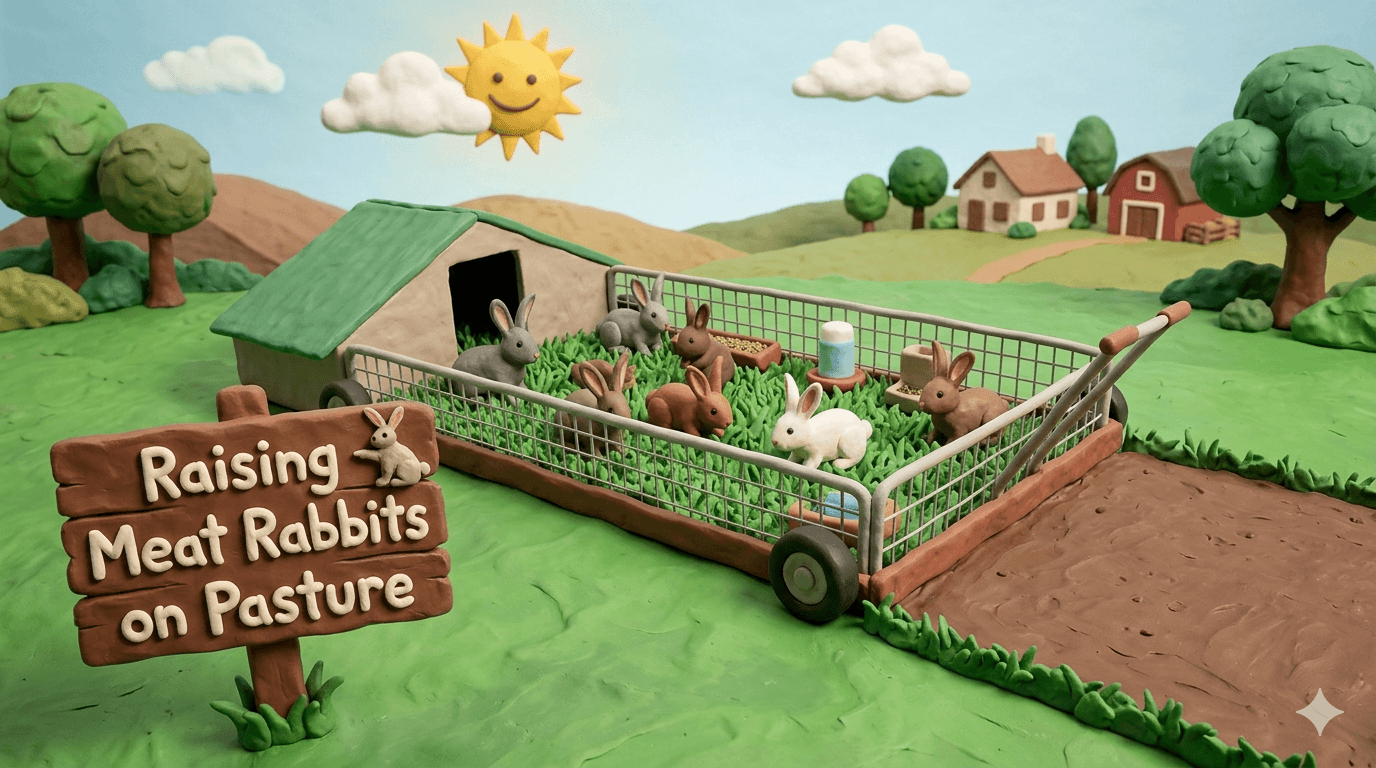
Pastured meat rabbits are one of the best returns on a small homestead. They turn grass and weeds into protein. They take up less space than chickens. They are quiet. They reproduce fast. And most of the work happens in five minutes a day.
The catch is that almost everything written about meat rabbits assumes a wire cage stack in a shed. That works, but it is not the only way. Pastured systems give you healthier rabbits, better tasting meat, lower feed bills, and a lot less smell. They also fit naturally into a rotational grazing setup if you already move chickens or sheep.
This guide walks through every step of getting started. It covers why pasture works, the best breeds, how to build a rabbit tractor, what your rabbits will actually eat off the grass, the daily routine, predators, breeding timelines, costs, butchering basics, and the most common mistakes. By the end you will know whether pastured rabbits fit your land and how to start with three breeders.
If you are still mapping out the bigger picture of homestead livestock, our homesteading for beginners pillar guide covers how rabbits fit alongside chickens, gardens, and the rest of homestead life.
Why Raise Meat Rabbits on Pasture?
Wire cage rabbitries dominate the meat rabbit world for good reason. They are easy to clean, easy to scale, and protect rabbits from weather and predators. But they also have well known costs. Sore hocks, ammonia buildup, total reliance on bagged pellets, and the slow grind of a system that never sees sunlight.
Pasture solves most of those problems at once.
Healthier rabbits. Rabbits on grass move more, sun themselves, and graze a varied diet. Coccidiosis pressure drops because manure does not pile up. Sore hocks disappear when the floor is grass instead of wire.
Better meat. Pastured rabbit meat has more flavor, more color, and a healthier fat profile. The meat tastes like the forage. It is the same reason pastured chicken beats supermarket chicken.
Lower feed bills. A 50 pound bag of pellets costs $25 to $40 in 2026. A doe and her litter on good forage can cut pellet use by 30 to 60 percent. Multiply that by a year and the savings pay for the tractor.
Free fertilizer placement. A rabbit tractor is a manure spreader that drops perfect cold compost exactly where you move it. Run it across a tired garden bed in fall and watch the soil bounce back the following spring.
Less smell. A wire cage rabbitry smells like ammonia by the second week. A pastured tractor smells like grass.
The tradeoff is honest. Pasture is more weather dependent. You cannot stack rabbits as densely. Predators get more chances. Winter still requires a backup plan in cold climates. But for most small homesteads, those tradeoffs are easy to live with.
Best Breeds for Pastured Meat Production
Not every meat rabbit breed thrives outside a wire cage. The best pastured rabbits are heavy bodied, fast growing, calm under pressure, and used to varied weather. These five breeds do the job well.
New Zealand White
The default American meat rabbit. Does kindle 8 to 10 kits per litter. Kits hit a five pound butcher weight at 8 to 10 weeks. Dressing percentage runs 55 to 60 percent. Calm temperament, white pelts that sell well, and easy to find from any breeder. Start here if you have no preference.
Californian
Originally bred from New Zealand, Chinchilla, and Himalayan stock. Slightly smaller adult weight than New Zealand but excellent feed conversion. The black points on a white body make them easy to spot in tall grass. Often crossed with New Zealand for the best of both.
American Chinchilla
A heritage breed that was nearly lost. Slightly slower growth than New Zealand but exceptional meat to bone ratio and a beautiful agouti coat. Strong mothers and calm temperament. A great pick if you care about heritage genetics.
Silver Fox
Heavy bodied, friendly, and one of the only American breeds that holds its weight on a higher forage diet. The black silvered coat is striking. Slower to mature than New Zealand, often needing 12 weeks to reach butcher weight, but the meat quality is outstanding.
Standard Rex
The Rex is a dual purpose breed valued for both meat and pelt. The fur is plush and salable if you process pelts. Slightly smaller carcass than New Zealand but excellent meat quality and very calm on pasture.
Avoid dwarf and angora breeds for meat. They grow too slow and dress out too small. Mini Rex are pet rabbits, not meat rabbits, despite the name.
If you can only buy three rabbits to start, get one buck and two does of the same breed. Two does keeps your kindling rolling without doubling your work. One buck handles both does and any future expansion.
What Is a Rabbit Tractor?
A rabbit tractor is a bottomless or wire floored cage that you move daily across pasture. The rabbits inside graze the grass under their feet, drop manure, and then move to fresh forage when you slide the whole unit a few feet over.
It is the rabbit version of a chicken tractor. Joel Salatin popularized the chicken version. Daniel Salatin and a handful of pasture based farmers have spent the last twenty years refining the rabbit version. The system works for the same reason chicken tractors work. The animals get fresh ground every day. The ground gets a single concentrated visit and then a long rest.
A good rabbit tractor handles three jobs at once. It contains the rabbits. It blocks predators. It moves easily across uneven ground without crushing rabbits in the process.
The daily move is the entire system. Skip a day and the manure starts to pile up. Skip three days and you are back to a wire cage with extra steps. Move it every morning before feeding and the system runs itself.
Building Your First Rabbit Tractor
You can buy a rabbit tractor or build one. Building is cheaper and gives you a unit tuned to your land. Most homesteaders can build a solid tractor in a weekend for under $200.
Dimensions That Work
The standard pastured rabbit tractor is 4 feet wide by 8 feet long by 18 to 24 inches tall. That gives a doe and her litter enough room to move, graze, and stay separated when needed. A single sheet of plywood and an 8 foot length of welded wire fit those dimensions exactly, which keeps cuts simple.
Two adjacent tractors of that size handle two does on rotation, which is the right starter scale for a family of four.
Wire Floor or Open Bottom?
This is the central design choice. Both work and both have tradeoffs.
Open bottom tractors put the rabbits directly on grass. They graze the most. The manure drops on the ground. The rabbits feel the most natural. The downside is digging. A doe in heat or a stressed rabbit can dig out in under an hour. Open bottom tractors require deep skirting or a wire apron to block escape.
Wire floor tractors use one inch by half inch welded wire as a floor. The rabbits graze the grass that pokes through. Manure falls through and lands on the pasture. Digging is impossible. Predators cannot reach up through the bottom. Wire floors are the safer choice for first time builders.
A hybrid design uses wire floor under the nest box area and open bottom under the grazing section. That gives the kits a safe nest area and the does a real grazing surface.
Materials
A working budget tractor uses two by twos for the frame, half inch hardware cloth for the sides, one by one welded wire for the floor if you go that route, a sheet of corrugated metal for shade and rain cover, and four small wheels on one end for moving. Skip chicken wire. Raccoons, dogs, and weasels go through chicken wire like paper.
Cover at least half the top with metal roofing. Rabbits handle cold far better than heat. Shade is not optional in summer.
Tip
Stocking density matters more than size. One doe with a litter of 8 kits needs 24 to 32 square feet of tractor floor. Two does with kits in one tractor will fight and trample. Run one breeding female per tractor.
The Move System
Add small wheels or skids to one end of the tractor. To move it, lift the wheel free end and walk forward. The rabbits get a moment to step forward as the floor passes over them. Move slowly. A foot or two per second is plenty.
Most homesteaders move tractors 4 to 8 feet per day on good pasture. On thin grass, move farther. On lush forage, move less.
Forage and Feed on Pasture
Rabbits are not cows. They cannot live on grass alone, no matter what the homesteading internet sometimes claims. But they get a meaningful percentage of their diet from pasture if the forage is good and varied.
What Rabbits Actually Eat
Rabbits prefer broadleaf forage over straight grass. The plants they go for first include:
- Clover (red and white)
- Plantain (the lawn weed, not the banana)
- Dandelion (leaves, flowers, and roots)
- Chicory
- Lambsquarter
- Wild lettuce
- Comfrey (in moderation)
- Brassica leaves and tops
A pasture seeded with a clover and chicory mix will support rabbit grazing far better than a straight grass lawn. If you have control over what gets planted, oversow your rabbit run with clover and let dandelion grow.
Supplementing With Pellets and Hay
Plan on supplementing with pellets and hay even on the best pasture. A growing kit needs 16 percent protein. Spring grass alone runs around 12 percent. The math does not work without a supplement.
A reasonable feed plan looks like this:
- Pellets: half the normal cage rate, fed once daily. About 4 ounces per adult, 6 to 8 ounces per nursing doe.
- Hay: free choice timothy or orchard grass in a hay rack inside the tractor.
- Pasture: unlimited grazing wherever the tractor sits.
- Garden scraps: lettuce ends, carrot tops, herb trimmings, broccoli leaves. Feed in the evening as a treat.
- Water: clean, fresh, and never empty. Rabbits stop eating when they stop drinking.
This setup cuts pellet use roughly in half versus a full cage diet without sacrificing growth.
Warning
Several common pasture and garden plants are toxic to rabbits. Avoid letting your tractor sit on rhubarb leaves, tomato leaves, potato plants, foxglove, lily of the valley, yew, oleander, avocado leaves, or any nightshade. Walk the path of your rotation before you set the tractor down.
Daily and Weekly Routine
The pastured rabbit routine is short and predictable. Most days take five to ten minutes per tractor.
Daily, Every Morning
- Move the tractor 4 to 8 feet to fresh ground.
- Refill water. In summer, add ice or move the bottle to shade.
- Feed the daily pellet ration.
- Top off the hay rack.
- Quick visual check. Look at every rabbit. Eyes bright, ears clean, no labored breathing.
That is the whole list. With two tractors, you are done in fifteen minutes.
Evening Check in Summer
In hot weather, a second visit in late afternoon catches heat stress before it kills. Frozen water bottles laid in the tractor work better than anything else. A rabbit lying flat with shallow breathing is in trouble. Cool it down fast.
Weekly
- Check tractor frame, wire, and latches for wear.
- Trim long forage that might be jamming the wheels.
- Weigh growing kits if you are tracking feed conversion.
- Note any does that should be rebred or weaned soon.
Monthly
- Walk the rotation path and note pasture recovery.
- Top up bedding in the nest box if a doe is kindling soon.
- Restock pellets and hay before you run out, not after.
Predator Protection on Pasture
Rabbits are prey. Every predator on your land is a potential threat, even ones that ignore your chickens.
The main attackers are the same cast you face with poultry. Raccoons reach through wire. Foxes and coyotes dig under tractor walls. Hawks try to grab kits through gaps in the top. Dogs, both stray and neighbor, kill more pastured rabbits than any wild predator. Weasels and minks slip through any gap larger than one inch.
The defenses are the same rules that apply to any small livestock outside a barn:
- Use half inch hardware cloth, not chicken wire, on every wall.
- Wrap a 12 inch wire apron around the base of any open bottom tractor.
- Cover at least half the top with solid roofing to block hawks.
- Park the tractors within sight of the house, not at the back fence.
- Lock the doors with predator proof latches, not simple hooks.
A livestock guardian dog patrolling the pasture eliminates most attacks. If you do not have a guardian, plan on losing a rabbit or two in your first year and harden the tractor based on what gets in.
The same hardware cloth and predator logic that protects chickens applies to rabbits. Our predator proof coop guide covers latch types, wire specs, and apron construction in detail. Every recommendation in that guide applies to a rabbit tractor.
Breeding and Grow Out Timeline
The reproductive math is what makes meat rabbits special. A single doe can produce 80 to 120 pounds of dressed meat per year on a moderate breeding schedule. Two does and a buck can feed a family of four with rabbit once a week, year round.
The Numbers
- Buck to doe ratio: 1 buck for every 5 to 10 does.
- Breeding age: 5 to 6 months for medium breeds, 7 to 8 months for heavy breeds.
- Gestation: 28 to 32 days.
- Litter size: 6 to 12 kits, with 8 being typical for New Zealand.
- Weaning: 4 to 5 weeks.
- Butcher weight: 4.5 to 5 pounds live, reached at 8 to 12 weeks depending on breed.
- Breed back: Rebreed the doe 2 to 4 weeks after kindling for a steady supply.
A Typical Year
Run two does on staggered breeding. Doe A kindles in March, June, September, and December. Doe B kindles in April, July, October, and January. That gives you a litter of 8 to 10 kits roughly every six weeks year round.
At a 55 percent dressing percentage, each butcher rabbit yields about 2.5 to 2.75 pounds of meat. Sixteen kits per breeding cycle times 2.5 pounds equals 40 pounds of meat every six weeks. That is about 320 pounds of meat per year from two does.
Bringing the Doe to the Buck
Always take the doe to the buck's tractor or cage, never the other way. Does are territorial and will attack a buck on their turf. A successful breeding takes 30 seconds and ends with the buck falling sideways off the doe. If that happens, mark the calendar. Kindling will come in 30 days.
Provide a nest box on day 28 with clean straw or hay. The doe will pull her own fur to line it. Do not interfere unless something is clearly wrong.
Costs and Returns
Pastured meat rabbits are one of the cheapest meat protein sources you can produce on a small homestead. The math holds up under scrutiny.
Startup Costs
- One buck and two does of breeding age: $90 to $200 total
- Two rabbit tractors built from scratch: $300 to $400 total
- Nest boxes, water bottles, hay racks, and feeders: $80 to $120
- First three months of pellets and hay: $100 to $150
A reasonable startup budget is $600 to $850 for a working two doe operation.
Ongoing Costs Per Year
- Pellets: $300 to $500
- Hay: $100 to $200
- Replacement bedding, supplies, and minor repairs: $50 to $100
Total operating cost runs about $450 to $800 per year for two does producing 300 plus pounds of meat. That works out to roughly $1.50 to $2.50 per pound of dressed rabbit, well below the price of pastured chicken at the farm gate.
If you want a more accurate model for your own setup, our feed cost calculator handles rabbits along with chickens, ducks, pigs, and goats.
Butchering Basics
Home butchering a rabbit is straightforward. The skills transfer directly from any small animal harvest, and most homesteaders find rabbit easier than chicken. A single rabbit takes 15 to 20 minutes from start to package once you have the workflow down.
The standard humane dispatch is the cervical dislocation method using a broomstick or a purpose built rabbit dispatcher. A single firm pull separates the spinal cord at the base of the skull. Death is instant. The rabbit feels no pain and does not flop or struggle.
After dispatch, the workflow is short:
- Hang by the back legs.
- Bleed for two to three minutes.
- Skin from ankles down to the head. Rabbit pelt comes off cleanly with no plucking.
- Remove the head and front feet.
- Open the abdomen and remove the entrails.
- Rinse the carcass in cold water.
- Rest at least 24 hours in the fridge before cooking. Rabbit meat is much better after a day of rest.
Tools needed: a sharp knife, a hose or spray nozzle, a clean bucket, a hanging rope or hook, and a cooler with ice. Many homesteaders process all weaned kits from a litter on a single afternoon, which makes the cleanup pay for itself.
If you cannot face home butchering, most rural areas have small custom processors that will handle rabbits for $5 to $10 per head. Call ahead. Rabbit processing is less common than chicken processing and requires a phone call to schedule.
Common Mistakes to Avoid
Most pastured rabbit projects fail for the same handful of reasons. Avoid these and your odds of a successful first year jump dramatically.
Wet ground. Rabbits do not tolerate sustained dampness. A tractor sitting in a low spot after rain will give you sick rabbits within a week. Move the tractor uphill or onto a pad of pine needles when the ground is soaked.
Summer heat. Rabbits die at 90 degrees and above without active cooling. Frozen water bottles, deep shade, and morning only feeding are not optional in southern climates. Plan your tractor placement around afternoon shade.
Skipping daily moves. A pastured tractor that sits in place for two days is a dirty wire cage. Move every single day or accept that you are not actually pasturing the rabbits.
Overstocking the tractor. Two does with kits in one tractor is a recipe for fighting, trampled kits, and stressed mothers. One breeding female per tractor.
Cheap wire. Chicken wire fails the moment a determined predator finds it. Use half inch hardware cloth or do not bother with the project.
Late predator hardening. The first attack always happens in the first month. Build the tractor for the worst predator on your land before day one, not after the first loss.
Is Pastured Rabbit Right for Your Homestead?
Pastured meat rabbits work well for most homesteads, but not every one. Here is the short honest filter.
You probably should: You have at least a quarter acre of grass, you eat meat regularly, you can commit to ten daily minutes of chores, and you want a fast return on the time.
You probably should not: You travel often without a sitter, you have severely limited yard space, your local laws ban backyard rabbits (some HOAs do), or you cannot face the harvest part of the system.
If you are weighing rabbits against other animals, our livestock quiz walks through space, time, and budget questions for chickens, ducks, goats, sheep, pigs, and rabbits. It will tell you which species fits your situation best.
For a budget conscious homesteader, pastured rabbits are hard to beat. The startup is low. The footprint is small. The return is real. Our homesteading on a budget guide lays out the broader cost picture if you are watching every dollar.
Frequently Asked Questions
Can rabbits live on pasture alone without pellets?
Not reliably. Pasture is not nutritionally dense enough on its own to grow kits to butcher weight in a reasonable time. Plan on supplementing with pellets at half the normal rate plus free choice hay. A pasture only diet works for adult bucks during off seasons but not for nursing does or growing fryers.
How many rabbits can I raise per acre on pasture?
A well managed pasture supports 3 to 5 breeding does plus their litters per acre on a rotational system. That works out to roughly 600 to 1,200 pounds of dressed meat per acre per year. Most homesteads need far less, since two does feed a family of four.
What is the best meat rabbit breed for beginners?
New Zealand White. Easy to find, calm, fast growing, large litters, and proven over decades on small homesteads. Californian and New Zealand crosses are also excellent. Save heritage breeds like Silver Fox and American Chinchilla for your second year once you have the system dialed in.
Do pastured rabbits get sick more often than caged rabbits?
No, they get sick less often if the system is built right. Manure does not pile up. Ammonia does not build up. Sore hocks disappear. The main risks shift to weather, predators, and parasite pressure from contact with wild rabbits. All three are manageable with good tractor design and rotational moves.
How much does it cost to get started?
A working two doe operation with two homemade tractors runs $600 to $850 in startup costs. Add another $450 to $800 per year in feed and bedding. The math gets you under $2.50 per pound of dressed meat by your second year.
Do I need a permit to raise meat rabbits?
In most rural and suburban areas, no. Rabbits are classified as small livestock or poultry in nearly every state and require no special permit for personal use. Some HOAs ban them. Check local zoning before you build. If you plan to sell rabbit meat, USDA and state regulations apply and vary widely.
Can I raise rabbits on pasture in winter?
Yes, with a backup plan. Rabbits handle cold far better than heat. Below 20 degrees, swap the tractor for a sheltered hutch with windbreaks or move the tractor under a covered area. Water is the main winter problem. Heated water bottles or twice daily refills keep the system running.
How long until I am eating my own rabbit meat?
About four months from the day you bring home your first breeders. Six to eight weeks for the does to settle and reach breeding weight. Thirty days of gestation. Eight to twelve weeks of grow out. Most homesteaders harvest their first litter 16 to 18 weeks after starting.
The Short Version
Pastured meat rabbits are one of the highest return animals on a small homestead. Two does and a buck on a daily move tractor system produce around 300 pounds of meat per year for under $2.50 per pound. The work is short. The footprint is small. The meat is excellent.
Build with hardware cloth. Move every morning. Supplement with pellets and hay. Watch the heat. Lock it tight at night. That is the whole system.
If you have grass, time, and the willingness to harvest your own food, the rabbit tractor is one of the best investments you can make in your first homesteading year.

Cole
Founder & Lead Researcher
Cole is the founder of Plan Your Homestead. He works in clinical research and brings a research-first lens to every guide on the site, drawing on a long family line of farmers for grounded, practical perspective.
More in Animals
More articles coming soon. Check back for new animals content.