
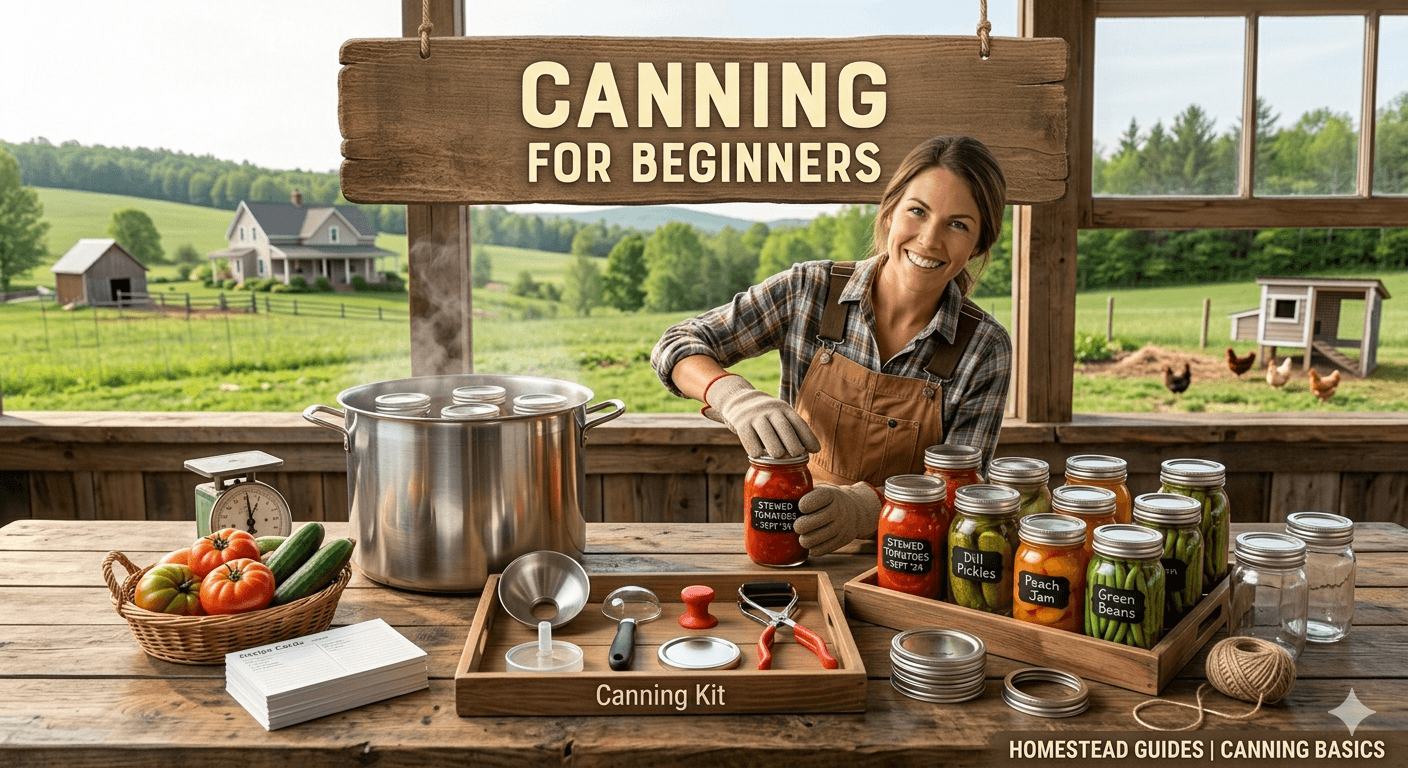
There is something wonderful about a row of full jars on a shelf. Tomato sauce in September. Peach jam in February. A pint of green beans you grew yourself, sitting next to ten more just like it. Canning is one of the oldest homestead skills, and it is still one of the most useful.
If you have never canned a thing in your life, welcome. You are about to learn a skill your grandparents probably knew by heart. The good news is that canning is not difficult. The science is settled. The tools are inexpensive. The recipes are everywhere. You just need a clear path in.
This guide is that path. We will cover what canning actually is, the two main methods you must learn, the gear you really need, and the rules that keep your family safe. We will walk through your very first batch from start to finish. By the end, you will be ready to put up your first jars with calm and confidence.
Take a deep breath. You can absolutely do this.
What Canning Really Is
Canning is the practice of sealing food inside a glass jar and heating it long enough to make it shelf stable. The heat does two jobs at once. It kills the spoilage organisms inside the jar. It also pushes air out so the lid seals tight as the jar cools. That seal keeps new microbes from getting in.
A properly canned jar can sit on your pantry shelf for a year or more. No refrigeration. No freezer space. No power required. That is the magic. You are turning a peak season harvest into food you can eat all winter long.
There are two main canning methods you need to know. They sound similar, but they are not interchangeable. Choosing the wrong method is the single most common mistake new canners make, and it is the one that can actually hurt you.
Water Bath Canning
Water bath canning uses a tall pot of boiling water to process jars. You fill your jars, place lids on top, and submerge them in the boiling water for a set time. The temperature inside reaches about 212 degrees Fahrenheit. That is hot enough to kill mold, yeast, and most bacteria.
Water bath canning works only for high acid foods. That includes most fruit, jams, jellies, pickles, salsa with added vinegar, and tomatoes with added lemon juice or citric acid. The acid blocks the growth of botulism bacteria, which is the one we worry about most.
Water bath canning is where almost every new canner starts. It is simple, quick, and very forgiving. You can begin this weekend with gear you already own.
Pressure Canning
Pressure canning uses a sealed pot and pressurized steam to reach much higher temperatures. Inside a pressure canner, the contents reach about 240 degrees Fahrenheit. That is hot enough to destroy botulism spores, which a boiling water bath cannot do.
Pressure canning is the only safe way to can low acid foods at home. That includes plain vegetables, beans, soups, stocks, meat, poultry, and fish. If you want to put up green beans, sweet corn, chicken stock, or chili, you need a pressure canner. There is no shortcut.
A pressure canner is a bigger investment, both in money and in learning curve. You do not need one to start canning. You will probably want one within a year or two if you keep going.
Warning
This is the most important rule in home canning. Never use a water bath canner for low acid foods. Never use old recipes from family cookbooks that skip the pressure step. Botulism is rare, but it is deadly, and it cannot be tasted, smelled, or seen. Stick with tested recipes from the USDA, your local extension office, or Ball, and you will be safe.
The Gear You Actually Need
You can start canning for less than the cost of a single restaurant meal. The gear list is short, and most of it lasts for decades.
A Water Bath Canner
A water bath canner is just a tall pot with a rack inside. The pot needs to be deep enough to cover the tops of your jars by an inch of water. Most enameled water bath canners run twenty to forty dollars and hold seven quart jars at a time.
If you have a tall stockpot at home, you can use that to start. Just add a folding metal rack or a folded kitchen towel on the bottom so the jars do not sit directly on the heat. The jars must not touch the bottom of the pot.
Mason Jars With Two Piece Lids
Use real canning jars with two piece lids. Ball, Kerr, and Bernardin are the common brands. Mayonnaise jars and pasta sauce jars are not designed for canning and can crack. Save those for storing dry goods.
The two piece lid is the heart of a safe seal. The flat metal lid has a sealing compound around the rim. The screw band holds it in place during processing. After the jar cools and seals, you remove the band and store the jar with just the lid on top.
Lids are single use. Bands can be reused for years.
A Jar Lifter and a Funnel
A jar lifter is a pair of rubber tipped tongs shaped to grip a hot jar safely. A wide mouth funnel keeps your food in the jar instead of on the rim. Both cost a few dollars. You will use them every single time you can.
A canning starter kit usually bundles a jar lifter, funnel, lid magnet, and bubble remover for about twenty dollars. It is worth it.
A Kitchen Scale and a Timer
A scale is helpful for matching recipes that list ingredients by weight. A timer is essential. Processing time is one of the variables that keeps your food safe, and you want it accurate to the minute.
A Pressure Canner When You Are Ready
When you decide to step up to pressure canning, you have two main choices. A weighted gauge canner uses a metal weight that jiggles to maintain pressure. A dial gauge canner uses a needle that you watch the whole time. Both work well. Weighted gauges are simpler and almost foolproof. Dial gauges need to be tested for accuracy once a year.
Look at the All American or the Presto brands. A good pressure canner costs between one hundred and four hundred dollars. It will outlive you.
Granite Ware 21.5 Quart Water Bath Canner with Rack
View on AmazonAs an Amazon Associate we earn from qualifying purchases.
The Safety Rules You Will Never Break
Canning safety is not about fear. It is about respect. Follow a small handful of rules and you will never have a problem. Skip them and you are gambling with your family.
Use Tested Recipes Only
A tested recipe has been studied in a lab to confirm it is safe at the listed processing time and acid level. Trusted sources include the USDA Complete Guide to Home Canning, the National Center for Home Food Preservation, your local university extension office, and the Ball Blue Book.
Do not invent your own canning recipes. Do not change ingredient ratios in tested ones. If your grandmother had a beloved recipe that calls for ten minutes in a water bath for green beans, retire it with love and use a tested pressure canning recipe instead. The science has changed since she learned.
Match the Method to the Acid Level
Use water bath canning only for high acid foods. Use pressure canning for everything else. If you are not sure, look it up. The pH boundary that matters is 4.6. Anything above that needs a pressure canner.
Adjust for Altitude
Water boils at lower temperatures the higher you go. If you live above one thousand feet of elevation, you need to add processing time for water bath canning, or add pressure for pressure canning. Every tested recipe includes an altitude chart. Use it.
Inspect Every Jar
Before you fill a jar, check the rim with your finger. Any chip, crack, or rough edge means the jar will not seal. Set it aside for storage use. Use a fresh lid every time. Bands should be clean and free of rust.
Trust the Seal, Then Verify
After your jars cool overnight, press the center of each lid. A sealed lid will not flex. An unsealed lid will pop down and back up. Anything that did not seal goes in the fridge to eat that week. Do not try to reprocess a single failed jar by itself, and do not store an unsealed jar on the shelf.
Tip
Label every jar with the contents and the date you canned it. A simple permanent marker on the lid works fine. You will be glad you did when you are squinting at six unmarked jars of red sauce in February.
Your First Batch, Step by Step
Let us walk through a real first batch together. We will use strawberry jam, because it is forgiving, fast, and the result is delicious. The whole project takes about two hours from start to finish.
Step One: Read the Recipe Twice
Find a tested strawberry jam recipe. The classic version is in the Ball Blue Book or on the Ball website. Read it from start to finish before you do anything else. Know what tools you need, what ingredients you need, and how long each step takes. Canning rewards calm preparation.
Step Two: Prep Your Workspace
Clear your counter. Set out your jars, lids, bands, jar lifter, funnel, ladle, and a clean towel. Fill your water bath canner about halfway with water and start it heating on the back burner. It will take a while to come up to a boil.
Wash your jars in hot soapy water and rinse them well. Modern lids do not need to be simmered in water anymore. Just keep them clean and dry.
Step Three: Make the Jam
Hull and crush your strawberries in a wide pot. Add sugar and lemon juice in the amounts your recipe specifies. Bring the mix to a hard boil while stirring. Add pectin if your recipe calls for it. Boil for the time the recipe lists, usually one minute. Skim any foam off the top.
Step Four: Fill the Jars
Place a clean jar on a folded towel. Set the funnel on top. Ladle the hot jam into the jar, leaving a quarter inch of headspace at the top. Slide a thin plastic spatula around the inside to release air bubbles. Wipe the rim with a clean damp cloth.
Center a lid on the jar. Add a band and tighten until it is fingertip tight. That means snug, not cranked down. The air inside the jar needs to escape during processing.
Step Five: Process the Jars
Lower the filled jars into the boiling water bath using your jar lifter. The water should cover the tops of the jars by at least one inch. If not, add more boiling water from a kettle.
When the water returns to a full rolling boil, start your timer. Process for the time your recipe specifies. For strawberry jam at sea level, that is usually ten minutes. Add more time if you live at altitude.
Step Six: Cool and Check the Seal
When the timer goes off, turn off the heat. Let the jars sit in the canner for five minutes so the contents settle. Lift the jars straight up with the jar lifter and set them on a folded towel on the counter. Leave at least an inch of space between jars.
Do not touch them. Do not press the lids. Just walk away.
Within an hour or two, you will start to hear the most satisfying sound in homesteading. A series of small metallic pops as each lid pulls down and seals. After twelve to twenty four hours, press the center of every lid. Any that flex go in the fridge. The rest are ready for the pantry.
Welcome to the club. You just canned.
Easy First Recipes to Try
Once you have one batch under your belt, you will want to try more. Start with high acid recipes that need only a water bath. They are the friendliest entry point.
- Strawberry, raspberry, or blackberry jam
- Apple butter or applesauce
- Whole peeled tomatoes with bottled lemon juice
- Refrigerator pickles, then move to canned dill pickles
- Salsa from a tested recipe with the right vinegar amount
- Peach halves in light syrup
- Pear sauce
- Pickled jalapenos
Once you have a pressure canner and a few water bath batches behind you, branch out. Plain green beans, chicken stock, and beef chili are wonderful pressure canned projects. They turn pantry storage into real meals.
For step by step recipes, the Ball Blue Book is the single best forty dollar investment you can make. The USDA Complete Guide to Home Canning is also free online and covers every method in detail.
Common First Year Mistakes and How to Avoid Them
Every new canner makes a few of these. Knowing them in advance saves you a lot of grief.
Skipping the Headspace
Headspace is the gap between the food and the lid. Too little, and the food bubbles up under the seal during processing and prevents a good vacuum. Too much, and the air left inside can keep the jar from sealing at all. Stick with what the recipe says. A quarter inch for jams and jellies. A half inch for fruit. An inch for vegetables and meat.
Tightening the Bands Too Much
Fingertip tight is the rule. If you crank the band down with all your strength, the air inside the jar cannot escape during processing. The lid can buckle, or the jar can crack. Snug is plenty.
Reusing Lids
The sealing compound on a flat lid is a one time use feature. After you use a lid once, the compound has been compressed and heated, and it will not seal reliably again. New lids only. Bands, jars, and rings can all be reused.
Cutting Processing Time to Save Energy
Some recipes feel long. A pint of green beans needs twenty minutes in a pressure canner at ten pounds. A jar of pickled beets needs thirty minutes in a water bath. Do not shorten any of these times. The processing time is the safety. There is no exception, ever.
Storing Jars With the Bands On
After your jars cool and seal, take the bands off before storing. This serves two purposes. First, you can spot a failed seal much faster, because a loose lid will lift right off. Second, the band can rust or stick on if it sits for months. Wash the bands, dry them, and tuck them away for next batch.
Note
You will hear people online say that you can can milk, butter, or bread in a jar. You cannot. None of these are tested and approved canning recipes, and several of them are actively dangerous. Stick with what is tested. The tested recipe list is huge. You will not run out of things to make.
How to Plan a Canning Season
Once you know how to can, the bigger question is what to put up and when. The answer comes from your garden, your local farms, and the rhythm of the seasons.
A simple plan looks like this. In late spring, you can strawberry jam, rhubarb sauce, and asparagus pickles. In early summer, blackberries and cherries are at peak. In midsummer, cucumbers go into pickles, and green beans go into pints. In late summer, you put up tomatoes in every form. Sauce, paste, salsa, whole peeled, juice. In fall, apples become applesauce and apple butter. Pumpkins and winter squash go into pressure canned chunks. Beets and carrots get pickled.
Pick two or three things to focus on the first year. Canning everything at once is a fast way to burn out. Most homesteaders eventually settle into a rhythm of three or four big projects per season, plus a handful of smaller ones. Tomato sauce in August is a tradition in our house. So is apple butter the first cool weekend of October. Find your own rhythm.
If you also keep a garden, it helps to plant with canning in mind. Paste tomatoes like Roma and San Marzano are bred for sauce and salsa. Pickling cucumbers like Boston Pickling stay crisp in the jar. Slicing cucumbers do not. A row of strawberries gives you enough for jam, eating fresh, and freezing.
Our vegetable gardening for beginners guide has more on planting for preservation. Our homesteading for beginners guide ties canning into the bigger picture of seasonal homestead life.
Where to Go Next
You started this guide knowing nothing about canning. You now know more than most home cooks ever will. You understand the difference between water bath and pressure canning. You know what gear you need. You know the safety rules. You know how to walk through a batch from start to finish.
Here is your next move. Pick one recipe. Strawberry jam is a wonderful first project. Buy or borrow a water bath canner and a dozen pint jars. Follow a tested recipe from start to finish. Listen for the pops as the lids seal. Set your first jars on the shelf and stand back.
You did that. You preserved food for your family. You connected to a tradition that goes back generations. You built a skill that will serve you for the rest of your life.
When you are ready for more, our deeper guides walk you step by step through specific methods.
- Water Bath Canning: A Complete How To
- Pressure Canning Basics for Vegetables and Meat
- Canning Safety: 5 Rules You Must Never Break
- Beginner Lacto Fermentation
The pantry is waiting. So is the satisfaction of a shelf full of jars you put up yourself. Go can something this weekend. You are ready.
Frequently Asked Questions
No. Start with a water bath canner. You can make jams, jellies, pickles, salsa, fruit, and tomatoes for years without ever needing a pressure canner. Add one when you want to put up plain vegetables, beans, soups, or meat.
Properly sealed home canned food is safe to eat for one to two years. Quality is highest in the first year. After that, color and texture begin to fade, but the food remains safe as long as the seal is intact.
No. The sealing compound is a one time use feature. Use a fresh flat lid every batch. The screw bands can be reused for many years as long as they are clean and free of rust.
Move it to the fridge and eat the contents within a week. Do not try to reprocess a single jar by itself. If you catch the unsealed jar within twenty four hours, you can replace the lid and reprocess for the full original time as part of a new batch.
Probably not. Canning science has advanced a lot since then, and many old family recipes use processing times that are now known to be too short. Use a current tested recipe from the USDA, the National Center for Home Food Preservation, or the Ball Blue Book.
If your recipe calls for processing of ten minutes or more, the canning process itself sterilizes the jars. Just wash them in hot soapy water and keep them warm. Recipes with shorter processing times list pre sterilization in the instructions.
Strawberry jam. It is fast, forgiving, only needs a water bath, and the result is delicious. After that, try refrigerator pickles, then water bath dill pickles, then a simple tomato sauce.

Cole
Founder & Lead Researcher
Cole is the founder of Plan Your Homestead. He works in clinical research and brings a research-first lens to every guide on the site, drawing on a long family line of farmers for grounded, practical perspective.
More in Food Preservation
More articles coming soon. Check back for new food preservation content.