
Backyard hens do not lay eggs on a steady schedule. In spring and early summer your counter overflows with cartons. In late fall and winter the basket can sit empty for weeks. Preserving the glut is what keeps your homestead in eggs all year.
The good news is that eggs are one of the easiest foods to put up. A few simple methods will hold them for six months, a year, or even longer. Some need no power. Some take less than ten minutes per batch. All of them taste close enough to fresh that your family will not notice.
This guide walks through every reliable way to preserve eggs at home. You will learn the science behind each method, the equipment you need, the step by step process, and how long the eggs actually keep. By the end you will know exactly which method fits your flock, your kitchen, and your storage space.
Why Preserving Eggs Pays Off
Hens lay on a cycle tied to daylight. A healthy flock peaks in spring when days stretch past fourteen hours of light. By December the same flock may produce a quarter of that number, or stop entirely while they molt. Without preservation, you either freeze the surplus or watch it go to waste.
The savings add up fast. A dozen pasture raised eggs at a farm stand can run six to nine dollars. A homestead that puts up a hundred dozen during peak season saves hundreds of dollars over winter and never runs out for baking, breakfast, or trading with neighbors.
Preserved eggs also build food security. Power outages, supply chain hiccups, and severe weather all become less stressful when your pantry holds a year of eggs alongside your canned tomatoes and dried beans. A jar of water glass eggs in the basement is the kind of quiet insurance every homestead deserves.
Note
Farmers preserved eggs long before refrigeration existed. Water glass, lime water, and lard coatings carried eggs through winter on farms across Europe and North America from the 1800s well into the 1950s. The methods still work because eggshells and chemistry have not changed.
The One Rule Every Method Shares
Every successful preservation method starts with the same egg. Fresh, clean, fully intact, and unwashed. Skip any of those four conditions and the egg will spoil no matter how well you store it.
Fresh means within a week of laying, ideally within a day or two. Older eggs already have small amounts of air and bacteria moving through the shell. They will not keep as long as truly fresh ones.
Clean means no manure, no nest mess, no blood spots on the shell. If an egg comes out of the nest with a small bit of dirt, brush it off dry with a soft cloth. Never wash a hatch fresh egg you plan to preserve.
Intact means no cracks, no hairline fractures, no soft spots. Hold each egg up to a bright light or use a candler. Even a tiny crack lets bacteria inside, and the whole jar will sour around it.
Unwashed is the most important rule. Every fresh egg comes coated in a thin protective layer called the bloom, or cuticle. The bloom seals thousands of microscopic pores in the shell and blocks bacteria, air, and moisture from getting in. Wash the bloom off with water or soap and the egg becomes ten times more vulnerable to spoilage.
Store bought eggs in the United States have already been washed at the processing plant and stripped of their bloom. They must be refrigerated and cannot be preserved with any method that depends on the bloom. If you do not raise your own chickens, source unwashed farm eggs from a trusted local flock for water glass, mineral oil, and other shelf stable methods.
Warning
Never preserve cracked, washed, dirty, or old eggs. One bad egg in a water glass jar can spoil every egg around it. Candle each egg in front of a bright light and discard any with cracks, soft spots, or unusual smells before they go into storage.
Method One: Water Glass (Sodium Silicate)
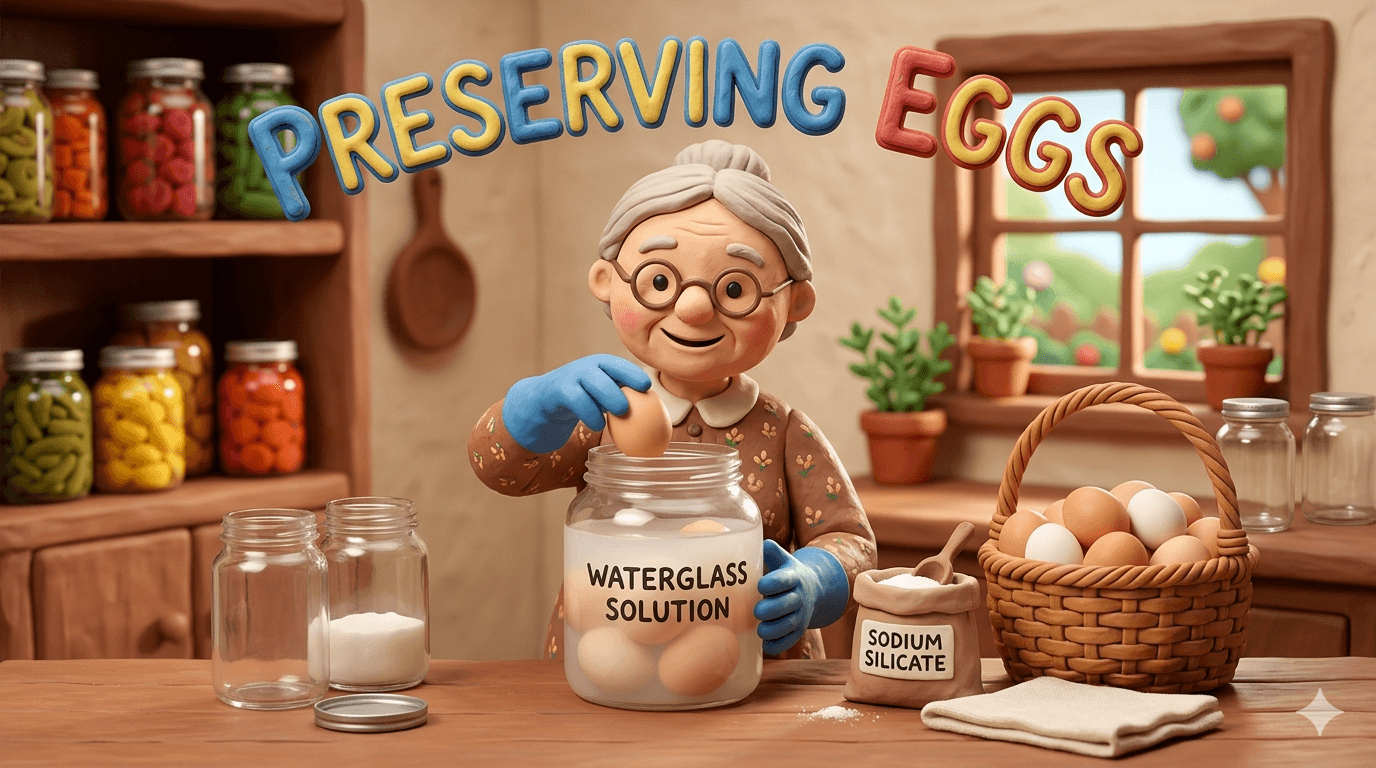
Water glass is the gold standard for long term egg storage without refrigeration. The method uses food grade sodium silicate dissolved in water to coat each egg in a thin mineral seal. That seal blocks oxygen and bacteria from getting through the shell. Eggs stored this way hold for twelve to eighteen months in a cool basement or pantry.
The technique was the standard farm method for over a hundred years. It fell out of fashion once electric refrigeration became universal, but homesteaders have brought it back in a big way. The chemistry has not changed. The eggs that come out of a water glass jar in March still scramble, bake, fry, and poach.
What You Need
- A clean half gallon or gallon glass jar with a tight lid
- Food grade sodium silicate, sometimes labeled liquid water glass
- Cooled boiled water (tap water is fine after it sits overnight)
- Fresh unwashed eggs from your own flock or a trusted local source
A half gallon jar holds roughly two dozen eggs. A gallon jar holds about four dozen. Buy more jars than you think you need. A productive flock fills jars faster than you expect.
Step by Step
- Boil a kettle of water and let it cool to room temperature. This drives off chlorine and other gases that could react with the silicate.
- Measure your water and your sodium silicate at a ratio of eleven parts water to one part silicate by volume. For a half gallon jar, that works out to roughly fifty six fluid ounces of water and just under five ounces of sodium silicate.
- Stir the mixture gently in a separate container until fully dissolved. The solution looks slightly cloudy and feels a little slippery.
- Place fresh unwashed eggs into the jar one at a time, pointed end down. Stack carefully and do not let any eggs crack against each other.
- Pour the cooled solution over the eggs until they are covered by at least two inches of liquid.
- Seal the jar with a tight lid. Label with the date and the source flock if you keep more than one.
- Store in a cool, dark, steady spot between fifty and seventy degrees Fahrenheit. A basement, root cellar, or interior pantry works.
That is the entire process. There is no daily checking, no stirring, no special equipment. The eggs sit quietly under the solution and wait for you.
Using Water Glass Eggs
Pull eggs out one at a time as you need them. Rinse each egg thoroughly under cool running water to remove the silicate film. Use the eggs as you would any fresh egg.
One quirk to know about. Water glass eggs sometimes hold a bit more air inside the shell after several months of storage. They can crack if you boil them straight from the jar. To avoid that, prick the wide end with a clean pin before boiling, or simply scramble, fry, or bake with them instead.
Where to Find Sodium Silicate
Look for food grade or chemically pure liquid sodium silicate. Most homestead suppliers sell it by the quart or gallon. Pottery suppliers sometimes carry it as well, but check the label to confirm it is the food safe grade. Avoid industrial sodium silicate sold for concrete or insulation. Those products contain additives that should never touch food.
A single gallon of sodium silicate preserves roughly thirty dozen eggs. The cost works out to around twenty cents per egg over the life of the jar. That is cheaper than most insurance policies.
Method Two: Mineral Oil Coating
Mineral oil works the same way the natural bloom does. A thin coat of food grade mineral oil seals the pores in the shell and blocks oxygen and bacteria from getting inside. Mineral oil eggs keep at room temperature for six to nine months and last well over a year in the refrigerator.
The method is faster than water glass for small batches and uses almost no special equipment. It also works well if you have already washed your eggs by accident. The oil replaces the missing bloom and brings the eggs back to shelf stable status.
What You Need
- Food grade mineral oil (the same kind sold for cutting boards and butcher blocks)
- A small bowl
- Soft cloth or paper towels
- A clean carton or wooden tray for storage
Step by Step
- Warm the mineral oil slightly by setting the bottle in a bowl of warm water for ten minutes. Warm oil flows into the pores more evenly than cold.
- Pour a small puddle of oil into the bowl.
- Dip a soft cloth or paper towel into the oil. You want a film, not a coating thick enough to drip.
- Roll each egg gently in the cloth so that the entire shell receives a thin even layer of oil.
- Set the coated eggs pointed end down in a clean carton or wooden tray.
- Store at fifty to seventy degrees Fahrenheit in a cool dark spot. Rotate the carton ninety degrees once a week to keep the yolk centered.
Mineral oil eggs taste indistinguishable from fresh after months of storage. Use them as you would any fresh egg. Wipe the shell with a dry cloth before cracking if you find the oil residue annoying.
Method Three: Refrigeration
Plain old refrigeration is still one of the simplest and most reliable ways to extend egg life. Fresh unwashed farm eggs hold for three to four months in the back of a cold refrigerator. Washed eggs hold for four to six weeks past the carton date.
The trick is to use the right spot inside the fridge. The door is the warmest place because it cycles through temperature changes every time you open it. Push your egg carton to the back of a middle shelf where the temperature stays steady around thirty seven degrees Fahrenheit.
Keep eggs in their original carton or a sealed container. The carton blocks odors from being absorbed through the porous shell. Onions, garlic, fish, and strong cheeses all leave a flavor in eggs stored uncovered.
If you keep your own flock, do not wash farm eggs before refrigerating unless they are actually dirty. The bloom keeps them fresher for far longer than washed eggs. Brush off dry dirt and store the eggs as is.
Method Four: Freezing Eggs
Freezing is the right choice for eggs you plan to use within a year. The technique works for baking, scrambling, omelets, and most savory dishes. It does not work for sunny side up or poached eggs because freezing changes the texture of the white.
What You Need
- Silicone ice cube trays or muffin tin liners
- A blender, whisk, or fork
- Freezer safe bags or jars
- Permanent marker for labels
Step by Step
- Crack each egg into a bowl and check for shell fragments or off smells.
- Whisk gently until the white and yolk are just combined. Do not whip in air.
- For yolks that you will use in savory dishes, add a small pinch of salt (about one eighth teaspoon per cup of yolk) to prevent gelling. For yolks bound for baking, use sugar at the same ratio.
- Pour the egg mixture into ice cube trays. One standard ice cube cavity holds roughly the volume of one egg, depending on the tray.
- Freeze solid, then pop the cubes out and store in labeled freezer bags or jars.
- Mark each container with the date, the number of eggs per cube, and whether you added salt or sugar.
Frozen eggs keep for twelve months at zero degrees Fahrenheit. Thaw cubes overnight in the refrigerator before using. Never thaw at room temperature, since the eggs warm unevenly and can spend too long in the bacterial danger zone.
Whole raw eggs in the shell should never go into the freezer. The water inside expands as it freezes and cracks the shell. The yolk also turns gummy on thaw and never recovers a smooth texture.
Method Five: Dehydrating Powdered Eggs
Powdered eggs are the most space efficient way to store eggs long term. A dozen eggs reduces down to less than a cup of powder, which fits in a small jar on a pantry shelf. Properly stored powdered eggs last five to ten years.
The method needs either a dehydrator that hits at least one hundred sixty degrees Fahrenheit or a freeze dryer. A standard low temperature dehydrator made for fruit and herbs will not bring the eggs to a safe temperature.
Step by Step
- Scramble the eggs in a nonstick pan over low heat with no oil and no salt. Cook just until set and dry, not browned.
- Spread the cooked eggs in a thin even layer on dehydrator trays lined with parchment.
- Dehydrate at one hundred sixty degrees Fahrenheit for eight to twelve hours, until the eggs feel crisp and snap when you break them.
- Pulse the dried eggs in a blender or coffee grinder until they form a fine powder.
- Store in clean glass jars with an oxygen absorber and a tight lid. A vacuum sealed Mylar bag also works for longer storage.
- Label with the date and the egg count.
Rehydrate one tablespoon of powder with two tablespoons of warm water for each whole egg you need. Let the mixture sit for five minutes before using. Rehydrated eggs work beautifully in baked goods, casseroles, and scrambles.
A freeze dryer produces an even better product. Freeze dried eggs can be crushed into powder or left in pieces, store for twenty five years, and rehydrate almost identical to fresh. The machine costs several thousand dollars, but homesteaders who put up large amounts of food find it pays for itself within a few seasons.
Method Six: Pickled Eggs
Pickled eggs are more of a snack than a long term storage solution. The vinegar brine flavors the eggs and extends their shelf life in the refrigerator, but the technique does not produce a shelf stable product. The National Center for Home Food Preservation does not recommend canning pickled eggs because the texture and density of the eggs prevents safe heat penetration.
That said, refrigerator pickled eggs are delicious, fast to make, and keep for three to four months in the cold.
Basic Recipe
- One dozen hard boiled eggs, peeled
- Two cups white or cider vinegar
- One cup water
- One tablespoon pickling salt
- Two tablespoons sugar
- Spices to taste (peppercorns, mustard seed, garlic, dill, beet juice for color)
Bring the vinegar, water, salt, sugar, and spices to a boil. Simmer for five minutes. Pack the peeled eggs into a clean quart jar. Pour the hot brine over the eggs until they are covered. Seal and refrigerate. Wait at least two weeks before eating so the flavors penetrate the eggs.
Pickled eggs should always go into the refrigerator, never on a shelf. Hold them at thirty seven degrees Fahrenheit or colder and use within four months.
Method Seven: Freeze Drying
Home freeze drying is the gold standard for long term egg preservation. Freeze dried eggs hold their flavor, color, and texture for up to twenty five years in sealed packaging. The process pulls almost all moisture out of the egg without using high heat, which leaves the proteins intact and the flavor close to fresh.
A home freeze dryer is the only piece of equipment that delivers this kind of shelf life. The machines run several thousand dollars and use significant power during the drying cycle, but they preserve eggs better than any other home method.
The basic process is straightforward. Scramble the raw eggs lightly, pour them into the freeze dryer trays in a thin layer, and run the cycle (usually twenty four to thirty six hours). The finished eggs come out as crisp lightweight sheets that crumble easily into powder or larger pieces. Store in Mylar bags with oxygen absorbers, seal, and label with the date.
To use, rehydrate at the same one to two ratio as dehydrated eggs. Most homesteaders cannot tell the difference between freeze dried scrambled eggs and fresh.
Comparison Table: Pick the Right Method
Use this table to match each method to your needs. Storage life assumes proper technique and steady storage conditions.
| Method | Shelf Life | Storage Temperature | Best For | Difficulty |
|---|---|---|---|---|
| Water glass | 12 to 18 months | 50 to 70 F, cool dark | Long term off grid storage | Easy |
| Mineral oil | 6 to 9 months at room temp, 12+ refrigerated | 50 to 70 F or refrigerated | Small batches, quick coat | Very easy |
| Refrigeration | 3 to 6 months (unwashed), 4 to 6 weeks (washed) | 37 F | Daily kitchen rotation | None |
| Freezing | 12 months | 0 F | Baking and scrambles | Easy |
| Dehydrating | 5 to 10 years | Cool dry pantry | Backpacking, deep storage | Moderate |
| Pickling | 3 to 4 months | 37 F refrigerated | Snacks and bar food | Easy |
| Freeze drying | 25 years | Cool dry pantry | Long term insurance | Easy with equipment |
Float Test and Other Freshness Checks
Every preserved egg deserves a quick check before it lands in your pan. The float test is the fastest and most reliable.
Fill a bowl with cool water. Drop the egg in gently. A fresh egg sinks and lies flat on the bottom. An older but still good egg sinks but stands on end. A bad egg floats. The float happens because the air cell inside the shell grows over time as moisture and gases pass through the pores. A floater has lost too much mass and gained too much air to be safe.
You can also sniff. Crack the egg into a small dish first, never directly into your skillet. A bad egg smells immediately and unmistakably. A good egg smells like nothing at all.
Visual checks help too. The white of a fresh egg sits up high around a domed yolk. The white of an older egg spreads thin and runny. Either is safe to eat as long as the smell test passes.
Common Problems and Fixes
Most preservation problems trace back to a small mistake at the start. Here are the issues you might run into and how to fix them.
Cloudy water glass solution
A slightly cloudy solution is normal. Heavy cloudiness or sediment can mean the silicate reacted with minerals in tap water. Use cooled boiled water or filtered water for the next batch. The current jar is still safe to use as long as the eggs smell and look fine on the float test.
Sulfur smell from a water glass jar
A sulfur or rotten egg odor means one or more eggs cracked or spoiled inside the jar. Carefully pour off the solution, remove every egg, and check each one. Discard any with cracks, soft spots, or off smells. Wash the good eggs, use them right away, and start a fresh jar with clean eggs and new solution.
Eggs floating in the water glass jar
Some eggs may float free in a fresh jar because the solution is denser than the egg. That is fine. If an egg floats up and stays at the very top after a few weeks, candle it for cracks and pull it for immediate use.
Yolks gel after freezing
Frozen yolks turn gummy when freezing pulls water out of the protein. Add a pinch of salt or sugar to whole eggs or separated yolks before freezing to prevent the gelling. Label each container with which one you added so you remember the next time you cook.
Powdered eggs clump in storage
Clumping means moisture got into the jar. Add a fresh oxygen absorber and a small food safe desiccant pack on top of the powder. Store in a cool dry spot and avoid opening the jar in humid weather. If the powder smells fine and rehydrates normally, it is still safe.
Mineral oil eggs feel greasy after months
A small amount of oil on the shell is normal and harmless. Wipe each egg with a dry cloth before cracking. The oil never penetrates the shell, so it does not affect the egg inside.
Safety Rules
Warning
A few hard rules keep your preserved eggs safe to eat. Never preserve cracked, washed, dirty, or old eggs. Never preserve store bought eggs with shelf stable methods because the bloom has been washed off. Never can pickled eggs in a water bath or pressure canner, since the NCHFP has not approved a safe process. Always crack each preserved egg into a separate bowl before adding it to your recipe, so you can spot a bad one before it ruins your batch.
Salmonella is the main bacterial risk with any egg, fresh or preserved. The risk is low for healthy flocks kept in clean conditions and low for properly preserved eggs. Cook eggs fully when serving anyone pregnant, very young, very old, or immune compromised. Avoid raw preserved eggs in dishes like homemade mayonnaise or eggnog unless you use a method like pasteurization.
Store your preserved eggs in a clean labeled space away from chemicals, raw meats, and strong smelling foods. Check on water glass jars and mineral oil cartons once a month for any sign of leaks, smells, or shifted lids. A two minute walk through saves you from finding a bad jar much later.
Frequently Asked Questions
Frequently Asked Questions
Properly preserved water glass eggs hold for twelve to eighteen months in a cool dark spot between fifty and seventy degrees Fahrenheit. Some homesteaders report eggs lasting up to two years, though quality starts to decline after the first year. The trick is starting with fresh unwashed eggs from a healthy flock and keeping the jar at a steady cool temperature the whole time.
It is safer to cook preserved eggs fully, especially after several months of storage. The shell has been exposed to the preservation medium for a long time, and even with the bloom intact, there is a small risk of bacterial contamination. Use cooked preserved eggs in scrambles, baking, omelets, and casseroles. Save raw applications like homemade mayonnaise for the very freshest eggs from your flock.
Not in any way that most people notice. Water glass eggs taste like fresh eggs once you rinse off the silicate film. The yolks may sit a touch flatter after many months of storage, and the whites can be slightly thinner, but the flavor is the same. They scramble, fry, and bake exactly like fresh eggs.
Store bought eggs in the United States have already been washed and stripped of their protective bloom. They cannot be preserved with water glass, mineral oil, or any other shelf stable method. They must stay refrigerated. You can still freeze, dehydrate, freeze dry, or pickle store bought eggs as long as you keep them cold until use. Source unwashed farm eggs from a local flock for the bloom dependent methods.
Food grade sodium silicate is safe and has been used to preserve eggs for over a century. The silicate forms a thin mineral seal on the shell and never enters the egg itself. Always buy a product labeled food grade or chemically pure. Avoid industrial sodium silicate sold for concrete, insulation, or pottery glazing, since those products contain additives that should never touch food.
Use the float test. Place the egg in a bowl of cool water. A good egg sinks and lies flat or stands on end. A bad egg floats. After the float test, crack the egg into a separate small dish to check the smell. A bad egg smells immediately and unmistakably of sulfur. A good egg has almost no smell at all.
Yes. Water glass, mineral oil coating, and dehydrating all produce shelf stable eggs that hold for months or years without any refrigeration. Water glass is the best choice for whole eggs with the longest shelf life. Mineral oil is the easiest for small batches. Dehydrating produces the most space efficient long term storage. All three methods need fresh unwashed eggs and a cool dark storage spot.
A standard gallon glass jar holds about four dozen large eggs with enough room for at least two inches of solution covering the top. A half gallon jar holds about two dozen. Pack the eggs gently with the pointed end down and never force them. Plan on roughly fifty six fluid ounces of water and five ounces of sodium silicate per half gallon jar.
Yes, and they perform beautifully in nearly all baked goods. Thaw the eggs overnight in the refrigerator before mixing into your recipe. One ice cube cavity from a standard tray equals roughly one egg, though it pays to measure your tray once to be sure. Frozen eggs work in cakes, cookies, breads, muffins, and pancakes with no noticeable difference from fresh.
Freeze drying is the absolute longest at up to twenty five years in sealed Mylar with oxygen absorbers. Dehydrated powdered eggs come next at five to ten years. Water glass holds eggs for twelve to eighteen months. If you do not own a freeze dryer, dehydrating and water glass together give you both deep pantry insurance and ready to use eggs for daily cooking.
Pair Egg Preservation With the Rest of Your Pantry
Preserving eggs is one piece of a larger food storage plan. Pair it with the rest of your homestead pantry for a year round food supply that almost runs itself.
The homestead food freezing guide walks through how to build a freezer pantry around bulk processing days and power outage planning. Frozen eggs slot right into that system.
The homestead root cellar guide covers cool, dark, humid storage for everything from carrots and apples to home canned jars. A root cellar shelf is also the best home for water glass eggs and mineral oil cartons.
The dehydrating 101 guide explains the equipment and technique behind powdered eggs and most other dried foods.
If you want to round out your shelf with shelf stable proteins and produce, the pressure canning guide covers the safe processing of low acid foods like meat, beans, and soup.
Start with one preservation method this season. Water glass is the easiest first project and rewards you the most through winter. Set up one jar with two dozen of your freshest eggs, label the lid with today's date, and tuck it into the basement. Six months from now you will pull eggs out of that jar for Saturday breakfast and wonder why you waited so long to start.

Cole
Founder & Lead Researcher
Cole is the founder of Plan Your Homestead. He works in clinical research and brings a research-first lens to every guide on the site, drawing on a long family line of farmers for grounded, practical perspective.
More in Food Preservation
More articles coming soon. Check back for new food preservation content.