
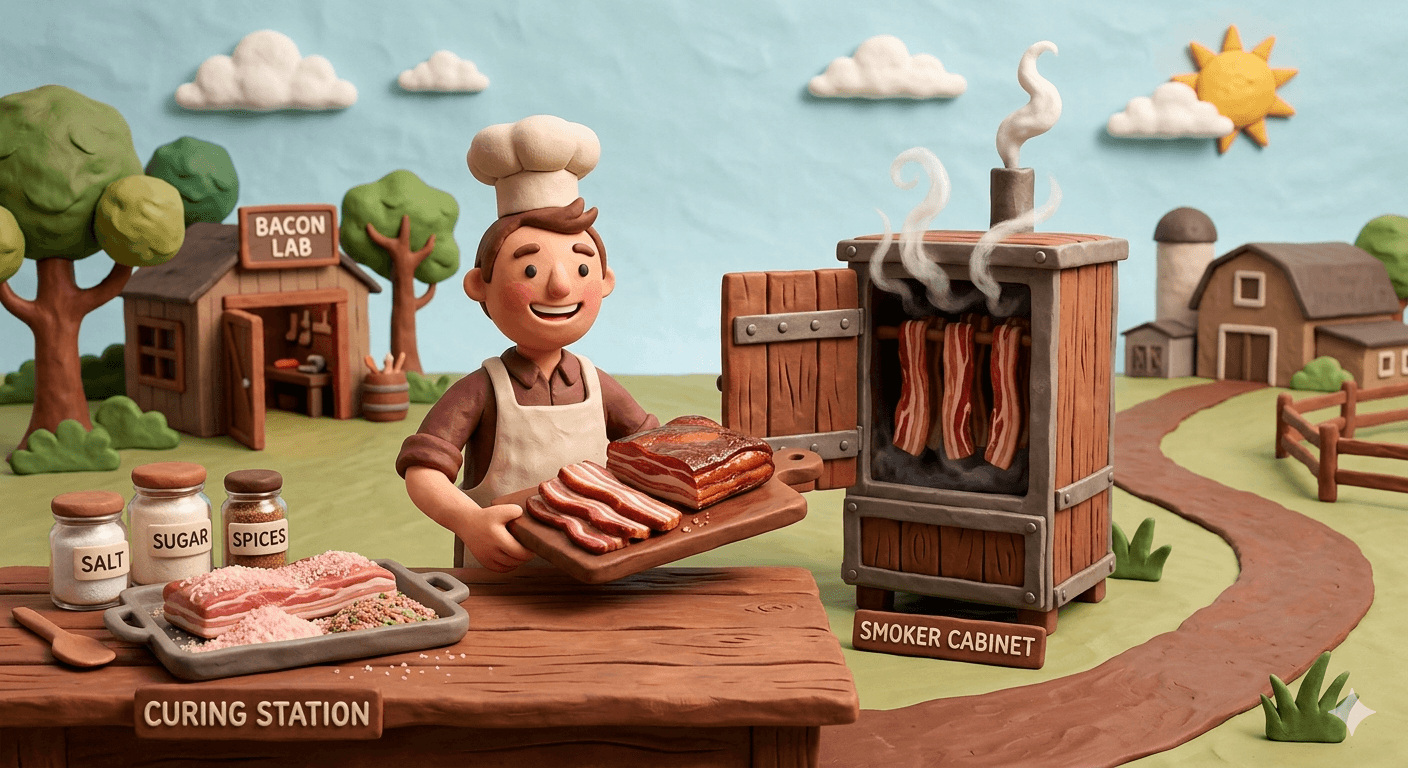
Homemade bacon is one of the most rewarding projects you will ever pull off in your kitchen. You start with a slab of pork belly, a careful measure of salt, a pinch of cure, and a few days of patience. You finish with thick, smoky strips of bacon that taste better than anything in the grocery aisle.
This guide walks you through both methods that home cooks rely on. The dry cure rubs salt and seasonings directly onto the belly. The equilibrium brine soaks the belly in a measured saltwater solution. Both produce excellent bacon. We will cover the science, the safety rules, the equipment, and the timing so your first batch comes out right.
You can absolutely do this. Curing and smoking sound technical, but the steps are simple once you see them laid out. By the end of this guide, you will know how to choose a belly, mix a cure, smoke the bacon at a safe temperature, slice it, and store it. Your kitchen will smell incredible for a week.
How Curing and Smoking Preserve Pork Belly
Bacon is preserved meat. Curing pulls water out of the pork, raises the salt level, and adds a tiny amount of nitrite. Smoking adds antimicrobial compounds and a layer of flavor. Together, these steps slow spoilage and create the texture and taste we all recognize.
Salt is the foundation. When salt sits against raw meat, it pulls moisture out through osmosis and replaces some of it with sodium ions. Bacteria that cause spoilage struggle in a salty environment. The meat firms up, the surface dries, and the pork transforms from belly into bacon.
Sodium nitrite, which comes from the small amount of pink curing salt called Cure #1, does two important jobs. It blocks the growth of Clostridium botulinum, the bacterium that produces botulism toxin. It also gives bacon its rosy pink color and that classic cured flavor. Without nitrite, your finished product would be gray, flabby pork belly, not bacon.
Smoke adds another layer of preservation. Wood smoke contains phenolic compounds and organic acids that slow microbial growth on the surface of the meat. Smoke also dries the outer layer slightly and infuses the bacon with the flavor of whatever wood you choose. The combination of cure plus smoke is what makes traditional bacon shelf stable in the fridge for weeks and freezable for months.
Note
People have been salt curing pork for thousands of years. The earliest written records of bacon making go back to ancient Rome. The science is older than refrigeration, older than thermometers, and older than printed cookbooks. You are joining a very long line of cooks.
Why Make Your Own Bacon
Flavor is the first reason most people try this. Store bought bacon is usually cured in liquid smoke, packed with water, and sliced thin so it crisps up fast in a hot pan. Homemade bacon is denser, meatier, and tastes like real wood smoke and real pork. One bite next to a supermarket strip and the difference is obvious.
Cost is a strong second. A whole pork belly from a local farm or butcher often runs five to eight dollars per pound. After curing and smoking, you lose about ten to fifteen percent in moisture, but the finished bacon costs roughly half what you would pay per pound at the grocery store for premium thick cut. A ten pound belly turns into nine pounds of finished bacon, which is a lot of breakfasts.
You also get full control over what goes in. Commercial bacon often contains added water, sugar, phosphates, and a long list of stabilizers. When you cure your own, you decide the salt level, the sweetener, the spices, and the wood. You can make it sweeter, smokier, peppery, or as plain as you like.
The reward factor is hard to overstate. Pulling your first slab of homemade bacon off the smoker, slicing it on the cutting board, and frying up a few strips for a taste test is the kind of homestead moment that gets people hooked on charcuterie for life. It is also a fantastic gift. A pound of homemade bacon wrapped in butcher paper makes friends and family very happy.
If you already enjoy other preservation skills like water bath canning, pressure canning, or dehydrating, bacon making is a natural next step. It uses the same mindset of careful measurement, time, and temperature.
Equipment You Need
You do not need much, but a few items are non negotiable. Start with these and you can make bacon every weekend.
A pork belly
Look for a fresh, skin off pork belly between five and ten pounds. Skin on bellies are fine if you want to remove the skin yourself with a sharp knife, but skin off saves time. Choose a belly with a good ratio of meat to fat, ideally roughly 50/50 or with slightly more meat. Heritage breed pork from a local farm tastes incredible. Costco, restaurant supply stores, and Asian markets all sell whole bellies at reasonable prices. Avoid frozen bellies that have been thawed and refrozen, since the texture suffers.
A digital kitchen scale that reads in grams
This is the single most important tool in the whole process. Cure and salt are measured by percentage of meat weight. Volume measurements like teaspoons are not precise enough for nitrite, which has a hard safety ceiling. A scale that reads to one gram or finer is essential. They cost twenty to thirty dollars and last for years.
Cure #1 (Prague Powder #1, pink curing salt)
Cure #1 is a blend of 93.75 percent table salt and 6.25 percent sodium nitrite, dyed pink to prevent confusion with regular salt. This is the only cure approved for short cures like bacon. You can buy it at butcher supply stores, sausage shops, and online retailers. A small bag costs ten dollars and lasts for many batches.
Kosher salt
Diamond Crystal kosher salt and Morton kosher salt are both fine. Avoid iodized table salt, which can taste metallic in cured meat. Coarse sea salt also works.
Sugar
White sugar, brown sugar, maple sugar, or honey all work. Sugar balances the salt, feeds beneficial bacteria, and helps the bacon brown when you fry it. About half as much sugar as kosher salt is the standard ratio.
A zip top bag, vacuum bag, or food grade container
You need something to hold the belly during the cure. Two gallon zip top bags work great for bellies up to about eight pounds. Vacuum sealed bags are even better because they keep the cure pressed tightly against the meat. A food safe plastic tub with a tight lid also works for the dry cure method.
A smoker, pellet grill, charcoal grill, or kettle smoker
Any cooker that holds a steady low temperature with indirect heat will smoke bacon. Pellet smokers like Traeger, Pit Boss, and Camp Chef make this almost effortless. Offset smokers and ceramic kamados produce excellent results with a little more attention. A standard kettle grill set up with charcoal on one side and the bacon on the other works just fine.
An instant read thermometer
A probe thermometer that you can leave in the bacon while it smokes is ideal. A handheld instant read is the minimum. Internal temperature is the only reliable doneness signal for bacon, so do not skip this tool.
A sharp knife or meat slicer
A long, sharp knife will let you hand slice strips at any thickness you want. An electric meat slicer makes the job faster and more uniform, especially for a five pound slab. If you cure bacon often, a slicer is a worthwhile upgrade.
Wood for smoking
Hickory is the classic. Apple, cherry, pecan, and oak are all excellent. Mesquite is too strong for most palates. Pellet smokers use small wood pellets. Charcoal and kettle setups use chunks or chips soaked briefly in water.
Tip
If you are buying gear for the first time, prioritize the digital scale and the Cure #1. Everything else can be improvised. You cannot improvise around a missing scale.
Understanding Cure #1
Cure #1 is the safety backbone of every bacon recipe. The pink color is a dye, not a salt grade. The active ingredient is sodium nitrite, which protects against botulism and creates the flavor and color we associate with bacon, ham, and hot dogs.
The standard rule is 0.25 percent of the total meat weight. A five pound belly weighs about 2,268 grams. Multiply that by 0.0025 and you get 5.67 grams of Cure #1. That is a tiny amount, which is why a precise scale matters. Too little and you lose the safety benefit. Too much and the bacon can taste harsh and contain unsafe levels of nitrite.
Some brands of cure use a different blend. Always read the label. Prague Powder #1, Insta Cure #1, DC Cure, and Pink Cure #1 are all the same product under different brand names. They all use the 0.25 percent rule.
Warning
Do not confuse Cure #1 with Cure #2. Cure #2 contains both sodium nitrite and sodium nitrate and is meant for long, dry cured products like pepperoni and prosciutto. Using Cure #2 for bacon is unsafe. Also do not confuse pink curing salt with Himalayan pink salt, which is just regular salt with a pink tint and contains no nitrite. Read the label every time.
Method 1: Dry Cure Step by Step
The dry cure rubs the salts, sugar, and seasonings directly onto the surface of the belly. The cure draws out moisture, mingles with it to form a concentrated brine, and works its way into the meat over the course of a week. This is the most common home method.
Step one: weigh the belly
Place the trimmed belly on your kitchen scale. Record the weight in grams. Every other measurement flows from this number.
Step two: mix the cure
For each kilogram of pork belly, use the following base recipe:
- 25 grams kosher salt (about 2.5 percent)
- 12 grams sugar (about 1.2 percent)
- 2.5 grams Cure #1 (exactly 0.25 percent)
- Spices and aromatics to taste, such as 2 grams cracked black pepper, 1 gram garlic powder, and 1 bay leaf, crumbled
Multiply the base recipe by the weight of your belly in kilograms. For a 2.27 kilogram belly, that becomes about 57 grams kosher salt, 27 grams sugar, and 5.7 grams Cure #1, plus your spice mix.
Combine everything in a small bowl and stir until uniform.
Step three: rub the cure into the meat
Place the belly on a clean cutting board. Sprinkle the cure mixture evenly over both sides and along the edges. Press it firmly into the meat so it sticks. Use every grain. Do not throw any cure away, since the safety math depends on the full amount staying with the belly.
Step four: bag and refrigerate
Transfer the rubbed belly into a two gallon zip top bag, a vacuum sealed bag, or a tight lidded container. Squeeze out as much air as you can. Place the bag on a sheet pan in the refrigerator. The pan catches any leaks and keeps your fridge clean.
Step five: flip every day
For the next seven to ten days, flip the bag once a day. Massage the liquid that collects in the bag back over the meat each time you flip. The cure pulls moisture out of the belly steadily, so you will see a generous puddle of brine in the bag by day three. That is normal and exactly what you want.
A general rule is one day of curing per half inch of thickness, plus two extra days for safety. A belly that is one and a half inches thick at its thickest spot needs at least seven days. A thicker belly needs more time. When in doubt, leave it longer. Equilibrium curing this way is forgiving.
Step six: rinse and dry
After the cure is complete, remove the belly from the bag. Rinse it briefly under cool running water to wash off the surface salt and spices. Pat it completely dry with paper towels.
Step seven: form the pellicle
Place the rinsed, dried belly on a wire rack over a sheet pan. Refrigerate, uncovered, for at least eight hours and ideally overnight. The surface will dry to a slightly tacky finish called the pellicle. Smoke sticks to a pellicle the way paint sticks to a primed wall. Skipping this step is the most common reason home bacon turns out under smoked.
Step eight: smoke
Move on to the smoking section below. After smoking, you have bacon.
Method 2: Equilibrium (EQ) Brine
The equilibrium brine is a wet cure where you dissolve the salts and sugar into water by precise percentages, then submerge the belly in the brine for the same seven to ten days. EQ brining is the most beginner friendly method because the salt percentage in the meat can never exceed the salt percentage in the brine. You can leave the belly in for a few extra days without ruining it.
Step one: weigh the belly and the water
Place the belly into a container that fits it snugly. Add cold water until the belly is fully submerged. Lift the belly out and weigh just the water. Add that weight to the weight of the belly. The total is your working weight.
Step two: mix the brine
Use these percentages of the total working weight:
- 2.5 percent kosher salt
- 1.2 percent sugar
- 0.25 percent Cure #1
For a belly plus water total of 4 kilograms (4,000 grams), that becomes 100 grams kosher salt, 48 grams sugar, and 10 grams Cure #1.
Heat about a quart of the water in a saucepan, add all the salts and sugar, and stir until completely dissolved. Pour the warm brine concentrate back into the cold water and stir well.
Step three: submerge the belly
Place the belly in a food safe container or a brining bag. Pour the brine over it. Make sure the belly is fully submerged. A small plate or zip top bag filled with water can hold the meat under the brine if it floats.
Step four: refrigerate seven to ten days
Move the container to the refrigerator. Flip or stir every other day so the brine circulates. EQ brining is patient by design. You can pull the belly anytime between day seven and day fourteen with similar results.
Step five: rinse, dry, pellicle, smoke
Pull the belly from the brine, rinse it, pat it dry, and form the pellicle on a wire rack overnight in the fridge, exactly as in the dry cure method. Then move to the smoker.
Tip
Choose dry cure when you want the firmest, most concentrated bacon and you have a vacuum sealer. Choose EQ brine when you want a softer, juicier bacon and the safest margin for timing. Both methods produce excellent results.
Smoking the Bacon
Smoking turns cured pork belly into bacon. There are two approaches that home cooks use, and they produce slightly different results.
Cold smoking
Cold smoking exposes the bacon to wood smoke at temperatures below 90 degrees Fahrenheit. The bacon does not cook during cold smoking. It just absorbs flavor and dries slightly. You then slice and cook the bacon raw in a pan, just like commercial bacon. Cold smoking produces a firmer, denser result and is the traditional European style.
Cold smoking at home requires a cold smoke generator or a separate smoke box that pipes smoke into the chamber without heat. Setting this up safely takes practice. Cold smoked bacon is not cooked, so the cure has to do all the safety work. Beginners are better off starting with hot smoking.
Hot smoking
Hot smoking exposes the bacon to smoke at temperatures between 175 and 225 degrees Fahrenheit until the internal temperature of the meat reaches 150 degrees Fahrenheit. The bacon cooks gently as it smokes. The finished product is fully cooked, ready to slice and crisp in a pan. Hot smoking is by far the most common method for home bacon.
This guide focuses on hot smoking. It is safer, simpler, and very forgiving.
Set up the smoker
Bring your smoker to a steady 200 degrees Fahrenheit. Use a fruit or hardwood. Hickory is bold and classic. Apple is sweet and mild. Cherry adds great color. Pecan is balanced and a little nutty. Oak is mellow. You can also blend two woods. Avoid pine, cedar, or anything resinous, which makes the bacon taste awful.
For a pellet smoker, fill the hopper and set the temperature to 200. For a kettle, build a small fire on one side and place a chunk or two of wood near the coals. For an offset, run a clean burning fire with consistent thin blue smoke.
Smoke to internal temperature
Place the belly on the cool side of the smoker, fat side up. Insert a probe thermometer into the thickest part. Close the lid and let the smoker do its work.
Do not chase a clock. The bacon is done when the internal temperature hits 150 degrees Fahrenheit. Depending on the size of the belly and the temperature of the smoker, this takes anywhere from three to six hours. Thicker bellies and lower temperatures push toward the longer end. Thinner bellies and warmer temperatures finish faster.
If your smoker fluctuates, that is fine. Internal temperature is the only number that matters at the end.
Rest before slicing
Pull the bacon from the smoker once it hits 150 degrees Fahrenheit. Place it on a wire rack and let it cool to room temperature, then move it to the refrigerator for at least four hours and ideally overnight. Cold bacon slices much cleaner than warm bacon. The fat firms up, the meat sets, and your slices come out even.
Slicing and Storage
Slicing is where the bacon becomes bacon. Take your time and the strips will look like the ones you see in cookbooks.
Pull the chilled slab onto a clean cutting board. Decide on a slicing direction. Slicing across the width gives you classic short strips. Slicing along the length gives you long strips that look beautiful in a pan but require a longer skillet.
Hand slicing works fine with a sharp twelve inch knife. Aim for slices about one eighth inch thick for traditional bacon. Slightly thicker slices, around three sixteenths of an inch, give you that meaty, restaurant style thick cut.
A meat slicer is a luxury, but it speeds up the job for big batches and gives perfectly even strips. Run the slicer on a low to medium thickness setting for standard bacon and a higher setting for thick cut.
For storage, vacuum seal the slices in pound or half pound packs. Vacuum sealed bacon keeps in the refrigerator for two to three weeks and in the freezer for up to three months at peak quality, longer if you are not picky. Without a vacuum sealer, wrap slices in parchment paper inside a zip top bag with as much air pressed out as possible. Label every package with the date.
The leftover trim from squaring up the slab is a treasure. Save it in the fridge or freezer to flavor pots of beans, soups, and stews. A single chunk of homemade bacon will deepen a pot of split pea soup more than a whole package of grocery store strips.
Variations and Flavor Profiles
Once you nail the basic recipe, the variations are endless. Adjust the sugar, the spices, and the smoke to match what you love.
Maple bacon. Replace the white sugar with the same weight of maple syrup or maple sugar. Brush the belly with a thin layer of maple syrup before forming the pellicle for an extra glaze.
Brown sugar bacon. Swap white sugar for brown sugar. The molasses in brown sugar adds a deeper, richer note. Add a teaspoon of black strap molasses per kilogram for an even bolder flavor.
Peppered bacon. Press a generous coat of cracked black pepper onto the belly after rinsing the cure off. The pellicle holds the pepper in place during smoking. Use coarse pepper for the best look.
Coffee bacon. Add 10 grams of finely ground coffee per kilogram of belly to your dry cure. Coffee pairs beautifully with smoked pork.
Savory bacon. Skip the sugar entirely or cut it in half. Add bay leaves, juniper berries, garlic, thyme, and rosemary to the cure. The result tastes more like European pancetta.
Spicy bacon. Add 5 grams of red pepper flakes or 10 grams of chipotle powder per kilogram of belly. The heat builds slowly and shines in breakfast burritos.
Mix and match freely. You cannot really ruin bacon by trying a new flavor as long as the salt and Cure #1 percentages stay correct.
Common Problems and How to Fix Them
A few problems show up over and over for new bacon makers. Most are easy to fix once you know the cause.
The bacon is too salty
Too salty almost always means the cure stayed on too long, the slab was thinner than expected, or the kosher salt was a denser brand. Soak finished bacon in cold water for thirty minutes to pull some salt back out. Next time, drop your salt percentage to 2.0 or 2.25 and shorten the cure by a day or two.
The bacon is mushy or soft
Mushy bacon usually means the cure did not run long enough. The center never lost enough moisture or absorbed enough salt. Cure thicker bellies for longer. Use the equilibrium brine method, which is more forgiving on time.
The color is gray instead of pink
A gray center means the Cure #1 did not reach the middle of the belly. Either too little Cure #1 was used, the cure time was too short, or the belly was too thick. Verify your Cure #1 weight against the meat weight. Add a day or two to the cure for very thick bellies.
Mold appeared during the cure
White surface mold can occur in long, slow cures, but it is rare in seven to ten day bacon cures. If you see fuzzy white spots on the surface, wipe them off with a vinegar dampened paper towel and continue. Black, green, or pink mold means the batch is unsafe. Throw it out, sanitize your container, and start over with fresh meat. Keep the fridge below 38 degrees Fahrenheit during cures.
The smoke flavor is weak
Weak smoke flavor traces back to one of three things. The pellicle was not formed properly, the smoker temperature was too high (which dries the surface before smoke can stick), or the smoker did not produce enough smoke. Form a real pellicle every time. Run the smoker at 200 degrees Fahrenheit. Use plenty of wood, and aim for a thin, steady stream of smoke rather than thick white billows.
The smoker temperature ran too high
If your smoker spiked over 250 degrees Fahrenheit, the fat in the belly may have rendered too aggressively. The bacon will still be safe, but the texture leans more toward roasted pork than traditional bacon. Future batches, dial back the heat. Use a water pan in the smoker to buffer temperature swings.
Safety Rules That Are Non Negotiable
Curing meat at home is safe when you respect a few rules. Skip them and you put your family at real risk.
Warning
Use Cure #1 every time. Measure it on a gram scale. Refrigerate the meat below 40 degrees Fahrenheit during the entire cure. Cook hot smoked bacon to an internal temperature of 150 degrees Fahrenheit. Throw out any batch that smells off, looks slimy, or shows colored mold. These rules exist because of botulism and other pathogens, and they are not flexible.
The 0.25 percent Cure #1 ratio comes from USDA limits for cured meats. Stay at or below it. A 5.67 gram measure for a 2.27 kilogram belly is correct and safe. Eyeballing the cure or using volume measurements is the most common cause of unsafe bacon.
Refrigeration matters as much as the cure itself. Curing at room temperature is dangerous. The cure works because it slows bad bacteria, not because it eliminates them entirely. Cold temperatures finish the job. Use a fridge thermometer to confirm your fridge actually holds below 40 degrees Fahrenheit during the cure.
When in doubt, throw it out. A ten dollar pork belly is not worth a hospital trip.
Frequently Asked Questions
Frequently Asked Questions
Salt only pork belly is technically called salt pork, not bacon. It has no nitrite, so the color is gray, the flavor is flat, and the safety margin against botulism is much smaller. If you want true bacon flavor, color, and safety, use Cure #1 at the 0.25 percent ratio. There is no real substitute for nitrite in short cures.
Hot smoked bacon is fully cooked at 150 degrees Fahrenheit internal temperature. At that point, you can slice and eat the bacon as is, or refrigerate it and crisp slices in a pan later. The USDA safe internal target for pork in general is 145 degrees Fahrenheit, but bacon traditionally goes to 150 for better texture and shelf life.
Yes, but cold smoking adds complexity and risk for beginners. You need a cold smoke generator that produces smoke without raising the chamber temperature above 90 degrees Fahrenheit. The bacon never cooks, so the cure does all the safety work. Cold smoked bacon must be cooked before eating, just like commercial bacon. Start with hot smoking and graduate to cold smoking once you have a few batches under your belt.
Pork belly is the raw cut. Bacon is pork belly that has been cured and usually smoked. Uncured pork belly is delicious roasted or braised, but it is not bacon. Curing changes the flavor, color, texture, and shelf life of the meat in ways that simple cooking cannot.
Hickory is the classic and produces the bacon flavor most Americans grew up with. Apple gives a sweeter, milder result that is great for breakfast bacon. Cherry adds a beautiful mahogany color. Pecan sits between hickory and apple in intensity. Oak is mild and balanced. Mesquite is too aggressive for most palates. Mix two woods like apple and hickory for a flavor that is layered without being heavy.
Always after smoking. Freezing raw cured belly is fine for storage, but you should fully cure, smoke, slice, and pack the bacon before freezing for the best texture. Vacuum sealed slices freeze beautifully for up to three months at peak quality. Thaw in the refrigerator overnight before cooking.
Local butchers, farmers markets, and small farm direct sellers are the best sources for high quality bellies. Costco often carries whole bellies in the refrigerated section near the pork. Asian and Latin grocery stores almost always stock them. Online retailers like Porter Road, Snake River Farms, and US Wellness Meats ship vacuum sealed bellies to your door. Heritage breed pork is worth the extra cost if you can find it.
Yes. The pellicle is a thin, tacky layer of dried protein on the surface of the meat that smoke clings to. Without it, smoke flavor sits weakly on the surface and washes off in the first cooking. With a proper pellicle, the smoke flavor penetrates and stays. An overnight rest on a wire rack in the fridge is all it takes. Skipping this step is the most common cause of weak smoke flavor.
Vacuum sealed homemade bacon keeps two to three weeks in the refrigerator and up to three months in the freezer at peak quality. Unsealed bacon wrapped in parchment lasts about a week in the fridge. Bacon trim and ends, sealed in a freezer bag, will hold flavor in the freezer for six months or longer.
Yes. Cured but unsmoked bacon is sometimes called green bacon or unsmoked bacon. Once the cure is complete, you can roast the slab in a low oven (around 200 degrees Fahrenheit) until it hits 150 degrees Fahrenheit internal temperature, then slice and use it like regular bacon. The flavor is milder and the texture is similar. Smoking adds flavor but is not strictly required for safety once the cure is done.
Slice Your First Batch This Weekend
Bacon making sounds technical until you actually do it. The first batch is the hardest because everything is new. After that, the rhythm becomes obvious. Weigh the belly, mix the cure, wait a week, smoke to 150, chill, slice, and eat.
Start small. A single five pound belly is the perfect first project. You will learn the equipment, the timing, and your own preferences. By the end of one batch, you will have nearly five pounds of incredible bacon and a process you can repeat for the rest of your life.
If you want to keep building your preservation skills, water bath canning is a natural next step for high acid foods like jams, pickles, and salsas. Pressure canning covers the low acid side, including beans, soups, and meats. Dehydrating 101 gives you shelf stable fruit, vegetables, and jerky with very little equipment. Lacto-fermentation rounds out the toolkit with crunchy, probiotic foods that live in your fridge for months.
For now, find a pork belly. Weigh it. Mix the cure. The hardest part of homemade bacon is waiting through the week. Welcome to the craft.

Cole
Founder & Lead Researcher
Cole is the founder of Plan Your Homestead. He works in clinical research and brings a research-first lens to every guide on the site, drawing on a long family line of farmers for grounded, practical perspective.
More in Food Preservation
More articles coming soon. Check back for new food preservation content.