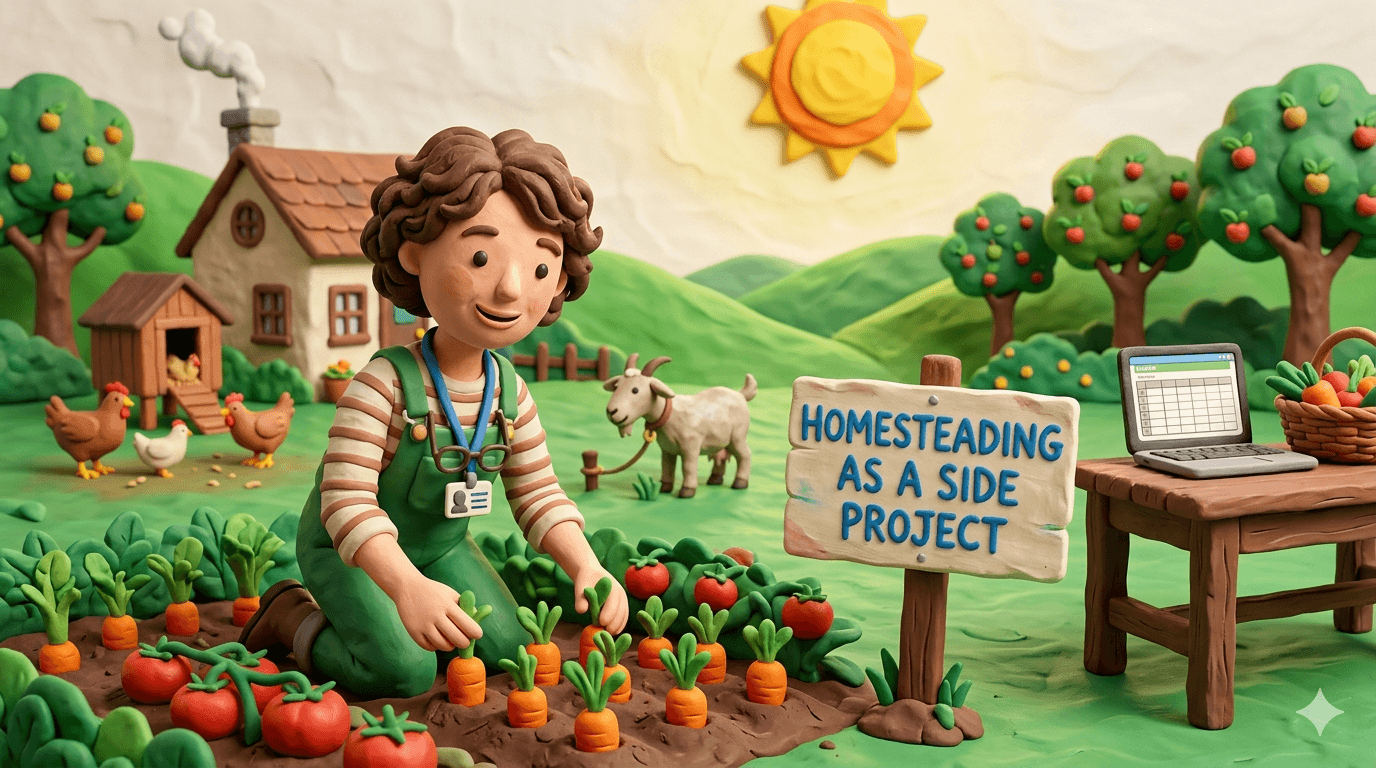
You have a job. A real one. The kind with a calendar full of meetings, a commute or a video call queue, and a paycheck that pays the mortgage. You also have a quiet pull toward something else. A garden that actually feeds you. A few hens out back. Eggs in a basket on the kitchen counter. A pantry that fills itself in late summer and stays full all winter.
You do not need to quit your job to live that life. You need to start it on the side.
This guide is for the office worker, the engineer, the teacher, the nurse, the project manager, anyone with a full time job who wants a homestead but cannot drop everything to chase it. Homesteading as a side project is a real path. It is slower than the full time version, but it is steadier, less risky, and far more common than the homesteading internet wants you to believe.
You can grow real food, raise real animals, and build real skills in five to ten hours a week. The trick is choosing the right projects, designing them for your actual schedule, and learning to say no to the dozens of things that sound exciting but will eat your weekends alive.
The Side Project Mindset
A side project homestead is not a smaller dream. It is a different shape of the same dream.
Most homesteading content assumes you have unlimited time. Forty acres, a tractor, all day to fence pasture and butcher chickens. That picture is real for some people, but it is not where most homesteaders start. Most start with a job, a yard, and a few hours a week. They build slowly, season by season, and ten years in they have something beautiful.
The side project mindset means three things. First, you accept that your homestead grows on a different timeline. A garden that an unemployed retiree builds in one season might take you three. That is fine. Second, you optimize for time, not output. Every project gets evaluated on how much it gives back per hour you put in. Third, you stop comparing your setup to people who do this for a living. Their job is the homestead. Yours is something else.
If you are brand new to all of this, our homesteading for beginners guide covers the foundations. This guide assumes you have read it (or will) and folds in the time constraint that changes everything.
Setting an Honest Time Budget
Before you plant a single seed, sit down and figure out how many hours you actually have.
Pull up your calendar for a normal week. Not the week you want to have, the week you actually have. Subtract work, sleep, commute, kids, family, exercise, and the unavoidable adult chores like laundry and groceries. What is left is your real free time. Now ask yourself how much of that you are willing to give to the homestead, every week, for the foreseeable future.
For most people with a full time job, the honest number lands somewhere between five and ten hours a week. Some weeks more. Some weeks zero. That is your time budget. Build inside it.
A useful way to break it down:
- Weekday evenings. Fifteen to thirty minutes per day, max. Quick chores. Watering. Closing the coop. Picking what is ripe. Total: 1.5 to 3 hours a week.
- Saturday morning. The big block. Two to three hours of focused work. Planting, building, weeding, harvesting in volume.
- Sunday wind down. One hour for putting things away, processing what you harvested, planning the next week.
That gives you roughly five to seven hours, which is enough for a real homestead at a small scale. If you have more time, great. Add to the weekend block first, not the evenings. Tired weeknight you will not show up for two hours of weeding, no matter what optimistic Sunday you promised.
Seasons also matter. Spring and fall are heavier (planting, harvest, putting the garden to bed). Summer is steady. Winter is almost nothing if you plan it right. A side project homestead breathes with the year.
What to Skip (At Least at First)
The fastest way to burn out is to take on something that demands more time than you have. Some homestead projects are wonderful and totally wrong for a side project schedule.
Skip these for now:
- Dairy goats. Goats are charming. They are also escape artists who need twice daily milking once they freshen, and milking does not pause because you have a sales call at 7am. Wait until you have flexibility.
- Cows. Same problem, bigger animal, bigger fences, bigger emergencies.
- Pigs in the spring you also start a garden. Pigs are easier than people think, but they are intense. One major project at a time.
- A market garden. Selling produce turns a hobby into a second job. Grow for yourself first.
- A big greenhouse. They are time sinks before they are time savers. Earn one.
- Major building projects in your first year. Building a barn while learning to garden while raising chickens while working full time is the recipe for an unfinished barn and dead chickens.
- Bees in year one. Bees are wonderful but unforgiving. Add them once your routine is steady.
None of these are bad. They are just bad first moves on a five to ten hour budget. Park them. Come back in two or three years when your foundation is solid.
The Highest Leverage Starter Projects
These are the projects that give the most homestead per hour. Pick two or three. Do them well. Add more later.
1. A Small, Perennial Heavy Garden
A garden full of annuals (tomatoes, lettuce, beans) needs replanting every year. A garden full of perennials (asparagus, rhubarb, blueberries, raspberries, herbs, fruit trees) plants once and feeds you for decades.
For a side project, lean perennial. Pick three or four annual crops you actually love (cherry tomatoes, basil, salad greens, garlic) and skip the rest. Add one perennial bed per year. Within five years you have a garden that mostly takes care of itself and gives back food in every season.
Our starting a garden guide walks through the first year planning. Use it, then ruthlessly cut anything that does not earn its keep.
2. A Three to Five Hen Flock
A small flock of laying hens is the perfect side project animal. Daily chores take ten minutes. Eggs show up in the basket whether you had a good week or a brutal one. With three to five hens, you get more eggs than a small family can eat, with very little daily fuss.
Build the coop right (or buy one) and the flock practically runs itself. Add an automatic coop door. Use a large feeder and waterer that hold a week of supply. Suddenly your daily chore is collecting eggs, which takes thirty seconds.
If you have never kept chickens, our backyard chickens guide covers everything from coop sizing to ordinances.
3. One Preservation Skill
You cannot eat tomatoes in February if you do not put them up in August. Pick one preservation skill and get good at it.
For a side project, the easiest is freezing. Wash, chop, freeze. Done. No special equipment beyond a chest freezer. The next easiest is fermenting (sauerkraut, pickles, hot sauce), which takes ten minutes of active time per batch and turns a glut of vegetables into months of food. Canning is rewarding but time intensive. Save it for year two or three.
The point is not to do all the preservation methods. It is to make sure none of your harvest goes to waste.
4. A Compost System That Runs Itself
Compost is the most useful free thing on a homestead. Build a system that does not need babysitting.
For a side project, a three bin system is overkill. Get one tumbler or one open bin. Toss in scraps and yard waste as they come up. Turn it every few weeks if you remember. In six to twelve months you have black gold for the garden and you have spent maybe an hour total.
5. One Fruit Tree or Berry Patch
Plant one fruit tree this year. Just one. A semi dwarf apple, a cherry, a peach, whatever grows where you live. Stake it, water it the first season, and walk away.
In three to five years it will give you fifty to a hundred pounds of fruit a year for almost no work. Berry patches (raspberries, blackberries, blueberries) are even faster, often producing in year two. These are the highest leverage projects on any homestead, and they cost almost no time once established.
Planting Calendar Tool
Enter your zip code to get a personalized planting schedule based on your USDA zone.
Try it free →A Realistic Weekly Rhythm
Here is what a steady week looks like for a side project homesteader from spring through fall.
Monday through Friday evenings. Get home, change clothes, walk to the coop. Open it in the morning before work, close it at dusk (or let your automatic door do that for you). Check water. Glance at the garden. Pick anything ripe and put it on the kitchen counter. Total time: 15 minutes a day, sometimes less.
Saturday morning. This is the work block. Coffee first. Then two to three hours outside. The exact tasks change with the season:
- Spring: planting, mulching, getting beds ready.
- Summer: weeding, watering deeply, harvesting in volume, succession planting.
- Fall: pulling spent plants, planting cover crops, putting beds to bed, harvesting the last of everything.
- Winter: planning, ordering seeds, light pruning, repairing tools and structures.
Saturday afternoon. Process the morning's harvest. Wash and store vegetables. Freeze what is too much. Start a ferment if the cabbage came in. Clean the eggs. This is often a kitchen hour, sometimes with a podcast on.
Sunday wind down. One hour. Close out the week. Refill feeders, top off waterers, take stock of what you grew and what you ate. Glance at next week's weather. Note anything you need to buy. Done.
That is roughly six hours a week. It is enough.
Tip
The single best thing a side project homesteader can do is build an evening that is fifteen minutes long. If your weekday chore takes more than that, redesign it. Bigger waterers, automatic coop doors, drip irrigation, mulch. Every minute you cut from your daily chores is a minute that gets your homestead through your busiest weeks.
Designing for Absences
Your job will pull you away. Travel, late nights, busy seasons. Your homestead has to keep functioning when you do not.
Build for absence from day one.
Watering. A drip irrigation system on a timer is the single best investment a busy homesteader can make. It runs every morning whether you are home or not. For container gardens, the same idea works with smaller emitters. If you cannot do drip, mulch heavily. Three inches of straw or wood chips cuts your watering needs by half or more.
Coop doors. An automatic coop door (battery or solar) opens at dawn and closes at dusk. It pays for itself the first time you stay late at work and do not lose a hen to a raccoon.
Feed and water capacity. Use feeders and waterers sized for a week, not a day. Five gallon waterers and bulk feeders mean you can leave for a long weekend without scrambling for a chicken sitter.
Neighbor swaps. Find one neighbor or friend who will collect eggs and check on the animals when you are out of town. Trade them eggs, produce, or returning the favor. This relationship is worth more than any tool you will ever buy.
Vacation proofing the garden. Plant things that will tolerate a week of inattention. Tomatoes are forgiving. Lettuce is not. Plan your garden so that a missed week in July does not cost you the season.
Warning
Do not buy animals you cannot leave for a weekend. If your hens, ducks, or rabbits cannot survive a Friday to Sunday trip with a friend doing a five minute check, you have built the wrong system. Fix the system before you add more animals.
What to Buy vs. What to DIY
Time is the scarce resource on a side project homestead, not money. That should change how you make decisions.
The full time homesteader can spend a Saturday building a chicken coop from scrap wood. You probably cannot, or if you can, that is your only Saturday for the month. Sometimes you should buy what you would otherwise build, even if it costs more. The hours you save go to the projects that only you can do.
A rough rule:
- Buy the chicken coop (or buy a high quality kit). One full Saturday saved.
- Buy the raised bed kits if your time matters more than the cost. Or buy lumber pre cut.
- Buy a good drip irrigation kit. Do not piece it together over months.
- Buy quality tools you will use for years. A cheap shovel breaks. A good one lasts thirty years.
- DIY the things you actually enjoy. Building a small structure from scratch is rewarding if you have the time. Skip it if you do not.
- DIY anything that does not have a good off the shelf option. Specific garden bed sizes, custom storage, a pantry shelf for canning jars.
Our homesteading on a budget guide makes the case for spending less. Both things can be true. Spend less than you think you need to, but spend on the things that buy back time.
Growing Without Burning Out
This is where most side project homesteaders fail. Not from lack of skill, but from doing too much, too fast.
The pattern is predictable. Year one, full of energy, you take on a garden, three chickens, a fruit tree, a beehive, and a sourdough starter. Year two, exhausted, you let the garden go to weeds, the bees swarm, and you are eating store bought eggs because you forgot to refill the feeder for the third week running. Year three you tell people homesteading is not for you.
The fix is simple. Add one thing per season. Not five.
Year one, just the garden and a small flock. Get those running smoothly. Year two, add a fruit tree and a fermenting habit. Year three, add berries and maybe expand the flock. Year four, add bees if you still want them. Each year, you only need to learn one new skill while keeping the old ones running. That pace is sustainable for decades.
Equally important: let projects die without guilt. The asparagus bed you planted in April that is now full of weeds in July does not have to be rescued. Mark it as a learning year. Try again next spring. Quitting a project is not failing at homesteading. It is making room for the projects that are actually working.
When (and Whether) to Go Full Time
Sooner or later most side project homesteaders ask whether they should leave their job and go full time. The honest answer is usually no, and that is fine.
Homesteading rarely pays as well as a job. A profitable small farm or homestead business is real, but it is a business, with marketing, sales, accounting, and risk. It is also a different lifestyle from the romantic picture. Our homesteading vs farming guide digs into the actual numbers.
Most successful homesteaders keep their day job (or one partner does) for years, sometimes forever. The job pays for the land, the infrastructure, and the freezer. The homestead pays in food, skills, calm, and meaning. That is a great trade.
If you do want to transition someday, treat your job as the seed money for a longer plan. Pay down debt. Buy land. Build skills. Stack savings. Then, when the homestead is mature enough to actually feed you and maybe sell a little, the move feels less like a leap and more like a step.
A Sample First Year as a Side Project
Here is a low pressure first year that does not eat your weekends alive.
January and February. Read. Plan. Order seeds. Sketch the garden on paper. Walk the yard and pick the sunniest spot. Maybe take a class on chicken keeping or canning. Total weekly hours: one or two.
March. Start a few seeds inside. Build or buy two raised beds in the chosen sunny spot. Order baby chicks (delivered in April or May). Decide on a coop plan or buy one. Hours: three or four a week.
April. Set up the coop. Plant cool season crops (lettuce, peas, radishes). Receive chicks if you ordered them, set up brooder. Hours: four to five a week (chicks need a daily check for the first six weeks).
May. Plant the warm season garden (tomatoes, basil, peppers, cucumbers, beans). Move chicks to the coop when feathered. Set up drip irrigation. Hours: five to six a week.
June and July. Maintenance mode. Weed, water, watch the garden grow. Eggs start arriving in late summer if your chicks were spring birds. Pick what is ripe almost daily. Hours: five to seven a week.
August. Peak harvest. This is the busiest month. Tomatoes everywhere. Squash everywhere. Fermenting and freezing on Saturdays. Hours: seven to ten a week.
September. Wind down annuals. Plant garlic for next year. Plant a fall lettuce bed. Eggs at full production. Hours: four to five a week.
October and November. Pull spent plants. Cover beds with straw or leaves. Last harvests. Plant one fruit tree. Hours: three to four a week.
December. Almost nothing outside. Inside, finish processing the last of the harvest. Order next year's seeds. Reflect. Hours: one or two a week.
By the end of year one, you have grown real food, raised real animals, and proven to yourself that this works around your job. That is the foundation. Year two grows from there.
For a more granular roadmap, our how to start homesteading guide breaks down the early steps in detail.
Frequently Asked Questions
How many hours a week does a small homestead really take? For a side project homestead with a small garden and a few hens, plan on five to ten hours a week on average. Spring and late summer run higher (eight to twelve). Winter is much lower (one to three). The number scales with what you take on.
Can I really homestead without quitting my job? Yes, and most homesteaders do exactly that. The full time homesteader is the exception, not the rule. A steady job actually helps, because it pays for the land, the infrastructure, and the slow build over years. The homestead grows on the side.
What is the smallest homestead worth starting? A few raised beds and three hens. That is it. You will eat your own salad greens, herbs, and eggs within months. From there, every year you add a little more. There is no minimum acreage to start. Even an apartment counts (see our urban homesteading guide).
What animals are best for someone with a full time job? Chickens, hands down. Quail are also excellent. Both are quiet, low maintenance, and forgiving. Avoid anything that needs daily milking (goats, cows) until you have flexibility. Rabbits and ducks are next tier, manageable but a bit more work.
How do I handle vacations? Build the system to run without you. Big feeders. Big waterers. Automatic coop doors. Drip irrigation on timers. Then arrange one neighbor or friend to do a five minute check every other day. With this setup, a long weekend is no problem and a week away is manageable.
What if I get behind for a few weeks because of work? Things will get weedy. The chickens will be fine if your system is right. The garden will recover. A side project homestead is forgiving if you set it up to be. Catch up the next free Saturday and move on. Guilt is not productive here.
Is it worth doing if I can only spare three or four hours a week? Absolutely. Three to four hours a week is enough for a small herb and salad garden, a tiny flock of three hens, and a fermenting habit. That is a real homestead. It is not a small one in the way that matters.
When should I expand to bigger projects like goats or bees? After at least two solid years of running your starter setup smoothly. By then you know your time, your land, and your stamina. Add one big project at a time, and only after you have a routine that is not breaking.
The Short Version
Your job is not the obstacle to homesteading. It is the foundation. The paycheck buys the land, the tools, and the time to build slowly.
Set an honest time budget. Pick two or three high leverage projects. Design every system to run without you for a long weekend. Add one thing per season. Skip the projects that do not fit your life.
In a year you will be eating your own eggs. In three you will have a garden that mostly takes care of itself. In ten you will have a homestead, built on the side, that looks every bit as real as anyone's. The slow path is still the path. Get started this weekend.

Cole
Founder & Lead Researcher
Cole is the founder of Plan Your Homestead. He works in clinical research and brings a research-first lens to every guide on the site, drawing on a long family line of farmers for grounded, practical perspective.
More in Lifestyle
More articles coming soon. Check back for new lifestyle content.