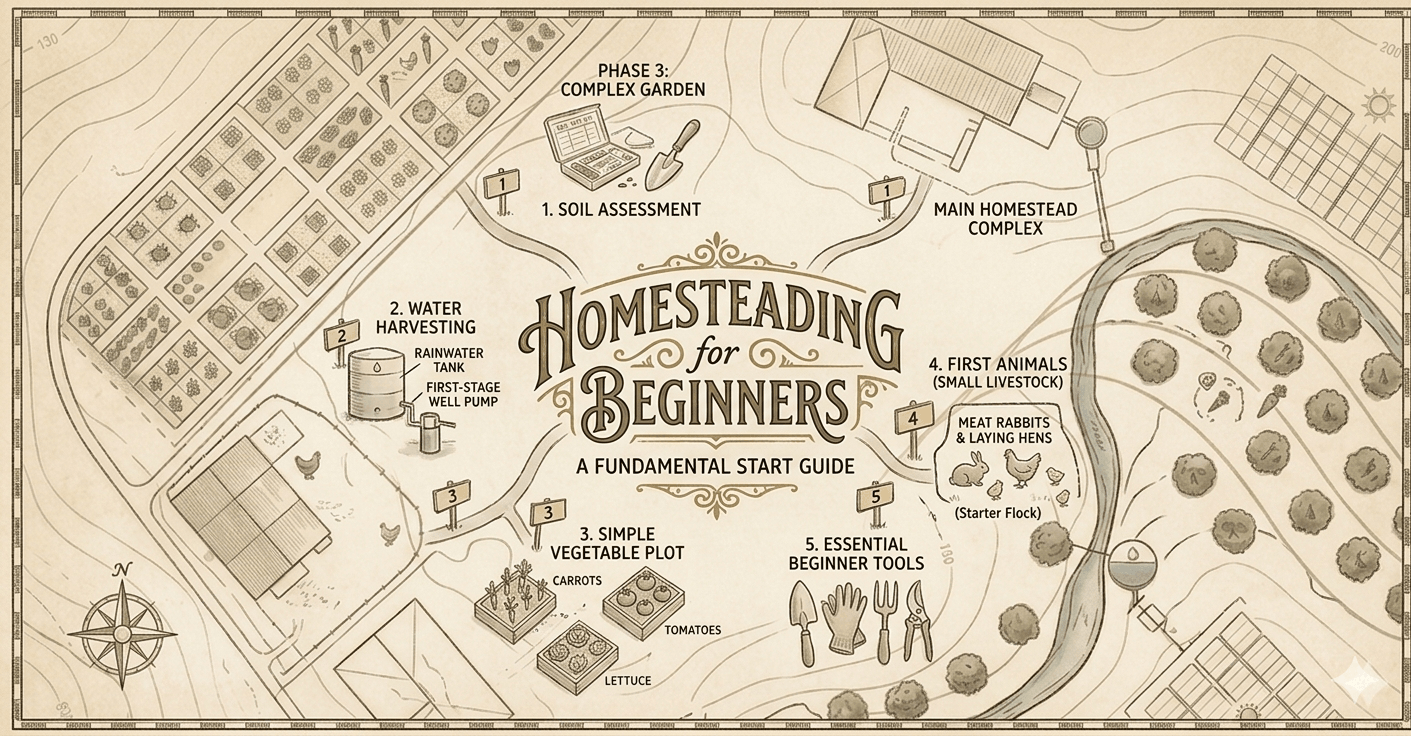
So you want to start a homestead. Maybe you have been watching videos for months. Maybe a single tomato from a friend's garden lit a quiet fire. Maybe you are tired of grocery prices and ready to take more of your life into your own hands. Whatever brought you here, welcome. You are in the right place.
Starting a homestead can feel huge. There are a thousand things you could do. Raise chickens. Plant a garden. Install solar. Build a root cellar. Bake your own bread. Learn to can tomatoes. The list never ends, and that is part of why so many people freeze before they ever begin.
Here is the good news. You do not have to do all of it. You do not have to do most of it. You just have to start with one thing, then add another. That is how every homesteader you admire actually got here. One project at a time. One season at a time.
This guide will walk you through the early decisions that matter most. We will cover what homesteading really means today, how to set goals you can actually keep, what to grow first, when to add animals, how to budget, and how to dodge the most common rookie mistakes. By the end, you will have a clear, calm plan you can act on this weekend.
Take a breath. You can do this.
What Homesteading Actually Means in 2026
Homesteading is not a place. It is a practice. It is the steady choice to grow, raise, build, or preserve more of what your household needs. The size of your land does not define you. Your habits do.
That matters because the word "homestead" carries a lot of imagery. The 40 acre farm. The cabin in the woods. The wood stove and the cow and the kids in muck boots. Those images are beautiful, but they are one version of a much bigger movement. There are people growing 300 pounds of food a year on a quarter acre. There are people fermenting kimchi in a city apartment. They are all homesteaders.
Most modern homesteaders fall into one of three loose categories. None is better than another.
Hobby and backyard homesteaders. You live in town or the suburbs. You garden, maybe keep a few hens if your zoning allows, and you preserve some of what you grow. You probably hold a regular job. The goal is not full self sufficiency. The goal is a more hands on life and better food on the table.
Rural and small acreage homesteaders. You have one to ten acres. You raise some combination of chickens, ducks, bees, rabbits, or goats. You grow a real garden. You may have a side income from eggs or honey or hay. You are aiming for meaningful self reliance without trying to opt out of the modern world.
Off grid and full time homesteaders. You have land, time, and the appetite for big projects. You may run on solar. You may have livestock for meat. You produce most of your food and a chunk of your energy. This life takes years to build, and almost everyone who lives it started in one of the first two categories.
If you are not sure which path fits you, that is fine. Your version will reveal itself as you go. You will learn things you cannot learn from any guide. The first year is mostly about listening, observing, and getting your hands dirty.
Define Your Why Before You Buy a Single Seed
Before you order chicks or build a raised bed, sit down and write out what self sufficiency means to you. Not in general. To you. To your household. In this season of your life.
This step sounds soft, but it is the most practical thing you can do. A clear "why" stops you from spending $400 on a fancy coop in March only to realize in June that you actually wanted to focus on canning. It keeps you from chasing every cool project you see online. It is the rudder.
Here are a few honest questions to ask yourself. Write the answers down. A simple notebook works fine.
- What does a successful homestead look like in one year? In five years?
- How many hours per week can you realistically commit during the growing season?
- What is your real budget for upfront infrastructure like fencing, raised beds, and a coop?
- Are there local rules, an HOA, or deed restrictions that limit what you can do?
- Which homesteading projects sound fun, and which ones sound like a chore?
- If you could only succeed at one thing this year, what would it be?
That last question is the one most people skip. It is also the most useful. Pick the one thing. Build everything else around it.
Tip
Try this. Set a 20 minute timer and write a one page letter to yourself, dated one year from today. Describe what your homestead looks like, what you have grown, what you have learned, and how you feel walking the property. Tuck the letter away. Open it in twelve months. You will be surprised how much of it you made happen.
Once you have clarity on your goals, everything else gets easier to prioritize. You will stop feeling pressure to do all of it at once. You will have a roadmap. And when a shiny new project shows up, you can ask one question. Does this serve my one thing? If yes, consider it. If no, write it down and come back to it next year.
Decide What Kind of Land You Need
The single biggest myth in homesteading is that you need a lot of land. You do not. You need a clear use of the space you have.
Some of the most productive homesteaders in the country are working with less than a quarter acre. Others are doing very little with 50. The land is a tool, not a trophy. Here is a realistic look at what is possible at each scale, so you can place yourself on the map and start where you are.
Apartment and Balcony Homesteading
Yes, this counts. You can grow herbs in a sunny window. You can grow lettuce, spinach, and microgreens in shallow containers. You can ferment vegetables, bake sourdough, and make your own yogurt. You can learn to can on a regular kitchen stove. None of that requires land. It just requires intent.
Quarter Acre Suburban Lot
This is where most modern backyard homesteaders live. With a quarter acre you can run a serious vegetable garden, plant two or three fruit trees, keep a small flock of three to six hens if your zoning allows, install a couple of rain barrels, and build a working compost system. A family can grow a meaningful share of its own produce without ever leaving the city. If you are in this category, our urban homesteading guide digs deeper into the layout decisions that matter.
One to Five Acres
This is the sweet spot for most rural homesteaders. You have room for a real garden, a chicken run with a generous coop, a beehive or two, a small rabbit setup, and perhaps a pair of dairy goats or a few ducks. You have space for a high tunnel or a small greenhouse. You can plant a small orchard. You can begin to produce a real surplus.
Five Plus Acres
With five acres or more, you can start thinking about larger livestock, hay production, woodlot management, and pasture rotation. You can keep a dairy cow if you want one. You can grow grain on a small scale. You can run a true off grid system if that is your goal. The work scales up too, so plan accordingly.
If you are still searching for land, do not skip the legal homework. Laws on livestock, raw milk, water rights, and building codes vary wildly between states. Our state by state homesteading hub is the fastest way to compare your options. Cost matters too. Use our land cost estimator to set realistic expectations before you tour properties.
Start With a Garden
A food garden is the single best first project for any new homesteader. It teaches you about your soil, your climate, your growing season, and your own work habits. It does all of that at a low cost and a fast feedback loop. You can have a salad on the table eight weeks after you plant a seed.
If you take only one piece of advice from this guide, take this one. Plant a garden this season. Even a small one. Even a single bed. Start.
Choosing What to Grow
Pick crops that are forgiving, productive, and things your family actually eats. Skip the exotic varieties for now. There will be plenty of time for purple carrots and obscure heirlooms once you know your land. A solid beginner list looks like this.
- Tomatoes. High yield, versatile, perfect for fresh eating and preserving.
- Zucchini and summer squash. They practically grow themselves. Plant two, not ten.
- Green beans. Easy from seed and very productive over a long window.
- Lettuce, spinach, and other greens. Fast to harvest and great in raised beds.
- Peppers. Both sweet and hot. Great fresh, dried, frozen, or fermented.
- Garlic. Plant in fall, harvest in summer. One of the easiest crops you will ever grow.
- Potatoes. Cheap to plant, easy to store, and deeply satisfying to dig.
- Herbs like basil, cilantro, parsley, and thyme. Small space, big flavor.
Resist the urge to plant 30 different varieties your first year. Five to eight crops, grown well, will teach you more than a chaotic scatter shot garden ever could.
Know Your Growing Zone and Frost Dates
Your USDA hardiness zone and your local frost dates are the foundation of your planting schedule. They tell you when to start seeds indoors, when to transplant, and when your season ends. Get these two numbers wrong and you will fight your garden all year.
The good news is they are easy to look up. The better news is we built a tool that does the math for you.
Planting Calendar Tool
Enter your zip code to get a personalized planting schedule based on your USDA zone.
Try it free →Soil First, Seeds Second
New gardeners obsess over what to plant. Experienced gardeners obsess over soil. Healthy soil grows healthy plants. Tired soil grows tired plants no matter what you do.
Before your first season, take a soil sample to your county extension office for a basic test. Most charge less than $20. The results will tell you your pH, your nutrient levels, and what amendments you need. Add compost generously. Add lime if your soil is acidic. Add a slow release organic fertilizer if your nutrients are low. Your future self will thank you. To go deeper, our companion guide on composting basics walks through how to build your own compost system from scratch.
Raised Beds vs In Ground vs Containers
There is no single right answer. Raised beds give you control over soil, drainage, and weeds, and they are easy on the back. In ground beds cost less and scale more easily once you know what you are doing. Containers are perfect for patios, balconies, and tight spots. Many homesteaders use all three.
If you are starting from scratch and you have the budget, two or three raised beds in a sunny spot will get you growing fast. For a deeper look at design, layout, and bed building, see our beginner vegetable gardening guide.
Add Animals Gradually
Animals are where homesteading goes from a hobby to a lifestyle. They will also humble you faster than anything else on the property. The right approach is simple. Start small. Get one species right before you add another.
Why Chickens Are the Best First Animal
Backyard chickens are the natural first step for almost everyone. They give you eggs. They give you compost material. They eat kitchen scraps and garden pests. They are fun to watch. They are also forgiving compared to most livestock, which matters when you are still learning.
A small flock of four to six hens is plenty for most beginners. Budget for a secure coop, a covered run, quality feed, and basic supplies like waterers and grit. Expect your first eggs around 18 to 22 weeks after you bring home pullets. Once they start laying, you will be amazed how fast a flock that small fills up your fridge.
If you are still deciding which breed is right for your climate and goals, our chicken breed picker sorts breeds by egg color, temperament, cold hardiness, and more. The hub at our chicken section also covers feeding, coop design, and winter care.
Common Beginner Mistakes With Chickens
These are the mistakes I see new chicken keepers make over and over. None of them are deadly on their own, but together they can sour the experience. Get these right from day one.
- Building a coop that is too small. Plan for at least 4 square feet per bird inside the coop and 10 square feet per bird in the run.
- Skipping predator proofing. Use hardware cloth, not chicken wire. Chicken wire keeps chickens in. It does not keep predators out.
- Underestimating winter care in cold climates. Plan ventilation without drafts. Plan for frozen waterers.
- Buying too many birds the first year. Six laying hens make about 24 eggs per week at peak. That is plenty.
- Forgetting that chickens are loud, dusty, and never take a vacation. Make sure your household is on board.
What Comes After Chickens
Once your chicken systems are running smoothly, the natural next steps are predictable. You do not have to add anything. But if you want to, here is the order most homesteaders follow.
Ducks. Ducks lay rich, large eggs and handle wet climates better than chickens. They are messier with water but easier on a garden.
Rabbits. Rabbits are quiet, compact, and one of the most efficient sources of meat for small properties. Their manure is gold for your garden.
Bees. Honeybees fit on almost any property. They support your garden through pollination and produce a luxury food you can store for years. Start with our beekeeping for beginners guide before you order a hive.
Goats. Dairy goats are wonderful but they are a real commitment. They need good fencing, daily milking once they freshen, and a herdmate. Do not start here.
Animals to Wait On
Some animals get romanticized online, but they are not where new homesteaders should begin. Cattle need acreage and serious infrastructure. Pigs are fast and powerful and require strong fencing. Sheep are sensitive to parasites and management mistakes. None of these are bad choices. They are just bad first choices.
If you are unsure where to start, our livestock quiz will steer you toward animals that match your space, climate, and lifestyle.
Warning
Do not buy any animal before its housing, fencing, water, and feed plan are ready. The single most common reason new homesteaders quit is impulse buying livestock without the infrastructure to keep them safe. Build the home first. The animals come second.
Learn to Preserve What You Grow
A garden produces in waves. You will go from no tomatoes to fifty tomatoes in a single week. The bridge from gardener to homesteader is preservation. Once you know how to put food up, the surplus stops feeling like pressure and starts feeling like wealth.
There are four core preservation methods worth learning in your first two years. You do not need to master all of them at once. Pick one per season.
Water bath canning. Best for high acid foods like tomatoes, pickles, salsas, jams, and fruit. The equipment is cheap. A large stock pot and a rack will do. This is the most beginner friendly method, and it is where most people start. Our canning for beginners guide walks through everything you need.
Pressure canning. Required for low acid foods like green beans, corn, soups, and meats. The equipment is more expensive and the process feels intimidating at first. It is genuinely safe when you follow tested recipes. Once you learn it, your pantry transforms.
Dehydrating. A simple dehydrator turns extra fruit, herbs, and vegetables into shelf stable snacks and ingredients. Dried tomatoes. Apple chips. Jerky. Powdered greens. Dehydrating uses very little energy and the results store for months in jars.
Fermenting. This is the oldest preservation method on earth and the most forgiving. Sauerkraut. Kimchi. Pickles. Hot sauce. You need salt, vegetables, and a clean jar. The flavor is incredible, and fermented foods are excellent for gut health. If this method calls to you, our fermenting vegetables guide is a great starting point.
Pick one method this year. Get good at it. Add another next year. Within three or four seasons you will have a real, working pantry that carries your family through the off season.
Build Skills, Not Just Infrastructure
There is a quiet truth that nobody puts on the highlight reels. The best homesteaders are not the ones with the most stuff. They are the ones with the most skills. Skills travel with you. Skills do not rust. Skills are the part of homesteading you keep forever.
If you cannot afford big infrastructure yet, this is great news. You can build a knowledge homestead anywhere. Here are the skills worth chasing in your first few years.
Basic carpentry. If you can measure, cut a straight line, and drive a screw, you can build raised beds, simple coops, compost bins, and shelves. None of this is fancy. All of it saves you money.
Sharpening tools. A sharp shovel, hoe, knife, or pair of pruners cuts your work in half. Most homesteaders never learn this. The ones who do work less and finish more.
Sourdough baking. Bread is the gateway food skill. Sourdough requires no commercial yeast and produces some of the best bread you will ever eat. The starter takes a week. The skill takes a season. The reward lasts a lifetime.
Soap making. A surprising number of homesteaders start with cold process soap. It uses fats from your own animals if you raise them, it makes thoughtful gifts, and the chemistry is deeply satisfying.
Basic mending. Patching jeans, darning socks, and replacing buttons are not glamorous, but they will save you hundreds of dollars over the years. Most of these skills can be learned from one good evening on YouTube.
Weather literacy. Read the sky. Watch barometric pressure. Know your local microclimates. Homesteaders who pay attention to weather waste fewer crops and lose fewer animals.
A working homestead is a stack of skills. Each one you add compounds with the rest. The more you can do with your hands, the less you need to buy with your wallet.
Plan Your Budget Honestly
Money is the part of homesteading that nobody talks about clearly. Either it gets glamorized as cheap and simple, or it gets dismissed as something only rich people can pursue. Neither is true. Homesteading scales to the budget you have, as long as you plan honestly.
Here are realistic ranges for what your first year can cost depending on your scale.
Backyard starter, under $500. A few raised beds, soil, seeds, basic hand tools, and a small starter set for canning. Many families fit a real first season into this budget.
Small homestead, $1,500 to $5,000. Add a chicken coop and a small flock, a starter set for food preservation, fencing for a small area, and basic infrastructure like a rain barrel or two.
Acreage homestead, $10,000 plus. Land improvements, a larger coop, perimeter fencing, a small barn or shed, possibly a high tunnel, and the equipment to maintain it all. Costs grow fast at this scale.
A simple first year breakdown might look like this.
| Category | Realistic First Year Spend |
|---|---|
| Garden setup (beds, soil, seeds) | $200 to $600 |
| Tools (shovel, hoe, pruners, gloves) | $100 to $250 |
| Chicken coop and starter flock | $400 to $1,200 |
| Feed and bedding (year one) | $400 to $700 |
| Food preservation gear | $150 to $500 |
| Fencing and infrastructure | $300 to $2,000 |
| Miscellaneous and surprises | $200 to $500 |
These numbers move quickly based on your region, whether you build or buy, and how much you can scrounge from local listings. Build a buffer for surprises. There will be surprises.
If staying lean is part of the plan, our homesteading on a budget guide covers tactics like sourcing free pallets, building from scrap, bartering with neighbors, and staggering big purchases across seasons.
Know the Laws Where You Live
The fastest way to get discouraged is to invest in a project only to find out it is not allowed where you live. Spend an hour on this before you spend a dollar.
There are three categories of rules to check before you start.
HOA and deed restrictions. If you live in a planned community, your HOA may ban chickens, clotheslines, visible compost piles, or vegetable beds in the front yard. Pull your covenants and read them. The rules are often stricter than people realize.
Zoning and livestock limits. Cities and counties set limits on how many animals you can keep, what species are allowed, and how close coops can sit to property lines. Some cities allow hens but ban roosters. Some allow goats but only at certain acreages. Call your local zoning office. Many are friendlier than you expect.
Cottage food and cottage industry laws. If you ever want to sell eggs, baked goods, jams, or honey, your state has rules. Some states are extremely permissive. Others require a licensed kitchen. Knowing the rules early helps you make smart choices about scale.
For a deeper national overview, see our guide to homesteading laws and zoning. For state specific details, our state by state homesteading hub covers right to farm protections, raw milk laws, and more for all 50 states.
Your First Year Month by Month
Most beginners feel lost because they do not know what to do when. Here is a simple, calendar based view of what your first year can look like. Your timing will shift based on your zone, but the rhythm is similar everywhere.
| Month | Focus |
|---|---|
| January | Plan goals. Order seeds. Sketch your garden. Read. |
| February | Start onions, peppers, and slow growing seeds indoors. Build raised beds. |
| March | Start tomatoes indoors. Prep soil outside. Plant cool weather crops. |
| April | Transplant cool crops. Set up a coop. Plant fruit trees if applicable. |
| May | Bring home chicks if your setup is ready. Plant warm weather crops after frost. |
| June | Mulch heavily. Set up irrigation. Begin staking and pruning tomatoes. |
| July | Harvest steadily. Start water bath canning. Watch for pests. |
| August | Peak harvest. Preserve aggressively. Plant fall crops. |
| September | Harvest fall crops. Cure garlic and onions. Start dehydrating. |
| October | Plant garlic for next year. Clean up beds. Add compost. |
| November | First eggs likely arriving. Winterize coop. Reflect on the season. |
| December | Rest. Plan next year. Read. Take stock of what worked and what did not. |
For a deeper, week by week version of this calendar, see our first year homesteading timeline.
Common Beginner Mistakes and How to Avoid Them
Almost every new homesteader makes the same handful of mistakes. The good news is that you can skip most of them by reading this section twice.
- Trying to do everything in year one. Pick one or two big projects and protect them. Save the rest for next year.
- Buying animals before infrastructure is ready. Build the coop, set the fence, and stock the feed before any animal lives on your property.
- Skipping the soil test. A $15 soil test will save you a season of frustration and often a bag or two of unnecessary fertilizer.
- Underestimating water. Gardens need consistent water. Animals need clean water daily. Plan for both before you scale up.
- Ignoring the calendar. Homesteading is seasonal work. Late seeds rarely catch up. Late transplants struggle in summer heat. Get the timing close to right.
- Building too small. Coops, beds, and storage all feel huge until you fill them. When in doubt, build slightly bigger than you think you need.
- Quitting in July. July is hard. The bugs are out, the weeds are winning, and you are tired. Push through. August is when the harvest arrives, and August changes everything.
If you can avoid these seven, your first year will go better than 90 percent of new homesteaders. None of these is exotic. They are just easy to overlook when you are excited.
Build Momentum, Not Perfection
The biggest trap new homesteaders fall into is trying to build the perfect setup before they start. Perfection is the enemy of progress on a homestead. A crooked raised bed that produces food is infinitely more valuable than a Pinterest worthy garden plan that never gets built.
Focus on one system at a time. Get your garden producing. Add chickens once you can keep them safely. Learn to can. Build a small skill. Add another. Each thing you do makes the next thing easier. Within a few years you will look up and realize you have built a real homestead, with your own hands, in the spaces you carved out of an ordinary life.
Start where you are. Use what you have. Plant something this week. If you are ready to map out your season, our planting calendar will tell you exactly what to start and when based on your zip code.
You can do this. We are glad you are here.
Frequently Asked Questions
You can start with as little as a small backyard, a balcony, or even a sunny window. Many homesteaders grow significant amounts of food on a quarter acre suburban lot. The key is using your space efficiently with raised beds, vertical growing, container planting, and smart succession.
A backyard garden can be started for under $200 with seeds, soil amendments, and simple raised beds. A chicken coop and starter flock typically runs $400 to $1,200. Larger projects like fencing, irrigation, and outbuildings can be phased in over several seasons as your budget allows.
Absolutely. Most homesteaders start while working full time. Plan on 5 to 10 hours per week of garden and animal chores during the growing season. Efficient systems like drip irrigation and automatic coop doors keep daily time low so you can focus on weekend projects.
True self sufficiency is a long arc, often a decade or more, and most homesteaders never aim for 100 percent. Within three to five years of consistent effort, most families can produce a meaningful portion of their own food and master core preservation skills. Treat it as a direction, not a finish line.
No. Most modern homesteaders keep their jobs and homestead on weekends and evenings. A steady income makes the early years easier because you can fund infrastructure without pressure. Many people transition to part time work or self employment only after their homestead is well established.
There is no single best state. Tennessee, Texas, Missouri, North Carolina, Virginia, and Idaho consistently rank well for affordable land, friendly laws, and long growing seasons. The right state depends on your climate preferences, budget, and family ties. Browse our state by state hub to compare.
Start with the garden. A garden teaches you about your soil, your weather, and your work habits at a low cost. Chickens are wonderful, but they are also a daily commitment, and they go better when you already have rhythms and infrastructure in place. Add them in year two.
Start with gardening, basic food preservation like water bath canning, and one practical skill such as sourdough baking or simple carpentry. These three areas cover food production, food storage, and the confidence to build small projects. Each one compounds with the others as you grow.

Cole
Founder & Lead Researcher
Cole is the founder of Plan Your Homestead. He works in clinical research and brings a research-first lens to every guide on the site, drawing on a long family line of farmers for grounded, practical perspective.
More in Guides
More articles coming soon. Check back for new guides content.