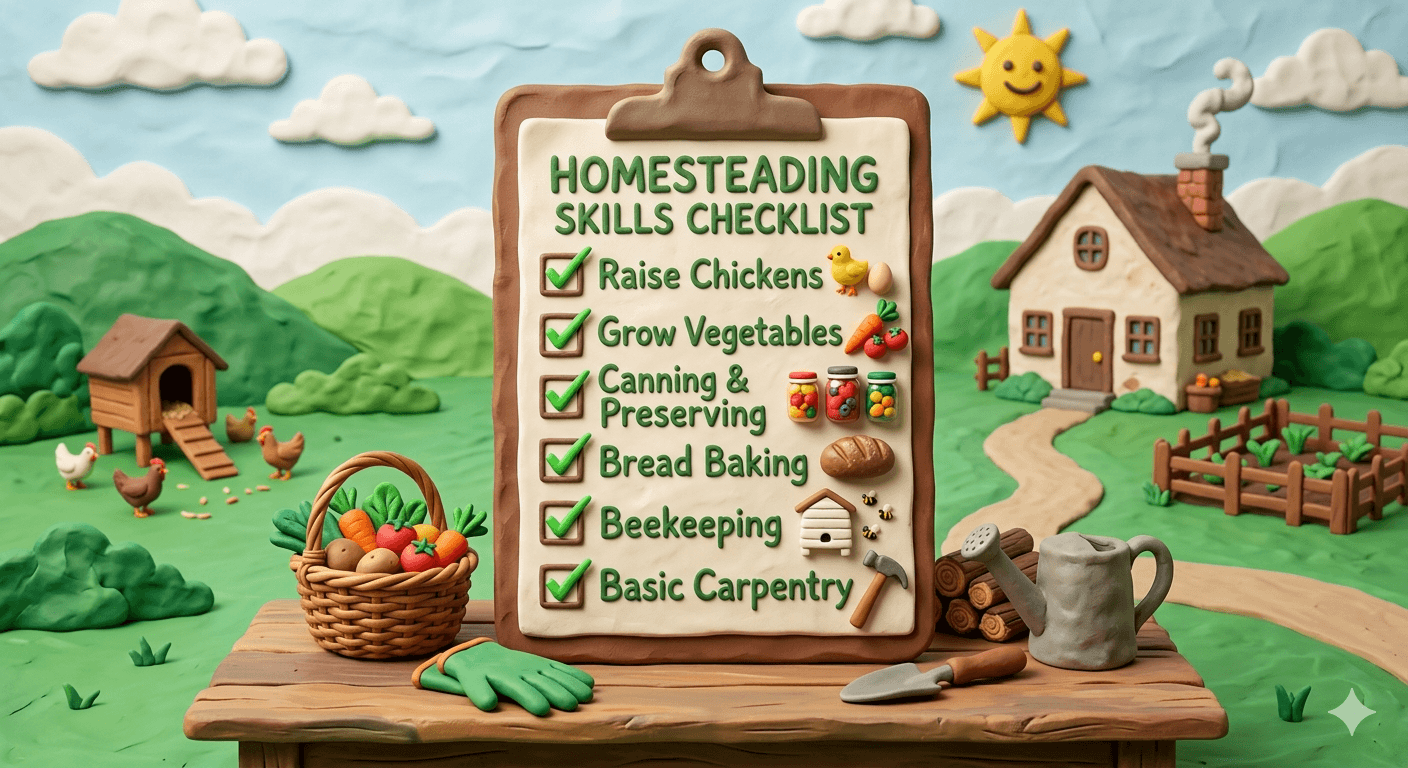
Land is the headline. Skills are what actually feed you. You can buy seeds, you can buy a coop, you can buy a chest freezer. You cannot buy the steady hands that come from doing the work a hundred times. That part has to be earned.
This is the homesteading skills checklist we wish someone had handed us in year one. One hundred real skills, grouped by category, written in plain language. Some you will pick up in an afternoon. Some take a season. A few take years. None of them are mysterious. They are old, practical, learnable, and stackable, and every one of them makes the homestead a little more yours.
If you are brand new, start with our homesteading for beginners guide for the big picture, then come back here for the to do list. If you want a month by month plan to actually learn these, our first year timeline walks through what to tackle when.
How to Use This Checklist
This is not a curriculum. You do not have to learn these in order. You do not have to learn all of them, ever. Pick what fits the homestead you are building. If you have no goats, skip the goat skills. If you live in an apartment, skip the firewood. The list is a menu, not a syllabus.
The pattern that works for most people is simple. Pick one skill from a few different categories each season. Practice it until it stops feeling clumsy. Move on. Skills compound. The person who can start seeds and bake bread and patch a fence is dramatically more capable than the person who can only do one of those, and the gap grows fast.
Bookmark this page. Print it if you want. Check things off as the years go by. The list will outlast a dozen seed catalogs.
Garden and Soil Skills (1 to 10)
The garden is where most homesteaders start, and for good reason. A working garden teaches you about weather, water, timing, and patience faster than anything else. These ten skills are the foundation. Master them and the rest of the food side of the homestead becomes much easier. For more depth, see our starting a garden guide.
- 1. Start seeds indoors. A windowsill, a tray, and a packet of tomato seeds is the whole setup. Learn this and you stop being dependent on the garden center calendar.
- 2. Build a raised bed. Two by ten boards, four screws per corner, fill with soil. The first one teaches you everything you need to build five more.
- 3. Read a soil test. Send a soil sample to your county extension office and learn to read the report. pH, nutrients, organic matter. Most garden problems show up here first.
- 4. Compost kitchen scraps. A pile, a bin, or a tumbler. Learn the brown to green ratio and you turn trash into the best soil amendment money can buy.
- 5. Mulch a bed. Straw, leaves, or wood chips. A mulched bed needs half the water and a quarter of the weeding. Skip this skill and you fight your garden all summer.
- 6. Save seeds from a tomato. Squeeze the seeds into a jar of water, ferment for a few days, rinse, dry, store. Free seeds for life from your best plants.
- 7. Identify common garden weeds. Pigweed, lambsquarters, purslane, plantain, dandelion. Half of them are edible. All of them tell you something about your soil.
- 8. Prune a fruit tree. A single yearly cut at the right time changes the next decade of harvests. Learn the basics with a young tree before you touch a mature one.
- 9. Transplant seedlings without killing them. Harden off, water deeply, plant on a cloudy afternoon. The hardening off step is the one most beginners skip and regret.
- 10. Plan a simple crop rotation. Four beds, four families, rotate one slot each year. Disease drops, soil improves, and you start thinking like a gardener instead of a hobbyist.
Planting Calendar Tool
Enter your zip code to get a personalized planting schedule based on your USDA zone.
Try it free →Food Preservation and Pantry Skills (11 to 20)
Growing food is half the work. Keeping it through winter is the other half. These skills turn a busy summer into a stocked pantry, and they pay back forever. Our preservation basics guide covers the safety side in more depth.
- 11. Water bath canning. Tomatoes, jams, pickles, applesauce. The first batch is nervy. By the third batch you are running a small operation in your kitchen.
- 12. Pressure canning. The only safe way to can low acid foods like beans, meat, and broth. A real pressure canner is one of the highest leverage purchases on a homestead.
- 13. Fermentation. Sauerkraut and pickles in a jar with salt and water. The cheapest preservation method ever invented and the best for gut health.
- 14. Dehydrating produce. A simple dehydrator turns a bumper crop of apples, peppers, or herbs into a year of pantry weight. Learn to read leathery versus crispy.
- 15. Freezing the right way. Blanching, portioning, dating, vacuum sealing if you have it. Most freezer waste comes from skipping these four steps.
- 16. Set up a basic root cellar. A spare closet, a cool basement corner, or a buried bin. Learn the temperature and humidity ranges and you store potatoes and carrots for six months.
- 17. Render lard or tallow. Slow cook clean fat into a shelf stable cooking grease. One hour of work replaces a year of vegetable oil.
- 18. Cure bacon at home. Salt, sugar, time, smoke. Once you taste your own bacon, the grocery store version stops feeling like food.
- 19. Dry and store herbs. Bundle, hang, crush, jar. A free spice rack from a single garden bed.
- 20. Pressure can bone broth. A whole chicken plus a few hours equals a dozen quarts of pantry stock. The single most useful staple in a homestead kitchen.
Kitchen and From Scratch Cooking Skills (21 to 30)
A homestead kitchen runs on staples, not recipes. These ten skills cover the daily basics that make a from scratch life sustainable instead of exhausting.
- 21. Keep a sourdough starter and bake a loaf. A jar of flour and water on the counter, fed once a day. The loaf that comes out of it for the next twenty years is free.
- 22. Bake biscuits from scratch. Flour, fat, salt, leavening, liquid. Five ingredients, ten minutes, a thousand variations.
- 23. Churn butter from cream. A jar with a lid and a tired arm, or a stand mixer if you cheat. Fresh butter is a different food entirely.
- 24. Make a soft cheese. Ricotta or chevre at home is a one hour project. The first batch will surprise you.
- 25. Make mozzarella. A gallon of milk becomes a ball of cheese in about thirty minutes. The gateway hard cheese, and the most rewarding.
- 26. Make yogurt. Milk plus a spoon of yogurt plus warmth equals more yogurt. Once you start you will not buy it again.
- 27. Make stock from bones. Roast bones, cover with water, simmer all day, strain. Free flavor, free nutrition, no waste.
- 28. Make pasta from flour and eggs. Three ingredients, a rolling pin, and an afternoon. Sunday pasta becomes a quiet homestead tradition.
- 29. Make jam without commercial pectin. Long cook, high sugar, careful skim. The flavor is brighter and the pantry shelf gets prettier.
- 30. Real knife skills. A sharp knife, a steady board, a basic claw grip. The single biggest upgrade to any home kitchen.
Chickens and Small Livestock Skills (31 to 40)
Chickens are the gateway animal for almost every homestead, and these are the skills that separate a working flock from a problem flock. For deeper coverage, see our backyard chickens guide.
- 31. Set up a brooder. A tote, a heat plate, water, chick starter, clean bedding. Get this right and the first three weeks are easy.
- 32. Butcher a chicken. The hardest skill on the list for most people, and the one that changes how you think about meat for the rest of your life.
- 33. Candle eggs. A flashlight in a dark room, a developing embryo against the shell. Useful for hatching, fascinating either way.
- 34. Integrate new birds into a flock. See but no touch for a week, then careful introductions at dusk. Skip the steps and the pecking order does the work for you.
- 35. Spot a sick chicken. Hunched, fluffed, quiet, off feed. The earlier you see it, the more options you have.
- 36. Trim a beak or a nail. Small clippers, a calm grip, and a styptic powder on standby. A skill you hope to use rarely and need to know cold.
- 37. Keep a coop clean without chemicals. Deep litter, dry bedding, ventilation, sun. Healthy birds come from a dry coop more than from any feed brand.
- 38. Raise meat birds. Cornish cross or a slower heritage breed, eight to twelve weeks from chick to freezer. A focused project that fills the freezer fast.
- 39. Raise quail or ducks. A different species teaches you what is universal about poultry and what is breed specific.
- 40. Predator proof a coop and run. Hardware cloth, buried apron, latched doors, covered top. One hard lesson here is enough for a lifetime.
Foraging and Wild Foods Skills (41 to 50)
Foraging is free food, free medicine, and a different relationship with the land. Start small. Learn three plants at a time, in person, with a real teacher or a careful field guide.
- 41. Identify three wild greens in your region. Dandelion, lambsquarters, and chickweed are a fine start almost anywhere in North America.
- 42. Identify three wild mushrooms. Morels, chanterelles, and oysters are common, distinct, and have few dangerous look alikes. Never trust an app.
- 43. Process acorns. Shell, leach the tannins, dry, grind into flour. An old skill that turns a yard pest into pantry weight.
- 44. Tap a maple tree. Drill, spile, bucket, boil. Even a few quarts of homemade syrup is a reward worth the effort.
- 45. Identify medicinal weeds. Yarrow, plantain, chickweed, mullein. The first aid kit growing in your driveway.
- 46. Harvest wild berries safely. Know your blackberries from your pokeberries, your elderberries from your nightshade. The differences are easy once seen in person.
- 47. Make a wild tea. Pine needle in winter, mint and nettle in spring. A free vitamin C habit and a way to slow down.
- 48. Harvest cattail. Roots, shoots, pollen, and fluff. The most useful wild plant most people walk past every week.
- 49. Identify edible flowers. Violets, redbud, dandelion, daylily. A flourish for any homestead plate, free for the picking.
- 50. Keep a foraging journal. Plant, place, date, weather, what you did with it. A field guide tailored to your land that gets better every year.
Tools, Repair, and Building Skills (51 to 60)
A homestead is a thousand small repairs. The person who can fix things is the person whose homestead actually runs. These skills are the difference between calling someone and handling it yourself before lunch.
- 51. Sharpen a kitchen knife. A simple stone and a steady angle. A sharp knife is safer, faster, and the first sign of a competent kitchen.
- 52. Sharpen an axe. A file, a stone, and a clean edge. The right edge turns a frustrating chore into a satisfying afternoon.
- 53. Run a chainsaw safely. Chaps, helmet, tension check, kickback awareness. The most useful and the most dangerous tool on most homesteads.
- 54. Swing a hammer well. Sounds basic, almost never is. A clean three swing nail is a small joy and a real skill.
- 55. Use a circular saw. Square cuts, ripped boards, the right blade for the job. Unlocks every basic build on the property.
- 56. Build a simple gate. Square frame, diagonal brace, decent hinges, a latch that works in winter. Every homestead needs gates and most are bad.
- 57. Mend a wire fence. Splice, tighten, staple, walk the line. A weekly skill on any homestead with animals.
- 58. Change a tractor or mower implement. Hitch pins, PTO shafts, hydraulic couplers. Reading your operator manual once is half of this skill.
- 59. Service a small engine. Oil change, air filter, spark plug, fresh fuel. Five minutes of maintenance saves a thousand frustrations.
- 60. Know when to call a welder, electrician, or plumber. A skilled homesteader knows their limits. The right call to a pro at the right time is also a skill.
Water, Energy, and Off Grid Skills (61 to 70)
You do not have to live off grid to need these. Power goes out. Pipes freeze. Wells fail. The homesteader who knows the basics is the one whose family stays warm and watered when things go sideways. For deeper coverage, see our off grid power guide.
- 61. Install a rain barrel. Downspout, screen, spigot, overflow. Free water for the garden and a habit that pays back every storm.
- 62. Fix a leaking pipe. PEX, copper, or PVC, depending on what you have. A confident first fix is worth a hundred dollars in plumber visits.
- 63. Find and use the main water shutoff. Walk the line from meter to house. Know where every shutoff is before you need them, not during.
- 64. Troubleshoot a well pump. Reset the breaker, check the pressure tank, listen for the click. Most well issues are simple if you know the order to check.
- 65. Wire a basic circuit safely. A switched outlet, a light fixture, a basic three way. Power off, voltage tested, then work begins.
- 66. Run a small solar setup. A panel, a charge controller, a battery, a USB inverter. Good for phones, fans, and small lights, and a great teacher for bigger systems.
- 67. Use a generator without ruining anything. Stable fuel, proper grounding, no back feeding the grid. The wrong generator setup has burned down more homes than the storm did.
- 68. Split firewood. A maul, a block, a steady swing, a dry shed. The skill that heats the home for free if you have trees.
- 69. Build a fire in wet weather. Tinder under cover, fine kindling, patience. A skill that has nothing to do with luck once you know the order.
- 70. Season firewood properly. Cut, split, stack, cover the top, leave the sides open. Two summers of drying time for hardwood, and your stove will love you.
Land, Weather, and Planning Skills (71 to 80)
A homestead is a long game. These planning skills are the ones that pay back over years, not weekends. Boring on the surface, deeply useful in practice. Our homesteading on a budget guide and homesteading laws and zoning guide cover two of the most important corners.
- 71. Read a property plat. Boundaries, easements, setbacks, right of ways. The single most useful document you own as a landowner.
- 72. Walk and mark your property line. Pins, tape, ribbons, and a good neighbor. Done once, useful forever.
- 73. Read frost dates and your hardiness zone. Last frost, first frost, average extremes. The calendar your garden actually runs on.
- 74. Build a simple seasonal plan. A one page document for the year, divided into four seasons. Goals, projects, animals, garden, repairs. Beats any app.
- 75. Track homestead expenses. A spreadsheet, an envelope of receipts, a notebook. Knowing what the homestead actually costs is what turns it into a real operation.
- 76. Read a weather forecast like a farmer. Frost windows, rain probabilities, soil temperature, wind shifts. The forecast tells you when to plant and when to wait.
- 77. Find your local cooperative extension office. Free soil tests, free advice, classes, and the best local network you can join.
- 78. File for the homestead tax exemption. Where applicable, a one time form that saves real money every year.
- 79. Keep a homestead journal. Weather, harvests, expenses, animal events, mistakes. Year three you will reread year one and learn more than from any book.
- 80. Plan a year of food storage. Calories per person per day, a target pantry list, a freezer inventory. The plan turns a panicked stockpile into a calm rotation.
Larger Livestock and Working Animal Skills (81 to 90)
Bigger animals are a different commitment than chickens. More feed, more fencing, more skill. None of this is hard, but all of it matters. Add one species at a time and master these basics before you stack on the next.
- 81. Halter and lead an animal. Goat, sheep, cow, or pig. Calm voice, slow hands, short sessions. The starting point for every other livestock skill.
- 82. Milk a goat or cow by hand. Clean udder, steady rhythm, patience. The animal teaches you faster than any video.
- 83. Give a basic shot. Subcutaneous, intramuscular, the difference between them, and how to keep the needle clean.
- 84. Trim hooves. Goats, sheep, and pigs all need it. A simple set of trimmers and a calm setup keep an entire herd sound.
- 85. Manage parasites without overusing chemicals. Pasture rotation, fecal checks, targeted treatment. The single biggest health lever in a small herd.
- 86. Set up rotational grazing. Smaller paddocks, frequent moves, longer rest. More grass, fewer parasites, healthier animals.
- 87. Raise a pig from weaner to freezer. Six months, decent fencing, good feed, a calm setup. The fastest meat return on most homesteads.
- 88. Work with a livestock guardian dog. Introduction, boundaries, trust. A working dog is a skill of its own and a gift to a small farm.
- 89. Identify pasture toxic plants. Cherry, oak in quantity, nightshades, ragwort. Walk the pasture each spring with a field guide.
- 90. Set up species appropriate fencing. Woven wire for goats, electric for pigs, high tensile for cattle. The wrong fence is the most expensive lesson in livestock.
Health, Home, and Old Time Crafts (91 to 100)
The last ten are the small skills that make the whole life feel like yours. None of them are required. Each one earns its keep in quiet ways.
- 91. Make soap. Cold process, lye, fat, water. The kitchen feels different the first time you wash up with your own bar.
- 92. Make lip balm or salve. Beeswax, oil, herbs. A starter project for the herbal medicine cabinet.
- 93. Build an herbal first aid kit. Yarrow tincture, plantain salve, calendula oil, dried chamomile. Old answers for small problems.
- 94. Mend clothes by hand. A simple running stitch, a button, a torn seam. Saves the wardrobe and slows the throwaway habit.
- 95. Darn a sock. A wooden egg, a needle, a darning thread. A two dollar tool that saves a closet of socks.
- 96. Sharpen sewing scissors and shears. A few passes on the right stone and they cut like new again.
- 97. Render and bottle beeswax. A double boiler, a strainer, and clean jars. The byproduct that powers most of the crafts on this list.
- 98. Hand make candles. Beeswax or tallow, a wick, a jar. A homestead in a power outage feels different by candlelight.
- 99. Hand split kindling. A small hatchet, a steady block, kindling that catches first try every time. A daily winter skill that becomes meditative.
- 100. Tie five useful knots. Bowline, clove hitch, taut line hitch, sheet bend, and a square knot. With these five you tie down a load, hang a tarp, secure a goat, and sleep better in a storm.
Where to Start If This All Looks Like Too Much
One hundred skills is a lot to look at on one page. It is not a lot to learn over a homesteading life. Year by year, season by season, you absorb most of these without trying very hard. Do not let the length of the list slow you down.
The simple rule we recommend is the rule of three. Each season, pick one garden skill, one kitchen skill, and one fix it skill. Practice them until they stop feeling clumsy. That is twelve real skills a year, plus the dozens you absorb by accident along the way. Inside of three years you have moved through most of this checklist without ever feeling rushed.
If you are working a full time job or raising young kids, slow it down even more. Two skills a season is plenty. Our homesteading as a side project guide is built around this kind of pace, and our first year timeline lays out a more structured month by month version if you want a roadmap.
The point is to start. Start with one skill from one section. Practice it this weekend. Then come back here and pick the next one.
Frequently Asked Questions
How many of these skills do I need before I start a homestead?
None. The whole point is to learn them by doing, not before. If you wait until you can check off all one hundred, you will never start. A handful of beginner skills, an open mind, and a willingness to try and fail is enough for year one.
Which skills should a true beginner learn first?
Start with five. Compost kitchen scraps, start seeds indoors, mulch a garden bed, bake a sourdough loaf, and set up a brooder for chicks. Those five touch every part of a working homestead and each one builds confidence for the next ten.
How long does it take to learn most of these?
Most of the skills on this list take a few hours to learn the basics and a few seasons to feel fluent. A serious homesteader will be comfortable with sixty to seventy of them inside five years. The remaining thirty are the deep skills that fill out a lifetime.
Do I need land for any of these skills?
No. About half of this checklist works in a small apartment with no yard. Sourdough, fermentation, soap, mending, knife skills, foraging, weather reading, knots, and most of the kitchen skills need only a counter and a willing hand. Our urban homesteading guide is built for this exact reader.
What is the most overrated skill on the list?
Hard cheese. It is fun and worth learning, but most homesteaders never make it more than a few times. The yogurt, butter, and soft cheese skills give you a much bigger return for the effort and run weekly in a real homestead kitchen.
What is the most underrated skill on the list?
Keeping a journal. It feels optional and turns out to be the skill that makes every other skill better. The notes you take in year one save you a hundred hours of re learning in year three.
The Short Version
A homestead is built one skill at a time. The list looks long because the life is long. Pick one skill this week. Learn it well. Pick another next week. Three years from now you will be the person someone else asks for help, and that is the whole reward.
If you want a structured next step, here is where to go:
- New to all of this? Start with homesteading for beginners.
- Want a month by month plan? Read the first year timeline.
- Working a full time job alongside this? Try homesteading as a side project.
- Worried about the budget? See homesteading on a budget.
Welcome to the work. One skill at a time.

Cole
Founder & Lead Researcher
Cole is the founder of Plan Your Homestead. He works in clinical research and brings a research-first lens to every guide on the site, drawing on a long family line of farmers for grounded, practical perspective.
More in Skills
More articles coming soon. Check back for new skills content.