
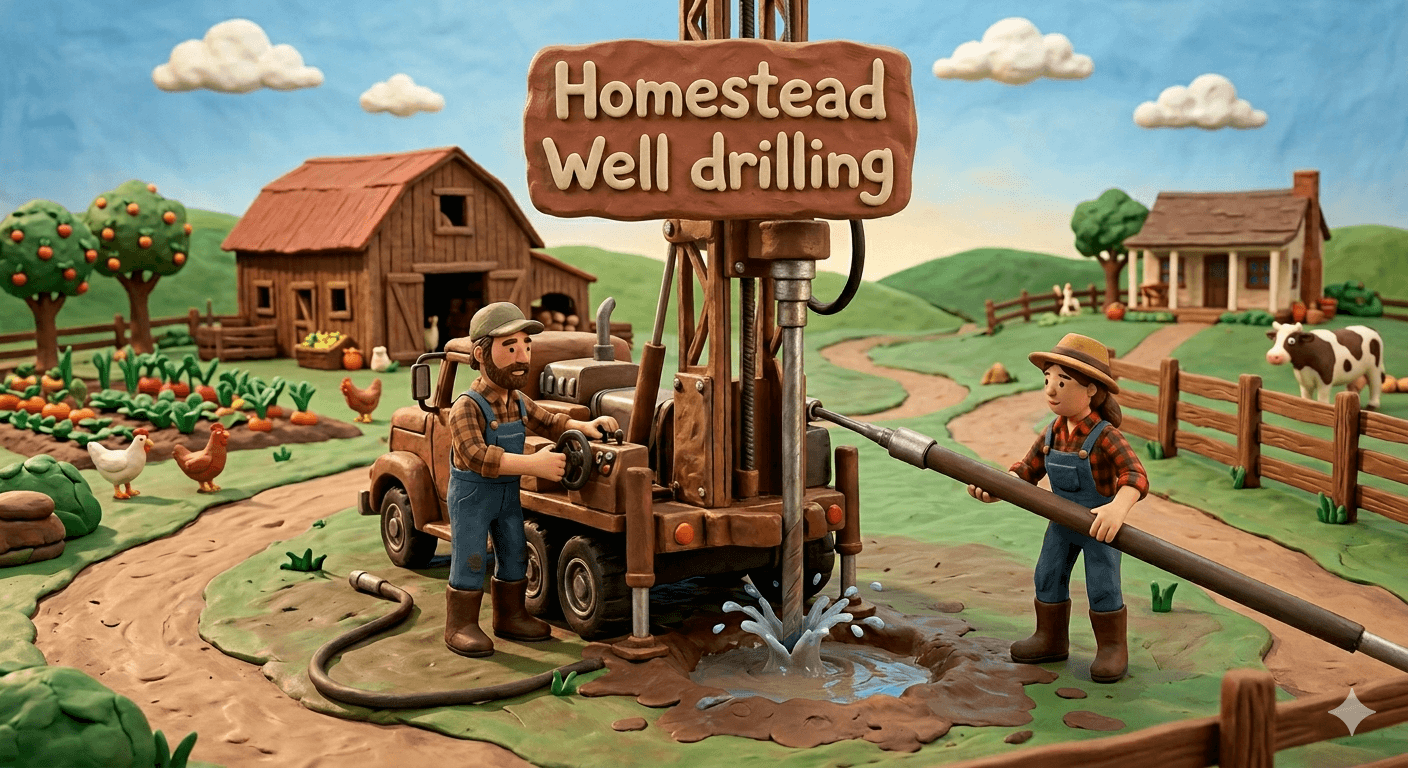
So you want your own well. Maybe the hauling trips are getting old. Maybe the spring runs thin by August. Maybe you just want a homestead that drinks from the ground under your boots. Whatever brought you here, welcome. Drilling a well is one of the most empowering moves a homesteader can make.
It is also one of the most opaque. The price quotes feel like guesses. The permits feel like riddles. The hardware feels like a foreign language. Casing, grout, pitless adapter, drop pipe, foot valve, well screen. Most beginners go quiet at the first bid and pay more than they should because they cannot ask sharp questions.
The good news is that none of this is mysterious once you have a friendly walkthrough. By the end of this guide you will know the four kinds of homestead wells, what a real job costs in 2026, how deep you actually need to go, what permits and setbacks apply, and how to pick a pump that fits your daily water needs. You will also walk away with a first year timeline and a list of the mistakes that drain beginners' wallets. Grab a coffee. Let us dig in.
What a Homestead Well Actually Is
A well is a hole in the ground that reaches a layer of water bearing rock or gravel called an aquifer. Once you reach water, you line the hole with a sealed pipe called a casing. A pump lifts the water from the bottom of the well to a tank on the surface. That is the whole idea, no matter what the rig out front looks like.
People have been drilling wells for thousands of years. The Chinese were using bamboo cable tool rigs by 200 BC. Roman villas had hand dug stone lined wells in the courtyard. The shallow farmstead wells of colonial America were dug by hand, lined with rock, and topped with a wooden bucket. Every version is solving the same problem.
A modern homestead well can be as humble as a 25 foot sand point hand pump in a sandy back yard. It can also be as ambitious as a 600 foot drilled bedrock well feeding a whole house through a constant pressure pump. The right answer depends on your geology, your daily water demand, and your budget.
A well is also a long term asset. A properly drilled and grouted well outlives the house it serves. Forty to seventy years is normal. A few well loved family wells in New England are pushing two hundred. Spend a little more on the install and you set up the next generation, not just the next decade.
Why Drilling a Well Is Worth It
A private well replaces a monthly bill with a one time investment and a small annual maintenance habit. In a town with average water rates, a family of four spends roughly 600 to 900 dollars a year on metered water. Over a 50 year well life, that is 30,000 to 45,000 dollars of avoided utility expense. Even a 12,000 dollar drilled well pays for itself well inside the first decade.
There is also the independence. A municipal line can fail. A water main can break. A boil water notice can park you at the store for a case of bottled water at three in the afternoon. A working private well with backup power gives you water on the worst day of the year, and that resilience compounds across every other system on the homestead.
Wells also unlock real homestead scale. A garden bed and three chickens run fine on city water. A market garden, a small dairy, and a freezer of meat birds drink more water than most utility contracts allow before they trigger surcharges. Your own well lifts that ceiling. You can water what you want, when you want.
Finally, well water is usually softer, colder, and tastier than treated municipal water. No chlorine. No chloramine. No fluoride. The mineral profile is whatever the local rock gives you, and most rock gives you something good. Plenty of homesteaders who switch from city water to a private well say the kitchen tap is the first thing they notice.
The Four Types of Homestead Wells
Not every hole in the ground is the same. Four well types cover almost every homestead in North America. Pick the one that matches your geology, your water need, and your budget.
| Well Type | Typical Depth | Yield | Lifespan | Typical Cost | Best Fit |
|---|---|---|---|---|---|
| Dug well | 10 to 30 feet | 1 to 3 gpm | 20 to 40 years | $1,500 to $6,000 | Wet ground, shallow water table, light use |
| Driven (sand point) well | 15 to 50 feet | 1 to 5 gpm | 10 to 30 years | $500 to $2,500 | Sandy or loose soil, off grid garden water |
| Bored well | 25 to 60 feet | 3 to 10 gpm | 30 to 50 years | $3,000 to $10,000 | Clay or soft soil regions, family scale use |
| Drilled well | 60 to 800 feet | 5 to 25 gpm | 40 to 70 plus years | $6,000 to $25,000 | Hard rock or deep water table, whole house |
A few honest notes on each.
Dug wells are wide, shallow, and old fashioned. They draw from the shallow water table and rise and fall with the rain. They are vulnerable to surface contamination, so most states no longer permit them as a primary potable source. They still shine for irrigation and livestock on a wet property.
Driven wells, often called sand point wells, are the friendliest do it yourself option. You hammer a slotted point on the end of a galvanized pipe down through sandy soil until you hit water. Add a shallow well jet pump or a hand pump on top and you have a functional well for a few hundred dollars. The catch is the soil. Driven wells need loose, rock free ground.
Bored wells are dug by a large auger truck. They are common in clay rich regions like the Carolinas and the Tennessee Valley. The wide diameter holds a lot of water in storage, which buffers low yield aquifers nicely.
Drilled wells are the modern default. A rotary or cable tool rig bores a narrow hole through soil and rock, sets steel or PVC casing, and seals it with grout. Drilled wells reach the deep, protected aquifers, produce the most reliable yield, and last the longest. They also cost the most. For most homesteaders building a whole house water supply in 2026, a drilled well is the right choice.
Tip
Call your state geological survey or your county extension office before you book a driller. Most states publish well log databases that show the depth, yield, and water quality of every well drilled in your area. A free hour of research can save you a 5,000 dollar overshoot on depth.
How Deep You Actually Need to Drill
Depth is the single biggest cost driver on a drilled well. Every foot you sink costs money. Every foot below your aquifer is wasted money. So how deep should you actually go.
The honest answer is local. Well depth varies by hundreds of feet across the same county, let alone the same state. The Texas Hill Country sees wells in the 150 to 400 foot range. Coastal Florida often hits water at 30 to 80 feet. The High Plains of Kansas can run 800 feet or more. Rocky New England averages 200 to 500 feet. Your neighbor's well log is the best predictor you will ever get.
There are two depths to understand. The static water level is where the water sits in the well when nothing is pumping. The pump intake depth is where your pump physically sits, usually 20 to 40 feet below the static level. You want the pump deep enough that even a hard pumping day or a dry season cannot drop the water level below the intake.
A well needs more than just enough water for one good day. A common rule of thumb sizes the well to deliver one full day of household demand even at the lowest expected water level. For a family of four using about 300 gallons a day, that means a sustained yield of at least 5 gallons per minute, plus a few hundred gallons of storage in the well column itself.
The driller's first job is to find water at a depth that gives you both volume and protection. Shallow water is cheaper to reach but more vulnerable to surface runoff, septic systems, and seasonal swings. Deep water is safer and steadier but pricier per foot. Most homestead drillers stop drilling once they hit a sustained 5 gallons per minute or more at a protected depth. If the first water bearing zone is weak, they push deeper until the well makes its number.
Ask any driller you interview for three things. Recent well logs within a mile of your site. Their average finished depth in your area. Their policy on a dry hole, which means how much you pay if no water is found at a workable depth. A reputable driller answers all three without flinching.
What a Well Drilling Job Really Costs
Well drilling pricing splits into two big buckets. The drilling itself, which is priced per foot. And the completion package, which is everything that turns a hole in the ground into a working water system. Here is a realistic breakdown for a typical 250 foot residential drilled well in 2026.
| Line Item | Realistic Spend | Notes |
|---|---|---|
| Drilling (per foot) | $35 to $75 per foot | $8,750 to $18,750 for a 250 foot well |
| Steel or PVC casing | $15 to $30 per foot | First 20 to 50 feet by code in most states |
| Grout and seal | $300 to $800 | Bentonite or cement sanitary seal |
| Well cap and screen | $100 to $250 | Locking sanitary cap, vented |
| Pitless adapter | $150 to $400 | Frost free connection to the house line |
| Submersible pump (1/2 to 1 hp) | $600 to $1,500 | Stainless steel preferred |
| Drop pipe and torque arrestor | $200 to $600 | Black poly or galvanized |
| Pressure tank (40 to 80 gallon) | $300 to $900 | Bigger tank, fewer pump cycles |
| Pressure switch, gauges, wiring | $150 to $400 | At the pressure tank |
| Trenching from well to house | $400 to $1,500 | 4 to 6 foot deep frost line trench |
| Electrical to wellhead | $300 to $1,200 | Permit, breaker, conduit |
| Water testing | $50 to $200 | Coliform, nitrate, basic minerals |
| Permits and inspection | $0 to $600 | Highly state and county dependent |
Add it up and a typical 250 foot well lands between roughly 11,500 and 27,000 dollars all in. Most homesteaders in moderate geology come in around 12,000 to 18,000 dollars. Rocky regions, deep aquifers, and remote sites push the high end higher.
There are real savings if you DIY parts of the job. The drilling itself almost always belongs to a licensed pro. The trenching, pump install, pressure tank plumbing, and electrical can be owner work in many states if you have the skills. Owners who do everything except the drilling often shave 3,000 to 6,000 dollars off the total.
Watch the gotchas. Hidden fees show up in surprise bedrock, deeper than expected drilling, and short notice trips back to the site. Get a written bid that names the price per foot, the assumed depth, the cost of going deeper, and the dry hole policy. A friendly driller will write all of that into the contract before they roll a truck.
Permits, Water Rights, and Setbacks
The legal side of well drilling surprises more beginners than the cost side. Drilling a hole is almost never the part that gets you in trouble. The paperwork is.
Almost every state requires a permit to drill a new well, even on private rural land. A licensed driller usually pulls the permit on your behalf, but the cost passes through to you. Permit fees range from no charge in a few states to over 500 dollars in places like New York or Washington. Some counties tack on their own fee on top.
Water rights are the deeper legal question. Two systems govern who owns the water under your feet. Riparian states, mostly east of the Mississippi, generally let you draw whatever water you reasonably need for your property without a separate water right. Prior appropriation states, mostly the arid West, treat water as a property right that may already belong to someone else. In states like Colorado, Nevada, and parts of California, even a household well can require a separate well permit, an attached water right, and annual reporting.
Setbacks are the rule that protects your water from your other systems. Most states require a minimum distance between the well and any potential contamination source. The numbers vary, but a working set of defaults looks like this.
- Septic tank: 50 feet minimum, 100 feet in many states
- Septic drain field: 100 feet minimum, 150 feet in stricter states
- Livestock yards and manure piles: 100 to 250 feet
- Buried fuel tanks: 100 feet
- Property line: 5 to 25 feet
- Surface water (stream, pond, lake): 50 to 100 feet
A few minutes with your county health department before you mark the well site can save a 5,000 dollar relocation later. Some jurisdictions require an on site inspection of the proposed well location before the driller is allowed to start.
Watch for HOA layers too. Even rural neighborhoods can sit inside a homeowner association that bans visible wellheads, requires vegetated screening, or limits the size of an above ground tank. Read the covenants before the rig shows up.
For state by state details on water rights, well permits, and other rural homesteading rules, browse our state by state homesteading hub. It covers all 50 states and links out to the actual statutes where they matter most.
Choosing the Right Pump for a Homestead Well
A well without the right pump is just a wet hole. Three pump styles cover almost every homestead.
Submersible pumps sit inside the well casing, below the water line, and push water up. They are quiet, efficient, freeze proof at depth, and the modern default for any well deeper than 25 feet. A half horsepower submersible can lift water from 200 feet at 8 to 10 gallons per minute, which fits most family homes. A 1 horsepower pump handles deeper wells and higher flow.
Jet pumps sit above ground next to the pressure tank and use suction to pull water up from the well. They work well on shallow wells of 25 feet or less. They are louder, less efficient at depth, and vulnerable to losing prime if the foot valve fails. They are still common on driven sand point wells and shallow bored wells.
Hand pumps are the off grid backup that pays for itself the first time the power goes out. A quality cast iron hand pump on a deep well sleeve can pull water from 200 feet without any electricity at all. Brands like Bison and Simple Pump cost 1,500 to 3,500 dollars installed and last decades. Every off grid homestead with a drilled well should have one in parallel with the submersible.
Solar well pumps deserve their own mention for off grid sites. Modern DC submersibles run directly off two or three solar panels, no battery bank needed, and fill an elevated cistern during the day. The cistern then gravity feeds the house. This setup is bulletproof, quiet, and surprisingly affordable, often under 3,000 dollars installed for a small homestead. Look at Grundfos SQFlex, Lorentz, and SunPumps for proven hardware.
Pump sizing has two numbers. Flow rate is gallons per minute, which has to match your household and irrigation peak demand. Head pressure is how high the pump has to lift, measured in feet, plus the desired pressure at the faucet. Match the pump to both numbers, not just one.
Before you size anything, run your daily and peak water demand through a friendly calculator.
Well Water Quality and Testing
A new well is not a clean well. The water that comes out on day one has rock dust, drilling mud, and the inside of new pipe in it. The water that comes out in year three has whatever the aquifer is doing chemically and biologically over time. Both need testing.
Run a full panel test before the driller leaves. A standard homestead well panel covers coliform bacteria, E. coli, nitrate, nitrite, arsenic, iron, manganese, hardness, pH, and total dissolved solids. Cost runs 75 to 250 dollars at a state certified lab. Many state extension offices subsidize the test for new wells.
Test again every spring for the first three years. After that, test annually for coliform and nitrate, and every three years for the full panel. Test any time the water changes color, taste, or smell. Test after any flood event. Test before you sell the property.
Common contaminants and what they mean.
- Coliform bacteria signals a surface contamination path. Shock chlorinate the well, then retest. If it comes back, find the path.
- Nitrate above 10 mg/L is unsafe for infants and pregnant women. Usually traces back to nearby agriculture or a failing septic.
- Arsenic is a regional bedrock issue. Common in parts of the Northeast, Upper Midwest, and Western states. Treatable with a whole house adsorption filter.
- Iron and manganese stain laundry and fixtures. Treatable with a water softener or an oxidizing iron filter.
- Hardness above 10 grains per gallon is hard on plumbing and water heaters. A standard ion exchange softener handles it.
- Hydrogen sulfide smells like rotten eggs. Common in deep wells. Treatable with aeration or an oxidizing filter.
Warning
A well that tests clean today can test dirty next year. Coliform bacteria, nitrate from new neighbors, and arsenic from a shifting plume are real risks even on a properly grouted well. Do not skip the annual coliform and nitrate tests. They cost 25 to 50 dollars and they catch problems while they are still small. Treat your water test schedule like a smoke detector battery. Boring to maintain, priceless to skip.
A Realistic First Year Drilling a Homestead Well
Most beginners feel lost because they do not know what to tackle when. Here is a friendly first year arc. Your timing will shift with your climate and your driller's backlog, but the rhythm holds.
| Month | Focus |
|---|---|
| January | Pull neighbor well logs from your state geological survey. Note depth, yield, and water quality. |
| February | Walk the property. Mark candidate well sites that meet septic, fuel, and property line setbacks. |
| March | Call three licensed drillers. Get written bids that name price per foot, depth assumption, and dry hole policy. |
| April | Apply for the well permit. Confirm any required water right paperwork in prior appropriation states. |
| May | Drilling week. Stay on site. Take photos. Save the driller's well log. |
| June | Disinfect the new well with shock chlorination. Pump it clear for 24 to 48 hours. |
| July | Run the full water test panel at a state certified lab. Order any needed treatment. |
| August | Install the pump, drop pipe, pressure tank, and pitless adapter. Trench and connect the house line. |
| September | Final electrical hookup. Pressure test the whole system. Commission the well. |
| October | Insulate the wellhead and any exposed plumbing. Add a hand pump if you plan to off grid the supply. |
| November | First winter check. Verify pressure tank cycling, listen for short cycling, watch for any pressure drops. |
| December | Annual review. File well log paperwork. Set the next spring's water test reminder. |
For a wider companion calendar that covers solar, water, waste, and heat together, pair this guide with our off grid living for beginners pillar.
Common Beginner Mistakes Drilling a Well
Almost every new homesteader makes a version of the same handful of well drilling mistakes. The good news is that you can skip most of them by reading this section twice.
- Picking the cheapest bid without reading the contract. A low price per foot with a brutal dry hole clause can cost you more than the highest bid in the stack. Read the contract.
- Drilling too close to the septic. A 49 foot setback to the septic tank looks fine on paper. The first time the inspector measures it, you will be drilling a second well.
- Skipping the well log review. Free well log databases tell you exactly what to expect. Skipping them is paying for surprise depth.
- Undersizing the pump. A half horsepower pump on a 350 foot well at 50 psi at the house struggles. Match the pump to the longest lift and the highest fixture.
- Forgetting the backup power. A submersible pump without a generator or a solar circuit is a dry tap during the next outage. Add a hand pump or a battery backed inverter.
- Skipping the water test. Eyeballing well water is not testing well water. Lab test before you drink it, then every spring after.
- Ignoring the pressure tank size. A tiny tank short cycles the pump and burns it out years early. Bigger tank, longer life.
Avoid those seven and your first year on a private well will go better than most.
Build Skills Alongside the Hardware
A well is not a set and forget asset. It is a working system that rewards a little attention every season. Pick up these five skills and your well will outlast the house.
Shock chlorination. Learn to disinfect your well with household bleach. Five gallons of water, one quart of unscented bleach per 100 feet of well depth, circulate, and let it sit overnight. A 30 minute job that saves a 300 dollar service call.
Pressure tank service. Learn to read a pressure gauge and to recharge the air bladder in your pressure tank. A correctly charged tank cycles less, runs cooler, and lasts twice as long.
Pump troubleshooting. Learn the symptoms of a tired pump. Short cycling means a waterlogged tank. No flow with the breaker tripping means the pump has shorted. A surging faucet means a worn impeller or a leaking foot valve.
Water testing. Buy a basic home test kit for chlorine, pH, hardness, and bacteria. Pair it with the yearly trip to a certified lab. The home kit gives weekly confidence. The lab gives the truth.
Freeze management. Insulate the wellhead, the pitless adapter, and any above ground plumbing. Trench the line below your frost depth, usually four to six feet. Practice locating and operating the main shut off before you actually need it.
A working well is a stack of small skills. Each one you add makes the next one easier.
You Can Start This Week
The biggest trap new homesteaders fall into is trying to design the perfect water system before they begin. Perfection is the enemy of progress on a homestead. A real bid from a real driller, sitting on your kitchen table, is more valuable than a beautiful Pinterest board that never breaks ground.
Pick one thing this week. Pull up your state geological survey and find three well logs within a mile of your property. Call one licensed driller and ask what their per foot price is for your county this year. Walk the property with a tape measure and confirm a candidate well site that hits every setback. Any of those moves turns this guide from theory into a project.
When you are ready for more, our off grid hub gathers every water, power, and heating guide as we publish them. Pair this article with our rainwater harvesting guide for a redundant water plan, and with our off grid living for beginners pillar for the bigger picture across power, waste, and heat.
For the broader homesteading roadmap, lean on our homesteading for beginners pillar. For the legal details in your state, our state by state homesteading hub covers water rights, well permits, and zoning across all 50 states.
You can do this. We are glad you are here.
Frequently Asked Questions
A typical 250 foot residential drilled well in 2026 costs 11,500 to 27,000 dollars all in, with most homesteaders in moderate geology landing between 12,000 and 18,000 dollars. Drilling is priced per foot at 35 to 75 dollars, and the rest of the cost is casing, grout, pump, pressure tank, pitless adapter, trenching, electrical, water testing, and permits. Rocky regions, deep aquifers, and remote sites push the total higher.
Well depth varies enormously by region. Coastal Florida wells often hit water at 30 to 80 feet, while parts of the High Plains run 800 feet or more. Rocky New England averages 200 to 500 feet. The honest answer is to pull recent well logs within a mile of your property from your state geological survey. Most homestead drillers stop once they hit a sustained 5 gallons per minute at a protected depth.
You can DIY a shallow driven sand point well in loose sandy soil, usually under 50 feet deep, for a few hundred dollars. Anything deeper than that, or anything in rocky or clay heavy ground, belongs to a licensed driller with a rotary or cable tool rig. Most states also require a licensed driller for the legal record of a new well. The trenching, pump install, and pressure tank plumbing are often allowed as owner work even on a pro drilled well.
Yes, almost everywhere. Most states require a state well permit and a licensed driller, even on private rural land. Permit fees range from no charge in a few states to over 500 dollars in places like New York or Washington. In prior appropriation states like Colorado, Nevada, and parts of California, even a household well can require a separate water right on top of the drilling permit. Always check with your county health department before you mark a well site.
They solve different problems. A well gives you a steady year round supply, independent of rainfall, and works well in dry climates. A cistern gives you cleaner, softer rainwater, no electricity required, and works well in wet climates. The strongest off grid homesteads use both. Drink and cook from the cistern, irrigate and water livestock from the well, and let each system back the other up when one runs low or needs service.
Yes, for most homestead scale wells. Modern DC submersibles like the Grundfos SQFlex, Lorentz, and SunPumps run directly off two or three solar panels with no battery bank, fill an elevated cistern during the day, and gravity feed the house. A small homestead setup runs 2,000 to 4,000 dollars installed. Solar well pumps shine on off grid sites with reliable midday sun and modest daily water demand, typically under 300 gallons per day.
It can be, but you cannot know without a lab test. A properly grouted drilled well in protected bedrock often tests clean for years at a time. A shallow dug or driven well is much more vulnerable to surface contamination and almost always needs filtration. Always test a new well with a full panel that covers coliform, E. coli, nitrate, arsenic, iron, manganese, hardness, and pH. Test annually for coliform and nitrate even after the first year, and add treatment only for what the test actually finds.
A drilled well with a pitless adapter, a buried supply line below the frost depth, and a properly insulated wellhead almost never freezes. The pitless adapter sits underground and lets the supply line leave the casing below frost depth. Above ground exposure is the risk. Insulate the wellhead, any visible plumbing, and the pressure tank area. In cold climates, add heat tape to any exposed pipe. Practice locating your main shut off before a hard freeze surprises you.

Cole
Founder & Lead Researcher
Cole is the founder of Plan Your Homestead. He works in clinical research and brings a research-first lens to every guide on the site, drawing on a long family line of farmers for grounded, practical perspective.
More in Off-Grid
More articles coming soon. Check back for new off-grid content.