So you want to catch the rain. Maybe the well ran dry last August. Maybe the water bill keeps creeping up. Maybe you just love the idea of a homestead that drinks the sky. Whatever brought you here, welcome. Rainwater harvesting is one of the most satisfying skills you can add to a homestead.
It is also one of the most misunderstood. The vocabulary alone scares most beginners off. First flush diverters, calmed inlets, ferrocement cisterns, potable grade liners, four stage filtration. It reads like a foreign language. The good news is that you do not need a plumbing license to get this right. You just need a friendly walkthrough and a willingness to measure twice.
By the end of this guide you will know how much rain your roof can actually catch, what every part of a real system does, how to take that water all the way from the roof to a kitchen faucet, what it costs at every scale, and what the law says in your state. Grab a notebook. Let us walk through it together.
What Rainwater Harvesting Actually Is
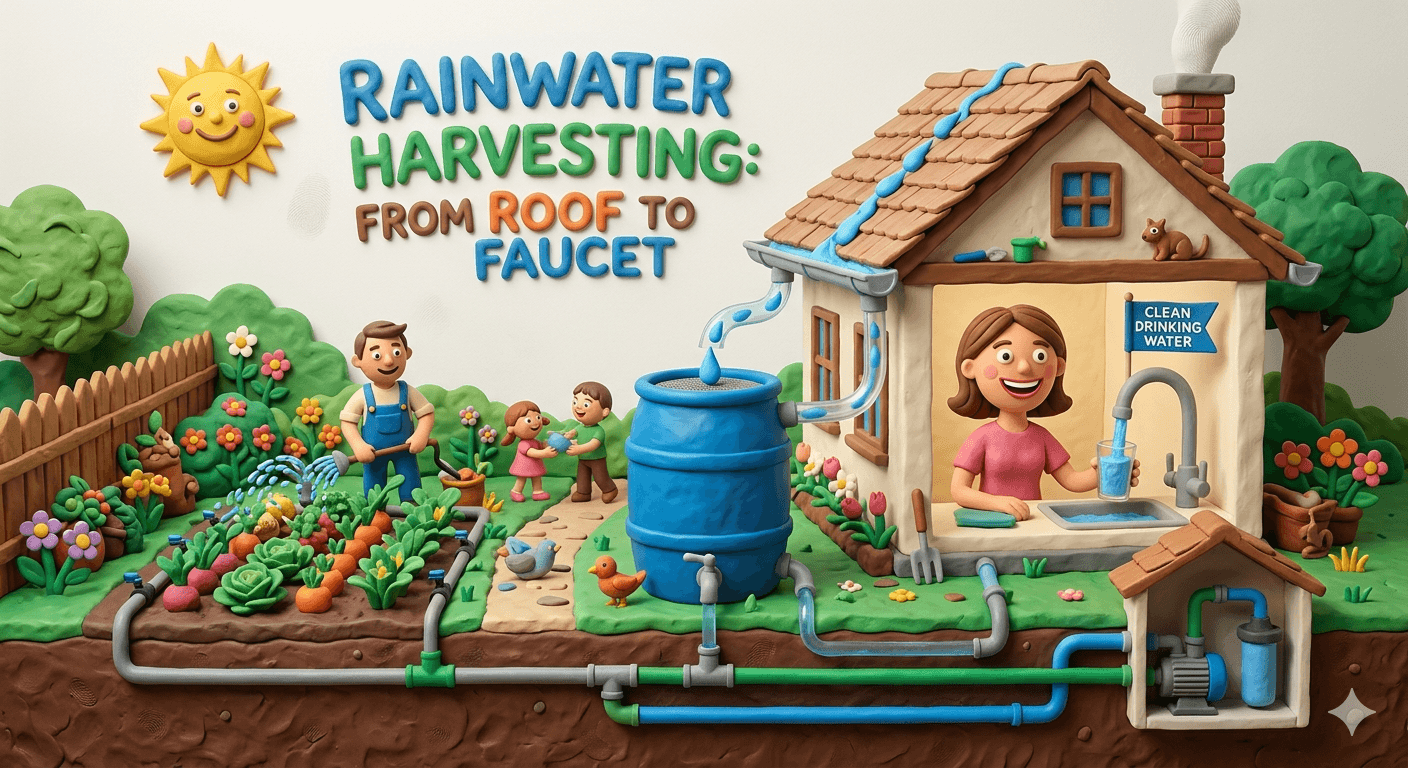
Rainwater harvesting is the simple practice of catching rain before it runs off your property and storing it for later use. Rain falls on your roof. Gutters carry it to downspouts. Downspouts feed a tank. The tank holds the water until your garden, your livestock, or your kitchen needs it.
People have been doing this for thousands of years. Cisterns under Roman villas. Stone tanks in the dry hills of Jordan. Wooden barrels under colonial farmhouse eaves. Long before municipal water lines, every household kept rain. The technology has improved, but the idea is the same.
A modern homestead system can be as small as a 55 gallon barrel under a downspout or as large as a 30,000 gallon underground cistern that runs the whole house. The scope you pick depends on your rainfall, your roof, your storage budget, and what you plan to do with the water.
Why Catching Rain Is Worth It
Rain is the softest, cleanest water that falls on your property. It carries no chlorine, no fluoride, no hard mineral scale, no sodium from a softener. Plants love it. Laundry rinses cleaner in it. A good rain stretches further than the same number of gallons from a hose.
There is also the money. A single 55 gallon barrel can save a few thousand gallons a year in garden water. A whole house cistern can replace a municipal connection entirely. In drought prone states, that buffer matters more every year.
And then there is the independence. A well can fail. A pump can quit. A power outage can shut down city water pressure. A full cistern with a hand pump on top will hand you water on the worst day of the year. That kind of resilience is hard to put a price on.
Finally, soil loves rain. Every gallon you catch on a roof is a gallon that did not flood your driveway or wash topsoil down the road. A good rainwater system slows the flow, sinks it locally, and gives the rest back to the land in a controlled way.
How Much Water Can You Actually Catch
Here is the friendly math every beginner should learn. Roof square footage times rainfall in inches times 0.623 equals gallons collected. That 0.623 is the conversion factor that turns inches of rain over square feet into actual gallons. Memorize it and you can size any system in your head.
Say your roof is 1,500 square feet and your area gets one inch of rain. That single rain event drops 1,500 times 1 times 0.623, or about 935 gallons, onto your roof. A typical real world catchment system captures around 80 percent of that thanks to splash, evaporation, and first flush losses. Call it 750 gallons in a single one inch storm.
Now stretch the math across the year. A 1,500 square foot roof in a 40 inch rainfall climate sees a theoretical 37,380 gallons of rain per year. Even at a conservative 75 percent capture rate, that is roughly 28,000 gallons of usable water. For a family of four using rain only for the garden and for laundry, that is a comfortable surplus most years.
A worked example for a dry climate looks different. The same 1,500 square foot roof in a 12 inch rainfall climate produces a theoretical 11,214 gallons per year. Capture 75 percent and you have about 8,400 gallons. That is plenty for a kitchen and a small garden, but it argues for bigger storage to ride out the dry months.
Tip
Pull up your local average annual rainfall before you size anything. Most states publish county level rainfall maps for free. The total tells you what is possible. The monthly chart tells you how much storage you need to bridge the dry season.
The Seven Parts of a Rainwater Harvesting System
Strip away the marketing and almost every rainwater system comes down to seven parts. Learn what each one does and the rest will start to make sense.
The Catchment Surface
The roof itself is your catchment. Bigger roofs catch more rain. Smoother roofs lose less to splash and absorption. The material matters too, which is its own section below.
The Gutters
Gutters carry water from the edge of the roof to the downspouts. Five inch gutters handle most residential roofs. Six inch gutters are friendlier for heavy storms or long runs. Keep them clean. A gutter full of leaves is a roof that drips water onto your foundation instead of into your tank.
The Downspouts
Downspouts move water from the gutter to the tank. Three inch by four inch rectangular downspouts move twice the water of a standard two inch round. Upsize them if you live in a heavy rain region.
The First Flush Diverter
The first flush diverter is the little hero of the whole system. The first water off a dirty roof carries dust, pollen, bird droppings, and grit. The diverter catches that first wash and sets it aside before the rest of the rain enters your tank. A simple PVC standpipe with a slow drip bottom does the job for under 30 dollars.
The Screens and Calmed Inlet
Mesh screens at the gutter and the tank inlet block leaves, bugs, and rodents. A calmed inlet is a short downturn at the bottom of the inlet pipe that releases water sideways instead of plunging straight down. That gentle entry keeps settled silt at the bottom of the tank from stirring up every time it rains.
The Storage Tank
The storage tank is the heart of the system. It holds the water until you need it. Tank type, size, location, and material drive most of the cost of the build. The next section covers tanks in depth.
The Distribution
Distribution is how the water leaves the tank and reaches the user. The simplest setup is a gravity fed spigot near the bottom. The most complex is a pressure pump, a pressure tank, and an indoor plumbing run that feeds a kitchen faucet through a full filter stack. Most homesteads land somewhere in between.
Get those seven parts right and you have a system that just works.
Choosing the Right Roof for Catchment
Not every roof makes friendly water. The material matters more than most beginners realize.
Metal roofs are the gold standard. Standing seam galvalume, painted steel, or aluminum sheds water cleanly and adds almost nothing to it. A metal roof can produce drinkable rain with the right filtration. If you are planning a new build, metal is the friendly pick.
Asphalt shingles are the next most common. They work, but they shed petroleum compounds and fine grit, especially in the first few years. Asphalt rain is fine for the garden, for livestock, and for laundry. Most experts steer you away from drinking it.
Cedar shake roofs make complicated water. The wood itself is fine, but most cedar roofs are treated with chemicals to slow rot, and that treatment leaches into the rain. Save cedar runoff for ornamentals.
Treated or painted roofs need a closer look. Some industrial paints contain lead, zinc, or copper at levels that make potable use a poor idea. Lead is the big one. Any roof installed before 1980 with original paint should be assumed lead suspect until tested.
A few small rules carry most of the weight. Trim the trees that overhang the roof. Sweep the roof or hose it off once a year. Keep the gutters clear. Skip pressure treated wood near the catchment surface. The cleaner the roof, the easier every other stage gets.
Sizing Your Storage Tank
Storage is where most of your money goes. It is also the part most beginners undersize. Here is a side by side look at the four tank tiers most homesteaders consider.
| Tank Type | Typical Size | Up Front Cost | Lifespan | Best Fit |
|---|---|---|---|---|
| Plastic rain barrel | 55 to 80 gallons | $50 to $150 | 5 to 15 years | Single downspout, garden irrigation |
| IBC tote (food grade) | 275 to 330 gallons | $100 to $250 used | 10 to 20 years | Small garden, livestock backup |
| Poly above ground cistern | 1,000 to 5,000 gallons | $800 to $4,000 | 20 to 30 years | Whole garden, partial house |
| Concrete or ferrocement cistern | 5,000 to 30,000 gallons | $4,000 to $20,000 | 50 plus years | Full off grid potable supply |
A few practical notes. Plastic tanks should be opaque, not translucent. Light through a clear tank grows algae fast. Food grade markings matter if the water is headed to a faucet. Used IBC totes are everywhere on Craigslist, but verify what was stored in them before you buy. A tote that held soap is fine. A tote that held herbicide is not.
Bigger is almost always better. Storage is what bridges the dry months. A roof that catches 28,000 gallons a year does you no good if your tank holds 275 gallons in May and the next rain is in October. A general planning rule is to size storage at one to three months of your expected use, then add a 20 percent cushion.
Location matters too. Tanks on the uphill side of the property can feed the garden by gravity. Tanks tucked against the north side of a house stay cool in summer and freeze less aggressively in winter. Buried tanks are the friendliest answer in cold climates, but they cost more to install and harder to inspect.
Tip
Multiple smaller tanks plumbed together often beat a single giant tank. You can stage them by use. The first tank feeds the kitchen with the cleanest water. The overflow feeds a garden tank. The garden tank overflows to a livestock tank. Every gallon serves three purposes before it leaves the system.
From Roof to Faucet: Making Rainwater Potable
This is the section that makes "from roof to faucet" real. Drinking rain is absolutely doable. It is also where most beginners cut corners and pay for it later. Do this part right or do not do it at all.
Potable rainwater needs four things in order. First, the water must come off a safe roof. Second, the system must catch the dirty first flush and never let it into the tank. Third, the storage must stay sealed, dark, and screened. Fourth, the water must run through a real filter stack before it touches a faucet.
Here is the four stage filtration ladder most off grid potable systems use.
- Sediment filter. A 20 or 50 micron cartridge catches grit, sand, and visible particles. Cheap to replace. Always the first stage.
- Fine sediment and carbon filter. A 5 micron cartridge with activated carbon removes finer particles, chlorine if any is present, and most taste and odor compounds.
- One micron absolute filter. This stage catches cryptosporidium and giardia cysts. Look for "absolute" rated cartridges, not "nominal," for real pathogen protection.
- Ultraviolet disinfection. A UV light kills bacteria and viruses as the water flows past. UV is the final pathogen barrier and the step that turns clean rain into truly potable water.
A reverse osmosis stage is optional after the UV. RO produces ultra pure water for drinking and for ice. It also wastes some water in the process, so most homesteads run RO on a dedicated faucet rather than the whole house.
Distillation is the simplest alternative for a single drinking faucet. A countertop distiller boils the water, captures the steam, and condenses it back into nearly pure water in a glass jar. It is slow but bulletproof. A good distiller pairs well with a simple sediment and carbon prefilter for the rest of the house.
Lab testing is the step almost everyone skips and almost everyone regrets. A basic potability test runs 25 to 75 dollars at a state certified lab and screens for coliform, E. coli, lead, and a handful of common contaminants. Test once before you drink the water. Test again every spring. Test after any change to the roof, the tank, or the filters.
Warning
Rainwater can carry pathogens, lead from old roof paint, and heavy metals from flashing. A clean system with the four stage filter ladder above is safe for almost any household. A neglected barrel under a mossy roof is not. If you are not willing to maintain the filters, swap UV lamps yearly, and test the water at a real lab, plan to use your rain for irrigation and laundry only. There is no shame in that. A garden grade system is still a huge win.
Cold Climate Considerations
Rainwater systems and freezing weather are old enemies. A frozen tank can crack. A frozen line can split a pipe inside a wall. A frozen first flush diverter is just a useless tube. Cold climates take some planning, but every problem has a friendly answer.
The simplest answer is to drain the system before the first hard freeze and refill it in spring. That is fine for a garden only setup. It is not fine if you depend on the rain for daily use.
For year round systems, three strategies cover most situations. Bury the tank below the frost line. Bring the tank inside a heated space, like a basement or a conditioned utility room. Or insulate the tank heavily and run a small thermostatically controlled heat tape on the lines.
Buried tanks are the gold standard in cold country. Below four feet, the ground rarely freezes, even in a Minnesota winter. The plumbing comes up through an insulated riser to a heated space, and the tank itself never sees a hard frost.
Above ground tanks in cold climates need foam insulation, a roof to shed snow load, and a small stock tank heater wired in for the worst weeks. A 100 watt aquarium heater can keep a 275 gallon tote ice free in a moderately cold winter. A 1,500 gallon poly tank needs more aggressive insulation and sometimes a small heated enclosure.
Always include freeze drain points in your plumbing. A simple ball valve at the lowest point in every outdoor run lets you dump the line at the end of fall. If a hard freeze surprises you, ten minutes with a wrench can save a thousand dollars in burst pipe repairs.
Is Rainwater Harvesting Legal in Your State
This is the question that surprises most new homesteaders. The answer is almost always yes, but the details matter, and a few states still impose meaningful limits.
The short version is that 46 states permit some form of rainwater harvesting, and many actively encourage it with tax credits or rebates. The remaining handful regulate it because rainfall is considered part of a downstream water right. Here are the highlights that catch beginners off guard.
Colorado is the most restrictive. Residential properties are limited to two rain barrels with a combined capacity of 110 gallons. Larger systems require a state water court process that is not friendly to first timers. If you live in Colorado, plan around the 110 gallon ceiling.
Utah allows up to 2,500 gallons of storage with simple state registration through the Division of Water Rights. Below 200 gallons no registration is needed. Above 2,500 gallons triggers a more formal water right process.
Texas is one of the friendliest states. Statewide law protects the right to harvest rain, exempts rainwater equipment from sales tax, and even requires HOAs to permit harvesting systems in many cases.
Arizona, New Mexico, and Nevada all permit rainwater harvesting with light or no regulation, and most counties offer rebates that pay back a chunk of a real installation.
Most eastern and midwestern states have no meaningful restrictions at all. Permits are usually tied to plumbing code rather than the rain itself. If you plan to connect rainwater to indoor plumbing, expect a plumbing inspection. If you plan to use it for irrigation only, a permit is rarely required.
The other layer to watch is your HOA. Homeowner associations can be more restrictive than state law. Read your covenants before you order a tank. Some HOAs ban above ground tanks but allow buried cisterns. Some require screening or specific colors. A ten minute read of the covenants saves a knock at the door six months in.
For a state by state breakdown of rainwater laws, permits, and other homesteading regulations, browse our state by state homesteading hub. It covers all 50 states and links out to the actual statutes and county codes where they matter most.
What a Rainwater Harvesting System Really Costs
Rainwater costs scale to what you are trying to accomplish. A barrel for the tomato bed runs a couple hundred dollars. A full whole house potable system can pass twenty thousand. Most homesteaders land somewhere in the middle. Here is a friendly snapshot.
| Tier | System Size | Typical Spend | What You Get |
|---|---|---|---|
| Garden starter | One to two barrels (55 to 165 gallons) | $150 to $500 | A barrel, a first flush diverter, screens, and a spigot. Waters a small bed through dry stretches. |
| Serious irrigation | 1,000 to 2,500 gallons | $1,500 to $5,000 | A poly cistern, gutters, downspouts, screens, first flush, a small pump, and drip lines to the whole garden. |
| Whole house non potable | 2,500 to 5,000 gallons | $4,000 to $9,000 | A larger cistern, a pressure pump, a pressure tank, basic sediment filtration, and indoor plumbing for laundry, toilets, and outdoor use. |
| Whole house potable | 5,000 to 30,000 gallons | $10,000 to $25,000 | A buried or conditioned cistern, the four stage filter ladder, UV disinfection, plumbing inspection, and a tested supply to the kitchen tap. |
Here is a cleaner breakdown for the middle tier, where most beginners actually land.
| Category | Realistic Spend |
|---|---|
| Poly cistern (1,500 to 2,500 gallons) | $800 to $2,800 |
| Gutters and downspouts upgraded for catchment | $400 to $1,500 |
| First flush diverter and screens | $80 to $300 |
| Calmed inlet, overflow, and basic plumbing | $150 to $400 |
| Pressure pump and pressure tank | $400 to $1,200 |
| Permits and inspections (if required) | $0 to $600 |
| Labor if you hire the install out | $1,000 to $3,000 |
Numbers move quickly with region, brand choice, and how much of the work you do yourself. A patient buyer can cut the total in half by sourcing used IBC totes, scoring last year's poly tanks on close out, and doing the plumbing in a single weekend.
A Realistic First Year With Rainwater Harvesting
Most beginners feel lost because they do not know what to tackle when. Here is a friendly first year arc. Your timing will shift with your climate, but the rhythm holds.
| Month | Focus |
|---|---|
| January | Pull rainfall data for your county. Measure roof square footage. Set a budget. |
| February | Decide irrigation only or potable. Walk the property for tank sites and pipe runs. |
| March | Order a starter setup. A first flush diverter, screens, and either a barrel or a small tote. |
| April | Install gutters and downspouts where needed. Run the first flush. Catch your first storm. |
| May | Watch how fast the tank fills and empties. Take notes. Add screens that are missing. |
| June | Add storage. A second tote or your first poly cistern. Plumb a drip line to the garden. |
| July | Run the garden on rainwater for a full month. Track gallons used per week. |
| August | Test water quality if you plan to drink it. Order filter cartridges and a UV lamp. |
| September | Service gutters before fall leaves. Add leaf guards if the trees are heavy. |
| October | Run a full filter swap. Verify the freeze drains work. Insulate above ground tanks. |
| November | First hard frost. Drain the lines that need it. Watch for ice issues. |
| December | Review the year. Plan next year's expansion. Rest. |
For a wider companion calendar that covers solar, water, waste, and heat together, pair this guide with our off grid living for beginners pillar.
Common Beginner Mistakes With Rainwater Harvesting
Almost every new homesteader makes a version of the same handful of mistakes. The good news is that you can skip most of them by reading this section twice.
- Undersizing storage. A tiny barrel fills in one storm and overflows for the rest of the year. Buy more storage than you think you need.
- Skipping the first flush diverter. Dust, pollen, and bird droppings end up in the tank without one. Spend the 30 dollars.
- Using a translucent tank in the sun. Algae will bloom inside the first summer. Opaque tanks, or a shaded site, every time.
- Drinking the water without proper filtration. A garden grade barrel and a kitchen faucet are very different systems. Do not blur the line.
- Forgetting the overflow. A tank without a real overflow can split, lift, or wash out its base in one heavy storm.
- Ignoring freeze risk. Even mild climates see a hard week. Plan drain points before the first frost.
- Skipping the lab test. If the water is headed to a faucet, you cannot eyeball whether it is safe. Test it, then test it again every spring.
Avoid those seven and your first year will go better than most.
Build Skills Alongside the Hardware
Hardware decays. Skills compound. The best rainwater systems belong to homesteaders who can fix what they have.
Basic plumbing. Learn to cut, glue, and thread PVC. Learn how a pressure tank and pump work together. A weekend with PVC and a few unions teaches you more than any video.
Water testing. Buy a home test kit for chlorine, pH, hardness, and bacteria. Pair it with a yearly trip to a state certified lab. The home kit gives you weekly confidence. The lab gives you the truth.
Pump sizing. Learn the difference between flow rate in gallons per minute and pressure in pounds per square inch. A pump that delivers 10 gallons per minute at 40 psi is a different animal than one rated at 5 gallons per minute at 60 psi. Match the pump to the longest run and the highest fixture in the house.
Freeze management. Practice draining and refilling the system before you actually need to. Five minutes of practice on a sunny October afternoon beats fifty minutes of panic on a frozen January morning.
Filter swaps. Set a calendar reminder for cartridge changes. Sediment filters in dirty seasons last a month. Carbon and one micron stages last six months in most systems. UV lamps need replacement every 9,000 hours, which is roughly once a year for a household running 24/7.
A working rainwater system is a stack of small skills. Each one you add makes the next one easier.
You Can Start This Week
The biggest trap new rainwater harvesters fall into is trying to design the perfect system before they begin. Perfection is the enemy of progress on a homestead. A simple barrel under a downspout that waters a tomato bed is more valuable than a beautiful, fully potable plan that never gets installed.
Pick one thing this week. Walk the perimeter of your house in the next rainstorm and watch where the water actually goes. Order a single barrel and a first flush diverter. Or read up on the step by step DIY rainwater catchment barrel build and plumb your first one this weekend. The first time you water a garden bed with rain you caught yourself, the rest of the build stops feeling so abstract.
When you are ready for more, our off grid hub gathers every water, power, and heating guide as we publish them. Pair this article with our off grid living for beginners pillar for the bigger picture across power, waste, and heat. And if solar is next on the list, our beginner solar power guide is the friendly companion to this one.
For the broader homesteading roadmap, lean on our homesteading for beginners pillar. For the legal details in your state, our state by state homesteading hub covers rain laws, permits, and zoning across all 50 states.
You can do this. We are glad you are here.
Frequently Asked Questions
About 623 gallons per inch of rain. Multiply your roof square footage by the inches of rain and by 0.623 to get gallons. A 1,000 square foot roof in a 30 inch rainfall climate produces a theoretical 18,690 gallons a year, and a real world system captures roughly 75 to 85 percent of that after first flush and splash losses.
Yes, with the right system. Rain becomes potable after a clean roof, a working first flush diverter, sealed and dark storage, and a four stage filter ladder ending in ultraviolet disinfection. Test the finished water at a state certified lab before you drink it, and test again every spring. If you are not willing to maintain the filters, use the rain for irrigation and laundry instead.
A first flush diverter is a simple standpipe that catches the dirty first water off a roof during a storm and sets it aside before the rest enters your tank. It removes most of the dust, pollen, bird droppings, and grit that accumulate between storms. Yes, you need one. A diverter costs about 30 dollars and saves your system from constant tank cleaning.
It depends on your state and what you plan to do with the water. Most states allow irrigation use with no permit at all. Colorado limits you to two barrels totaling 110 gallons. Utah requires registration above 200 gallons. If you plan to plumb rainwater into indoor fixtures, expect a plumbing inspection in almost every state. Check your local rules before you build.
Most experts steer you away from drinking asphalt shingle runoff. The shingles shed petroleum compounds and fine grit, especially in their first few years. The water is fine for the garden, livestock, laundry, and toilet flushing. Save the kitchen faucet for water that came off a clean metal roof, or run asphalt water through a heavier filter stack and lab test before drinking.
Indefinitely if the tank is sealed, opaque, and screened. Rainwater in a dark, sealed tank can last for years without going bad. Translucent tanks grow algae within weeks. Open or screened only barrels become mosquito factories in days. A good system keeps the water cold, dark, and free of fresh debris, and tested water can sit for a full year between storms.
It can. Above ground tanks need foam insulation, a small heater, or a complete drain before the first hard freeze. Buried tanks below the frost line rarely freeze even in cold climates. Always include drain valves at the lowest points in outdoor plumbing so you can dump the lines before a hard freeze. Ten minutes of prep beats a burst pipe.
For irrigation only, a 1,500 to 2,500 gallon tank covers most family gardens in moderate rainfall climates. For laundry, toilets, and outdoor use combined, plan on 3,000 to 5,000 gallons. For a fully potable whole house supply, plan on 5,000 to 30,000 gallons depending on your local rainfall and how dry your driest months are. Always size storage to bridge your dry season plus a 20 percent cushion.

Cole
Founder & Lead Researcher
Cole is the founder of Plan Your Homestead. He works in clinical research and brings a research-first lens to every guide on the site, drawing on a long family line of farmers for grounded, practical perspective.
More in Off-Grid
More articles coming soon. Check back for new off-grid content.