The first time you find a pile of feathers in the yard, your stomach drops. You count the hens. One is missing. You walk the fence line looking for a clue. Welcome to the part of chicken keeping nobody warns you about. Almost every homesteader loses a bird in their first year, and almost every loss traces back to a small gap in the defense plan.
This guide is the whole homestead playbook for keeping your flock alive. You will learn who is hunting your chickens, how to layer your defenses across the coop, the run, and the perimeter, when free ranging is safe, which guardian animals actually earn their keep, and how to respond after a predator visit. If you are still picking your first birds, start with the complete guide to raising chickens. If you are still building, the predator proof coop guide covers the hardware and design side in depth. This article is the strategy that wraps around all of it.
Know What You Are Up Against
You cannot defend against an attacker you do not understand. Every part of the country deals with a slightly different cast, but the same handful of predators show up on most American homesteads. Here is a quick brief on each one and how they hunt.
Raccoons
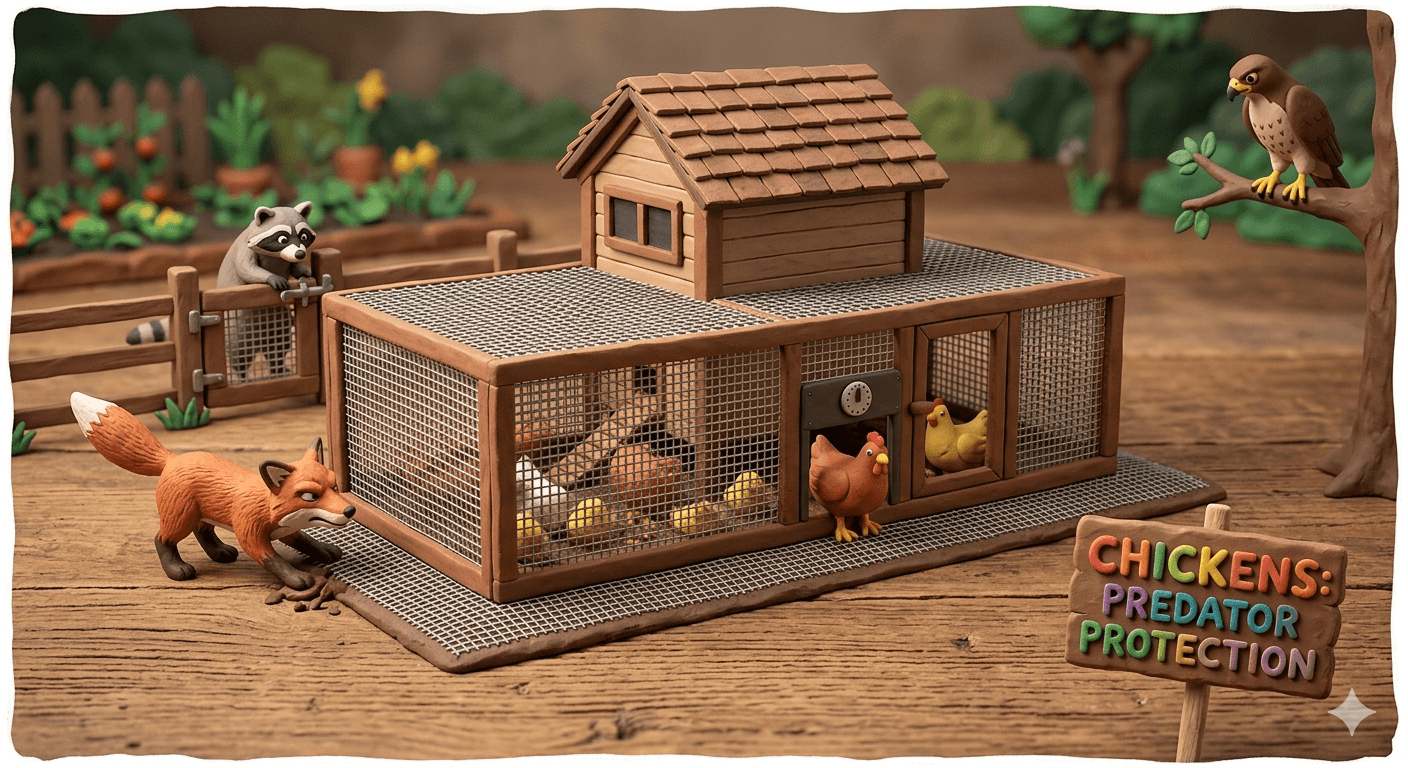
Raccoons are the smartest predator most chicken keepers ever face. They have hands and they use them. They can flip simple latches, slide bolts, and reach through wire to pull a hen apart piece by piece. A raccoon that finds your flock will keep coming back for weeks until it gets in.
Foxes and Coyotes
Foxes dig. Coyotes climb. Both will scout your coop for days before they strike. Foxes prefer dawn and dusk. Coyotes will grab a free range bird in broad daylight and disappear before you can react.
Hawks and Owls
Hawks hunt during the day, with peak activity at sunrise and a few hours before dusk. Owls hunt at night and will perch silently above an open run for hours. Both can take a chicken in seconds. Aerial predators are the single biggest reason a covered run matters.
Weasels and Minks
Weasels are the most underestimated predator in the country. A full grown weasel slips through a one inch gap. Once inside, it will kill every bird in the flock in a single night and barely eat any of them. If you see multiple birds dead with small bite marks at the neck and no other damage, you had a weasel.
Snakes
Snakes rarely take adult hens, but they steadily eat eggs and chicks. A four foot rat snake can squeeze through a half inch gap and clean out a nest box overnight. Missing eggs with no shells and no signs of breakage almost always mean a snake.
Neighborhood Dogs
People are surprised to learn that domestic dogs kill more backyard chickens than any wild predator in most suburban areas. A roaming dog from down the road will chase and kill an entire flock for fun. Talk to your neighbors early and build your fence with stray dogs in mind.
For a deeper look at the seven coop features that stop each of these animals at the door, the predator proof coop guide is the right next stop.
The Layered Defense Mindset
Here is the single most important idea in this whole article. No single fix protects your flock. Every successful predator attack exploits one weak link in a chain. Your job is to build enough overlapping layers that one failure does not lead to a dead hen.
A good layered defense has five parts. A secure coop for nighttime lockup. A predator resistant run for daytime safety. A perimeter that makes the property unattractive to predators in the first place. Smart flock behavior, which mostly means putting the birds where they can hide and run. And a response plan for when something does slip through.
Most beginners pour everything into the coop and ignore the other four layers. Then they lose a hen in the run at noon and feel betrayed by a coop that worked perfectly. Spread your effort across all five and the math turns in your favor.
Tip
Walk your setup at dusk once a week with the eyes of a hungry predator. Where would you climb in? Where would you dig? Where would you ambush a hen from above? Most weak points are obvious once you stop looking at the property like a person and start looking at it like a raccoon.
The Run: Your Daytime Defense Zone
Your hens will spend most of their waking hours in the run. If the run is not predator resistant, daytime kills will pile up fast. The good news is a few simple choices solve almost everything.
Use half inch hardware cloth, never chicken wire. Chicken wire keeps chickens in. It does not keep predators out. A raccoon will tear through chicken wire in under a minute. Hardware cloth is rigid steel mesh that almost nothing can chew or rip.
Bury the cloth or run an apron. Foxes and dogs dig under fences faster than you would believe. Dig a trench eight inches deep along the run perimeter and bury the wire, or lay an eighteen inch wide apron of hardware cloth flat on the ground outside the fence. Predators paw at the fence base, hit the apron, and give up.
Cover the top. An open run is an open invitation to hawks and owls. A polycarbonate roof panel or a layer of welded wire over the run blocks aerial attacks completely. If covering the whole run is not in the budget, string parallel rows of fishing line across the top about two feet apart. Hawks see the line, misjudge their dive, and abandon the attack.
Secure the pop door and any vents. A small vent or a sloppy pop door is the most common breach point. Frame every opening with hardware cloth on the inside and check for gaps with the back of your hand. If your hand fits, so does a weasel.
For the full hardware spec list, locking routine, and design choices that turn the coop itself into a fortress, the predator proof coop guide is the deep dive.
Automatic Coop Doors and the Lockup Routine
Most predator losses happen between dusk and dawn. The single highest leverage upgrade you can make is locking your hens in the coop every single night without exception. One forgotten night is all a raccoon needs.
An automatic coop door tied to a light sensor or a timer is the best 150 dollar purchase on a homestead. It opens at sunrise and closes after sunset, every day, whether you are home or not. Brands like Run Chicken, ChickenGuard, and Omlet all work well. Spend the money. It pays back the first time you go to a friend's wedding and remember at midnight that you forgot to close the coop.
Still count heads at dusk. Auto doors do not check that every hen is inside before they close. A broody hen tucked under a bush, a young pullet too scared to go in, a sick bird hiding in a corner of the run. Walk out at sunset, count to your full flock number, and chase any stragglers in by hand. If you cannot get out there yourself, set the door to close fifteen minutes after sunset to give every hen time to get in.
If you skip the auto door, the rule is simple. Last thing before bed, every night, lock the coop. No exceptions. Set a phone alarm if you have to.
Warning
Auto doors fail. Springs wear out. Sensors get blocked by spider webs. Batteries die. Walk out and verify the door is closed at least once a week. Mark a calendar reminder. A trusted door that quietly stopped closing three weeks ago will cost you the whole flock on the wrong night.
Free Range Safety: When and How
Free ranging is one of the great joys of backyard chickens, and it is also where most daytime losses happen. The trick is not to skip it. The trick is to do it on terms that stack the odds in your favor.
Time it right. Let the flock out a few hours before sunset. Hawks are still active but most heavy hunting happens earlier in the day, and a shorter window means fewer chances for something to go wrong. Hens head back to the coop on their own as the light fades.
Free range with cover. A flock with nowhere to hide is a flock waiting to die. Plant or place dense low cover every fifteen or twenty feet across the foraging area. Tall grass islands, brush piles, low evergreen shrubs, a few overturned pallets propped up on bricks. When a shadow crosses overhead, your hens will dive for the nearest cover. If there is no cover, they freeze in the open.
Stay nearby when you can. Even a person quietly working in the yard cuts predator pressure in half. Hawks and foxes both prefer to hunt where they will not be seen. If you cannot be out there, a barking dog, a portable radio playing talk shows, or even a scarecrow that you actually move around helps.
Watch the sky for crow alarms. Crows mob hawks aggressively and they make a distinctive harsh cawing when raptors are nearby. If you hear a chorus of crows screaming in the trees, get the flock under cover for the next hour.
Read your flock. A relaxed flock is scratching, dust bathing, and spreading out. A flock that has stopped foraging and is huddled in a tight group has seen something. Trust them. Walk the property and look up.
Livestock Guardian Animals
A good guardian animal is the closest thing to magic on a homestead. The wrong one is a heartbreak. Choose carefully and you can free range a flock all day with almost no losses.
Guardian Dogs
The breeds bred for this work are the Great Pyrenees, Anatolian Shepherd, Maremma, Akbash, and Karakachan. A well bred and well trained livestock guardian dog will patrol your property day and night, mark territory that keeps coyotes and foxes away, and physically engage any predator that pushes through.
The catch is real. These dogs are not pets. They need to bond with the flock as puppies, they need fencing that contains a 100 pound dog with a job to do, they bark a lot at night, and they need eight to fourteen years of food and vet care. A working livestock guardian dog is a serious commitment. If you have the property and the patience, nothing else compares.
Geese
A pair of geese is a budget guardian setup that works for many small flocks. Geese are loud, territorial, and unafraid of most predators in the air or on the ground. They will charge a fox, dive at a hawk, and shriek at anything they do not recognize. They also live with chickens just fine and eat mostly grass.
Geese will not stop a determined coyote or a pack of dogs. They will reliably scare off hawks, opossums, and most casual visitors. For a quarter acre backyard flock, a pair of African or Toulouse geese gives you most of the alert system of a dog at a fraction of the cost.
Llamas and Donkeys
On a larger pastured property, a guardian llama or a standard donkey can do the work. Both are intensely protective and both hate canids. A llama or donkey will chase a coyote across a pasture with real intent. They are easier to keep than dogs, they eat the same forage as your other livestock, and they live a long time.
The downside is that they need pasture, they do not protect against aerial predators, and a donkey can hurt a chicken if it decides it does not like the bird underfoot. Best for properties of an acre or more where the flock free ranges with goats or sheep.
What Does Not Work
A regular pet dog, no matter how nice, is not a guardian dog. Most pet breeds will either ignore predators completely or, worse, chase the chickens themselves. Cats do nothing for predator pressure on adult hens and may take chicks. Pigs and goats are not guardians.
Fencing and Perimeter Strategy
The fence you can see is only half of the protection. The other half is everything that goes into making your homestead an unattractive place for predators to visit at all.
Electric poultry netting is the fastest perimeter you can put up. A four foot tall electrified mesh fence around the foraging area gives your flock a safe daytime zone and shocks any fox or raccoon that tests it. Premier 1 and other brands make portable kits you can move around the property. The combination of a covered coop, electric netting, and a guardian goose is enough for most backyard setups.
Add a hot wire to a permanent fence. If you have an existing wood or wire fence, two strands of electric wire transform it. Run one at six inches off the ground to stop diggers and one at twelve inches to discourage climbers. Solar fence chargers run all season without a power outlet.
Clear brush and tall grass around the coop. Predators stage their attacks from cover. A six foot buffer of mowed lawn around the coop and run forces them out into the open where your guardian animals and motion lights can do their work. A neat perimeter is a less inviting perimeter.
Install motion activated lights and sprinklers. Cheap solar floodlights aimed at the coop perimeter startle most nocturnal predators the first few times they trigger. Motion activated sprinklers do the same for daytime visitors. Predators are creatures of habit and three or four bad experiences send them looking elsewhere.
Clean up food. Scattered feed, full feeders left outside overnight, fallen fruit under trees, and uncovered compost piles attract raccoons, opossums, and rats. Rats attract weasels. Feed inside the coop, store grain in metal trash cans with locking lids, and pick up windfall fruit. A clean homestead has half the predator pressure of a messy one.
Scare Tactics and What Actually Works
The internet is full of cheap predator deterrents and most of them stop working after a week. Predators are smart. They watch. They test. They learn that the fake owl on the post never moves. Here is the honest verdict on each one.
Reflective tape and flash strips work for about a week against hawks, then the local birds figure out the strips do not actually do anything. Useful in the short term. Rotate to a new location every few days to keep it fresh.
Fake owls and snake decoys are nearly useless after the first 48 hours. Crows and hawks will use a fake owl as a perch within a month. Skip them or move them daily.
Predator urine and granules can deter foxes and coyotes for a few days, especially right after a fresh kill nearby. They wash off in rain and need constant reapplication. A reasonable supplement, not a strategy.
Radios and talk stations playing in the run during the day are one of the simplest and most effective scare tactics. Predators avoid human voices. A 30 dollar weatherproof radio on talk radio earns its keep.
Motion sprinklers are surprisingly effective against deer, raccoons, and stray dogs, and they keep working because the trigger is random. Worth the 60 dollars per unit. Aim them at the run perimeter and refill the water reservoir weekly.
Solar flashing predator lights like Nite Guard work well against nocturnal canids. Mount four units at the corners of the coop facing outward at predator eye height. Foxes and coyotes interpret the red flash as another animal staring back at them.
The rule is to rotate and combine. One scare tactic, alone, fails by the second week. Three rotating tactics together extend the protection for months.
Daytime vs Nighttime Threats
A useful way to plan defenses is to split the day into two windows and ask, who is hunting now, and what stops them.
Daytime threats are mostly aerial and canine. Hawks, eagles, coyotes, neighborhood dogs, and the occasional bold fox. The defenses are a covered run, low cover throughout the foraging area, guardian animals, and human presence. Lock the coop at night and you address almost nothing here. This is where most beginners lose their first hen.
Nighttime threats are mammals on the ground. Raccoons, possums, skunks, weasels, foxes, coyotes, owls, and rats. The defense is the coop itself. Hardware cloth, two step latches, a buried apron, sealed vents, and a closed pop door. Free range is a daytime concern. Lockup is a night concern. Build for both.
The bridge windows of dusk and dawn are the most dangerous. Predators are active. Visibility is low. Your hens are still settling onto the roost. Set your auto door to close after sunset, count heads at dusk, and lock the coop tight before full dark.
Reading the Signs: How to Tell What Got Your Hen
When something does get through, the evidence on the ground tells you almost everything you need to know. Identifying the predator quickly is the only way to fix the right hole in your defense.
A pile of feathers with no body usually means a hawk. Hawks fly the kill away. If the feathers are in an open spot in the yard and there are no tracks, it was almost certainly aerial. A pile of feathers with the body left, often with the head and neck eaten, points to a great horned owl that was scared off before it could carry the bird away.
Missing birds with no feathers at all are foxes or coyotes. Both carry the entire body away to eat elsewhere. Tracks in soft dirt or snow confirm it. Foxes leave a narrow oval print with four toes and clear claws. Coyote prints look like dog prints but tighter and more uniform.
Multiple dead birds inside the coop with bites at the neck and almost no consumed flesh is a weasel attack. Weasels kill for sport. Look for a hole under a wall or a gap at the bottom of a pop door no wider than your thumb.
Eggs gone with no shells and no broken pieces is a snake. A snake that has been eating eggs for a week will sometimes still be curled in the nest box at dawn. Move slowly, identify the species, and relocate it well away from the coop.
A torn open coop wall, smeared mud or droppings, and a half eaten hen left behind is a raccoon. Raccoons reach through wire and tear at any soft target. The damage is usually obvious.
A scattering of bodies across the yard with no eating at all, often during the day, points to a domestic dog. Dogs kill for sport too. If you suspect a neighbor's dog, document with photos and have the conversation before it happens again.
What to Do After a Predator Attack
When you lose a hen, the temptation is to grieve and move on. Resist it. The predator that got in will come back. The first 48 hours after an attack are the most important time to act.
Lock the entire flock down. Keep the hens in the coop for two or three days, even during the day, while you fix the breach. A stressed flock is also a vulnerable flock, and a return visit on day two is almost guaranteed.
Identify the predator using the signs above. The defense for a hawk is different from the defense for a raccoon. Get this right before you spend money.
Find and close the breach. Walk the entire fence line. Check every vent, every gap, every seam. If the predator went through hardware cloth, the cloth was too thin or the staples were too far apart. If it dug under, you need an apron. If it dropped from above, you need a cover. Fix the actual hole, not just the obvious one.
Set out motion lights, scare tactics, or extra traps. The same predator will return for three to five nights to test the new defense. Make those nights miserable for it.
Watch for new tracks every morning for two weeks. Most predators give up after a few failed attempts. A few will not. If you keep finding fresh sign, escalate. A live trap from your state wildlife office, an electric fence around the coop, or a guardian dog are the next steps.
Check the surviving flock for injuries. Hens that escaped a predator attack often have hidden wounds under their feathers. Pick each bird up, run your hands over the body, and treat any open cuts with poultry safe ointment. Stress will also drop egg production for a week or two, which is normal.
For deeper care on injured or stressed birds, the common chicken health issues guide walks through wound care, infection signs, and when to call a vet.
A Simple Predator Protection Routine
The whole strategy reduces to a short list of habits you can do without thinking once they are dialed.
Morning, around sunrise. Open the pop door or trust the auto door to do it. Walk the perimeter while you do morning chores. Look for fresh tracks, fresh digging, and disturbed bedding. Count heads.
Midday, when you free range. Be outside or have a radio playing. Glance up for hawks every few minutes. Watch your flock for sudden freezing or huddling.
Evening, just before dark. Count heads again. Walk every hen into the coop yourself if the auto door is on a timer. Lock the door and tug on the latch to verify it caught.
Weekly. Walk the full property line and look for tracks, scat, fresh digging, or chewed wire. Test electric fences with a tester. Replace dead batteries in scare lights and motion sprinklers. Cycle scare tactics to keep them effective.
Monthly. Hose down sensor housings and clear spider webs from auto door sensors. Inspect every hardware cloth seam with a flashlight for new gaps. Replace any rusted staples.
That is the whole job. Twenty minutes a day, an hour on the weekend, and your odds of losing a hen drop by an order of magnitude.
Putting It All Together
Protecting chickens from predators is not about one heroic fix. It is about stacking enough small layers that one bad night does not cost you the flock. A sturdy coop. A covered run. A clean perimeter. A guardian animal. A nightly lockup routine. A daytime habit of watching the sky and reading your flock. None of it is glamorous. All of it works.
Start where you have the biggest gap. Most new homesteaders need a covered run and an auto door before anything else. A few need to clear brush. A few need a goose. Add layers as you can afford them and as the threats reveal themselves.
If you are still picking your birds, the chicken breed picker helps you find calm, alert breeds that handle predator pressure better. If you are still building or upgrading the coop itself, the predator proof coop guide is the next step. If you are about to brood new birds, the raising chicks guide covers the extra precautions chicks need until they grow into the flock.
The morning you lose a hen is the worst day of your first year. Most homesteaders never have to live it twice. Build the layers now, run the routine every day, and your flock will outlast every predator that ever scouts your yard.
Frequently Asked Questions
Raccoons cause the most chicken losses in North America, followed closely by foxes, hawks, and neighborhood dogs. The exact mix varies by region. Suburban backyards lose more birds to roaming dogs and raccoons. Rural homesteads see more foxes, coyotes, and aerial predators. Build your defenses to stop all of them since the predator pressure shifts season to season.
The single best defense against hawks is a covered run with a solid roof, welded wire, or netting. If you cannot cover the whole run, string parallel rows of fishing line across the top about two feet apart. When free ranging, provide dense low cover every fifteen or twenty feet so hens can dive under brush when a shadow passes overhead. Watch for crow alarms and keep the flock close to cover at dawn and dusk.
A well bred and well trained livestock guardian dog from a working breed like Great Pyrenees, Anatolian Shepherd, or Maremma is one of the most effective predator deterrents on a homestead. They patrol, bark, mark territory, and engage threats day and night. A regular pet dog will not do this work and may chase the chickens itself. Guardian dogs need real training, secure fencing, and a long term commitment.
Yes, every single night, without exception. Most predator losses happen between dusk and dawn. An automatic coop door tied to a light sensor is the easiest way to make this routine bulletproof. Count heads at dusk to make sure every bird is inside before the door closes, and verify the door is working at least once a week. One forgotten night is all a raccoon needs to wipe out a flock.
Chicken wire is thin lightweight mesh designed to keep chickens in, not to keep predators out. A raccoon or a determined fox can tear through it in under a minute. Hardware cloth is rigid steel mesh, usually a quarter or half inch grid, that resists chewing and ripping. Use hardware cloth on every coop wall, vent, window, and run section that touches the ground. The added cost is the cheapest insurance on the homestead.
Yes. Electric poultry netting is designed to shock predators on contact while delivering only a brief mild pulse that does not harm chickens, even if a hen brushes against it. Brands like Premier 1 sell portable kits that go up in an hour and create a strong daytime perimeter around a free range area. The fence needs a charger sized for the length of wire and grounding rods driven deep into damp soil for the shock to work.
Weasels can squeeze through a hole the size of your thumb, so close every gap on the coop. Frame all vents and windows with half inch or quarter inch hardware cloth, seal the perimeter where the coop meets the ground, and check the pop door for daylight when it is closed. Weasels usually attack at night through small gaps near the floor, so focus your inspection there. A coop with no gap larger than half an inch is a coop with no weasel problem.
Lock the flock in the coop for two or three days while you identify the predator and fix the breach. Use the kill pattern, tracks, and missing feathers to figure out what got in. Walk the entire perimeter and close every gap, then set up motion lights or scare tactics for the return visits that usually come within three to five nights. Check survivors for hidden injuries and treat any wounds. Expect egg production to drop briefly from the stress.

Cole
Founder & Lead Researcher
Cole is the founder of Plan Your Homestead. He works in clinical research and brings a research-first lens to every guide on the site, drawing on a long family line of farmers for grounded, practical perspective.
More in Animals
More articles coming soon. Check back for new animals content.