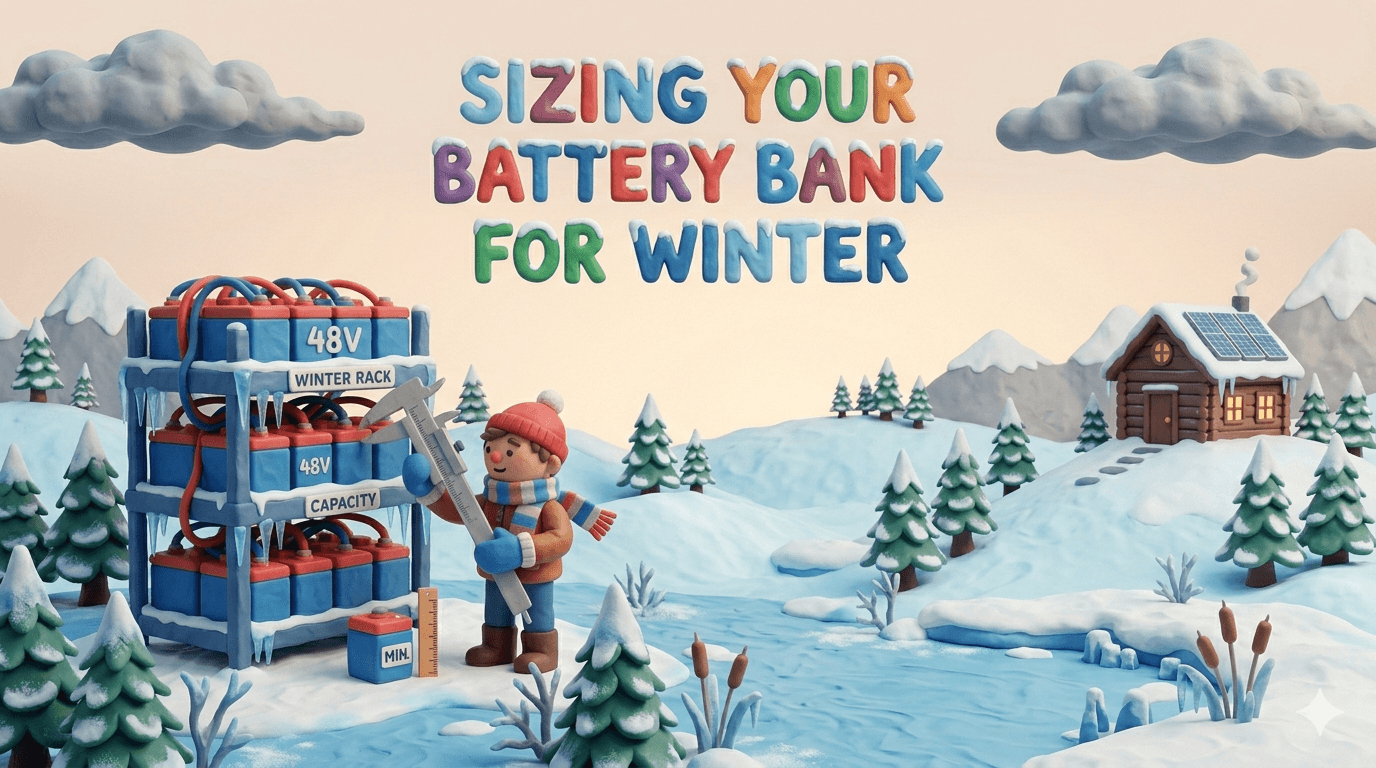
Winter is the season that exposes every weakness in an off grid power system. The sun dips low. The days get short. The clouds roll in for a week at a time. Your batteries do all the heavy lifting, and any sizing mistake you made back in July shows up in December as a dead bank at six in the morning.
A right sized battery bank is the difference between a calm winter and a stressful one. Get it right and your lights stay on through the cloudiest weeks. Get it wrong and you spend the season nursing a generator and rationing power between the well pump and the freezer.
By the end of this guide you will know exactly how to size a battery bank that holds up in winter. You will understand watt hours, depth of discharge, days of autonomy, and cold weather capacity loss. You will run the same math the pros use, with a worked example for a small cabin and a second for a full size off grid home. Grab a notebook. Let us walk through it.
What Battery Bank Sizing Actually Means
Sizing a battery bank is the process of matching your stored energy to your real power use, with enough cushion to ride out cloudy days and cold weather. It sounds simple, and the math is friendly once you slow down. The trap is that most beginners size for a perfect July day instead of a cloudy January week. Winter is where the bank earns its keep, so winter is where the sizing has to work.
There are three concepts you need to understand before any calculation makes sense. Take a minute on each one. The math gets easy when the vocabulary stops fighting you.
Rated Capacity Versus Usable Capacity
Every battery has a number printed on the side. That number is the rated capacity, often shown in amp hours or watt hours. A 100 amp hour battery at 12 volts holds 1,200 watt hours of energy on paper. That paper number is not what you actually get to use.
Usable capacity is the portion of that rated number you can safely pull out without damaging the battery. The difference between rated and usable is the single biggest source of beginner confusion. A lead acid battery and a lithium iron phosphate battery can have the same sticker capacity and deliver wildly different amounts of real power. The chemistry decides how deep you can go.
When you size a bank, always work in usable watt hours. Never use the rated number as your real budget. If you do, you will undersize by 30 to 50 percent and never know why your lights keep dimming in January.
Depth of Discharge in Plain English
Depth of discharge, often shortened to DoD, is how much of the rated capacity you can safely use before recharging. It is the rule that converts the sticker number into the real number.
Lead acid batteries like to live between 50 and 100 percent state of charge. Pulling them below 50 percent shortens their life dramatically. So the usable DoD for a flooded or AGM lead acid bank is about 50 percent. A 100 amp hour lead acid battery gives you about 600 watt hours of real, repeatable energy at 12 volts.
Lithium iron phosphate, often called LiFePO4 or just lithium, can be discharged 80 to 90 percent without harm. Most quality LiFePO4 packs are rated for 80 percent DoD as a daily practice. A 100 amp hour LiFePO4 battery at 12 volts gives you about 960 to 1,080 watt hours of real, repeatable energy. That is roughly double a lead acid battery of the same sticker rating.
You will use the DoD number in every battery sizing formula in this guide. Memorize the two values. Lead acid, 50 percent. LiFePO4, 80 percent.
Why Winter Changes the Math
A battery bank that performs beautifully in July can fail by Christmas. Four things change as the seasons turn. Solar production drops because the sun is lower and the days are shorter. Cloudy stretches get longer, which means the bank carries the home for more days at a time. Cold weather robs raw capacity from the cells themselves, especially lead acid. Household loads go up because lights run longer, the well pump cycles more often when pipes need to flow, and any electric heat or fan draws climb.
Each one is a small effect on its own. Stack them together and your real winter capacity can be half of what your spec sheet promised in summer. That is why winter is the design case. If your bank works in January, it will work in July with room to spare.
Why Winter Is the Real Test for Your Battery Bank
If you only remember one thing from this guide, remember that winter is when battery banks fail. The reasons are stackable. Each one alone would be manageable. Together they put real pressure on a system.
The first reason is peak sun hours. Most of the lower 48 averages 5 to 6 peak sun hours per day in summer and drops to 2 to 3 in December. The same panel array makes half the energy on a clear winter day that it made on a clear summer day. Cloudy stretches cut that in half again.
The second reason is multi day cloud cover. Summer storms come and go. A winter low pressure system can park over your homestead for five days. Your bank has to carry the load through every one of those days without a meaningful recharge.
The third reason is cold weather capacity loss. Battery chemistry slows down in the cold. A flooded lead acid battery at 32 degrees Fahrenheit delivers about 80 percent of its 77 degree capacity. At 0 degrees it can drop to 60 percent. Lithium iron phosphate holds its capacity better at low temperatures, but most LiFePO4 packs refuse to accept a charge at all once the cells drop below freezing. More on that later.
The fourth reason is household load creep. Winter pushes more current through the system. Lights run longer. Pipes need a slow flow to keep from freezing, which cycles the well pump. Furnace blowers, septic effluent pumps, and stock tank heaters all draw harder. If your summer audit said 4,000 watt hours per day, your winter reality might be 5,500 or 6,000.
The fifth reason is generator fuel cost. Many off grid homes use a backup generator to cover the worst stretches. An undersized bank means more generator runtime, more fuel hauled in, and more wear on the engine. The cheapest gallon of gas you ever burn is the one you do not need because your bank is sized right.
How to Calculate Your Winter Battery Needs, Step by Step
Here is the whole sizing process in five steps. Do them in order. Skip none. The math is mostly addition and multiplication, and it works on the back of an envelope.
Step 1: List Every Load in Watt Hours per Day
Walk through your home with a notepad and write down every appliance that uses power. For each one, note the watt draw and the hours per day you actually run it. Multiply the two to get watt hours per day. Sum the column. That number is your daily load budget.
Be honest about winter. Lights run 6 to 8 hours instead of 2. The fridge cycles slightly less because the cabin is cooler, but a chest freezer in an unheated outbuilding may run more if the thermostat is fighting the cold. The well pump cycles to keep pipes flowing. A furnace blower runs hundreds of hours a month.
You do not need a perfect number. You need an honest one. Round up where you are unsure. A 10 percent cushion at this step saves headaches later.
Step 2: Pick Your Days of Autonomy
Days of autonomy is the number of cloudy days your bank carries the home with no solar input. The baseline number for most temperate climates is 3 days. Cloudy regions like the Pacific Northwest or upstate New York often size for 4 to 5 days. Sunny regions like Arizona or New Mexico can sometimes get away with 2 days.
Three days is the sweet spot for most homesteads. It covers a typical winter low pressure system, leaves you a small margin, and does not push your battery cost into the stratosphere. If you can run a backup generator without much fuss, 3 days works. If your generator is hard to start in the cold or your fuel supply is hours away, lean toward 4 or 5.
Step 3: Apply Depth of Discharge for Your Chemistry
Multiply your daily load by your days of autonomy. That gives you the raw watt hours you need to store. Now divide that number by your DoD to get the rated capacity you need to buy.
For lead acid, divide by 0.5. For LiFePO4, divide by 0.8. The lithium number is smaller, which is why a lithium bank costs less per usable watt hour even though it costs more per rated watt hour.
Step 4: Apply Cold Weather Derating
If your bank lives in an unheated space and you are using lead acid, multiply your result by 1.2 to add a 20 percent cushion for cold capacity loss. If your bank lives in a conditioned space at 60 degrees or warmer, you can skip this step. If you are using LiFePO4 in a heated enclosure or with internal heaters, you can also skip this step. Most LiFePO4 banks live in a heated room or use self heating cells precisely so the math stays clean.
Step 5: Round Up for Inverter and Wiring Losses
Add a final 10 percent for inverter inefficiency, wiring losses, and the natural aging of the cells over the next 5 to 10 years. Round the final number up to the next standard battery size. You now have your target rated capacity.
Worked Example: A Small Off Grid Cabin
Imagine a small cabin in central Vermont. The owner runs LED lights, a small fridge, a laptop, a Starlink dish, and a well pump on a pressure tank. The winter audit comes out to 2,500 watt hours per day.
Step 1: Daily load. 2,500 Wh. Step 2: Days of autonomy. 3 days. 2,500 times 3 equals 7,500 Wh of raw need. Step 3: DoD for LiFePO4. 7,500 divided by 0.8 equals 9,375 Wh of rated capacity. Step 4: Cold weather derate. Skipped because the bank lives in a heated mechanical room. Step 5: Inverter and wiring buffer. 9,375 times 1.1 equals 10,313 Wh.
Round up to a clean number. A 48 volt LiFePO4 bank at about 10,500 watt hours, which is roughly 220 amp hours at 48 volts, handles the job. In real product terms, that is two server rack style LiFePO4 modules at 5 kWh each, or a single 10.24 kWh wall mount unit.
Tip
A useful sanity check. Your winter battery bank should equal roughly 3 days of your daily load in usable watt hours. If the rated number on your batteries is less than 4 times your daily load, you are probably undersized for a winter with snow and clouds.
Worked Example: A Full Time Off Grid Home
Now imagine a family of four in a 1,600 square foot off grid home in northern Idaho. They run a full kitchen with a propane stove, a chest freezer, two fridges, a washing machine, LED lights, two laptops, a Starlink dish, a furnace blower for a propane furnace, a deep well pump, and a small home office. The winter audit lands at 7,500 watt hours per day.
Step 1: Daily load. 7,500 Wh. Step 2: Days of autonomy. 4 days for a region with frequent multi day cloud cover. 7,500 times 4 equals 30,000 Wh. Step 3: DoD for LiFePO4. 30,000 divided by 0.8 equals 37,500 Wh. Step 4: Cold weather derate. Skipped because the bank lives in a conditioned utility room. Step 5: Inverter and wiring buffer. 37,500 times 1.1 equals 41,250 Wh.
Round up. A 48 volt bank of about 42 kWh handles the job. In product terms, that is roughly four server rack LiFePO4 modules at 10 kWh each, or eight 5 kWh modules in parallel.
Compare the same home built with flooded lead acid. The DoD drops to 0.5. The cold derate kicks in if any of the bank lives in an unheated battery room. The required rated capacity climbs to about 79 kWh, which is roughly double the lithium bank. The lead acid bank weighs about 5,000 pounds. The lithium bank weighs about 800 pounds. This is the math behind the industry wide shift to LiFePO4 for new builds.
Lead Acid Versus Lithium Iron Phosphate for Winter
There are still good reasons to pick lead acid in 2026, but they are getting narrower every year. Here is how the two main chemistries compare on the metrics that matter for a winter homestead.
| Metric | Flooded Lead Acid | AGM Lead Acid | LiFePO4 |
|---|---|---|---|
| Usable depth of discharge | 50 percent | 50 percent | 80 to 90 percent |
| Cycle life at daily DoD | 1,200 to 1,800 cycles | 600 to 1,200 cycles | 4,000 to 6,000 cycles |
| Cold weather capacity at 32 F | 80 percent of rated | 80 percent of rated | 95 percent of rated |
| Will accept a charge below freezing | Yes, slowly | Yes, slowly | No, unless self heated |
| Calendar life | 5 to 8 years | 4 to 7 years | 10 to 15 years |
| Weight per usable kWh | 130 to 180 pounds | 110 to 150 pounds | 18 to 25 pounds |
| Maintenance | Monthly water top off | None | None |
| Cost per usable kWh, installed | 350 to 500 dollars | 500 to 700 dollars | 450 to 750 dollars |
For most new off grid builds in cold climates, LiFePO4 wins on every metric except up front cost per rated kWh. Once you account for usable capacity, calendar life, and cold weather behavior, the cost per usable kWh delivered over the life of the bank is lower for lithium. Lead acid still makes sense for very small camper builds, infrequent use cabins, and homes with budget constraints that make the lower up front cost the deciding factor.
If you are starting fresh and the budget allows, pick LiFePO4 and never look back. If you are replacing an existing lead acid bank that is reaching end of life, the swap to LiFePO4 usually pays back in 3 to 5 years just on the avoided replacement cycle.
How Cold Weather Hurts Battery Capacity
Cold weather is the silent thief of off grid power. Every battery chemistry loses something in the cold, but the way it loses matters. Knowing the failure mode for your chemistry lets you design around it.
Lead Acid in the Cold
Lead acid batteries lose raw capacity as the temperature drops. The chemistry inside slows down. The electrolyte gets thicker. The plates accept and release charge less freely. The published capacity rating is at 77 degrees Fahrenheit. At 32 degrees you have about 80 percent of that number. At 0 degrees you have about 60 percent. At minus 20 degrees you can lose almost half.
The good news is that lead acid will still accept a charge in the cold. The bad news is that the charge goes in slowly and not all of it stays. Plan on a heated battery room for any serious lead acid bank in a climate that drops below freezing for long stretches. An insulated enclosure with a small thermostatic heater pad solves the problem cheaply and reliably.
There is one more cold weather concern with lead acid. A fully charged battery resists freezing down to about minus 75 degrees Fahrenheit. A fully discharged battery starts freezing solid at about 20 degrees. A frozen lead acid battery cracks its case and dies. This is why winter sizing matters so much. A bank that gets drained to 20 percent on a cold January night is a bank that might not survive the morning.
Lithium in the Cold
LiFePO4 holds its discharge capacity in the cold much better than lead acid. At 32 degrees you still get about 95 percent of rated capacity on discharge. That is excellent news for power availability on a cold morning.
The bad news is on the charge side. Almost every LiFePO4 cell on the market refuses to accept a charge once the cell temperature drops below 32 degrees. Forcing a charge into a cold lithium cell causes lithium plating on the anode, which permanently destroys capacity and can lead to internal short circuits. The cell battery management system, often shortened to BMS, will simply shut off charging when it senses cold cells. Your panels will be making power. The BMS will refuse to take it.
There are two clean solutions. Put the bank in a conditioned space that stays above 40 degrees year round. Or buy LiFePO4 batteries with built in self heating, which use a small portion of stored energy to warm the cells before they accept a charge. Self heating batteries cost about 10 to 15 percent more and are worth every penny for a cabin without a heated mechanical room.
Warning
Never try to charge a frozen LiFePO4 battery by overriding the BMS. The cell damage is permanent, the warranty is voided, and the internal short circuit risk is real. If you wake up to a cold pack and a sunny morning, let the room warm up first, then let the bank charge. Better still, heat the room overnight to keep the bank above freezing.
Insulated Battery Boxes and Self Heating Batteries
The cleanest fix for cold weather is to put the bank in a space that does not get cold in the first place. An interior closet, a conditioned utility room, or an insulated enclosure inside the heated envelope of the home all work. The bank stays warm for free because the home is warm.
When that is not possible, build an insulated battery box. Use rigid foam panels, two inches thick or more, on all six sides. Add a small thermostatic heater pad set to maintain 45 to 50 degrees. The heater draws a few watts most of the time and only kicks on in deep cold. A 50 watt heat pad in a well insulated box can keep a battery bank above 40 degrees in 0 degree weather using less than 1 kWh per day.
Self heating LiFePO4 batteries are the simplest fix of all. The cells include a small resistive heater inside the case. When the BMS senses cold cells and incoming charge current, it diverts a tiny portion of that current to warm the cells until they cross the 40 degree threshold, then opens the main charge path. You install the bank, you turn it on, and you forget about it. For a cabin without a reliable heated mechanical room, this is the easiest answer.
Days of Autonomy: How Many Cloudy Days Should You Plan For?
Days of autonomy is the single biggest lever in battery sizing. Add one day and the bank grows by a third. Subtract one day and the bank shrinks by a third. The choice deserves more thought than most beginners give it.
Three days is the right answer for most off grid homes in temperate climates with a working backup generator. It covers the majority of winter low pressure events, leaves a small buffer, and keeps the battery cost reasonable. If your generator starts reliably and your fuel supply is close, 3 days is your number.
Four days is the right answer for cloudy regions, homes without a generator, or homes where the generator is a last resort. The Pacific Northwest, the Great Lakes, the Northeast, and parts of Appalachia regularly see 4 day cloud cover events in winter. Sizing for 3 days in those regions means you run the generator every few weeks. Sizing for 4 days means you almost never do.
Five days is the right answer for full time off grid homes in cloudy regions where the owner wants minimum generator runtime, or for any home that values absolute reliability. The extra battery cost is real but the peace of mind is also real.
Two days is sometimes the right answer for sunny southwestern climates where multi day cloud cover is rare. Arizona, New Mexico, parts of Texas, and southern California can support 2 day autonomy with a reliable generator backup. Most other climates cannot.
Check the National Renewable Energy Laboratory peak sun hour maps for your region. Look at the December and January numbers, not the annual average. If your December peak sun hours are under 2.5, plan for 4 days. If they are under 2.0, plan for 5.
For a similar approach to other winter loads, the heating with wood guide explains how a properly sized wood stove can shave hundreds of watt hours per day off your winter load by replacing electric resistance heaters and reducing furnace blower runtime.
Wiring Your Bank: 12V, 24V, and 48V for Winter Loads
The voltage of your battery bank affects winter performance more than most people realize. Higher voltage banks carry the same power with less current, which means smaller wire, smaller losses, and less heat in the system.
A 12 volt bank is fine for very small systems under 1,500 watts of continuous load. Vans, small cabins, and weekend RVs all run happily at 12 volts. Wire sizes stay manageable, components are cheap, and the math is simple. Above that scale, 12 volts becomes a problem. A 3,000 watt inverter at 12 volts pulls 250 amps from the bank. That requires very fat copper, very large fuses, and very careful connections.
A 24 volt bank doubles the available power at the same current. It is the sweet spot for medium sized off grid homes, cabins with full kitchens, and any system in the 2,000 to 5,000 watt range. Component selection is still wide, prices are reasonable, and wire sizes are sane.
A 48 volt bank is the right answer for almost any modern full size off grid home. It is the standard for server rack LiFePO4 modules, almost all hybrid inverters, and most new charge controllers above 60 amps. A 6,000 watt inverter at 48 volts pulls 125 amps, which is one third the current of a 12 volt setup at the same wattage. The wire stays small, the breakers stay reasonable, and the system runs cooler.
Cooler matters in winter. Lower current means less resistive heating in the wiring, which means less voltage sag during the hard pulls that winter loads create. A well pump kicking on at 6 in the morning is the kind of surge that exposes voltage sag problems in undersized banks.
If you are starting a new system today and the household load is more than 3,000 watts of continuous, choose 48 volts. It costs slightly more in components and saves you in copper, in losses, and in future expandability.
The Real Cost of Undersizing Your Battery Bank
It is tempting to save money by buying a smaller bank than the math suggests. Resist that temptation. An undersized battery bank costs more in the long run than a right sized one. The savings on day one are real. The costs on day 365 are larger.
The first hidden cost is shortened battery life. Lead acid batteries that get drained below 50 percent regularly lose half their cycle life or more. A 1,500 cycle bank becomes a 700 cycle bank. You pay twice for what should have been one purchase. Lithium batteries are more forgiving but still see life shortening from frequent deep cycles.
The second hidden cost is generator fuel. An undersized bank runs the generator more often. A 5,000 watt generator burns about half a gallon per hour at moderate load. Two hours per day for a winter month is 30 gallons. At current fuel prices, that is 100 to 150 dollars per month in fuel alone, plus oil changes, filters, and generator wear.
The third hidden cost is comfort and safety. An undersized bank means winter mornings with no power. The well pump will not start. The propane furnace blower will not run, which means no heat even though the propane tank is full. Pipes can freeze. Food in the fridge gets warm. The cost of one frozen pipe repair can exceed the price of a properly sized bank.
The fourth hidden cost is replacement. A bank that gets cycled hard fails sooner. Replacing batteries every 4 years instead of every 10 is the single most expensive mistake an off grid owner can make.
The math on day one is easy. The math on day 1,500 is what matters. Size for winter and the bank pays for itself.
Common Mistakes Beginners Make
A few patterns show up over and over in undersized banks. Avoiding these mistakes is most of the battle.
Sizing for July instead of January is the most common error by far. A bank that works in summer can be half short in winter. Always run the math on your December load and your December peak sun hours.
Trusting nameplate ratings instead of usable capacity is the second most common error. A 10 kWh lead acid bank gives you 5 kWh of usable energy. A 10 kWh lithium bank gives you 8 to 9. Plan with usable numbers.
Forgetting the inverter overhead is sneaky. An inverter pulls 20 to 50 watts continuously just to stay on, which adds up to 500 to 1,200 watt hours per day before any appliance is used. Add this to your daily audit.
Underestimating winter loads is the third most common error. Lights run longer. Pumps cycle more. Blowers run hundreds of hours. Walk the winter load list with a notepad and be generous.
Skipping cold weather derating leads to surprises in February. If any part of the bank lives below 50 degrees Fahrenheit, derate accordingly.
Mixing old and new batteries kills banks. A new battery wired to a 4 year old battery gets dragged down to the older battery's performance within weeks. Replace banks all at once or run them as separate banks.
Skipping the BMS on a DIY lithium build is dangerous. The BMS is what prevents overcharge, over discharge, and cold charging. Never run lithium cells without one.
A Simple Winter Battery Sizing Checklist
Use this checklist any time you size a new bank or audit an existing one.
- Build a winter load list with watt draw and hours of use for every appliance.
- Sum the list and add 10 percent for inverter overhead and audit gaps. This is your daily load in watt hours.
- Pick your days of autonomy. 3 for sunny climates with a good generator. 4 for cloudy climates. 5 for cloudy climates without a reliable generator.
- Multiply daily load by days of autonomy to get raw watt hour need.
- Divide by your chemistry DoD. Lead acid uses 0.5. LiFePO4 uses 0.8.
- If the bank lives in an unheated space and uses lead acid, multiply by 1.2 for cold weather derating.
- Multiply by 1.1 for wiring and aging buffer.
- Round up to the next standard battery size.
- Choose 48 volts for any bank over 5 kWh. Choose 24 volts for 2 to 5 kWh. Choose 12 volts only for tiny systems.
- Plan where the bank will live. Heated room, insulated box, or self heating batteries are the three good answers.
Walk through the checklist once and the right size becomes obvious. Skip a step and the bank that looked great in October will let you down in January.
If you want a refresher on how the bank works with the rest of the system, the beginners guide to off grid solar power walks through the four core components and how they fit together. For homes that pump water from a cistern or well, the rainwater harvesting guide covers the pump loads that often surprise new off grid owners in winter.
The free Solar Sizing Calculator is on the way and will automate this whole process. Until then, the back of the envelope math in this guide is what every installer uses on the first walk through. It works.
Final Thoughts
A right sized battery bank is the quiet hero of every reliable off grid home. The sizing math is not hard. The vocabulary is small. The decisions are real but they are knowable. Walk through the five steps, pick honest numbers, lean toward conservative on autonomy and chemistry, and you will build a bank that carries you through every winter without drama. You can do this.

Cole
Founder & Lead Researcher
Cole is the founder of Plan Your Homestead. He works in clinical research and brings a research-first lens to every guide on the site, drawing on a long family line of farmers for grounded, practical perspective.
More in Off-Grid
More articles coming soon. Check back for new off-grid content.