So you have a spring on the property. Maybe the well bids came back higher than the truck. Maybe you watched water trickle out of a hillside in February and wondered where it goes. Maybe you want a water source that never asks for electricity. Whatever brought you here, welcome. Developing a spring is one of the most elegant water moves a homesteader can make.
It is also one of the most misunderstood. A spring is not a puddle. A developed spring is not a hole with a bucket. The difference between a clean, year round, gravity fed water source and a muddy seep that fails every August is a few feet of gravel, a sealed box, and a handful of decisions you make on day one. Most beginners skip those decisions and pay for them in water tests and rework.
The good news is that none of this is hard once you have a friendly walkthrough. By the end of this guide you will know the three kinds of homestead springs, how to test a seep for real flow, what a developed spring actually costs in 2026, what permits and water rights apply, and how to plumb a gravity fed system that runs without a single watt of power. You will also walk away with a first year timeline and the mistakes that drain beginner wallets. Grab a coffee. Let us dig in.
What a Developed Spring Actually Is
A spring is the spot where groundwater finds the surface on its own. Rain and snowmelt soak into the soil, slide along an impermeable layer of clay or rock, and emerge at the place that layer meets daylight. Most springs are not dramatic. They are wet patches at the base of a slope, a damp pocket in a wooded hollow, a faint trickle in a fern bed. The water has been filtered by soil for months or years before it appears.
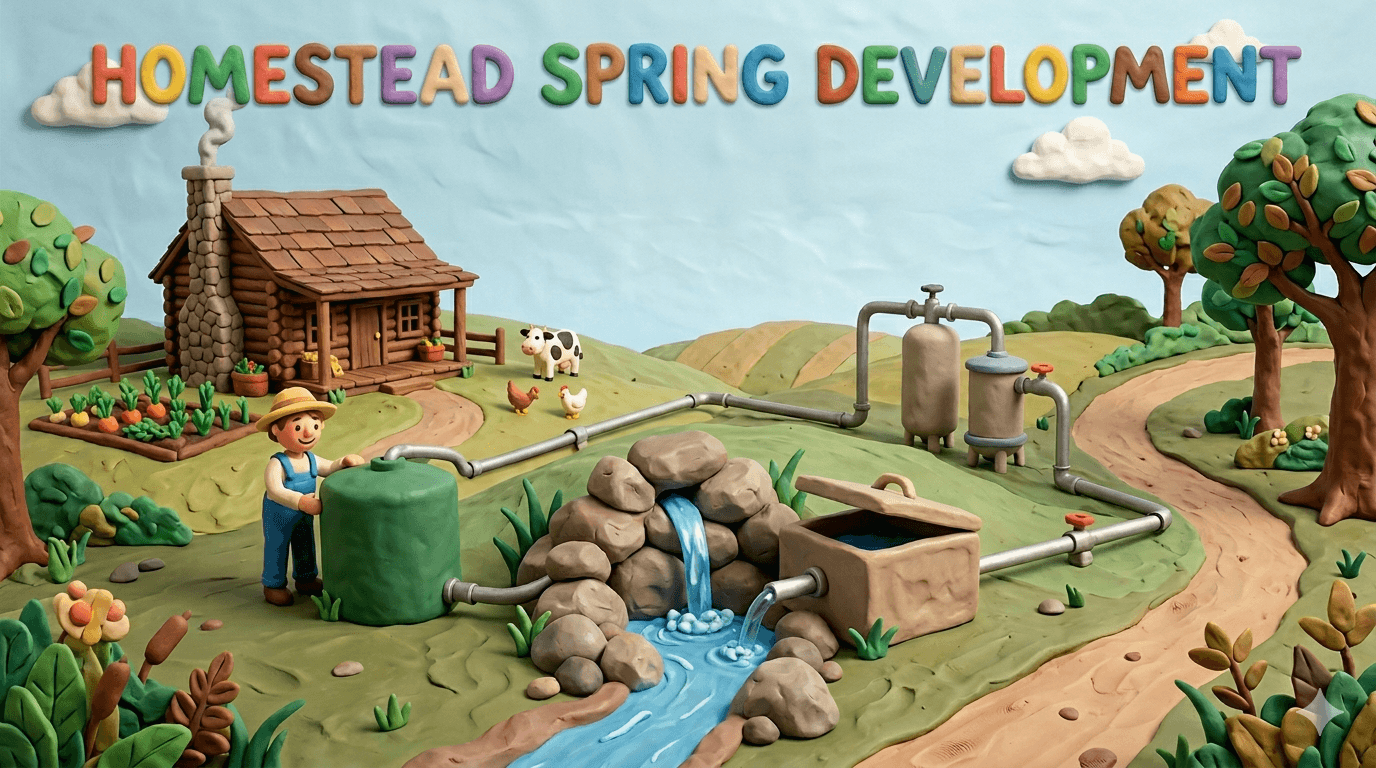
Spring development is the work of capturing that emerging water cleanly, before any surface runoff can mix in, and routing it where you want it to go. The core idea is to dig back to the actual water bearing layer, lay a collection field, build a sealed box around the source, and let gravity carry the rest. A properly developed spring delivers cleaner water than a shallow well and asks for nothing in return.
People have been doing this for a long time. Roman aqueducts started at developed springs in the Italian hills and ran for fifty miles on a gentle downhill grade. Appalachian hollows are full of springhouses built by settlers in the 1700s, many of them still flowing today. Plenty of mountain cabins in Vermont, North Carolina, West Virginia, and Tennessee have never had a well because the spring on the property already does the job.
A modern developed spring can be as humble as a half barrel of pea gravel and a length of buried pipe feeding a garden hose. It can also be as ambitious as a concrete spring box with a perforated collection field, a sediment cleanout, a screened overflow, a 1500 gallon header tank, and a pressurized house line. The right answer depends on flow, geology, and how much water you need every day.
A developed spring is also a long lived asset. A spring box built with sound materials and proper sealing routinely lasts 40 to 80 years with light maintenance. The aquifer itself has been there since the last ice age and is not going anywhere. Spend a little more on the build and you set up the next generation, not just the next decade.
Why Spring Development Is Worth It
A developed spring replaces a monthly water bill with a one time investment and a quiet annual maintenance habit. In a town with average water rates, a family of four spends roughly 600 to 900 dollars a year on metered water. Over a 50 year spring life, that is 30,000 to 45,000 dollars of avoided utility expense. A 3,000 dollar spring development pays for itself in the first three to five years and produces water from then on.
Spring water is also free of the electricity bill that runs every well pump. A drilled well needs a submersible pump, a pressure tank, a breaker, and a wire run. A spring on a hillside above the house runs on gravity alone. No pump. No power. No outage to worry about. The grid can fail for a week and your kitchen tap still works.
The cost gap with drilling is real. A typical 250 foot drilled well in 2026 runs 12,000 to 18,000 dollars all in. A clean spring development on the same property often comes in between 1,500 and 4,000 dollars, sometimes less if you own the excavator and the labor. For homesteads with a known flowing spring, it is one of the highest return projects you can take on.
There is also independence at the deeper level. A municipal line can fail. A well pump can short. A boil water notice can ruin a Tuesday. A developed spring with a sealed box, a screened overflow, and a header tank above the house gives you running water on the worst day of the year. That resilience compounds across every other system you build.
Spring water itself tends to be soft, cold, and clean tasting. The mineral profile is whatever the local rock gives you, and most rock gives you something good. No chlorine. No fluoride. No municipal aftertaste. Plenty of homesteaders who switch from city water to a developed spring say the kitchen tap is the first thing they notice. The second thing they notice is the power bill.
The Three Kinds of Homestead Springs
Not every wet spot in the woods is the same. Three spring types cover almost every homestead in North America. Pick the one that matches what is actually emerging on your land.
| Spring Type | Typical Flow | Ease of Development | Typical Cost | Best Fit |
|---|---|---|---|---|
| Concentrated (single point) | 1 to 10 gpm | Easiest | $800 to $3,000 | Hillside outcrop with a clear emergence point |
| Seepage (diffuse) | 0.25 to 3 gpm | Moderate | $1,500 to $5,000 | Wet meadow or wide damp patch with no single source |
| Artesian (under pressure) | 2 to 20 plus gpm | Easy if the cap is sound | $1,000 to $4,000 | Confined aquifer that wants to rise above ground level |
A few honest notes on each.
Concentrated springs emerge at a clear single point, often at the base of a rock outcrop, a cut bank, or a hillside seep. They are the friendliest type to develop because the water tells you exactly where to dig. A concrete or polyethylene spring box sets right over the emergence point. Most Appalachian springhouses were built on this kind of source.
Seepage springs spread across a wider area instead of pouring from one spot. You will see a damp patch ten to forty feet across with no obvious center. Developing a seepage spring means digging a long, shallow collection trench across the wet zone, lining it with washed gravel, laying perforated pipe, and routing the combined flow into a sealed box at the downhill end. More dirt work, but the total yield is often larger than a single point spring.
Artesian springs sit under their own pressure because the aquifer is sandwiched between two impermeable layers. The water wants to rise. Sometimes it bubbles straight out of the ground in a small dome. Developing an artesian spring is mostly about capping the rise cleanly and routing the pressurized flow into a closed pipe. Some artesian springs run pressurized enough to push water uphill into a tank without any pump.
A spring that runs strong in spring and dries by July is technically all three at once. It is a shallow, perched aquifer that recharges only with the wet season. You can still develop it, but plan a header tank with several days of storage and pair it with rainwater catchment. Treat seasonal springs as a supplement, not the sole supply.
Tip
Walk your candidate spring site in February, in August, and after a 24 hour drought of at least three weeks. The February walk shows you the maximum potential flow. The August walk shows you the dependable minimum. The dry walk tells you if the water is truly groundwater or just slow draining surface water. A spring that flows in August after a dry stretch is the spring worth developing.
How to Find and Assess a Spring on Your Land
Before you can develop a spring, you have to confirm you actually have one. The signs are friendlier than people expect once you know what to look for.
Walk the property after a long dry stretch in late summer. The patches that stay green when the rest of the field is browning out are almost always sitting on a shallow water source. Look for plants that need wet feet to live. Skunk cabbage, jewelweed, willow saplings, sedges, horsetail, and lush ferns are reliable markers. Look at the toes of slopes, the bases of rock outcrops, and the wooded hollows where two ridge lines meet. Springs love a contact between a permeable layer and an impermeable layer, and that contact is almost always at the base of a slope.
Walk again in winter. A spring that flows year round will keep ice from forming at its emergence point even on a 15 degree morning. Look for unfrozen patches in otherwise frozen ground. Watch for steam rising off a damp spot when the air is below freezing. That faint plume of vapor is groundwater holding its 50 degree warmth as it meets cold air.
Once you find a candidate, measure the flow. A bucket and a stopwatch is enough. Set up a temporary catch using a short piece of pipe or a board to channel the flow into one stream. Hold a 5 gallon bucket under it and count the seconds until it fills. Divide 300 by the seconds to get gallons per minute. A bucket that fills in 60 seconds is 5 gpm. A bucket that fills in 5 minutes is 1 gpm. Repeat the measurement weekly through the driest month of the year. The lowest reading is the number you design around.
A family of four needs roughly 200 to 300 gallons of water per day for indoor use. A flow of just 0.2 gpm produces 288 gallons over 24 hours. That means even a thin, dependable spring can run a whole household if you store the flow in a tank between draws. Storage turns a slow spring into a usable spring.
Run your daily and peak water needs through a friendly calculator before you size anything.
Check the elevation difference between the spring and the house. Every foot of vertical drop gives you about 0.43 psi at the faucet. A spring 50 feet above the house delivers 21 psi at the tap on gravity alone. Sixty to 80 feet of drop gets you in the comfortable range for showers and washing machines. If your spring is downhill from the house, you will need a pump anyway, and a drilled well is probably the better choice.
The Anatomy of a Properly Developed Spring
A clean spring development is a stack of small parts that each solve one problem. Skip any one of them and you will pay for it later in a water test or a frozen pipe.
The collection field is the hidden hero of every spring. Dig back to the actual water bearing layer, usually 3 to 8 feet upslope from the emergence point. Lay a bed of washed pea gravel or 3/4 inch crushed stone 12 to 24 inches deep. Set perforated PVC or HDPE pipe through the gravel, holes pointing down, with the pipe sloping a quarter inch per foot toward the spring box. Wrap the whole bed in non woven geotextile fabric to keep silt from migrating in. The collection field gives the spring room to breathe and keeps fine sediment out of your tank.
The spring box is the sealed chamber at the downhill end of the collection field. Concrete is the gold standard. A precast 4 foot by 4 foot vault holds plenty of flow and lasts 50 plus years. Food grade polyethylene tanks work well in milder climates and ship to remote sites in a pickup bed. The inlet from the collection pipe sits high on the upslope wall. The supply outlet sits a few inches above the floor so settled sediment never enters the line. The whole box gets a sealed top, a locking sanitary cover, and a screened vent.
The overflow standpipe is non negotiable. Springs do not stop flowing when the tank is full. The overflow lets the surplus leave the box without pressurizing the collection field or pushing water back into the hillside. Use a screened pipe that exits the box at a level just below the inlet, runs downhill on its own grade, and discharges into a splash pad or a stone lined ditch. The screen keeps mice, frogs, and snakes from finding the inside of your water source.
The cleanout is a sealed access port at the floor of the spring box. It lets you drain settled silt and shock chlorinate the box once a year without ripping the lid off. A 2 inch threaded plug at the lowest point of the floor is enough.
The supply line carries water from the box to the house, the barn, or the header tank. 1 inch PEX or HDPE is the homesteader default. Bury the line below the local frost depth, usually 24 inches in mild climates and 48 inches in cold ones. Use as few fittings as possible. Every fitting is a future leak.
The header tank is the buffer that turns a slow spring into a usable supply. A 1,000 to 2,500 gallon polyethylene tank set above the house at the highest practical point gives you several days of storage and steady gravity pressure at the tap. The supply line from the spring fills the tank, an overflow exits the tank, and a separate gravity line feeds the house.
The fence is the last and most ignored component. Livestock will trample a spring box, foul the source, and break the sealed cover in a season. Fence the collection area at minimum 30 feet upslope of the spring and 50 feet to either side. A simple three strand woven wire fence is plenty.
What Spring Development Really Costs
Spring development pricing splits into two big buckets. The excavation and box installation, which depend on access and access soil type. And the plumbing package, which is everything that turns a sealed source into a working water system. Here is a realistic breakdown for a moderate concentrated spring development in 2026.
| Line Item | Realistic Spend | Notes |
|---|---|---|
| Excavation labor or rental | $200 to $1,200 | Mini excavator day rate or a few hours of pro time |
| Spring box (precast concrete) | $400 to $1,200 | 4 ft by 4 ft sealed vault, or polyethylene equivalent |
| Washed gravel and geotextile | $150 to $400 | Pea gravel or 3/4 inch crushed stone, non woven fabric |
| Perforated collection pipe | $50 to $150 | 20 to 40 feet of slotted PVC or HDPE |
| Sanitary cover and vent screen | $80 to $250 | Locking lid, vented, vermin proof |
| Overflow standpipe and screen | $40 to $120 | Schedule 40 PVC plus stainless mesh |
| Cleanout fitting | $20 to $60 | 2 inch threaded plug at floor level |
| Supply line (1 inch PEX or HDPE) | $200 to $1,200 | Varies with distance to house and pipe quality |
| Header tank (1,000 to 2,500 gallon) | $400 to $1,500 | Food grade polyethylene, dark colored |
| Tank stand or earth pad | $100 to $600 | Level base, frost protected on cold sites |
| House side plumbing and shutoffs | $150 to $500 | Ball valves, hose bibs, pressure gauge |
| Water testing | $75 to $250 | Full panel at a state certified lab |
| Permits and inspection | $0 to $500 | Highly state and county dependent |
Add it up and a typical concentrated spring development lands between roughly 1,900 and 7,900 dollars all in. Most homesteaders in moderate terrain with reasonable access land between 2,500 and 4,500 dollars. Seepage springs that need a longer collection trench push the high end higher. Artesian springs with a strong natural flow often run cheaper because the box does most of the work.
The biggest savings come from doing the dig yourself. A homesteader with access to a rented mini excavator can knock out the excavation, gravel placement, and trench in a single weekend for the cost of a rental, fuel, and a few yards of stone. That alone can shave 1,500 dollars off the bid. Most rural counties allow owner installation of a spring development without a licensed contractor, but always confirm before you break ground.
Watch the gotchas. Hidden costs show up in surprise bedrock during excavation, longer supply lines than expected, and undersized tanks that have to be replaced in year two. Get a written estimate that names the box size, the collection field length, the supply line distance, and the tank gallons before any work starts.
Permits, Water Rights, and Setbacks
The legal side of spring development surprises more beginners than the construction side. The dig is rarely the problem. The paperwork is.
Most states treat a developed spring on your own property as a private water source and do not require a state permit for household use, but the rules vary widely. A few states require a domestic water source permit, a public health department inspection, or a plumbing permit for the house side hookup. Always call your county health department before you mark a spring site.
Water rights are the deeper question. Two systems govern who owns the water that flows out of the ground. Riparian states, mostly east of the Mississippi, generally let you capture and use a spring that originates on your own property without a separate water right. Prior appropriation states, mostly the arid West, treat surface water and many springs as a property right that may already belong to someone else. In states like Colorado, Idaho, Montana, and Wyoming, even a spring on your own land can require a separate water right, a permit, and annual reporting. The rules tighten further if the spring discharges into a named stream.
Setbacks protect your water from your other systems. Most states require minimum distances between a developed spring and any potential contamination source. The numbers vary by jurisdiction, but a working set of defaults looks like this.
- Septic tank: 50 feet minimum, 100 feet in many states
- Septic drain field: 100 feet minimum, 150 feet in stricter states
- Livestock yards, manure piles, and barns: 100 to 200 feet
- Buried fuel tanks: 100 feet
- Cropland under fertilizer or pesticide: 100 feet
- Property line: 10 to 25 feet
- Roads or driveways: 25 to 50 feet
A few minutes with your county health department before you set the spring box can save a 4,000 dollar relocation later. Some jurisdictions require an on site inspection of the proposed spring location before any excavation starts.
Watch for HOA and easement layers too. A spring that sits in a recorded utility or drainage easement may not be developable at all without written permission. Read the deed and the covenants before the excavator rolls in.
For state by state details on water rights, spring permits, and rural homesteading rules, browse our state by state homesteading hub. It covers all 50 states and links to the actual statutes where they matter most.
Water Quality and Testing a Spring
Spring water has a reputation for being pure. The reputation is half true. A properly developed spring drawing from a deep, protected groundwater layer often tests beautifully clean. A shallow seep with surface runoff mixing in can carry coliform bacteria, nitrate, and turbidity that no eyeball can detect. The only honest answer is to test.
Run a full panel test on the spring before you drink a drop. A standard homestead spring panel covers total coliform, E. coli, nitrate, nitrite, turbidity, iron, manganese, hardness, pH, and total dissolved solids. Cost runs 75 to 250 dollars at a state certified lab. Many state extension offices subsidize the test for newly developed sources. Take the sample after the spring has been flowing and overflowing for at least two weeks, not on day one.
Test again every spring for the first three years. After that, test annually for total coliform and nitrate, and every three years for the full panel. Test any time the water changes color, taste, or smell. Test after any flood event or after livestock have grazed the upslope area. Test before you sell the property.
Common spring contaminants and what they mean.
- Total coliform bacteria signals a surface contamination path. Even one positive sample means something is wrong with the seal, the cover, the overflow screen, or the upslope buffer. Shock chlorinate, find the path, fix it, and retest.
- E. coli is the more serious version of the same signal. Stop drinking the water, shock chlorinate, find the source, and retest before resuming use.
- Nitrate above 10 mg/L is unsafe for infants and pregnant women. Usually traces back to nearby agriculture, a failing septic, or heavy livestock upslope.
- Turbidity above 1 NTU points to a collection field that is letting fine sediment through. Add geotextile fabric, deepen the gravel bed, or add a sediment filter at the house.
- Iron and manganese stain laundry and fixtures. Treatable with a water softener or an oxidizing filter.
- Hardness above 10 grains per gallon is hard on plumbing and water heaters. A standard ion exchange softener handles it.
For drinking water, plenty of homesteaders add a final treatment stage even on a clean tested spring. A simple stacked filter at the kitchen sink covers the everyday. A whole house treatment train of sediment filter, UV lamp, and carbon block gives you potable water at every tap. A ceramic gravity filter on the counter is a quiet backup for the worst day.
Warning
A spring that tests clean today can test dirty next year. A cracked spring box lid, a chewed overflow screen, a new neighbor running cattle on the upslope, or a heavy rain event can introduce contamination overnight. Do not skip the annual coliform and nitrate tests. They cost 25 to 50 dollars and they catch problems while they are still small. Treat your water testing schedule like a smoke detector battery. Boring to maintain, priceless to skip.
A Realistic First Year Developing a Homestead Spring
Most beginners feel lost because they do not know what to tackle when. Here is a friendly first year arc. Your timing will shift with your climate and your soil, but the rhythm holds.
| Month | Focus |
|---|---|
| January | Walk the property in winter. Mark candidate seeps that stay unfrozen. Take notes on plants and slopes. |
| February | Measure flow weekly with a bucket and stopwatch. Record the highest reading you see during the wet season. |
| March | Call your county health department. Confirm permit and setback requirements. Pull any required paperwork. |
| April | Finalize the spring site. Mark the collection field and the supply line route. Order the spring box and tank. |
| May | Excavation week. Dig back to the water bearing layer. Lay gravel, geotextile, and collection pipe. Set the spring box. |
| June | Plumb the supply line to a temporary discharge. Let the spring flush and overflow for two weeks to clear the system. |
| July | Run the full water test panel at a state certified lab. Shock chlorinate if needed. Plan any treatment. |
| August | Confirm the dry season flow rate. Measure weekly through the driest stretch. Adjust storage plans if the spring runs thinner than expected. |
| September | Install the header tank, the tank stand, and the gravity line to the house. Add hose bibs and shutoffs. |
| October | Insulate the spring box, the overflow, and any exposed plumbing. Bury the supply line below frost depth. |
| November | First winter check. Watch for any freezing at the spring box vent, the overflow standpipe, or the tank inlet. |
| December | Annual review. File any required paperwork. Set the next spring's water test reminder. |
For a wider companion calendar that covers solar, water, waste, and heat together, pair this guide with our off grid living for beginners pillar.
Common Beginner Mistakes Developing a Spring
Almost every new homesteader makes a version of the same handful of spring development mistakes. The good news is that you can skip most of them by reading this section twice.
- Developing the spring in the wet season only. A spring that pours water in April can stop completely in August. Measure flow through the driest month of the year before you commit. Design around the minimum, not the maximum.
- Skipping the collection field. A spring box plopped directly over a seep without gravel and geotextile silts up within the first year. The collection field is what keeps the water clean. Do not skip it to save 200 dollars.
- No overflow path. A spring keeps flowing whether the tank is full or empty. Without a screened overflow, the surplus backs up into the collection field, blows out the cover seal, or finds a new path around the box entirely. Build the overflow first, fittings second.
- An unsealed or unscreened cover. Frogs, mice, snakes, leaves, and small mammals will find an open spring box in a single season. A sealed lid with a stainless mesh vent is non negotiable for any spring you plan to drink from.
- Ignoring the upslope buffer. Cattle, sheep, septic drain fields, fuel tanks, and gardens above the spring all contaminate the source. Fence the upslope at minimum 50 feet, and confirm there are no septic or livestock setbacks any closer.
- Undersized header tank. A 200 gallon tank on a 0.5 gpm spring runs the family dry every shower hour. Size the tank for at least three days of household use. Bigger tank, calmer life.
- Skipping the lab test. Spring water can look, smell, and taste clean while carrying coliform that will keep a toddler home from preschool for a week. Test before you drink it, then every spring after.
Avoid those seven and your first year on a developed spring will go better than most.
Build Skills Alongside the Hardware
A developed spring is not a set and forget asset. It is a working system that rewards a little attention every season. Pick up these five skills and your spring will outlast the house.
Flow measurement. Learn to measure spring flow with a 5 gallon bucket and a stopwatch. Record monthly readings in a notebook. Trends over years tell you whether your aquifer is steady, recovering, or declining.
Shock chlorination. Learn to disinfect your spring box and supply line with household bleach. One quart of unscented bleach per 200 gallons of system volume, mixed in, circulated, and held overnight. Flush until the chlorine smell is gone, then retest. A 45 minute job that resets your system after a contamination event.
Sediment management. Learn to drain the cleanout, scoop out settled fines, and rinse the spring box once a year. A clean box runs clearer water and protects every downstream filter. Do it before water testing season.
Freeze protection. Insulate the spring box lid, the overflow standpipe, and the supply line at any above ground exposure. Trench the buried line below your local frost depth. Inspect the tank inlet and overflow before the first hard freeze.
Water testing routine. Build a yearly habit. Spring test for total coliform and nitrate. Full panel every three years. Pair the lab work with a simple home test kit for chlorine, pH, hardness, and bacteria for weekly confidence between lab visits.
A working spring is a stack of small skills. Each one you add makes the next one easier.
You Can Start This Week
The biggest trap new homesteaders fall into is trying to design the perfect water system before they begin. Perfection is the enemy of progress on a homestead. A real flow measurement on a real spring, written down in a notebook, is more valuable than a beautiful Pinterest board that never breaks ground.
Pick one thing this week. Walk your property after a rain and mark every wet patch you can find. Measure the flow at the most promising seep with a 5 gallon bucket and a stopwatch. Call your county health department and ask what permits and setbacks apply to a developed spring on private land. Any of those moves turns this guide from theory into a project.
When you are ready for more, our off grid hub gathers every water, power, and heating guide as we publish them. Pair this article with our well drilling guide if you want to compare costs and tradeoffs, and with our rainwater harvesting guide to build a redundant water plan that survives any season.
For the bigger off grid picture across power, waste, and heat, lean on our off grid living for beginners pillar. For the wider homesteading roadmap, see our homesteading for beginners pillar. For the legal details in your state, our state by state homesteading hub covers water rights, spring permits, and zoning across all 50 states.
You can do this. We are glad you are here.
Frequently Asked Questions
A typical concentrated spring development in 2026 costs 1,900 to 7,900 dollars all in, with most homesteaders in moderate terrain landing between 2,500 and 4,500 dollars. The price covers excavation, a sealed spring box, gravel and geotextile for the collection field, perforated collection pipe, a screened overflow, a buried supply line, a header tank, plumbing, water testing, and permits. Seepage springs that need a longer collection trench push the high end higher. A spring is usually 70 to 85 percent cheaper than drilling a comparable well.
Measure the flow weekly through the driest month of the year, usually August or September, using a 5 gallon bucket and a stopwatch. A spring that still flows after a three week drought is almost always groundwater fed and will likely run year round. A spring that goes dry during the driest stretch is a perched seasonal source that recharges only with the wet season. Seasonal springs are still useful as a supplement, but you should not build a primary water supply around one.
Sometimes, but never assume so without testing. A properly developed spring drawing from a deep, protected groundwater layer often tests clean for years at a time. A shallow seep with surface runoff mixing in can carry coliform bacteria, nitrate, and turbidity that no eyeball can detect. Always run a full lab panel before drinking from a new spring, then test annually for total coliform and nitrate. Many homesteaders add a sediment filter, a UV lamp, and a carbon block as a whole house treatment train even on a clean tested spring.
It depends on the state. Most riparian states east of the Mississippi let you develop a spring on your own property for household use without a state permit, but some require a domestic source permit or a plumbing permit for the house hookup. Prior appropriation states like Colorado, Idaho, Montana, and Wyoming often require a separate water right and permit even on private land, especially if the spring discharges into a named stream. Always call your county health department before you mark a spring site.
A well bores a hole into a deep aquifer and uses an electric pump to lift water to the surface. A developed spring captures water that is already emerging on its own and uses gravity to move it. A well runs 12,000 to 18,000 dollars and needs a pump, a pressure tank, and electricity. A spring development runs 1,900 to 7,900 dollars and uses no power at all. A well works almost anywhere. A spring only works if you have one. The strongest off grid homesteads use a spring when they have one and drill a well as a backup.
A typical homestead spring delivers anywhere from 0.25 to 10 gallons per minute, depending on the source and the season. Even a thin spring at 0.5 gpm produces 720 gallons over 24 hours, which is more than enough for a family of four with a buffer tank. The trick is storage, not flow. A 1,000 to 2,500 gallon header tank turns a slow steady spring into a usable household supply with several days of buffer for high use periods or short dry stretches.
A properly developed spring rarely freezes at the source because groundwater emerges at roughly 50 degrees Fahrenheit year round. The risk is at the above ground exposures. Insulate the spring box lid, the overflow standpipe, the supply line entry, and any visible plumbing. Bury the supply line below your local frost depth, usually 24 inches in mild climates and 48 inches in cold ones. Add heat tape to any exposed pipe in very cold regions. Inspect every exposure before the first hard freeze and treat the spring box lid like any other outdoor faucet.
A spring box is a small sealed chamber built directly over a spring to capture the emerging groundwater cleanly. It is usually 200 to 500 gallons and sits at the spring itself. A cistern is a larger storage tank, typically 1,000 to 5,000 gallons, that holds water between the source and the house. A complete spring system uses both. The spring box captures the source, the supply line carries the flow uphill or downhill to a header tank or cistern, and the cistern stores enough water to buffer dry stretches and peak household demand.

Cole
Founder & Lead Researcher
Cole is the founder of Plan Your Homestead. He works in clinical research and brings a research-first lens to every guide on the site, drawing on a long family line of farmers for grounded, practical perspective.
More in Off-Grid
More articles coming soon. Check back for new off-grid content.