
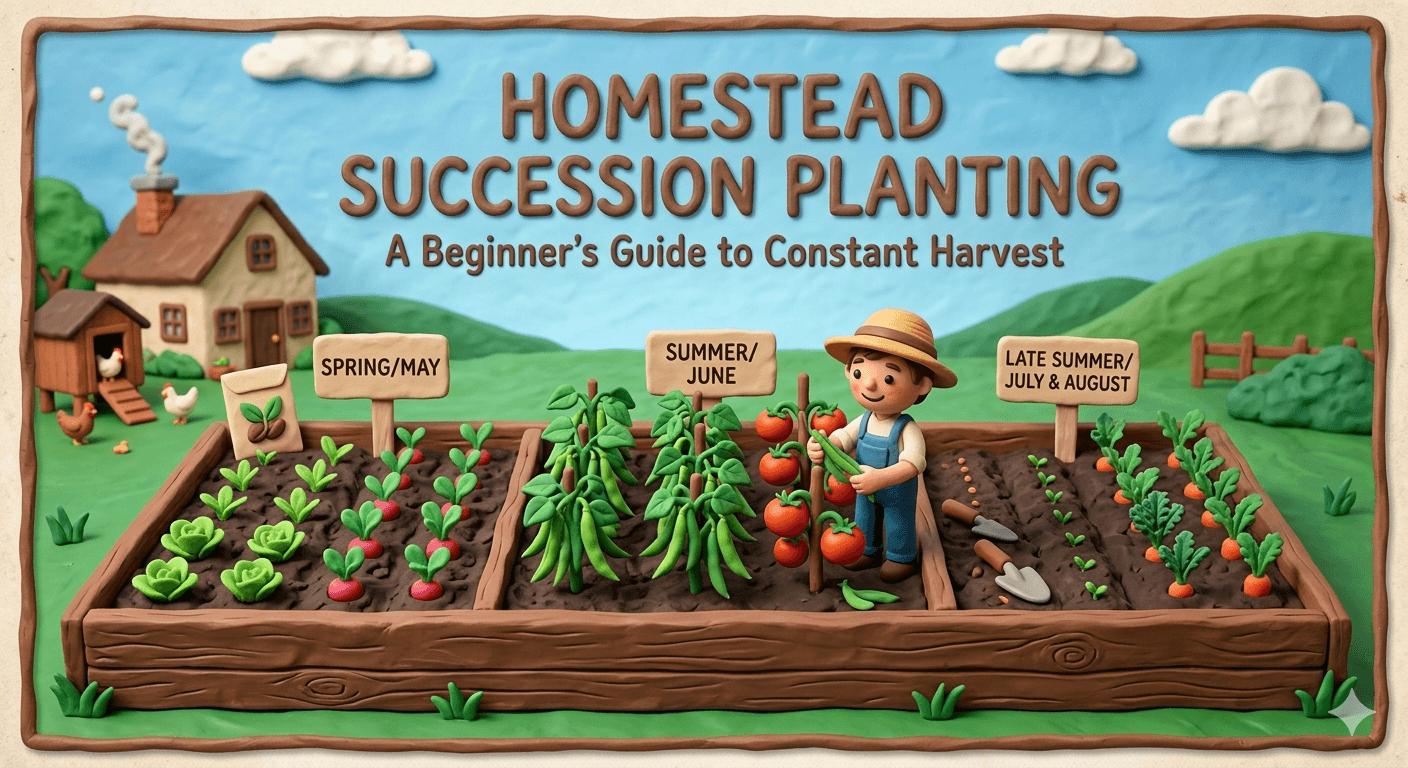
Most beginner gardens have the same problem. Everything comes ripe at once in July, the kitchen disappears under zucchini, and by September the beds are empty and tired. That feast or famine cycle is what stops people from feeling like real food growers. They had vegetables for three weeks and then nothing for the rest of the year.
Succession planting solves it. Instead of sowing one giant batch of lettuce in April and watching it bolt in May, you sow a small row every two weeks from March through October. Instead of one bed of beans that all pod at the same time, you plant a fresh round just as the last one finishes flowering. The harvest spreads out across the whole growing season, the kitchen never gets buried, and you eat fresh food from the garden for seven or eight months instead of three.
This guide walks you through everything you need to know. You will learn the four kinds of succession planting and when to use each one, the ten crops that respond best to staggered sowing, how to build a planting calendar around your frost dates, and the most common beginner mistakes that cause succession plans to fall apart. By the end you will have a working schedule for spring, summer, and fall.
What Succession Planting Actually Means
Succession planting is the practice of sowing a crop in small, repeated batches across the growing season instead of one big planting at the start. The goal is a steady, continuous harvest rather than one short glut followed by months of empty beds.
There is a second, related idea inside the same phrase. Succession also describes the way one crop follows another in the same bed. When your spring lettuce finishes in June, you pull it out and plant bush beans in the same spot. When the beans wind down in August, you sow a fall crop of spinach or carrots. The bed never sits idle. Every square foot of soil grows two or three crops per year instead of one.
Both meanings get used by gardeners and the techniques overlap. A real succession plan blends them together. You stagger short, fast crops every couple of weeks, and you also chain longer crops into a sequence that fills the bed from frost to frost. Done well, succession planting can double or triple the total yield of the same garden footprint without adding any extra square footage.
Why Succession Planting Belongs on Every Homestead
The first benefit is the one everyone notices first. You eat fresh food longer. A homestead that does succession well harvests salad greens from March through November, beans from June through October, and root crops from May right into winter storage. The kitchen always has something fresh, and you stop buying produce at the store for half the year.
The second benefit is that preservation gets manageable. When all your tomatoes ripen the same week, you have to can fifty pounds in three exhausting days. When you stagger plantings so the harvest spreads across six weeks, you can put up ten pounds at a time, evenings and weekends, without burning out. The same logic applies to beans, cucumbers, peppers, and anything else you preserve.
The third benefit is yield per square foot. By chaining crops back to back in the same bed, you grow far more food than a single big planting. A four foot by eight foot raised bed that produces one spring crop will produce two or three crops per year on a succession plan. That is a real difference when you have limited space.
Finally, succession planting builds resilience. If a single big planting fails because of a late frost, a pest outbreak, or a stretch of bad weather, you lose everything. When you have multiple smaller plantings spread across the season, one batch may fail and the next will be fine. The risk gets spread out alongside the harvest.
For more on building soil that supports back to back plantings without burning out, our soil building guide covers the foundation that makes succession possible in the first place.
The Four Types of Succession Planting Explained
Succession planting is not one technique. It is four related strategies that you mix and match depending on the crop and the season. Once you know the four patterns, you can apply them to any vegetable in your garden.
Interval planting
Interval planting is the simplest version. You sow the same crop over and over again on a fixed schedule. A short row every two weeks is the classic example. Lettuce, radishes, bush beans, and cilantro all respond beautifully to this approach. You get a steady supply because each row matures two weeks after the one before it.
Most fast maturing crops work on a fourteen day interval. Some short season crops like radishes can be planted every ten days. Longer crops like bush beans space out to three week intervals because each planting produces for longer. Match the interval to how long each round lasts in the kitchen.
Relay planting
Relay planting means swapping one crop for a completely different one as the first finishes. When your spring peas die back in the heat of June, you yank them out and plant bush beans in the same bed. When the beans wind down in August, you plant fall spinach in the same row. Each crop hands the baton to the next.
Relay planting works because different crops thrive in different parts of the season. Peas love cool spring, beans love warm summer, spinach loves cool fall. By chaining them in order you keep the bed productive from the first thaw to the first frost.
Companion succession
Companion succession is the trick of planting a fast crop and a slow crop in the same bed at the same time. The fast crop matures and gets harvested before the slow crop needs the space. Radishes planted between carrot rows are the classic example. The radishes come out in twenty five days, exactly when the carrots are starting to need elbow room.
You can pair lettuce with tomatoes, spinach with peppers, or arugula with squash. The fast crop shades the soil while the slow crop is small, and you double the harvest from a single bed. For more on which crops play nicely together, the companion planting guide lays out the best pairings.
Seasonal rotation
Seasonal rotation is the big picture version. You divide the year into three windows and plant a different family of crops in each one. Cool spring crops like peas, lettuce, brassicas, and spinach come first. Warm summer crops like tomatoes, peppers, beans, and squash fill the middle of the year. Cool fall crops like kale, chard, fall lettuce, and root vegetables finish the season.
Most homestead beds can grow at least one crop from each window. A bed that grew spring lettuce, summer tomatoes, and fall kale produced three full crops in the same space. Layered with interval and relay plantings, this is how serious gardeners get year round food from a small footprint.
The 10 Best Crops for Succession Planting
Some crops respond to succession planting more than others. These ten are the ones that should anchor every beginner schedule. Start here and you will see immediate results.
Lettuce
Lettuce is the poster child of succession planting. It grows fast, bolts in summer heat, and stops producing once it goes to seed. A small row every two weeks from early spring through late fall gives you continuous salad greens without ever having too much at once. Switch to heat tolerant varieties in midsummer and back to standard varieties in fall.
Radishes
Radishes mature in twenty five to thirty days, which makes them the fastest crop in the garden. Plant a short row every ten to fourteen days from early spring through the start of summer, then again from late summer through the first frost. They get woody and bitter if left in the ground past maturity, so the small batch approach is the only way to do them well.
Bush beans
Bush beans produce heavily for two to three weeks and then taper off. Plant a new row every three weeks starting after the last frost. The first planting will be winding down just as the second hits peak production. By overlapping three to four plantings you can harvest fresh beans from June through the first hard frost.
Carrots
Carrots take sixty to eighty days but they hold well in the ground. Plant a row in early spring, another in mid spring, a third in midsummer for fall harvest, and a final row in late summer for winter storage. Each round can stay in the ground for weeks past maturity, which gives you a wide harvest window.
Beets
Beets follow the same pattern as carrots. Spring, late spring, and late summer plantings cover the whole season. Young beets are tender and sweet, so smaller more frequent plantings beat one big crop. The greens are also edible, which gives you a double harvest from every row.
Spinach
Spinach hates heat and bolts the minute summer arrives. Plant early spring rows two weeks apart, stop for the hot months, and pick up again in late summer for fall harvest. A fall planting often outproduces the spring crop because cool nights extend the harvest window.
Arugula
Arugula matures in twenty one days and bolts almost as fast. Sow short rows every ten to fourteen days from early spring through early summer, then resume in late summer. The leaves taste milder when picked young, so small batches always beat big plantings.
Cilantro
Cilantro bolts in the heat faster than almost any other herb. Plant a small batch every two weeks all season long. The leaves you do not use will flower and set seed, which gives you a free coriander harvest at the end of the season.
Bush peas
Bush peas thrive in cool weather and stop producing once the heat arrives. Sow them as early as the soil can be worked in spring, then again in late summer for a fall crop. Most regions do not get a midsummer pea harvest, so plan around the cool windows on either end of the season.
Summer squash
Summer squash plants get tired and disease prone after six to eight weeks of heavy production. Plant a second round about a month after the first. When the original plants start declining in midsummer, the second wave is just kicking into gear. This trick gives you fresh, healthy squash plants right up to the first frost.
For more on choosing easy, productive crops to anchor your first season, our easiest vegetables for beginners guide pairs naturally with this list.
How to Build Your Succession Planting Calendar
A working succession calendar is built around two dates. Your last spring frost and your first fall frost. Every sowing date in your plan gets calculated from one of these two anchors.
Look up both dates for your zip code first. The planting calendar tool gives you exact dates for your zone. Write them down. These are the bookends of your gardening year.
From the last spring frost, work forward. Cool crops like peas, lettuce, spinach, and brassicas can go in two to six weeks before the last frost. Warm crops like beans, squash, tomatoes, and peppers go in after the frost danger has passed. Repeat plantings of fast crops keep going every two to three weeks until the heat shuts them down.
From the first fall frost, work backward. Find the days to maturity for each crop you want to harvest in fall. Add two weeks of buffer for the slower fall growth, then count back from your frost date. If you want fall carrots that mature in seventy days, you sow them about eighty four days before your first frost. The same backward math works for fall lettuce, spinach, kale, and root crops.
Tip
Keep your succession plan in a simple notebook or a calendar app. Write the planting date and the crop on every single sow, and check the entry off as you do it. The act of marking sows off keeps you from missing the two week intervals when life gets busy.
A good first year plan has eight to twelve scheduled sow dates total. That is enough to give you a real succession schedule without overwhelming the start of the season.
A Spring, Summer, and Fall Succession Schedule
Here is a working example for a typical zone 6 garden with a last frost around April 25 and a first frost around October 15. Adjust each date by two weeks earlier for warmer zones, or two weeks later for colder zones.
| Window | Sow date | Crop |
|---|---|---|
| Early spring | Mar 15 | Spinach, peas, radishes (round 1) |
| Early spring | Mar 30 | Lettuce (round 1), radishes (round 2), arugula (round 1) |
| Mid spring | Apr 15 | Lettuce (round 2), spinach (round 2), beets, carrots (round 1) |
| Late spring | May 1 | Bush beans (round 1), summer squash (round 1), cilantro (round 1) |
| Late spring | May 15 | Lettuce (round 3), cilantro (round 2), carrots (round 2) |
| Early summer | Jun 1 | Bush beans (round 2), cucumbers, basil, cilantro (round 3) |
| Midsummer | Jun 20 | Bush beans (round 3), summer squash (round 2) |
| Mid to late summer | Jul 15 | Fall carrots, fall beets, bush beans (round 4) |
| Late summer | Aug 1 | Fall lettuce, fall spinach, kale, chard |
| Late summer | Aug 15 | Radishes (fall round), arugula (fall round), turnips |
| Early fall | Sep 1 | Final lettuce sow, mache, winter greens |
That schedule produces something fresh in the kitchen from the first week of May straight through the first hard freeze. The same skeleton works in any zone once you slide the dates against your frost calendar.
If you want help thinking through how to pair the spring sows with their summer relays in the same beds, the companion planting guide shows which families share beds easily and which ones fight.
Succession Planting in Small Spaces and Raised Beds
Succession planting shines hardest in small gardens and raised beds. When you only have four or eight beds to work with, you cannot afford to let any of them sit empty for six weeks between crops. Every bed needs a plan for the whole season.
The trick in tight spaces is to think in zones inside each bed. A standard four foot by eight foot raised bed can hold three or four succession zones at once. The front section grows fast crops on a two week interval. The middle section grows medium crops that get relayed once or twice. The back section grows long season crops that hold the whole year.
Intercropping is the next layer. Plant fast crops between the rows of slow crops. Radishes between carrots, lettuce between tomato cages, arugula between pepper plants. The fast crops come out before the slow crops need the room, and you double the harvest from the same square footage.
Pay extra attention to soil between successions. Each crop pulls nutrients out of the bed, and raised beds have a smaller buffer than in ground gardens. A handful of compost worked in between rounds keeps the soil productive all season. For a deeper look at maintaining bed fertility across multiple crops, the raised bed gardening guide covers the soil management piece in detail.
Tip
Keep a fast growing cover crop like buckwheat or crimson clover in your back pocket for any bed that sits empty for more than three weeks. Even a short cover crop adds organic matter, protects soil from erosion, and feeds the next planting.
The smaller your garden, the more succession planting matters. A homesteader with a quarter acre of beds can afford a single big planting. A homesteader with two raised beds cannot.
Common Succession Planting Mistakes to Avoid
Most failed succession plans come down to a small handful of beginner mistakes. Sidestep these and your schedule will hold up across the whole season.
Planting too much at once in spring. New gardeners get excited and put in the entire seed packet on April 1. The whole bed bolts together in May. The fix is to count the seeds in your row and sow only a fraction. Save the rest for two weeks later.
Forgetting fall sows. Late summer is the hardest time to think about planting. The garden looks full, the heat is brutal, and the last thing you want to do is sow more seeds. But late July and early August are when fall succession plantings have to go in. Skip them and you lose the entire fall harvest. Put the dates on your calendar in February while you are still excited about the year.
Ignoring day length. Crops grow faster in long summer days than in short fall days. A lettuce that matures in forty five days in May may take seventy days when sown in September. Add two weeks of buffer to every fall sow date to account for the slower autumn growth.
Not feeding the soil between rounds. Each crop you pull out takes nitrogen and other nutrients with it. By the third or fourth succession in a bed, the soil is depleted and the new crop sulks. A shovel of compost or a handful of slow release organic fertilizer between rounds fixes the problem. The composting 101 guide covers the easiest ways to keep finished compost on hand.
Planting heat sensitive crops in midsummer. Lettuce, spinach, peas, and cilantro all bolt or refuse to germinate when soil temperatures climb past eighty degrees Fahrenheit. Stop sowing those crops in late June and resume in mid August when soil cools off again. Trying to push them through the heat wastes seed and bed space.
Warning
Never plant the same family of crops back to back in the same bed. Tomatoes followed by peppers followed by eggplants will pull the same nutrients out of the soil and invite the same pests. Rotate families across the relay sequence to keep diseases and pest cycles broken.
Skipping the planting journal. Two weeks slips by faster than you think. Without a written calendar of sow dates, you will forget the second and third rounds, and the schedule will collapse by midsummer. A simple notebook with the dates and crops listed at the start of the year prevents this.
Frequently Asked Questions
Frequently Asked Questions
Most fast crops respond to a two week interval. Lettuce, radishes, arugula, spinach, and cilantro all do best with new sowings every fourteen days. Medium crops like bush beans go on a three week interval because each planting produces longer. Slow crops like carrots and beets get sown three or four times across the season at the major windows of spring, midsummer, and late summer. Match the interval to how long each round produces in the kitchen.
Long season fruiting crops that produce continuously all summer rarely need successions. Tomatoes, peppers, eggplant, and indeterminate cucumbers will keep flowering and setting fruit from midsummer through frost on a single planting. A second round in early summer can extend the season slightly, but the first planting will usually carry most of the harvest. Save your succession effort for crops that mature quickly and stop producing.
Raised beds are actually the best place to succession plant because the soil warms faster in spring, drains better between crops, and lets you replant the same square footage three or four times per year. The only adjustment is paying closer attention to soil fertility. Raised beds have a smaller nutrient buffer than in ground gardens, so a handful of compost between every succession keeps the soil productive across many crops.
Most succession crops are direct sown right into the garden bed. Lettuce, radishes, beans, peas, carrots, beets, spinach, arugula, and cilantro all prefer to be seeded outside where they will grow. The exceptions are long season warm weather crops like tomatoes and peppers, which need a head start indoors. For a true succession schedule, build your plan around direct sown crops and treat the indoor starts as a separate spring task.
Just sow the next round whenever you remember and slide the rest of the schedule forward by the same amount. A missed two week sow is not the end of the season. The whole point of succession planting is overlap and redundancy. One missed batch will create a small gap in the harvest, but the next round will cover for it. Forgive yourself, write the new date down, and keep going.
A single four foot by eight foot raised bed can host a complete succession schedule. Divide the bed into three zones. The front zone grows fast leafy crops on a two week interval. The middle zone runs a spring to summer to fall relay sequence. The back zone holds long season crops like carrots and beets. A garden this size will keep one or two people in fresh greens and roots for most of the year.
Top dress the bed with a half inch of finished compost between every succession. Add a small handful of slow release organic fertilizer like an all purpose blend on top of the compost. Water the bed deeply before sowing the next round to settle the amendments into the soil. If you have time for a longer break between crops, a fast cover crop like buckwheat will rebuild fertility even more. Healthy soil is what makes succession planting sustainable across the whole season.
Yes, and it is one of the best reasons to grow open pollinated varieties for your successions. Let the very last round of the season go to seed instead of harvesting it. Lettuce that bolts in August, beans that dry on the plant in September, and cilantro that flowers and sets coriander all give you seed for next year's successions for free. The [seed saving guide](/gardening/seed-saving-guide) walks through the harvest and storage steps in detail.
Succession planting is the single biggest shift between a garden that feeds you for three weeks and a garden that feeds you for nine months. The whole technique is just two ideas. Sow small batches often, and chain crops back to back in the same bed. Once those two habits are in place, every other gardening skill you have gets multiplied.
Start this season with two or three crops on a real succession plan. Lettuce, radishes, and bush beans are the easiest place to begin. Write the sow dates on your calendar today, mark them off as you go, and by the end of the year you will be eating fresh food from your garden longer than you ever thought possible.
For a full picture of how succession fits into the rest of a self sufficient garden, our ultimate guide to starting a homestead garden from scratch ties soil, seeds, and seasonal planning together into one yearly plan.

Cole
Founder & Lead Researcher
Cole is the founder of Plan Your Homestead. He works in clinical research and brings a research-first lens to every guide on the site, drawing on a long family line of farmers for grounded, practical perspective.
More in Gardening
More articles coming soon. Check back for new gardening content.