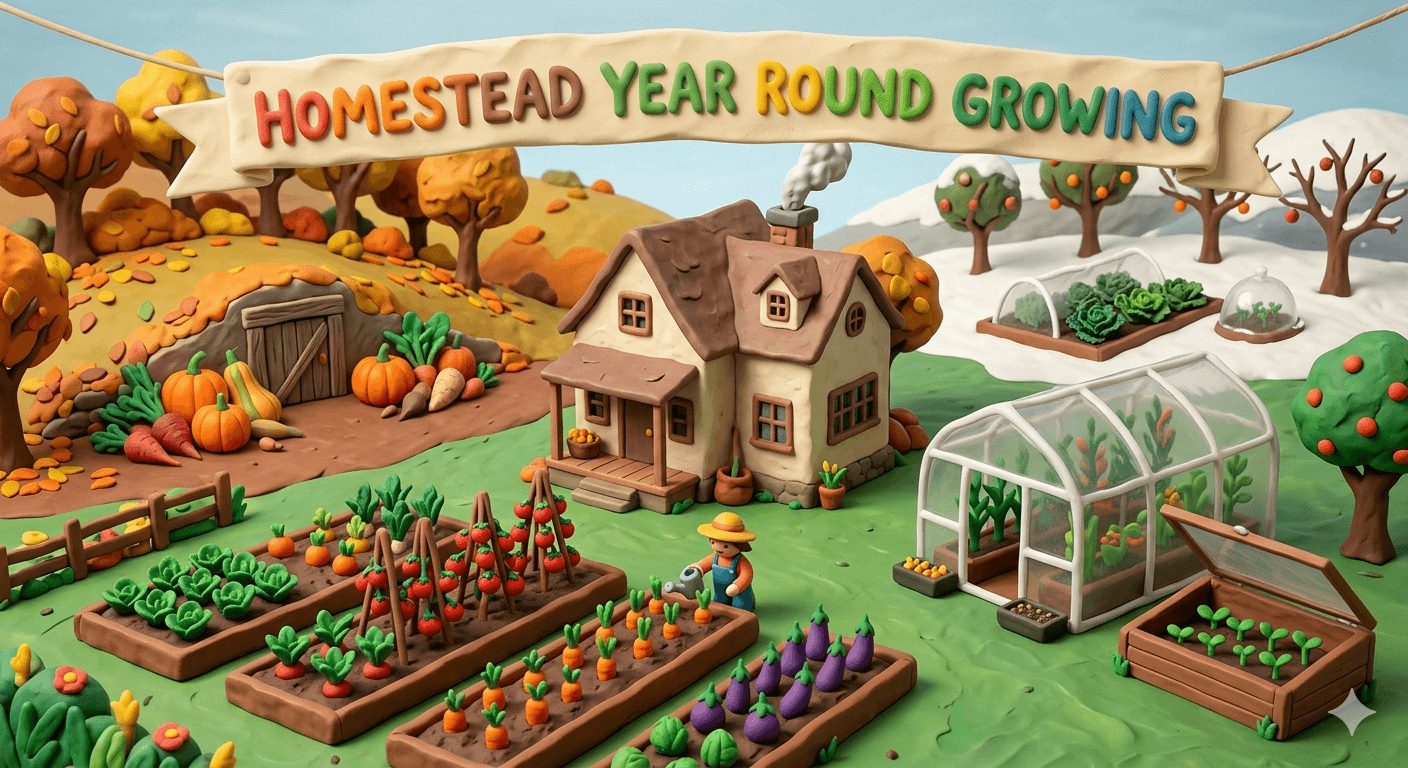
Most gardens fall asleep in October and stay that way until April. The beds sit bare, the kitchen goes back to grocery store produce, and six months of homegrown food disappears from the table. It does not have to be that way.
Year round growing is the practice of harvesting fresh food from your homestead every single month of the year. Not every crop in every month, but always something. Salad greens in January. Carrots in February. Eggs and stored squash through the dead of winter. A first cutting of spinach before the snow even melts.
This guide walks you through everything a beginner needs to plan a year round garden. You will learn the five tools that make winter harvests possible, which crops to focus on, how your climate zone changes the plan, and a month by month calendar that turns the whole idea into something you can actually start this weekend.
Let us get into it.
What Year Round Growing Actually Means
Year round growing is not the same as growing summer crops all winter. Nobody is harvesting tomatoes in February without serious heat and grow lights. The real goal is simpler. Have something fresh and edible coming out of your garden, your storage, or your protected beds every single month of the year.
That changes the math. Instead of fighting the seasons, you work with them. Cold hardy crops carry you through the dark months. Storage crops bridge the gap between fall harvests and spring planting. A cold frame or low tunnel keeps a few rows alive when everything else is frozen. By stacking these tactics, you can put homegrown food on the table twelve months in a row.
This is different from simple season extension, which usually means adding a few weeks on each end of the growing year. Year round growing closes the loop entirely. There is no off season. There is just a different pace of growing in winter.
Why Year Round Growing Belongs on Every Homestead
The first reason is food security. A homestead that produces food eleven months a year and then goes silent for one is fragile. A homestead that produces every month of the year is resilient. You eat what you grow regardless of grocery prices, supply chain hiccups, or a snowstorm that closes the highway.
The second reason is money. Winter greens are some of the most expensive produce at the store. A small bed of spinach under a low tunnel can pay for the tunnel in a single season. Stored carrots, potatoes, onions, and winter squash replace dozens of grocery trips. Eggs from a small flock cover breakfast all winter.
The third reason is nutrition. Greens harvested an hour before dinner are stunningly better than greens trucked across the country. Winter is when fresh nutrition matters most, and it is also when most people get the least of it. Year round growing flips that script.
The fourth reason is the garden itself. Soil that grows something living all year stays healthier than soil that sits bare for half of it. Living roots feed soil biology. Mulch and cover stop erosion. The garden you grow in February makes the garden you grow in July better.
Finally, year round growing pairs perfectly with succession planting. Succession spreads the harvest across the warm season. Year round growing extends it into the cold one. Together they take a homestead from feast or famine to a steady, reliable supply.
Know Your Climate Zone First
Before you pick a single seed packet, you need to know what climate you are working with. USDA hardiness zones describe the average coldest winter temperature in your area. They run from zone 1 (brutally cold) to zone 13 (tropical). Most of the lower forty eight falls between zone 4 and zone 9.
Your zone changes everything. A cold frame that holds spinach all winter in zone 7 will freeze solid in zone 4. A low tunnel that lets a zone 5 gardener harvest carrots in January is barely necessary in zone 8. Knowing your number tells you which methods you need and which crops will survive.
Three broad bands will guide most of the choices in this guide.
Cold zones (3 to 5). Real winter. Single digit nights, weeks of frozen ground. Year round growing here means storage crops, a heated or insulated structure, and a tight focus on the most cold hardy greens. You can still pull it off. You just need more protection.
Temperate zones (6 to 7). The sweet spot for year round growing. Cold frames and low tunnels carry greens and roots straight through winter without supplemental heat. Most of the techniques in this guide are written with this reader in mind.
Warm zones (8 to 10). Winter is the easy season. You can grow lettuce, broccoli, peas, and brassicas in open beds when zone 5 gardeners are buried in snow. Summer is your hard season instead, and shade cloth becomes the tool that does what a cold frame does up north.
If you do not know your zone, look it up on the USDA hardiness zone map, then check first and last frost dates for your zip code on our planting calendar. Those two numbers anchor every other decision you will make.
Tip
The Five Tools of Year Round Growing
Year round growing is built on a stack of five tools. None of them are complicated. You do not need all of them on day one. Start with one, get comfortable, then add the next.
| Method | Typical Cost | Frost Protection | Best For |
|---|---|---|---|
| Deep mulch | 0 to 50 dollars | A few degrees | Overwintering root crops in the ground |
| Cold frame | 30 to 150 dollars | 10 to 15 degrees | Salad greens, herbs, hardening off seedlings |
| Low tunnel | 50 to 200 dollars per bed | 10 to 20 degrees | Winter spinach, kale, carrots, scallions |
| Hoop house | 500 to 2,000 dollars | 15 to 25 degrees | Walk in winter growing, early spring starts |
| Permanent greenhouse | 1,500 to 8,000 dollars | 25 degrees and more | True year round production, heat loving crops |
Mulch: The Free Tool
Mulch is the first and cheapest layer of season extension. A foot of straw or shredded leaves piled over a row of carrots in late October keeps the soil from freezing solid. When January hits, you pull the mulch back, pull a few carrots, and rake the cover right back into place.
The same trick works for parsnips, beets, leeks, and Jerusalem artichokes. The mulch does not actively warm the soil. It just keeps the cold from reaching as deep. In zones 5 through 7, that is often enough to harvest from frozen ground all winter.
Lay the mulch on after the first hard frost but before the soil freezes. If you mulch too early, you trap voles and mice in there with your dinner. If you mulch too late, the ground is already frozen and the mulch does nothing.
Cold Frames: The First Real Structure
A cold frame is a bottomless wooden or metal box with a clear lid that sits over a small patch of soil. The lid traps solar heat during the day and slows heat loss at night. Inside, you can grow salad greens, herbs, and hardy radishes long after the open garden has died back.
A simple four foot by eight foot cold frame costs under a hundred dollars to build from scrap lumber and an old storm window. Pre built kits run two hundred to four hundred dollars. The economics are obvious. One winter of homegrown lettuce easily covers either price.
Cold frames work best in zones 6 through 8. In colder zones you can still use them, but you may want to bank straw bales or snow against the outside walls for extra insulation. Ventilation matters too. A sunny February day can roast everything inside if you do not prop the lid open.
Low Tunnels and Row Cover: The Workhorse
A low tunnel is a row of half hoops covered in clear plastic or a heavy floating row cover. They sit two to three feet tall over a standard four foot bed and convert any raised bed into a winter growing space. This is the tool that does the most work for the least money on a real homestead.
Cost is modest. A few wire hoops, a roll of agribon row cover, and a sheet of greenhouse plastic will run you a hundred to two hundred dollars for a single bed. They go up in an afternoon. They come down in spring and store in a corner of the shed.
Underneath a double layer of cover (row cover and plastic), a low tunnel can keep spinach, kale, mache, claytonia, and arugula alive through nights into the single digits. That covers most of zone 5 and all of zones 6 and warmer. For colder areas, the low tunnel becomes a layer inside a larger structure rather than the structure itself.
Hoop Houses: The Walk In Step Up
A hoop house is a larger, walk in version of a low tunnel. Bowed steel or pvc ribs form a tunnel ten to twenty feet wide and as long as you want, covered in a single layer of greenhouse plastic. You can stand up inside, run rows of plantings down the length, and treat it like a real season extension building.
A small hoop house runs five hundred to two thousand dollars in materials. They are a serious project but well within reach of a beginner with a weekend and a friend or two. For most homesteads, a hoop house is the upgrade you make once you have outgrown low tunnels. Our diy hoop house guide walks through building one step by step.
Inside a hoop house, you get the same temperature gain as a low tunnel but you can walk between the rows. That makes maintenance and harvest dramatically easier in deep winter, when you do not feel like crawling on your knees in the snow.
Permanent Greenhouses: The Final Upgrade
The top of the stack is a permanent greenhouse with rigid walls, a real foundation, and double walled glazing. This is where you can run supplemental heat, start seedlings at scale in February, and grow tomatoes and peppers later than anyone else in the county.
A greenhouse is a real investment, but it is the only structure that lets you grow heat loving crops out of season. Our full greenhouse growing guide covers sizing, glazing, heating, and ventilation in depth. Most homesteads work up to a greenhouse over years. Few start with one.
The Year Round Crop Categories
You do not need to grow forty different vegetables to keep food on the table all year. You need to grow the right ones. Year round crops fall into three groups, and a strong homestead grows from all three.
Cold Hardy Greens
Cold hardy greens are the most useful crop on a year round homestead. They grow fast, harvest as cut and come again, and survive temperatures that wipe out everything else. Spinach can take temperatures into the single digits under a row cover. Mache, claytonia, and tatsoi laugh at frost. Kale gets sweeter after a freeze.
Plant cold hardy greens in late summer for fall and winter harvest. The trick is to time the seeding so the plants are nearly full sized by the first hard frost. Growth slows to a crawl once daylight drops below ten hours per day, so anything that is not big by mid November will not get much bigger until February.
The reliable list for most homesteads: spinach, kale, mache, claytonia, tatsoi, arugula, winter lettuce mixes, and parsley. Add cilantro and chervil if you have a low tunnel.
Cold Hardy Roots
Root crops are the second pillar of year round growing because they store right in the ground. Once the tops die back in late fall, the roots sit in the soil like a natural root cellar, waiting for you to pull them as needed.
Carrots, parsnips, beets, leeks, salsify, and Jerusalem artichokes all overwinter in the ground in zones 5 and warmer with a foot of mulch on top. Parsnips actually need a freeze to develop their full sweetness. Carrots that overwinter taste like candy compared to summer carrots.
Plant root crops in early to mid summer so they size up before the first hard frost. Once frost arrives, top them with deep mulch and stop watering. Pull as you need them through the entire winter.
Storage Crops
Storage crops are harvested in fall and held in a cool, dry place to eat through winter. They are the third leg of the stool. Winter squash, garlic, onions, potatoes, and dry beans can feed a homestead from October through April with very little effort once they are in the bin.
Winter squash and pumpkins keep three to six months in a cool basement. Garlic and onions hang in mesh bags for six to nine months. Potatoes store three to five months in a dark, humid spot. Dry beans hold for years.
A solid storage harvest is what separates a homestead that eats well in February from one that runs out. Plan to grow enough that you have something on hand even when the cold frames freeze for a week and the chickens slow down on eggs.
A Month by Month Year Round Growing Calendar
This calendar is written for a zone 6 to 7 reader with first frost in mid October and last frost in mid April. If you are in a colder zone, push dates two to three weeks later in spring and earlier in fall. If you are warmer, do the opposite.
Winter (December, January, February)
The slow season. Daylight is short, growth nearly stops, and the goal is to harvest what you already planted rather than start anything new.
| Month | Harvest From | Sow | Set Up |
|---|---|---|---|
| December | Mulched roots, cold frame greens, low tunnel spinach, storage crops | Nothing outside | Vent structures on sunny days, watch for vole damage |
| January | Same as December, plus stored garlic and onions | Microgreens indoors, onions and leeks under lights | Order seeds, plan spring beds |
| February | Same, plus mache, claytonia, overwintered spinach | Onions, leeks, parsley, brassicas under lights | Repair tunnels and frames, sharpen tools |
The single most important winter task is ventilation. A sunny day in February can push the inside of a cold frame past ninety degrees while the outside air is freezing. Open the lid or prop the tunnel cover in the morning, close it again before the sun drops.
Spring (March, April, May)
The wake up. Growth speeds up, the soil thaws, and you start staging in everything for the warm season.
| Month | Harvest From | Sow | Set Up |
|---|---|---|---|
| March | Overwintered greens, last roots, indoor microgreens | Peas, spinach, radishes, lettuce direct sown under cover | Start tomatoes, peppers, and brassicas indoors |
| April | First spring spinach, lettuce, radishes, asparagus | Carrots, beets, more peas, hardy greens outdoors | Prep beds, transplant brassicas under cover |
| May | Asparagus, spring greens, radishes, first lettuce heads | Beans, corn, squash, transplants of tomatoes and peppers after last frost | Open cold frames for the season, remove low tunnels |
Spring is when the year round calendar starts to overlap with succession planting. Anything you sow in cold frames or under low tunnels comes in two to four weeks ahead of open beds. That head start is what fills the kitchen during the hungry gap of late April and early May.
Summer (June, July, August)
The flood. Every bed is full, the kitchen is overwhelmed, and most of the work is harvesting and replanting. This is the season most beginners think of as the only season. It is also where you set up everything for the winter ahead.
| Month | Harvest From | Sow | Set Up |
|---|---|---|---|
| June | Spring greens, peas, garlic, first summer squash | Bush beans, fall brassicas, more carrots | Plan fall garden, order fall seeds |
| July | Tomatoes, peppers, summer squash, cucumbers, beans | Fall carrots, beets, kale, spinach, cabbage transplants | Mulch beds heavily for heat and moisture |
| August | Peak of everything, plus dry beans, melons | Fall spinach, lettuce, mache, claytonia, cilantro | Plant overwintering garlic plan, prep low tunnels |
July and August are the secret months of year round growing. Almost everything you will eat from November through March needs to go into the ground during this window. Skip these sowings and your winter garden will be empty before the snow even hits.
Warning
Fall (September, October, November)
The transition. You are harvesting summer crops, getting fall plantings in, and setting up every structure for the cold ahead.
| Month | Harvest From | Sow | Set Up |
|---|---|---|---|
| September | Tomatoes, peppers, summer squash, first fall greens | Last spinach, mache, garlic late in the month | Pull spent summer beds, plant cover crops |
| October | Winter squash, sweet potatoes, fall greens, root crops | Garlic, shallots, last quick greens under cover | Install low tunnels, prep cold frames, mulch roots |
| November | Carrots, beets, leeks, fall greens, brassicas | Almost nothing outside | Close tunnels and frames for winter, set up storage |
October is the busiest month of the year on a year round homestead. The summer garden is finishing, the winter garden is sizing up, and every structure needs to be in place before the first hard freeze. Get the work done before Halloween and the rest of winter feels easy.
Building Your Year Round Plan
Year round growing looks intimidating when you read it all at once. It is not. Almost every homesteader who pulls it off built it one piece at a time. Here is a path that works.
Year one. Pick one structure and three crops. Buy or build a single low tunnel or cold frame. Plant three crops inside it. Spinach, kale, and mache is a forgiving starter mix. Mulch a row of carrots in the open garden and call that your fourth crop. That is enough to put fresh greens on the table from December through February.
Year two. Add a second structure and stretch the calendar. Maybe a second low tunnel, maybe your first real hoop house. Add fall lettuce, claytonia, scallions, and overwintering garlic. Start a few brassicas under lights in February for an early spring transplant. Now you have fresh food eight to ten months of the year.
Year three. Round out the storage side. Plant a real garlic and onion crop. Grow enough winter squash to last until March. Pickle, ferment, and can the summer surplus. Add a small flock of chickens if you do not have one yet. The combination of fresh growing and proper storage closes the last gap.
The biggest mindset shift is to stop thinking of the garden as something that runs from April to October. Once you start sowing in July for November and mulching in October for February, the calendar bends into a circle. There is no off season anymore. There is just the next thing to plant or harvest.
Tip
Common Year Round Growing Mistakes to Avoid
A few patterns trip up almost every beginner. Most of them are easy to fix once you see them coming.
- Planting winter crops too late. Cold hardy greens stop growing once daylight drops below ten hours per day. If your plants are not nearly full sized by mid November, they will sit dormant until February. Sow fall crops in late July or early August, not September.
- Skipping ventilation on sunny days. A closed cold frame on a sunny twenty degree day can hit ninety degrees inside. Cooked plants are deader than frozen ones. Vent every structure when the sun is strong, even when it feels too cold to bother.
- Watering during a freeze. Wet roots in frozen soil rot fast. Water generously on warm afternoons before a cold snap, then leave the beds alone until things thaw. Most winter plants need far less water than you think.
- Expecting summer growth rates. Plants in winter are surviving, not racing. A spinach plant in January grows slower than the same plant in May. Harvest lightly, give plants two to three weeks to recover between cuttings, and do not strip a bed bare.
- Forgetting about voles and mice. Mulch is a home for rodents. They will happily eat your carrots from underneath while you wait for harvest. Set traps in late fall, keep a cat or two around, and check mulched rows every couple of weeks.
- Skipping the storage side. Fresh winter greens are amazing, but a small cold frame cannot feed a family by itself. Combine your fresh growing with a real harvest of garlic, onions, winter squash, potatoes, and dry beans. The fresh side is the topping. Storage is the base.
Frequently Asked Questions
Frequently Asked Questions
Yes, but you need more protection than warmer zones. Plan on a low tunnel or hoop house over a cold frame, deep mulch on root crops, and a strong storage harvest. The core idea works. You just stack one more layer of cover than a zone 7 gardener would.
Spinach is the most forgiving winter crop for a beginner. It germinates in cool soil, survives single digit nights under cover, sweetens with frost, and harvests as cut and come again from October through April with a little protection. Plant it in late August and you will eat from it for six months.
No. Most year round growing is done without supplemental heat. Cold frames, low tunnels, and hoop houses use solar gain and insulation to keep cold hardy crops alive. Heat is only needed if you want to grow heat loving crops like tomatoes out of season.
In zones 6 and 7, sow most fall and winter crops between mid July and mid August. Cold hardy greens like mache and claytonia can wait until early September. Garlic goes in mid October to mid November. The rule of thumb is to count back from your first frost and add the days to maturity printed on the seed packet.
Mature spinach under a double layer of cover can survive temperatures as low as zero or even minus five degrees fahrenheit. Without cover, healthy spinach handles the high teens and low twenties. Plants going into winter need to be at least half sized to come through reliably.
A bit of both. Once daylight drops below ten hours per day (roughly mid November to late January in most of the United States), growth nearly stops. Plants hold steady. Once daylight climbs back over ten hours, growth picks up again, often before the air feels warm. That is why a December harvest is small and a February harvest can be generous.
The Persephone period is the stretch of days with less than ten hours of daylight, named by gardener Eliot Coleman. During this period plant growth essentially stops, no matter how warm you keep the structure. Knowing your Persephone dates lets you plan to have crops fully sized before it begins and ready to grow again when it ends.
Yes. Even a single four foot by eight foot low tunnel can supply a family of four with fresh salad greens through most of the winter. The cost is low, the time commitment is small, and the savings on winter produce are immediate. Start with one bed and add more once you see how easy it is.
Your Path to Twelve Months of Fresh Food
Year round growing is not a single project. It is a small set of habits that work together. You mulch a row of carrots in October. You drop a low tunnel over a bed of spinach in November. You sow your fall crops in July before the summer garden is even done. Each piece is simple. The combination is what fills the table every month.
Start this year with one structure and three crops. Add the storage side next year. Bring in a hoop house or greenhouse when you are ready. By year three, the garden will feed you in every month of the calendar, and the idea of a bare winter bed will feel strange.
For the next layer of the plan, our greenhouse growing guide walks through the biggest upgrade you can make to a year round homestead. The succession planting guide shows how to keep food coming nonstop through the warm half of the year. The soil building guide covers the foundation that lets back to back crops thrive without burning out. And the planting calendar tool gives you exact sow dates for your zip code so you never miss a fall planting window again.
Pick the first structure. Plant the first three crops. Mark your calendar for July. The rest of it builds itself.

Cole
Founder & Lead Researcher
Cole is the founder of Plan Your Homestead. He works in clinical research and brings a research-first lens to every guide on the site, drawing on a long family line of farmers for grounded, practical perspective.
More in Gardening
More articles coming soon. Check back for new gardening content.