So you finished a laundry load and watched 40 gallons of warm soapy water vanish into the septic tank. The garden is dry. The fruit trees would love a drink. And every gallon of greywater you bury is one more gallon you have to pull from the well, filter, heat, and pay for. The math starts to bother you, and that is exactly the moment most homesteaders discover greywater.
A greywater system is the simplest off grid water upgrade you can make. It takes the gently used water from your laundry, shower, and bathroom sinks and pipes it straight to your landscape. No pumps in most cases. No power. No filters to change. Just plants drinking water that was about to go to waste.
The good news is that two of the cheapest, code friendliest systems handle 90 percent of homestead greywater needs. Laundry to landscape covers the washing machine. A branched drain system handles the shower and bathroom sinks. Both can be built by a confident DIYer for a few hundred dollars in parts. By the end of this guide you will know how each system works, how to size yours, what they really cost, the legal picture in most states, and the small handful of habits that keep them running for decades.
What a Homestead Greywater System Actually Is
A greywater system reroutes lightly used household water away from the septic system and out to a landscape that wants it. Every shower, every bathroom sink, and every laundry load drains into a separate plumbing run that ends in a garden, an orchard, or a mulch basin instead of a septic tank.
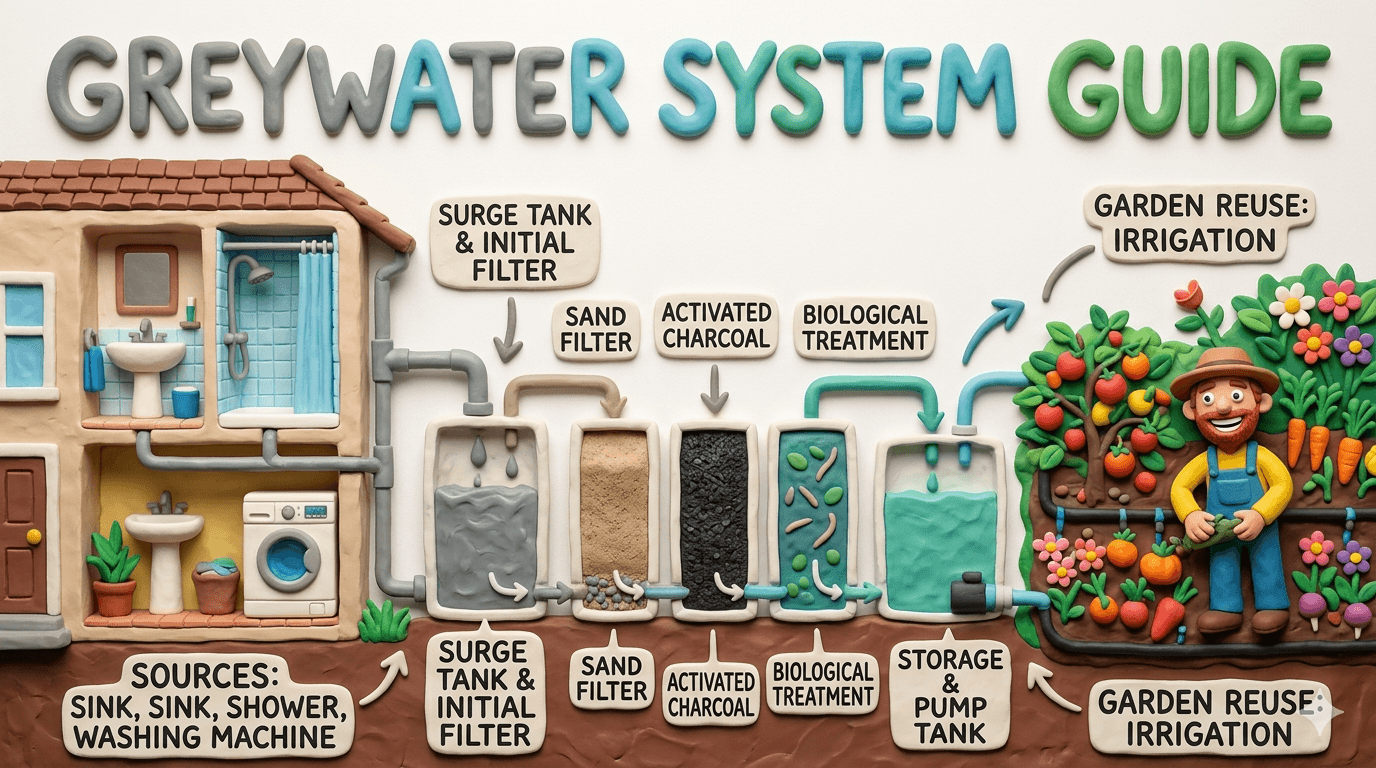
The system has three working parts. A diverter valve at the source that sends water either to the septic or to the landscape. A transport pipe that moves the water by gravity. And a discharge zone that releases the water under a few inches of mulch where roots, soil microbes, and plants finish the cleaning work.
A residential greywater system uses gravity from start to finish in most cases. The fixture sits above the pipe. The pipe sits above the mulch basin. The basin sits at the lowest point. No pumps, no electricity, no moving parts. That is why greywater fits the off grid mindset so well. The same gravity that runs your septic system can water your fruit trees for free.
Most plumbing codes call this an On Site Water Reuse System or simply a greywater system. The terms graywater and greywater mean the same thing, with the spelling depending on the code and the region.
Why Greywater Matters for an Off Grid Homestead
Greywater is the easiest water savings a homestead can capture. The average household sends 30 to 50 gallons per person per day down the drain as greywater. A family of four can reuse 120 to 200 gallons a day, every day, without any change in habits. That is a swimming pool every couple of months, poured straight onto plants you already wanted to grow.
It is also the easiest septic upgrade. Every gallon of greywater that bypasses the septic tank is a gallon that does not have to settle, separate, and soak into the drain field. A typical greywater install can drop septic loading by 50 to 70 percent. That means longer pump intervals, smaller drain field stress, and a system that lasts ten to fifteen years longer. Pair the greywater system with the septic system basics guide and you have the full waste picture for the property.
There is a real water security case as well. Off grid wells and rainwater tanks have a fixed capacity. A drought, a frozen pump, or a busy summer can drain a 5,000 gallon tank in two weeks. A greywater system stretches every gallon of fresh water twice. You drink it, bathe in it, wash with it, then grow food with it before it ever leaves the property.
And then there is the food. A mature fruit tree drinks 20 to 50 gallons a day in summer. A laundry to landscape system covers that demand from one wash load. The first time you taste a peach grown from your own shower water, the math stops feeling theoretical.
Greywater vs Blackwater vs Dark Greywater
Not all wastewater is the same. The fixtures in the house produce three categories of water, and only one category belongs in a landscape reuse system.
Greywater is the water from laundry, showers, bathtubs, and bathroom sinks. It carries soap, hair, skin cells, lint, and trace food residue. It is safe to use immediately on plants when handled under a few inches of mulch. Greywater is the only category this guide recommends for landscape reuse.
Blackwater is the water from toilets. It carries pathogens, solids, and the full bacterial load of human waste. Blackwater stays on the septic system or in a composting toilet. Never in the landscape.
Dark greywater is the water from kitchen sinks and dishwashers. It carries grease, food particles, and high biological load that clogs distribution lines and feeds harmful bacteria in the soil. Most codes route kitchen water to the septic system and not the greywater system. A small number of advanced systems with grease traps and pre filters can handle kitchen water, but the simple homestead setups in this guide skip it.
The clean rule is laundry, shower, and bathroom sink to the landscape. Everything else to the septic. Get that split right and the system runs for decades without a problem.
The Three Stages of Greywater Reuse
Every greywater system handles water in three stages. The names change by region, but the process is the same.
Stage one is source separation. A three way diverter valve at each fixture sends water either to the septic or to the greywater line. The valve is a manual lever or a quarter turn ball valve. Flip it one way and the water goes to the garden. Flip it the other and it goes to the septic. Source separation is the single most important step. It lets you bypass the system during a freeze, a sick household member, or a heavy bleach load.
Stage two is transport. Greywater leaves the diverter and flows by gravity through a one inch or one and a half inch pipe to the landscape. The pipe falls a quarter inch per foot at minimum so water never pools or stagnates inside it. A short run skips any storage, since storing greywater for more than 24 hours turns it into blackwater. Live water in, live water out.
Stage three is soil treatment. The pipe ends inside a mulch basin under three to six inches of wood chips. Greywater seeps out, soaks into the soil, and feeds the roots of fruit trees, perennials, or vines. Aerobic bacteria living in the mulch and topsoil consume the soaps, the skin cells, and the trace pathogens. By the time the water reaches the root zone, it is biologically clean and the nutrients are right where the plants want them.
Each stage matters. Skip the diverter and a sick household member dumps pathogens into the garden. Skip the slope on the pipe and water pools and goes anaerobic. Skip the mulch and you create a smelly pond. The three stages together make greywater work.
Laundry to Landscape Systems Explained
Laundry to landscape, often called L2L, is the cheapest, fastest, and most code friendly greywater system on the planet. It taps the drain hose from a standard washing machine and uses the machine's internal pump to push water out to the landscape through a small diameter pipe.
A typical L2L install includes a three way diverter valve next to the washer, a one inch flexible pipe running out through the wall, and a buried main line that branches to between five and twelve outlets. Each outlet sits inside a small mulch basin around a fruit tree or a heavy feeding plant. The whole system runs without any extra pump, since the washing machine is already pressurized.
The reason L2L is so popular is that most states allow it without a permit. California, Arizona, New Mexico, Texas, Oregon, and a dozen others have explicit codes that exempt L2L systems under a few simple rules. The standard rules are that the pipe stays above ground or shallowly buried, that no greywater pools on the surface, that the outlets sit in mulch basins, and that the diverter valve allows return to the septic. A weekend install can meet every one of those rules.
L2L works best when you have one to twelve trees within 50 feet of the washing machine. The pump can push water about 50 feet horizontally and 4 feet vertically. Past that, the flow slows and the last outlets dry out. A drip irrigation calculator helps you map the layout before cutting any pipe.
The build itself is four steps. Mount the diverter valve to the wall next to the washer. Drill a one inch hole through the exterior wall and run flexible pipe out. Trench a shallow main line to your trees. Cut a quarter inch hole in the pipe at each tree, push in a one inch fitting, and bury the outlet under six inches of wood chip mulch. Total parts cost runs $150 to $300 for an average home.
A finished L2L system handles 20 to 40 gallons per load. Two loads a week sends 40 to 80 gallons to the landscape, enough to keep three to six fruit trees deeply watered through a hot summer.
Branched Drain to Mulch Basin Systems Explained
A branched drain system handles the shower and bathroom sinks. Where L2L uses pump pressure, branched drain uses pure gravity. Every fitting is sized to split the flow evenly without any moving parts.
A branched drain starts at the P trap under a shower or sink, goes through a three way diverter valve, and runs out to the landscape in a buried one and a half inch or two inch ABS or PVC pipe. The pipe falls a quarter inch per foot. At each fork in the system, a special double ell fitting splits the flow into two equal streams. The forks continue until each end of the network drops into a mulch basin under a tree, a shrub, or a vine.
The key fitting is the flow splitter, also called a double ell or a Y. A clean horizontal split is what keeps every basin getting the same amount of water. A tilted or sloppy split sends all the water to one basin and starves the others. A four foot level on every fork is non negotiable.
Branched drain is the workhorse for a homestead because it handles the big volume. A four minute shower runs 12 to 25 gallons. A daily shower for two people sends 50 gallons to the landscape every day. Spread across four mulch basins, that is enough water to grow a small backyard orchard with no irrigation system at all.
The build is more involved than L2L. You cut into the existing drain line below the P trap, install the diverter valve, run two inch ABS through an exterior wall, and trench the buried network. Total parts cost runs $400 to $1,200 depending on how many basins and how long the main runs. Many homesteaders combine L2L and branched drain on the same property to capture every drop of greywater.
Branched drain works in any climate that does not deep freeze the upper foot of soil. In colder climates, the pipe is buried below the frost line and only the last few feet of each outlet sit shallow under deep mulch.
Sizing Your Greywater System
Sizing comes down to two numbers. How much greywater your house makes per day. And how much water your plants want. Match those two and the rest is plug and play.
Daily greywater output is driven by the fixtures and habits of the household. A typical breakdown for a family of four looks like this.
| Fixture | Gallons Per Use | Daily Output (Family of 4) |
|---|---|---|
| Washing machine | 15 to 40 per load | 30 to 80 gallons |
| Shower | 12 to 25 per shower | 50 to 100 gallons |
| Bathroom sink | 1 to 3 per use | 8 to 20 gallons |
| Bathtub | 30 to 50 per fill | 30 to 50 gallons (occasional) |
Total daily greywater for a four person homestead lands between 90 and 250 gallons. The wide range is mostly about habits. A short shower household with one wash load a week sits at the low end. A long shower family with three wash loads sits at the high end.
Plant demand is the other half of the math. Mature trees and heavy feeders set the upper bound.
| Plant Type | Water Demand (Summer) | Basin Size |
|---|---|---|
| Apple, peach, pear tree | 15 to 30 gallons per day | 4 to 6 foot diameter |
| Citrus tree | 15 to 25 gallons per day | 4 to 6 foot diameter |
| Berry bush | 3 to 6 gallons per day | 2 to 3 foot diameter |
| Grape vine | 5 to 10 gallons per day | 3 foot diameter |
| Perennial herb bed | 2 to 5 gallons per day | 2 foot diameter |
| Banana, papaya, heavy feeder | 20 to 40 gallons per day | 6 foot diameter |
Match the output to the demand. A 150 gallon per day homestead can support five to eight fruit trees through summer using greywater alone. A 250 gallon per day household can support a small orchard plus a berry hedge. Anything beyond that needs storage or supplemental irrigation.
Run your real numbers through a friendly calculator before you cut any pipe.
A common rookie mistake is sizing the basins too small. Five gallons a day in a one foot basin pools, smells, and kills the tree. The same five gallons in a four foot basin under six inches of mulch is invisible and good for the soil. Always go bigger on the basin than you think you need.
Greywater System Costs
Costs run a wide range depending on the system, the layout, and how much you do yourself. Here is a realistic breakdown of a combined laundry to landscape and branched drain install for a three bedroom homestead with five to eight mulch basins.
| Line Item | Realistic Spend |
|---|---|
| Three way diverter valves (2) | $80 to $200 |
| Laundry to landscape kit and tubing | $80 to $200 |
| Branched drain double ell fittings (4 to 8) | $40 to $120 |
| ABS or PVC main line pipe and fittings | $80 to $250 |
| Mulch basin excavation (DIY shovel) | $0 to $400 |
| Wood chip mulch (5 to 10 yards) | $100 to $400 |
| Inspection ports and clean outs | $40 to $120 |
| Permit fees (if applicable) | $0 to $400 |
| Designer or consultant (optional) | $0 to $800 |
A patient owner doing all the labor themselves can land near $400 to $700 for a combined system. A turnkey install by a licensed greywater installer usually lands $2,500 to $6,000. The DIY path is realistic for most homesteaders because the work is shallow trenching, ABS gluing, and shoveling mulch.
Here is the tier table for full installs by system type.
| Tier | What You Get | Typical Total |
|---|---|---|
| L2L only | Washing machine to 4 to 6 trees, DIY | $150 to $300 |
| L2L plus branched drain shower | One washer line plus one shower line, 6 to 10 basins, DIY | $500 to $1,000 |
| Whole house DIY | Washer plus all showers plus bathroom sinks, 8 to 14 basins | $800 to $1,800 |
| Whole house pro install | Licensed installer, permits, full design | $3,500 to $8,000 |
| Pumped system with sand filter | Sites without gravity, larger landscapes | $6,000 to $15,000 |
Annual operating cost is essentially zero on a gravity system. No power, no filters, no chemicals. You add a yard of fresh mulch to each basin once a year. That is the entire ongoing cost.
The payback math is fast. A typical L2L system saves 5,000 to 15,000 gallons of well or rain water a year. On a metered well or a trucked water budget, the system pays for itself inside two seasons. On an off grid rainwater system, the savings show up as longer dry season runway and less tank stress.
Soaps, Detergents, and What Goes Down the Drain
Greywater is only as plant friendly as the soaps you wash with. The good news is that switching to greywater safe products is cheap, easy, and rarely changes the way the laundry or shower feels.
Avoid sodium based products. Sodium is salt, and salt builds up in soil, kills beneficial microbes, and locks out nutrients. Skip detergents that list sodium chloride, sodium sulfate, or sodium carbonate near the top. Look for potassium based liquid detergents instead.
Avoid boron and borax. Boron is essential to plants in trace amounts and toxic in larger doses. Borax in the laundry pushes the soil past that line in a year. A box of borax in the basement is fine. A box in the wash is not.
Avoid bleach in normal loads. A small bleach load every few months is fine if you flip the diverter back to the septic for that load. Routine bleach in greywater kills the soil microbes that finish the cleaning.
Avoid antibacterial soaps. They do the same damage as bleach over time.
Look for these labels. Phosphate free, biodegradable, plant based, greywater safe. Brands like Oasis Biocompatible, Bio Pac, Ecos, and Dr Bronner's are the homestead standards. Most cost the same as conventional brands at any natural foods store.
The diverter is your safety net. Flip it back to the septic any time someone in the house is sick, doing a bleach load, or trying out a new product. That ten second habit prevents almost every problem a greywater system can hit.
Trace shampoo, conditioner, hair, lint, and skin cells are not a problem. The mulch and soil bacteria handle them within a few hours.
Legality, Permits, and Setbacks
The legal picture for greywater has changed dramatically in the last decade. Twenty years ago, most states were silent or hostile. Today, about half of the states have written codes that explicitly allow simple greywater systems with no permit, and the rest are slowly catching up.
The most permissive states for greywater are California, Arizona, New Mexico, Nevada, Texas, Oregon, and Washington. Each has a tier system that allows laundry to landscape and small branched drain installs without a permit, provided the system meets a short list of common sense rules.
The standard rules across most permissive states are these.
- No surface ponding of greywater. Discharge sits under at least two inches of mulch.
- No spray or aerosol irrigation. Drip or basin discharge only.
- A three way diverter sends water back to the septic when needed.
- Setbacks of 50 feet from drinking water wells, 5 feet from property lines, 100 feet from creeks or wetlands, and 2 feet from buildings.
- No greywater on root crops where edible parts touch soil. Trees, vines, and bushes are fine.
- No storage beyond 24 hours.
States with stricter codes still allow greywater under a permitted design, usually $200 to $500 in permit fees and a stamped plan from a designer.
The full state by state rules are a moving target. Walk through our state by state homesteading hub for the current rules where you live before any excavation starts. A 30 minute call to the county environmental health office before the first cut saves weeks of headache later.
The good news is that for most homesteaders, the rules read like a how to guide rather than a barrier. Build the system inside the standard rules and the legal layer takes care of itself.
A Realistic Maintenance Calendar
A gravity greywater system is one of the lowest maintenance things on the homestead. A 20 minute habit twice a year keeps it humming.
| Time of Year | Focus |
|---|---|
| January | Walk the buried main line on a warm day. Listen for trickling water that could mean a winter leak. |
| February | Check the diverter valve action. Flip it both ways and listen for clean flow on each route. |
| March | Pull lint from the laundry valve screen. Clean any visible debris from outlet fittings. |
| April | Top off each mulch basin with two to three inches of fresh wood chips before the growing season. |
| May | Walk every outlet during a wash load or a shower. Confirm water flows out and disappears within minutes. |
| June | Inspect each fruit tree for healthy leaves and steady growth. Vivid green means the system is working. |
| July | Flush the longest main line with a hose to clear summer biofilm. Five minutes of fresh water keeps the pipe clear. |
| August | Confirm no surface ponding on hot days. Add mulch to any basin showing wet soil at the surface. |
| September | Walk the trench lines for animal damage. Gophers and voles sometimes find buried pipe. |
| October | Pull lint screens again. Flush each main line one more time before winter. |
| November | In cold climates, insulate any exposed pipe near the diverter or near the wall penetration. |
| December | Log the year. Note any plant changes, basin moisture, and total wash loads. The log helps you tune output to demand next year. |
The two highest leverage tasks are the spring mulch top off and the twice yearly outlet walk. Together they prevent more problems than every other task combined.
A gravity branched drain system can run for ten to twenty years on this rhythm before any part needs replacement. The pipe is buried below UV. The fittings are passive plastic. The only consumable is the mulch, and a yard of wood chips a year is the entire ongoing cost.
What Kills a Greywater System
Most greywater failures trace back to a few preventable habits. Avoid these and the system runs for 20 years.
Surface ponding. A flat outlet that pools water rather than spreading it is the single most common failure. Pooled greywater goes anaerobic, smells, breeds mosquitoes, and kills the plant root zone. Always discharge under mulch.
Sodium and bleach in the wash. A regular bleach habit kills the soil bacteria and salts up the basin over a season. Salt locks out nutrients and the trees yellow.
Storage beyond 24 hours. A surge tank that holds water more than a day turns clean greywater into stinking blackwater. Run greywater live to the landscape with no storage.
Kitchen sink water in the line. Grease and food clog the pipe and feed harmful bacteria. Route kitchen water to the septic.
Tilted distribution boxes or flow splitters. A flow splitter even a quarter inch off level sends all the flow to one basin and starves the others. The starved basins do nothing. The loaded one floods.
Buried lint and hair clogs. A laundry line without a lint screen builds a thick mat in the first 90 degree elbow and slows flow over a few months. A simple in line screen prevents it.
Fruit tree roots in the pipe. A perforated buried pipe close to a thirsty tree fills with roots in a few seasons. Use a solid pipe to within a few feet of the basin and discharge into a mulch covered air gap instead.
Frozen surface pipe in winter. A shallow run that drops below freezing turns into an ice plug at the lowest point. Run pipe below frost or fully drain the system before deep cold.
Running greywater on root crops. Root crops like carrots and beets touch the soil where the greywater discharges and may pick up bacteria. Reserve greywater for fruit trees, vines, ornamentals, and grass.
Skipping the diverter for sick household days. A sick household member pours pathogens into the greywater that mulch and soil bacteria are not built to handle. Flip the diverter to the septic on sick days.
Most of these are habits, not hardware. Adjust the habits and the system lasts.
Cold Climate and Off Grid Power Considerations
Greywater and winter coexist well, but a cold climate rewards a little planning.
Burying the main line below frost depth is the single most important winter move. In Tennessee or the deep south, 12 inches is enough. In the northern Midwest or the mountain west, 36 to 48 inches is the minimum. The diverter and the wall penetration sit inside the conditioned envelope where they cannot freeze.
A snow blanket helps. Bare frozen ground over a mulch basin is colder than the same ground under two feet of snow. A few inches of wood chips plus a winter snow load keeps the discharge zone above freezing in most climates.
A vacation freeze is a real risk for a part time cabin. With no warm wastewater flowing, the pipe cools and ice can form at any low point. Either heat the cabin enough to keep small flows going, or fully winterize by flipping the diverter to the septic and blowing the lines out.
Power use is essentially zero. A pure gravity greywater system runs through any blackout indefinitely. The washing machine pump is part of the appliance load and does not change for L2L. The branched drain side uses no power at all.
Pumped systems are the exception. A site without enough fall for gravity may need a small effluent pump and a surge tank. A typical greywater pump runs 100 to 300 watts during a few minute cycle. On an off grid solar setup, the load is small but real. The battery bank sizing guide walks through how to plan for those loads in winter if you go that route.
A well planned off grid greywater system uses gravity wherever possible and reserves power only for the steps that truly need it.
Common Beginner Mistakes With Greywater Systems
Almost every new homesteader walks into the same set of traps. The good news is you can skip nearly all of them.
- Storing greywater overnight in a barrel. Stored greywater turns to blackwater inside 24 hours. Run it live or send it to the septic.
- Putting greywater on a root crop garden. Reserve greywater for trees, vines, and ornamentals. Run a separate fresh water drip line on the vegetable rows.
- Skipping the three way diverter. A diverter is the single cheapest part of the system and the most useful. Never wire greywater plumbing directly to a buried outlet.
- Using regular laundry detergent. Sodium and borax salt up the soil over a season. Switch to a greywater safe brand on day one.
- Pooling water at the outlet. Always discharge under at least two inches of mulch in a basin sized for the daily volume.
- Running the line on flat ground. A quarter inch of fall per foot is the minimum. Less than that and water sits, smells, and grows biofilm.
- Mixing kitchen water into the system. Grease and food clog the lines and feed harmful bacteria. Kitchen stays on the septic.
- Burying the pipe without inspection ports. A simple T with a cap every 50 feet lets you snake the line clear if anything ever does clog.
- Skipping the lint screen on the laundry line. A handful of lint a year is enough to choke off a quarter inch outlet. A two dollar screen prevents it.
- Forgetting the diverter on sick days. A stomach bug load in the greywater can stress the soil microbes. Flip the diverter and let the septic handle a couple of weeks.
Avoid those ten and your greywater system will run for as long as the trees stand.
Build Skills Alongside the Hardware
Hardware decays. Skills compound. The best greywater systems belong to homesteaders who understand them.
Map every outlet. A simple hand drawn site plan with the diverter location, each fork, and each basin pays for itself the first time you forget where the line runs. Keep a copy in the basement and a photo on your phone.
Learn the quarter inch per foot rule. A four foot level held against the pipe should show a half inch of drop end to end. The second you understand this number, you can lay any greywater run by eye.
Practice the diverter flip. Train every adult in the house to flip the diverter back to the septic for bleach loads, sick days, or any unusual product. Ten seconds of practice now prevents a week of trouble later.
Read the soil moisture. A finger pushed two inches into the mulch tells you if the basin is wet, damp, or dry. A wet basin in dry weather points to a leak or undersized basin. A dry basin during normal use points to a clog.
Keep a maintenance log. Mulch top off dates, valve flips, outlet walks, and any unusual smells. Two minutes a month for a year produces a record that quickly shows the rhythm of the system.
Sharpen the soap habit. Once a greywater safe detergent is in the laundry room, the system runs itself. The hardest part is the first shopping trip.
A working greywater system is a small set of skills. Each one you add makes the next one easier.
You Can Start This Week
The biggest trap new homesteaders fall into is feeling stuck because the system seems hidden behind plumbing and codes. The truth is you can take the first step in an afternoon.
Pick one thing this week. Switch to a greywater safe laundry detergent on your next shopping trip. Or pull out a tape measure and pace off the distance from your washing machine to the nearest fruit tree. The first day you can see the path the water wants to take, the rest of the system stops feeling like a project and starts feeling like a weekend build.
When you are ready for more, our off grid hub gathers every water, power, waste, and heating guide we have. Pair this article with our septic system basics guide to see the full waste picture, or our water filtration guide to round out the supply side of the same plumbing.
For the broader off grid picture, lean on our off grid living for beginners pillar. For the wider homesteading roadmap, our homesteading for beginners pillar lays out the full sequence. For the legal details in your state, our state by state homesteading hub covers greywater rules, set backs, and water rights across all 50 states.
You can do this. We are glad you are here.
Frequently Asked Questions
Greywater is safe for fruit trees, vines, berry bushes, and ornamentals where the edible part never touches the soil. Reserve it for those plants. Run a separate fresh water drip line on root crops like carrots, beets, and potatoes, and on leafy greens that touch the ground. The risk on root crops is minor with a properly mulched system, but the cost of a separate drip line is so low that most homesteaders keep the two waters separate as a clean rule.
A do it yourself laundry to landscape system runs $150 to $300 in parts. A full home greywater install including the washer, the showers, and the bathroom sinks runs $500 to $1,800 in parts. A licensed installer with permits and stamped design runs $3,500 to $8,000. Annual operating cost is essentially zero on a gravity system other than one yard of wood chip mulch each spring.
It depends on the state. California, Arizona, New Mexico, Texas, Oregon, Nevada, and Washington allow simple laundry to landscape and small branched drain systems with no permit, provided the install meets standard rules around mulch cover, setbacks, and a diverter valve. About half of the remaining states require a permit for any greywater install, usually $200 to $500. Always call the county environmental health office before the first cut.
Not for more than 24 hours. Stored greywater turns anaerobic, develops the bacteria load of blackwater, and starts to smell within a day. Homestead greywater systems are designed to run live, with each load or each shower flowing straight to the landscape and out within an hour. If a site truly needs storage, the answer is usually a pumped system with treatment, not a passive barrel.
A properly built greywater system does not smell. Greywater discharged under three to six inches of wood chip mulch is broken down by aerobic bacteria inside the mulch and the top inch of soil. The whole process happens out of sight. Smells point to a problem like surface ponding, kitchen water in the line, storage beyond 24 hours, or a clogged outlet. Each of those has an easy fix.
Yes, for any plant friendly system. Conventional detergents are loaded with sodium and sometimes boron that salt up the soil and kill beneficial microbes over a season. Switch to a phosphate free, biodegradable, plant based detergent that explicitly lists greywater safe or graywater safe on the label. Brands like Oasis Biocompatible, Ecos, Bio Pac, and Dr Bronner's are the standard. Most cost the same as conventional detergent at any natural foods store.
Yes, in cold climates the buried pipe can freeze if it runs above the frost line or if no warm flow moves through it for days. The fix is two layers. Bury the main line below the local frost depth, which ranges from 12 inches in the south to 48 inches in the northern Midwest. Then keep the diverter accessible inside the conditioned envelope so you can switch to the septic during a hard freeze or a vacation. A snow blanket over the basins also helps.
Yes, and that is a common off grid pairing. The composting toilet handles blackwater. The greywater system handles the laundry, shower, and bathroom sink. Together they take the entire wastewater load off the septic system, which means you may not need a conventional drain field at all. Many states still require a small septic tank or holding tank for emergencies, but the day to day load is zero. Always confirm the legality of the pairing with the county health office before building.

Cole
Founder & Lead Researcher
Cole is the founder of Plan Your Homestead. He works in clinical research and brings a research-first lens to every guide on the site, drawing on a long family line of farmers for grounded, practical perspective.
More in Off-Grid
More articles coming soon. Check back for new off-grid content.