You walk the property line one more time before the deposit clears. The land is everything you wanted. Then you remember the catch. The nearest power pole is a quarter mile away, and the utility wants nineteen thousand dollars to run a line. You have a decision to make, and you have to make it before the first frame goes up.
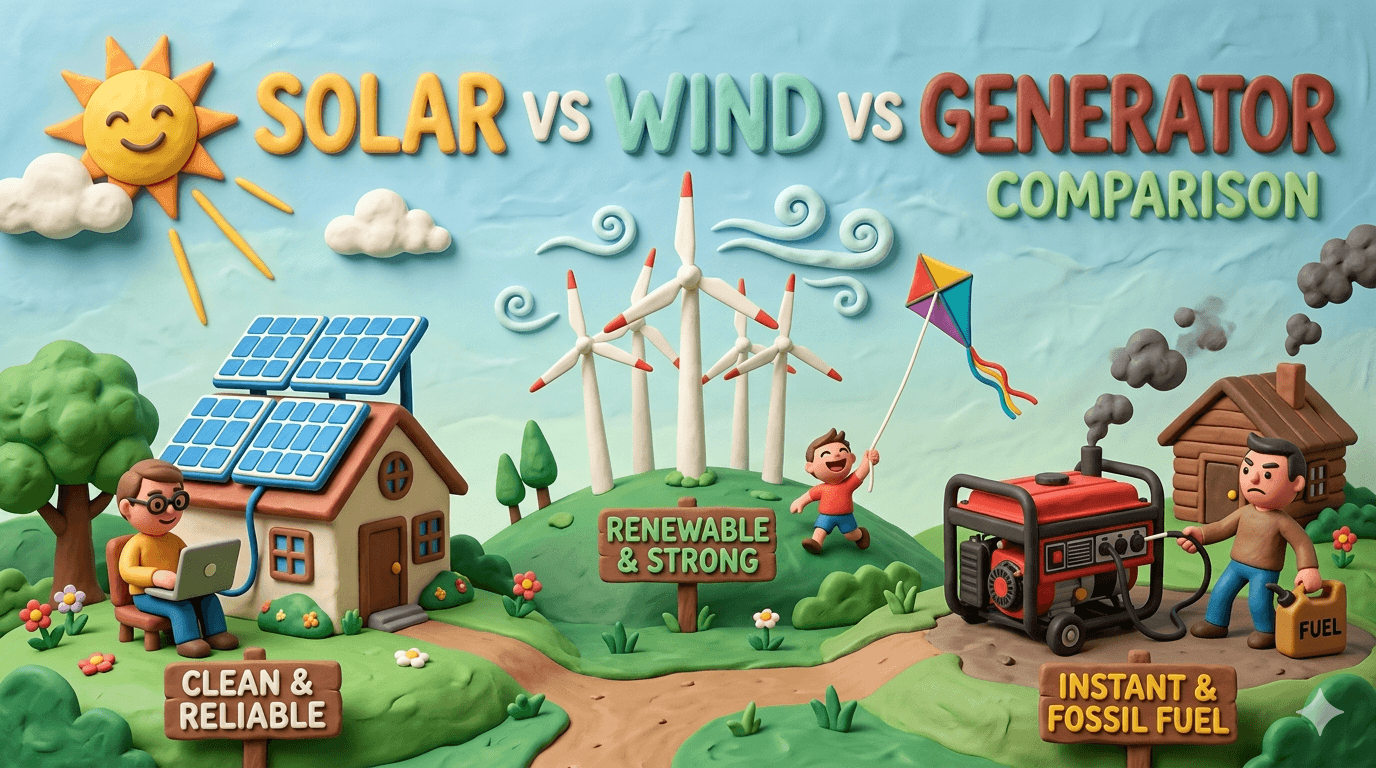
Off grid power comes down to three real choices and a fourth option that quietly wins more often than any of them. Solar pulls watts out of the sky. Wind pulls them out of the air. A generator pulls them out of a fuel tank. The fourth option, the one most experienced homesteaders settle into, is a hybrid system that mixes two or three of those sources so no single weakness can take the whole house down.
This guide walks through the honest tradeoffs. Real 2026 costs. Real maintenance. Real watt hours per dollar. Real reasons each source wins, and real reasons each one fails. By the end you will know which combination fits your land, your budget, and your stomach for fiddling with hardware. Grab a notebook. Let us walk through it together.
What Off Grid Power Actually Means
Off grid means your home makes and stores its own electricity. There is no utility meter. There is no monthly bill. When the lights come on, it is because something on your property made the watts and something on your property held onto them.
That independence comes from one of three primary sources. Solar photovoltaic panels turn sunlight into direct current electricity. A small wind turbine turns moving air into the same direct current. A fuel powered generator burns gasoline, propane, or diesel to spin an alternator and produce alternating current on demand. All three feed a battery bank and an inverter, and the inverter sends usable household power into your walls.
You can run a homestead on any one of them. Most homesteaders eventually run on a combination. The right combination depends on what your land actually does for you, not on what looked good in a YouTube video.
Why the Choice Matters More Than People Think
This is the most expensive decision you will make in the first year on the land, and the one that is hardest to undo later.
A solar system that is too small forces you into a generator habit you never planned for. A wind turbine you bought because the wind felt strong on the day you signed papers can sit idle for nine months a year. A whole house propane standby generator can quietly burn fifteen thousand dollars of fuel over a decade if the rest of the system is underbuilt.
Over a twenty year horizon, the cheapest off grid power setup and the most expensive setup are often forty thousand dollars apart for the same household. The good news is that the cheapest setup is also usually the most pleasant to live with. Fewer fuel runs. Less noise. Lower stress when the weather turns. The math and the lifestyle line up, once you understand the tradeoffs.
Off Grid Solar Power: The Modern Default
Solar is the default answer for almost every off grid home built in 2026. The hardware has dropped to a tenth of its 2010 price. Lithium iron phosphate batteries have replaced the heavy lead acid bank that used to scare everyone off. Most properties with a clear southern view can run a full household on solar alone.
A working solar system has four parts. The panels make direct current when the sun hits them. A charge controller manages the flow into the batteries so they do not overcharge. The battery bank stores the day's harvest for use at night and during cloudy weeks. An inverter turns the stored direct current into the 120 or 240 volt alternating current your appliances expect. For the deeper walkthrough of every component, see our beginner's guide to off grid solar power.
Real 2026 costs for a 6 kilowatt hour per day household, which is enough for a small family with a propane stove, propane hot water, and a chest freezer, run about 12,000 to 22,000 dollars installed. The breakdown looks roughly like this. Panels are 0.30 to 0.50 dollars per watt at the wholesale level, so a 4,000 watt array runs 1,500 to 2,500 dollars. A 15 kilowatt hour lithium battery bank runs 6,000 to 10,000 dollars. A solar charge controller and a quality inverter together run 1,500 to 3,500 dollars. Racking, wire, breakers, conduit, and a transfer switch run 1,500 to 2,500 dollars. Labor, if you hire it out, doubles the soft costs.
Sun hours decide whether the same system runs comfortably or struggles. Phoenix gets 6.5 peak sun hours a day in winter. Seattle gets 1.5. A homestead in Tennessee or Missouri lands in the middle at about 3.5 in December. Use the free PVWatts calculator from the National Renewable Energy Laboratory to look up your zip code before you size anything.
The honest weaknesses are real. Solar makes almost no power during a week of dense overcast. Snow on the panels stops production until you sweep it off. Short December days in the northern third of the country mean a two day storm can drain a normal battery bank to its floor. The upfront cost is the biggest barrier for most homesteaders, since you pay for the whole next twenty years of electricity in the first month.
Lifetime is the quiet superpower. Quality panels carry 25 year warranties and run for 35 to 40 years at slowly fading output. A lithium iron phosphate battery is rated for 6,000 cycles, which is about 16 years of daily use. The inverter is the shortest lived major component at 10 to 15 years. Once installed, a solar system rewards you with almost no maintenance. Wipe the panels twice a year. Watch the battery monitor. That is most of it.
Tip
Before you price a single panel, run your address through the free PVWatts calculator at pvwatts.nrel.gov. It tells you the average kilowatt hours per day your roof or yard will produce in each month of the year, using actual local weather data. Sizing a solar system without that number is guessing. The five minutes of input pays for itself a hundred times over.
Wind Power for the Homestead
Wind looks great on paper. The math is simple. A 12 mile per hour average wind on a 1 kilowatt turbine produces about 2,500 kilowatt hours a year, almost half a small household's annual load. The reality is that most homesteads in North America do not have those wind conditions, and the ones that do still face a hard maintenance reality.
A small wind turbine is a mechanical device with bearings, brushes, blades, and a tail. Everything that spins also wears. Most small turbines need an inspection once a year and a serious overhaul every five to seven years. The blades sit 30 to 100 feet in the air on a tower that itself has guy wires, anchors, and a foundation. The closest a small turbine ever comes to maintenance free is when you stop using it.
Cost is the second hurdle. A real residential wind turbine in the 1 to 5 kilowatt class runs 5,000 to 15,000 dollars for the head unit. The tower, the foundation, the guy wires, the controller, and the installation add another 10,000 to 25,000 dollars. A complete 3 kilowatt installation lands between 15,000 and 35,000 dollars before any solar or batteries.
Siting is the third hurdle, and the one most people underestimate. Useful wind power lives above the tree line and any nearby building. The rule of thumb is that the bottom of the turbine blade should sit at least 30 feet above anything within 500 feet. That usually means a 60 to 100 foot tower. A short tower in a sheltered yard generates a small fraction of the rated output and wears the bearings out fast.
The honest sweet spot for residential wind is a Class 3 or better site with an annual average wind speed of 12 miles per hour or higher, measured at the planned hub height. The National Renewable Energy Laboratory publishes interactive wind maps at the windexchange.energy.gov site that show you exactly where those conditions live. Most of the Great Plains qualifies. Most of the Southeast does not. Coastal ridges, high desert, and open prairie often qualify. Wooded valleys almost never do.
Noise is the lived experience nobody warns you about. A small wind turbine in a steady 20 mile per hour wind sounds like a refrigerator running in the next room. Most owners get used to it. A few never do. Talk to your spouse before the tower goes up.
If your land sits in a real wind corridor, a turbine can earn its keep and pair beautifully with solar, since wind often blows hardest in the same season the sun gets short. If you live anywhere else, the same dollars almost always buy more reliable power as additional solar panels and a larger battery bank.
Generators: Gas, Propane, and Diesel
A generator is the muscle car of off grid power. It is loud. It burns fuel. It comes alive in seconds and delivers full load instantly. For backup duty and for short bursts of heavy work, nothing else competes.
Three fuel types dominate. Gasoline generators are the cheapest to buy and the most common as portable units. A reliable 5,000 to 8,000 watt portable runs 600 to 1,500 dollars. The downside is that gas goes stale in six months without a stabilizer, and the engine needs frequent oil changes. Propane generators cost slightly more but burn cleanly, store fuel indefinitely, and pair with a large yard tank that can sit for years between deliveries. Diesel generators are the heaviest duty option. They cost more upfront, last longer per hour, and burn slightly more efficiently, but the fuel is harder to source rurally and the engines are noisier.
The cost per kilowatt hour delivered is where the truth comes out. A portable gasoline generator running at half load uses about 0.6 gallons per hour to make roughly 3 kilowatt hours of electricity. At 3.50 dollars per gallon, that is 0.70 dollars per kilowatt hour. Propane is a little cheaper at about 0.50 per kilowatt hour in 2026. Grid power, for comparison, averages 0.16. Solar amortized over 20 years lands at 0.08 to 0.15. A generator delivers the most expensive electricity by a wide margin.
Lifetime hours is the other number that surprises people. A portable gas generator is rated for 1,000 to 2,000 hours of total runtime. A residential standby propane generator runs 3,000 to 5,000 hours. A premium diesel unit can hit 20,000 hours. Run a 5,000 watt gas portable as your primary power source and you will replace it inside two years.
A standby generator is the right tool for backup duty. A 12 to 22 kilowatt propane standby unit with an automatic transfer switch costs 4,500 to 9,500 dollars installed. It sits next to the house, watches the inverter, and starts itself when the battery bank hits a low set point. You can be at work or asleep when the freezer needs power, and the generator handles it without a human.
A portable generator is the right tool for an emergency closet. Pull it out for a long storm, a winter battery dip, or the rare 48 hour stretch when the sun and the wind both fail. Plug a few critical circuits into it directly, run it for two or three hours to recharge the bank, then put it back in the shed.
Generator only setups exist but are rare for permanent homesteads. The fuel cost adds up. The noise is constant. The maintenance never stops. For a hunting cabin used six weekends a year, a portable generator alone can pencil out. For a full time residence, it almost never does.
Head to Head Cost Table
Here are the real 2026 numbers for a 6 kilowatt hour per day household. That is enough for lights, a fridge, a freezer, a well pump, a laptop, a router, and modest entertainment, assuming the stove, hot water, and clothes dryer run on propane.
| Cost Category | Solar Only | Wind Only | Generator Only |
|---|---|---|---|
| Hardware capital cost | $12,000 to $22,000 | $15,000 to $35,000 | $4,500 to $9,500 |
| Installation labor | $0 DIY to $8,000 pro | $3,000 to $8,000 | $1,500 to $3,500 |
| Annual fuel cost | $0 | $0 | $2,400 to $4,800 |
| Annual maintenance | $50 to $150 | $400 to $1,200 | $400 to $800 |
| Major component replacement, 20 years | $4,000 inverter | $5,000 to $10,000 overhaul | $8,000 to $15,000 unit replacement |
| 20 year total cost of ownership | $18,000 to $36,000 | $35,000 to $70,000 | $58,000 to $115,000 |
| Cost per kilowatt hour delivered | $0.08 to $0.15 | $0.20 to $0.40 | $0.50 to $0.90 |
A solar only setup is the cheapest path to a fully powered home over any honest time horizon. Wind only sits in the middle on cost but only works on the right land. Generator only is the most expensive way to run a permanent home, even before you count the noise and the fuel runs.
Head to Head Reliability and Lifestyle Table
Dollars matter. So does daily life. Here is the honest comparison of what each option feels like to live with.
| Lifestyle Factor | Solar | Wind | Generator |
|---|---|---|---|
| Noise | Silent | Constant low hum | Loud, 65 to 80 dB |
| Daily attention required | Almost none | Weekly check | Daily during use |
| Weather sensitivity | Cloudy weeks hurt | Calm days hurt | None |
| Fuel dependence | None | None | Total |
| Failure mode | Battery slowly drains | Bearings or tower issue | Engine seize or fuel out |
| Scalability | Easy, add panels | Hard, tower limit | Easy, swap unit |
| Spouse and neighbor friendly | Yes | Sometimes | Often not |
| Time to install | 1 to 4 weeks | 2 to 8 weeks | 1 day to 1 week |
| Useful life | 20 to 35 years | 10 to 20 years | 5 to 15 years |
| Long power outage tolerance | High with batteries | Variable | High while fuel lasts |
The pattern that emerges is the same one the cost table showed. Solar is the calm default. Wind is conditional on the right land. A generator is the right backup but a tough primary.
Hybrid Systems: Why Most Real Homesteads Pick Two or Three
Almost every off grid homestead that has been running smoothly for more than five years uses a hybrid setup. The reason is simple. Each source has a weakness, and pairing two of them covers each other's gaps.
The dominant 2026 hybrid is solar primary plus a propane standby generator. Solar handles 95 percent of the year. The generator covers the long cloudy stretches in winter, the surprise multi day storm, and the days you run an unusual heavy load like a welder or a well pump on a deep cycle pull. A homestead with this setup might burn 30 to 60 gallons of propane a year on backup duty, costing 100 to 200 dollars total. The peace of mind is worth the line item.
A second common hybrid adds wind to the mix on the right land. Solar handles the sunny summer. Wind picks up the dark, windy winter when solar production drops. A propane generator handles the rare gap when both fail at once. This setup is the gold standard on the Great Plains, on coastal ridges, and on high desert sites where wind blows reliably for half the year.
A third hybrid is wind plus generator on a property with strong wind and weak winter sun. Solar may still be present as a small array for daytime peaks, but the workhorses are the turbine and the propane backup. This is less common but real, especially in Alaska, parts of Wyoming, and the windier corners of the Dakotas.
Sample sizing for the dominant solar plus generator hybrid on the 6 kilowatt hour per day household looks like this. A 4,000 watt panel array. A 15 kilowatt hour lithium battery bank. A 6,000 watt pure sine inverter. A 14 kilowatt propane standby generator with an automatic transfer switch. A 500 gallon propane tank shared with the heater and the stove. Total installed cost lands between 22,000 and 35,000 dollars depending on labor and brand.
That setup runs a typical household with very little daily thought. The solar makes the watts. The batteries hold them. The generator wakes up two or three times a winter and goes back to sleep. You will spend more time chopping firewood for the wood stove than tending the power system.
A Simple Decision Framework
Five honest questions take you from confused to certain in about ten minutes.
First, what are your peak sun hours in December? Look it up on PVWatts. Less than 2.5 means solar alone will struggle in winter. Between 2.5 and 4.5 is the heartland of solar plus generator hybrid territory. More than 4.5 makes solar dominant year round.
Second, what is your average wind speed at 80 feet? Check the National Renewable Energy Laboratory wind map. Less than 10 miles per hour means skip wind entirely. Between 10 and 12 makes wind a maybe, worth a real anemometer test for a year before buying. Above 12 makes wind a strong second source.
Third, how much capital can you spend in year one? Less than 8,000 dollars means start with a portable generator and a small starter solar kit, then expand. Between 8,000 and 20,000 means a complete solar plus light generator setup. More than 25,000 opens up wind and a full standby generator.
Fourth, how often will you be on the property? A weekend cabin tolerates a generator only setup that a full time residence cannot. A full time home demands the lowest possible daily friction, which means solar dominant.
Fifth, how far is propane delivery? A 500 gallon tank delivery within 30 miles makes propane the easy backup fuel. If propane delivery is rare or expensive, diesel may be a better generator fuel, or solar plus a larger battery bank may be the right answer to avoid generators entirely.
The answer almost always lands in the same place. Solar primary, propane generator backup, optional wind only if the land truly supports it.
For the battery side of the equation, see our guide to sizing your battery bank for winter. The right battery size is what lets a solar dominant system carry you through cloudy weeks without leaning on the generator.
Sizing Each Option for a Real Homestead
Here is the worked example for the same 6 kilowatt hour per day household, sized four ways so you can see the tradeoffs side by side.
Solar only. 5,000 watts of panel, 20 kilowatt hours of lithium battery, an 8,000 watt inverter, and a 60 amp charge controller. The oversized battery covers a four day cloudy stretch. The oversized array refills the bank quickly when the sun returns. Total installed cost around 22,000 dollars. Best for sunny states like Arizona, New Mexico, Colorado, Texas, and most of the Southwest.
Wind only. A 3 kilowatt turbine on an 80 foot tower, a 15 kilowatt hour lithium battery for low wind days, a charge controller rated for wind, and the same inverter. Total installed cost around 30,000 dollars. Best only for properties with a year round 12 mph average wind, which is rare outside the open plains and certain coastal sites.
Generator only. A 14 kilowatt propane standby generator, a 1,000 gallon propane tank, a 5 kilowatt hour battery to handle short bursts, and the same inverter. Total installed cost around 11,000 dollars. Annual fuel cost runs 3,500 dollars. Twenty year total cost of ownership lands around 85,000 dollars. Best for weekend cabins used less than 50 days a year, or as a temporary stopgap during a multi year build.
Solar primary plus generator backup. 4,000 watts of panel, 15 kilowatt hours of battery, a 6,000 watt inverter, a 12 kilowatt propane standby generator, and a 500 gallon tank. Total installed cost around 28,000 dollars. Annual fuel cost runs under 200 dollars. Twenty year total cost of ownership lands around 38,000 dollars. Best for the vast majority of off grid homesteads in the lower 48.
The hybrid wins almost every comparison. Slightly more upfront than solar only. Dramatically less than generator only over time. Vastly more reliable than either alone.
Common Beginner Mistakes
Most off grid power regrets trace back to the same handful of mistakes. Skip these and the system runs reliably for decades.
- Sizing for August instead of December. Summer solar production is double winter production in most of the country. A system that feels generous in August will starve in January. Always size to your worst month.
- Buying a turbine on a windy day. A single windy week is not data. Mount a small anemometer at the planned hub height for a full year before spending money on a turbine.
- Underbuilding the battery to save money. A small battery on a big solar array still runs out in three cloudy days. Battery capacity is what lets a solar system stop using the generator.
- Using a gas portable as primary power. Gasoline engines wear out in 1,000 to 2,000 hours. Run one four hours a day and it is dead inside two years.
- Skipping the propane tank size upgrade. A 100 gallon tank refills every winter. A 500 gallon tank gets refilled once every two or three years. The bigger tank costs 1,500 dollars and saves years of fuel delivery hassle.
- Ignoring the inverter rating. A 3,000 watt inverter cannot start a well pump that pulls 6,000 watts at startup. Match the inverter to the heaviest single load you plan to run, with 50 percent headroom.
- Mounting solar panels under tree shade. Even partial shade on one panel can cut the whole string's output by 60 percent. Find the clearing first, then plan the array.
- Forgetting the snow load on panels. Heavy wet snow can stay on a low angle array for a full week. A 30 to 45 degree tilt sheds snow most days on its own.
- No power monitoring. You cannot manage what you cannot measure. A 200 dollar battery monitor pays for itself the first month by catching a bad habit before the bank goes dead.
- Treating the generator as decoration. A standby generator that has not run in six months will fail when you need it. Set the controller to auto exercise itself for 15 minutes once a week.
Avoid those ten and your power system outlasts most marriages.
Warning
The most expensive power mistake is going generator only because solar feels complicated. A generator only setup for a full time home in 2026 will cost you 50,000 to 90,000 dollars more over 20 years than a solar plus generator hybrid. Solar is not that complicated. A four panel starter kit is easier to install than a dishwasher, and the wiring lessons scale to any size you want later. Start small. Add over time. Skip the regret of running a 14 kilowatt generator at 2 AM in February because the battery is dead.
A 30 Day Plan To Choose Your Power Source
You do not need to figure this out in a weekend. You do need to take action so the build can start. Here is the simple sequence that takes a new landowner from confusion to a finalized power plan in 30 days.
Week 1. Run your address through the PVWatts calculator and write down your December peak sun hours. Pull the National Renewable Energy Laboratory wind map for your county and write down your 80 foot wind speed. List every appliance you plan to run, multiply each by hours per day, and total it up. That number is your daily load in watt hours.
Week 2. Get two off grid solar quotes. One from a regional installer. One from a DIY supplier like Signature Solar or Current Connected. Compare hardware, scope, and labor. Add 20 percent for unexpected costs.
Week 3. If your wind data looks promising, schedule a 12 month anemometer rental from a local extension office or a turbine dealer. If not, lock in the solar plus generator hybrid path. Get two propane standby generator quotes. Get one propane tank delivery quote.
Week 4. Decide on the final system size, place the deposit, and schedule the install. Pull permits with the county building office if required. Order any DIY components with the longest lead time first.
By day 30, you should have a finalized scope, a budget, an install date, and a clear picture of what your homestead will run on for the next twenty years.
Where To Go From Here
Power is one system on a much bigger property. Pair the right power plan with the right water, heat, and connectivity plan and the homestead comes together.
For the deeper solar walkthrough, lean on our beginner's guide to off grid solar power. For the battery side, our sizing battery bank guide is the next read after this one. For the off grid life as a whole, our off grid living for beginners pillar ties power to water, heat, and waste in a single sequence.
For heat, see our heating with wood guide and our rocket mass heater guide. For staying connected, our off grid internet guide covers the routers and dishes that share your power budget. For the wider homesteading roadmap, our homesteading for beginners pillar lays out the full sequence. For the local rules where you live, our state by state homesteading hub covers permits, utilities, and renewable energy incentives across all 50 states.
When you are ready to size the panels and battery, our solar sizing calculator walks you through the math in about five minutes.
The road to a self powered homestead starts with one good comparison and one good plan. You already have the comparison. The plan is a weekend away.
You can do this. We are glad you are here.
Frequently Asked Questions
For a full time off grid home, yes, in almost every case. Solar delivers electricity at 0.08 to 0.15 dollars per kilowatt hour over a 20 year lifetime, while a propane generator delivers the same kilowatt hour for 0.50 to 0.70 dollars. Solar runs silently with almost no daily attention. A generator burns fuel, makes noise, and needs maintenance every season. The honest answer is that you want both. Solar as the primary source, a propane standby generator as the backup. That hybrid is the cheapest and most reliable setup on the market in 2026.
Only on the right land. A small residential wind turbine needs an average wind speed of 12 miles per hour or more at the planned hub height to pencil out. That qualifies most of the Great Plains, parts of coastal ridges, and some high desert sites. It disqualifies most of the Southeast, most of the Midwest, and almost any wooded valley. Check the National Renewable Energy Laboratory wind map at windexchange.energy.gov for your county before you spend a dollar. If the map shows a Class 3 or better site, wind can pair beautifully with solar. If not, the same money buys more reliable power as additional solar panels.
Over a full 20 year horizon, solar with a small propane generator backup is the cheapest reliable answer for almost any household. The upfront cost runs 22,000 to 35,000 dollars for a 6 kilowatt hour per day home, and the total 20 year cost of ownership lands around 38,000 dollars. A generator only setup looks cheap in year one at around 11,000 dollars but ends up at 70,000 to 100,000 dollars over 20 years once you count fuel and replacements. The cheapest day one option is a portable generator paired with a small starter solar kit, around 6,000 dollars, with the plan to expand the solar each year.
Modern photovoltaic panels carry 25 year power warranties and physically last 35 to 40 years at slowly fading output. After 25 years a panel typically still produces 80 to 85 percent of its original rated wattage. The shortest lived major component of an off grid solar system is actually the inverter, which runs 10 to 15 years. Lithium iron phosphate batteries last 12 to 16 years at typical homestead cycling. Plan on one inverter replacement and one battery replacement over the life of the panels.
Strictly speaking, no, if you oversize the solar array and the battery bank enough to ride out the worst cloudy stretches of winter. In practice, almost every full time off grid home keeps a generator as a quiet insurance policy. A 12 to 22 kilowatt propane standby generator with an automatic transfer switch costs 4,500 to 9,500 dollars installed and uses 30 to 60 gallons of propane a year in backup duty. That is roughly 100 to 200 dollars of fuel annually for a system that lets you sleep through a January storm. It is some of the best value insurance on a homestead.
An average wind speed of 12 miles per hour measured at the planned hub height is the working threshold. Below 10 mph average, a small turbine produces almost nothing and the bearings wear out faster than the energy pays for. Between 10 and 12 mph is a maybe, and the only honest way to know is to mount an anemometer at hub height for a full year before buying anything. Above 12 mph, a turbine can produce 2,000 to 5,000 kilowatt hours a year and earn its keep. Tower height matters as much as wind speed. The bottom of the blade should sit at least 30 feet above anything within 500 feet.
Yes, a 14 to 22 kilowatt propane standby generator can run a typical American home, including air conditioning, well pump, and electric appliances. The question is whether you want to pay for that. Running a propane generator as the primary power source on a full time home costs 3,500 to 6,000 dollars a year in fuel alone, plus 400 to 800 dollars in maintenance, plus the cost of replacing the generator every 8 to 12 years. Most homesteaders use the generator only as backup to a solar system, which drops the annual fuel cost to under 200 dollars. The generator handles the rare 48 to 72 hour stretch when the sun and the wind both fail.
A solar primary plus propane generator hybrid wins in almost every cold climate, including Maine, Minnesota, Montana, and northern New England. Solar still works in winter, just at lower output. A correctly sized array can cover 60 to 80 percent of a cold climate household's annual load. The generator covers the short December days and the long arctic storms. In the windiest cold sites, a small turbine can be added as a third source, since wind often blows hardest in the same months solar drops. Lithium iron phosphate batteries should live inside the heated envelope of the home, since lithium chemistry will not charge below 32 degrees Fahrenheit.
For a 6 kilowatt hour per day household, the cheapest complete off grid power system runs about 11,000 dollars (generator only, not recommended long term), the most common runs 22,000 to 35,000 dollars (solar plus generator hybrid), and a premium setup with wind plus solar plus generator can reach 50,000 to 70,000 dollars. Larger households with electric heat, electric hot water, or shop loads need to double those numbers. Most full time off grid families in 2026 are spending 25,000 to 40,000 dollars total on the entire power system. That is roughly the same as one quarter of the cost of running a utility line a half mile or more.
Yes, and that is the most common path for first year homesteaders. Start with a portable propane or gas generator for 800 to 1,500 dollars, add a small 1,000 to 2,000 watt solar starter kit with a 5 kilowatt hour lithium battery for 4,000 to 6,000 dollars, and live with that combination through the first winter. As you learn your real daily load, expand the panel array and the battery bank in stages. By year three, most homesteads have grown into a full solar primary system with the generator demoted to backup. The total spent is often the same as a one shot install, but the cash flow is far easier to absorb.

Cole
Founder & Lead Researcher
Cole is the founder of Plan Your Homestead. He works in clinical research and brings a research-first lens to every guide on the site, drawing on a long family line of farmers for grounded, practical perspective.
More in Off-Grid
More articles coming soon. Check back for new off-grid content.