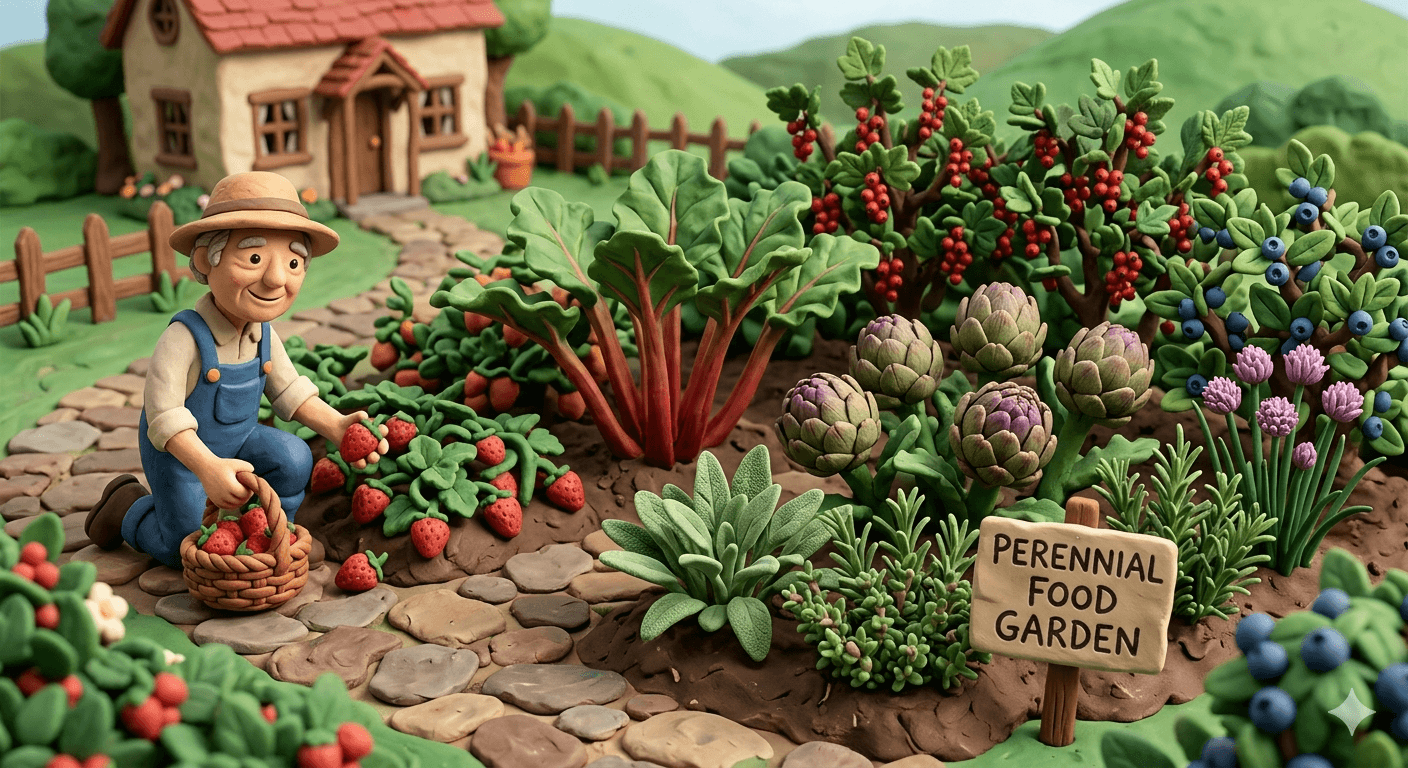
Annual gardens reset every spring. You till, you sow, you weed, you water, you harvest, and then you tear it all out and start over the next year. After a few seasons of that grind, most homesteaders start looking for crops that come back on their own. That is what a perennial food garden is. You plant it once, and the same plants feed you for ten, twenty, even thirty years.
A mature perennial food garden produces berries, fruit, nuts, perennial vegetables, and herbs without yearly replanting. The soil never gets tilled. The roots dig deep and pull water from places annual roots cannot reach. The plants get tougher and more productive every season instead of fading at the end of the year. Most of the labor comes in the first two years, and after that you mostly walk around with a basket.
This guide walks you through the whole system. You will learn what a perennial food garden actually is, why it belongs on every homestead, the four layers that make it work, the twelve best perennial food crops for beginners, how to design your layout, how to build soil that feeds long lived crops, what to expect in the first three years, and the common mistakes that sink a new perennial garden. By the end you will have a real plan you can put in the ground this fall or next spring.
What a Perennial Food Garden Actually Is
A perennial food garden is a planted system of edible plants that live for more than two years and return on their own without replanting. The plants are the same kind you might see in a landscape design. Trees, shrubs, vines, and clumping herbaceous plants. The difference is that everything in the garden is chosen because it produces food.
This is not the same thing as a vegetable garden with a few perennials tucked in. It is also not the same as an ornamental landscape with a fruit tree as a focal point. A real perennial food garden is built around the perennials. The annual vegetables, if you grow any at all, are added later as a small bonus in the spaces between.
The big mental shift is that you stop thinking in seasons and start thinking in decades. An asparagus bed takes three years before it produces well, and then it keeps producing for twenty five. A pawpaw tree takes seven years to fruit, and then it bears every fall for the rest of your life. You are not planting for this summer. You are planting for the rest of the time you live on this land.
Why a Perennial Food Garden Belongs on Every Homestead
The first reason is labor. A mature perennial bed needs a fraction of the work an annual bed needs. No yearly tilling, no yearly seeding, no transplanting, no big spring start. You mulch in the fall, prune in the winter, and harvest in summer and fall. That is most of the work.
The second reason is soil. Perennial roots stay in the ground all year, which feeds the soil microbes continuously instead of starving them every winter when annual beds get cleared. The roots also dig three to ten feet down depending on the plant, breaking up subsoil and pumping minerals up to the surface. After five years, the soil under a perennial bed is alive in a way an annual bed almost never gets to be.
The third reason is food security. Annual crops fail when something goes wrong. A late frost, a hot dry month, a pest outbreak, or a busy spring at work can wipe out an entire year of vegetables. Perennials are far tougher. Their established root systems carry them through droughts and bad weather, and they keep producing whether you have time to garden that year or not. If something happens to you in March, your asparagus does not care. It still feeds your family in April.
The fourth reason is beauty. A well planned perennial food garden looks like a landscape design instead of a farm. Fruit trees in bloom, berry bushes loaded with color, strawberries spilling out as ground cover, and edible flowers everywhere. You can put one in the front yard and the neighbors will compliment it instead of complaining.
The fifth reason is resilience. Perennials get tougher every year as their root systems mature. Annual gardens get the same workout every spring no matter how long you have been at it. Five years into an annual bed, you are doing the same labor as year one. Five years into a perennial bed, the plants are bigger, the soil is better, and the harvest is two or three times larger than year one.
For a wider view of how perennials fit alongside the rest of a self sufficient garden, our ultimate guide to starting a homestead garden from scratch ties the annual and perennial pieces together into one yearly plan.
The Four Layers of an Edible Perennial System
A perennial food garden works like a forest. Plants stack vertically in layers so every square foot of ground produces something at multiple heights. The classic permaculture model talks about seven layers, but for a beginner homestead garden, four layers cover most of the work and most of the harvest.
The canopy layer
The canopy is the tallest layer. Fruit trees, nut trees, and large fruiting shrubs. Apples, pears, plums, cherries, peaches, walnuts, chestnuts, hazelnuts, and full size pawpaws all live in this layer. The canopy provides the bulk of the calories in a mature perennial garden, and it also shades the layers below from harsh afternoon sun.
In a beginner garden, two or three trees in the canopy layer is plenty. Most people overplant trees in the first year and end up with a crowded mess at year five. Give each tree the full mature spread it needs. A standard apple wants twenty feet. A semi dwarf wants twelve. Pace it out before you dig.
The shrub layer
The shrub layer sits below the canopy. Berry bushes, currants, gooseberries, elderberries, sea buckthorn, and shrub form fruit like serviceberry and Cornelian cherry all live here. This layer produces the highest volume of fruit per square foot in most homestead gardens. A single mature blueberry can give you ten pounds of fruit a year, and ten bushes is a serious harvest.
Plant the shrub layer two to five feet apart depending on the species. Most berry bushes hit full size in three to five years, and they keep producing for fifteen to thirty years after that. The shrub layer is also where most of the bird and pollinator habitat ends up, which makes the whole garden healthier.
The herbaceous layer
The herbaceous layer is the layer of soft stemmed plants that die back to the ground in winter and regrow from the roots every spring. Asparagus, rhubarb, sorrel, perennial onions, perennial leeks, chives, mint, oregano, thyme, sage, and lovage all live here. This is the layer that fills the gaps between the shrubs and the trees.
The herbaceous layer is also where most of the perennial vegetable harvest comes from. A mature asparagus bed produces a pound of spears a week for six to eight weeks every spring. A rhubarb patch gives you pies, sauce, and jam from May through July. Perennial herbs hand you flavor for the kitchen twelve months a year.
The ground cover layer
The ground cover layer is the carpet at the bottom. Strawberries, creeping thyme, sweet woodruff, alpine strawberry, clover, and wild ginger all spread along the soil surface, smother weeds, and hold moisture in. A good ground cover layer means almost no weeding once it fills in.
Plant the ground cover layer last, after the canopy and shrub layers are in. Give the bigger plants their space first, then fill the gaps. Strawberries are the most productive food ground cover for most homesteads because they spread fast and produce real fruit, but a mix of strawberries, creeping thyme, and clover is even better for soil health and pollinators.
These four layers stack together so every spot in the garden produces something at multiple heights. The deeper food forest model adds vines climbing the trees, root crops underground, and edible mushrooms in the leaf litter, but four layers is enough for a first homestead garden to feel like a real edible system.
The 12 Best Perennial Food Crops for Beginners
Some perennial crops are easy. Plant them once, give them a little mulch, and they take care of themselves for decades. Others are finicky. They need acid soil, special pruning, careful pollinators, or three different cultivars to set fruit. For your first perennial garden, stick to these twelve. Every one is forgiving, productive, and beginner friendly.
Asparagus
Asparagus is the gold standard of perennial vegetables. A bed planted from crowns in spring will produce a few spears the second year and a full harvest the third. From there, the same bed gives you six to eight weeks of fresh asparagus every spring for twenty five years. Plant in deeply prepared soil with lots of compost, mulch heavily, and let no one cut spears for the first two years. The patience pays for itself many times over.
Rhubarb
Rhubarb is almost impossible to kill. Plant a few crowns three feet apart, water them in well, and they will give you stalks for pies and jam from May through July. The plants get bigger every year and can be divided after five years if you want more. Rhubarb tolerates clay soil, partial shade, and benign neglect, which makes it one of the easiest perennials on any homestead.
Strawberries
Strawberries are the easiest perennial fruit for beginners. June bearing varieties give you one big crop in early summer. Everbearing varieties give you smaller crops in spring, summer, and fall. They spread by runners and will fill in any open ground in two seasons, which makes them double as a ground cover. Replace the bed every three to five years to keep production high, or let the runners refresh it on their own.
Blueberries
Blueberries are slightly fussy because they need acid soil with a pH of 4.5 to 5.5, but in the right soil they are incredibly productive. A mature highbush blueberry gives you eight to twelve pounds of fruit a year for thirty years. Plant two or three different varieties for best pollination, mulch heavily with pine needles or wood chips, and water through the summer. The first real harvest comes in year three.
Raspberries
Raspberries are wildly productive once established. Summer bearing varieties fruit in June and July on canes that grew the year before. Everbearing varieties fruit in summer on old canes and again in fall on new canes. They spread by underground runners and will take over a bed in three years, so plan for a contained patch. Cut old canes to the ground after fruiting and the patch renews itself indefinitely.
Blackberries
Blackberries are even tougher than raspberries. Thornless varieties make picking easy, and most thornless cultivars are heavy producers. A row of blackberries gives you a wall of fruit in midsummer that yields ten to twenty pounds per plant. Like raspberries, they fruit on canes from the previous year and need yearly pruning of spent canes. They also spread aggressively, so a permanent border is helpful.
Currants and gooseberries
Currants and gooseberries are underrated in the United States but they grow themselves once in the ground. Black currants make incredible jam and syrup. Red and white currants make sparkling jelly. Gooseberries are the easiest small fruit there is. They tolerate partial shade, cold winters, and clay soil, and they produce within two years of planting. A single mature bush gives you five to ten pounds of fruit a year.
Elderberries
Elderberries grow into large shrubs eight to twelve feet tall and produce huge clusters of small dark berries in late summer. The berries make incredible syrup for cold and flu season, jam, and wine. Elderberries grow in almost any soil, including wet spots that other fruits hate. Plant two different varieties for best pollination. A mature plant gives you twenty to thirty pounds of berries a year.
Sorrel
Sorrel is a perennial leafy green that tastes like a tart lemon. It is one of the first plants up in spring, often before the snow is even gone, and it produces tender leaves all the way through fall. Sorrel goes into salads, soups, sauces, and pesto. A small clump will feed a family without ever bolting like spinach does, and the plant lives for ten years or more in the same spot.
Walking onions
Walking onions are perennial onions that produce tiny bulbs on the top of their stalks. The stalks bend over from the weight, the top bulbs touch the ground, and the plant walks itself across the bed. You harvest green onion stalks in spring and bulb sets in fall. A single patch planted once will give you onions every year forever.
Perennial herbs
Sage, thyme, oregano, chives, mint, lemon balm, and lovage are all perennial herbs that come back every year on their own. Plant them once and harvest leaves and stems all season long. Most perennial herbs prefer well drained soil and full sun, and most are drought tolerant once established. A small herb patch by the kitchen door is one of the highest value square feet on any homestead.
Hardy kiwi
Hardy kiwi is the surprise on this list. It is a vigorous vine that produces grape sized fuzzless kiwis that taste like the regular ones from the store. The vines are cold hardy down to twenty five below zero Fahrenheit, fruit in three to four years, and produce fifty to a hundred pounds of fruit per vine at maturity. You need one male and two or three female vines, and a strong arbor or fence to grow them on. Hardy kiwi is one of the most underrated perennial fruits for a homestead.
For more on how the easiest beginner crops compare, our top ten easiest vegetables guide focuses on the annual side of the equation.
Adding Fruit and Nut Trees as the Backbone
Fruit and nut trees are the slowest part of a perennial food garden to come into production, which is why they should be the first thing you plant. A semi dwarf apple takes three to five years from planting to first real harvest. A standard apple takes five to seven. A chestnut takes six to eight. A pawpaw takes seven to nine. The sooner the trees go in the ground, the sooner they start carrying their share of the harvest.
Choose two or three species that grow well in your climate and three or four cultivars of each. Apples, pears, plums, cherries, and peaches are reliable in most zones. Apricots, persimmons, and pawpaws work in a narrower range. Hazelnuts and chestnuts are excellent nut trees for most homesteads. Walnuts grow into huge shade trees, which makes them a long term commitment.
Plant trees in fall or early spring when they are dormant. Dig a hole twice as wide as the root ball but no deeper. Plant the graft union two inches above the soil line. Stake young trees for the first year and protect the trunks from deer with a wire cage. Mulch out to the drip line with wood chips or compost, but keep the mulch off the trunk itself.
A planted fruit tree produces nothing for the first three to five years, which makes underplanting essential. Surround each young tree with a guild of beneficial companions that improve the soil, attract pollinators, and repel pests. Our fruit tree guild guide walks through the whole companion planting design step by step.
How to Design Your Perennial Garden Layout
A good perennial garden design starts with the land, not with the plants. Walk the site you have in mind and notice five things before you plan a single bed.
Sun. Most fruit, berries, and perennial vegetables want six to eight hours of direct sun a day. Identify the sunniest part of your homestead and reserve it for the perennial garden. Partial shade pockets can still grow rhubarb, gooseberries, currants, sorrel, mint, and some herbs.
Soil. Get a basic soil test before you plant anything permanent. A home pH test kit and a soil sample sent to your county extension cost almost nothing and tell you exactly what amendments your soil needs. Long lived plants suffer for decades in bad soil, so spending a season improving the soil before planting saves years of frustration.
Water. Map the wet spots and dry spots on your property. Wet pockets are great for elderberries, currants, and rhubarb. Dry sunny spots are perfect for fruit trees, raspberries, and Mediterranean herbs. Match each plant to the conditions it actually wants instead of fighting the site.
Wind. Strong winds dry out young trees, snap fruit laden branches, and chill blossoms before pollination. Identify the prevailing wind direction. A windbreak of evergreens or hedgerow shrubs on the windward edge of the garden protects everything downwind.
Access. Plan a path system before you plant. A perennial garden you cannot walk through is a perennial garden you will not harvest. Use three foot wide gravel or mulched paths between major beds, with smaller stepping stone paths between shrubs and herbaceous plants. You will thank yourself in year five.
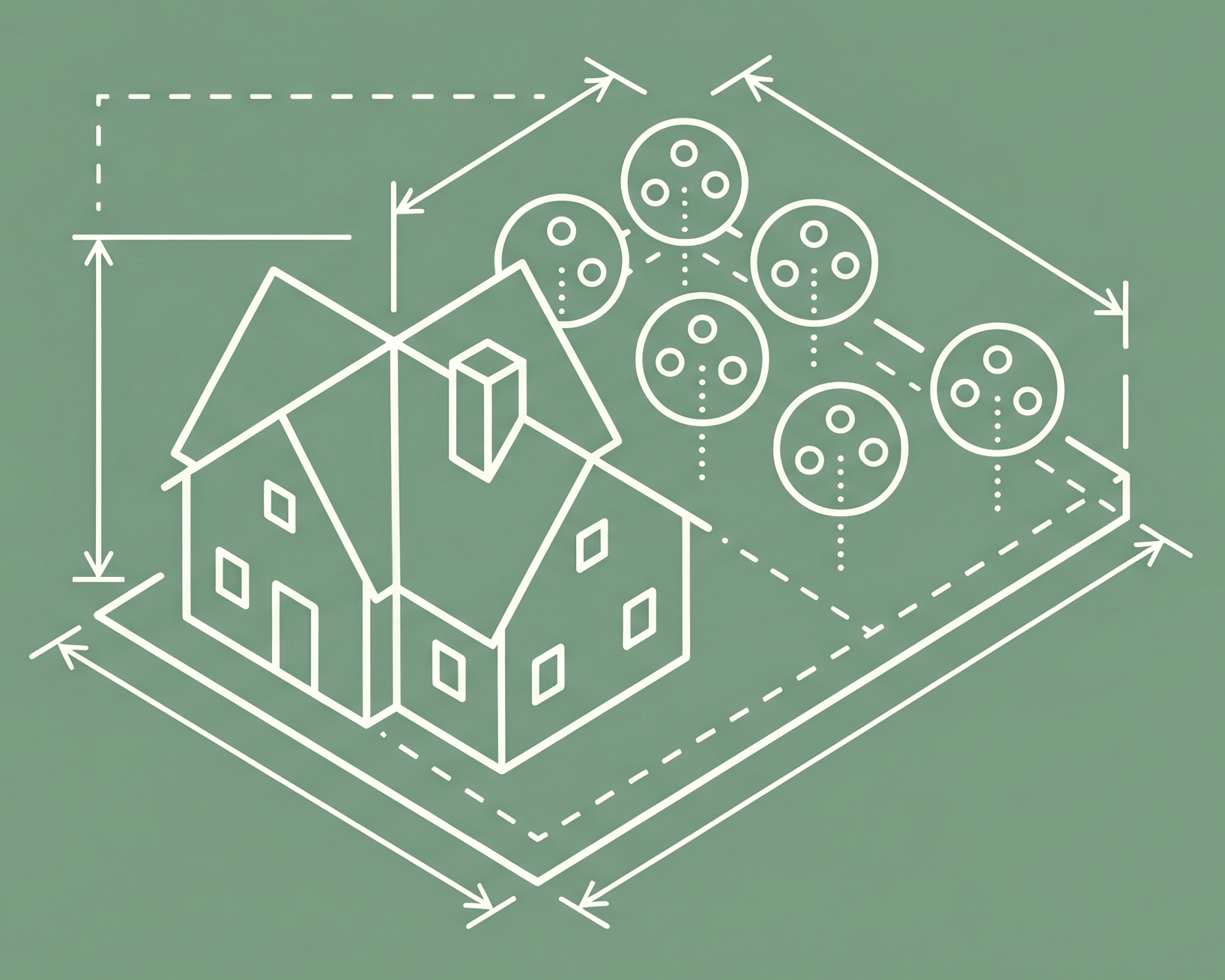
With those five things in mind, lay out the garden in zones. Closest to the kitchen, plant the things you harvest most often. Perennial herbs, sorrel, chives, walking onions, and strawberries belong right outside the back door. Next zone out, plant the berry shrubs and rhubarb. Furthest from the house, plant the fruit and nut trees. This zone based layout follows the permaculture principle that high frequency harvest crops should be the closest to where you walk every day.
For more on which perennial pairings naturally support each other, the companion planting guide lays out which species share root space and which ones compete.
A Sample Quarter Acre Perennial Garden Plan
Here is a starter design for a quarter acre of usable land, suitable for most zone 5 to zone 8 homesteads. Adjust species for your climate. This layout produces real food in year two, serious harvests in year five, and is a fully mature system by year ten.
| Zone | Plants | Spacing | Years to first real harvest |
|---|---|---|---|
| Kitchen edge (closest to house) | Sage, thyme, oregano, chives, walking onions, parsley | 1 to 2 feet apart | Year 1 |
| Front herbaceous bed | Sorrel, lovage, mint in a buried pot, perennial leeks | 2 feet apart | Year 1 to 2 |
| Strawberry ground cover | June bearing strawberries | 12 inches apart | Year 2 |
| Asparagus bed | 20 asparagus crowns | 18 inches apart | Year 3 |
| Rhubarb patch | 4 to 6 rhubarb crowns | 3 feet apart | Year 2 |
| Berry shrub row | 6 blueberries, 4 raspberries, 4 currants, 2 gooseberries | 3 to 5 feet apart | Year 2 to 3 |
| Elderberry hedge | 3 to 4 elderberry plants on the wet side | 6 feet apart | Year 2 |
| Fruit tree row | 2 semi dwarf apples, 1 pear, 1 plum, 1 cherry | 12 to 15 feet apart | Year 3 to 5 |
| Nut tree corner | 2 hazelnuts, 1 chestnut | 12 to 20 feet apart | Year 4 to 7 |
| Vine arbor | 1 male and 2 female hardy kiwi | 10 feet apart on a trellis | Year 4 |
In a fully mature version of this design, you harvest fresh asparagus and rhubarb in spring, strawberries and cherries in early summer, raspberries and blueberries in midsummer, blackberries and apples in late summer, pears and plums in early fall, elderberries and hardy kiwi in mid fall, and nuts in late fall. Perennial herbs come in year round, and walking onions and sorrel start the harvest in late March or early April.
That is a serious amount of food. Most beginner perennial gardens of this size produce three to five hundred pounds of fresh fruit, berries, and perennial vegetables a year by year seven, without the yearly tilling and replanting an annual garden of the same size requires.
Tip
Plant the fruit trees first, even if you cannot afford to fill in the rest of the garden right away. Trees take the longest to mature, so every year you wait to plant them is a year of harvest you push further into the future. Get the trees in the ground, then add shrubs and herbaceous plants over the next two or three seasons as your budget allows.
Building Soil for Long Lived Crops
Annual beds get rebuilt every year. You add compost in spring, plant, harvest, clear, and start fresh next year. Perennial beds get one chance to start with good soil, and then you are working with whatever you put down for the next two decades.
That changes the way you prep soil for a perennial garden. The single best investment you can make is six to twelve inches of compost worked into the planting zone before the plants go in. Heavy clay soils need additional sand or grit to improve drainage. Sandy soils need extra compost and organic matter to hold water. A soil test from your county extension tells you exactly what minerals your soil is missing.
Once the plants are in, you switch from tilling to mulching. A two to four inch layer of wood chips, shredded leaves, straw, or aged manure on the soil surface feeds the soil microbes, holds moisture, and smothers weeds. Refresh the mulch once a year in fall or early spring. After three to five years of yearly mulching, the soil under a perennial bed is dark, crumbly, and full of life in a way you almost never see in an annual bed.
The soil building guide walks through the test, amend, and mulch steps in detail. The composting 101 guide covers how to make enough finished compost at home to start a serious perennial planting without buying yards of it.
One more thing. Perennial roots do not want to be disturbed once they are in. Do not rototill the bed once the plants are planted. Do not turn over the soil. Just keep adding mulch on top and let the worms and microbes pull the organic matter down. This is the no till approach taken to its natural conclusion, and our no till gardening guide covers why that matters for soil health.
The First Three Years: What to Expect
A perennial food garden is slow at first and then suddenly very fast. Most beginners get discouraged in year one because the plants look small and produce almost nothing. Knowing the timeline in advance keeps you from giving up before the system kicks in.
Year one: establishment
In year one, you plant, water, mulch, and try not to expect a harvest. Most perennials put their energy into roots in the first season, not into fruit or leaves. Asparagus crowns send up a few thin spears that you do not cut. Berry bushes grow new canes but rarely fruit. Fruit trees grow leaves and new branches. Strawberries produce a few berries but should be picked off so the plants can focus on running.
Your jobs in year one are simple. Water every plant deeply once a week through the first summer. Mulch heavily to suppress weeds and hold moisture. Stake young trees and protect trunks from deer and rabbits. Remove flowers from strawberries the first year so the plants spread instead of fruiting. That is most of it.
Year two: light harvest
Year two is when the garden starts giving back. Rhubarb gives a small first harvest. Strawberries produce real fruit. Herbs are big enough to harvest from. Berry bushes produce a few pounds. Asparagus is still off limits. Fruit trees are growing fast but not yet fruiting.
Your jobs in year two are pruning and shaping. Trim back fruit trees to establish good structure. Cut spent canes off raspberries and blackberries. Divide perennial herbs that have outgrown their space. Refresh the mulch in fall. The garden is gaining momentum.
Year three: real production
Year three is when the system starts to feel like a real food garden. Asparagus gives you a full first cutting season. Berry bushes hit serious production. Strawberries hand you ten to twenty pounds. Perennial herbs are huge. Fruit trees may set their first small crop. You start to see the shape of what the mature garden will be.
From year three forward, every season is bigger than the last. Year five is double year three. Year seven is double year five. By year ten, a properly designed and tended perennial food garden is producing more food than most annual vegetable gardens of the same size, with a fraction of the work.
Year Round Harvest Calendar from a Perennial Garden
A mature perennial food garden produces food in every month of the growing season, with stored harvests filling the winter months. Here is what a typical zone 6 or zone 7 harvest year looks like.
| Month | What is ready to harvest |
|---|---|
| March | Sorrel, walking onion greens, perennial chives, last stored apples |
| April | Asparagus, sorrel, chives, perennial herbs |
| May | Asparagus, rhubarb, strawberries (everbearing), salad greens |
| June | Rhubarb, strawberries, currants, cherries, summer raspberries |
| July | Blueberries, raspberries, blackberries, gooseberries, summer apples |
| August | Blackberries, peaches, plums, fall raspberries, herbs |
| September | Apples, pears, elderberries, fall raspberries, hardy kiwi, walnuts |
| October | Apples, pears, hardy kiwi, hazelnuts, chestnuts, herbs |
| November | Last apples, stored harvests, dried herbs |
| December to February | Stored fruit, frozen berries, dried herbs |
Pair that with a winter year round growing approach and you have fresh or stored food twelve months a year from your own land.
Common Mistakes Beginners Make
Most failed perennial food gardens come down to a small handful of beginner mistakes. Sidestep these and your garden will mature into the long term producer it is meant to be.
Planting too close together. A tomato plant is a year long commitment. A blueberry bush is a thirty year one. New gardeners plant blueberries three feet apart because that looks right at planting, and then in year six the bushes are colliding and shading each other out. Look up the mature spread of every plant and space accordingly. Empty space at planting is supposed to feel a little awkward. That is correct.
Skipping the soil prep. Annual beds tolerate mediocre soil because you rebuild them every year. Perennial beds do not. A blueberry planted in clay soil with no compost will suffer for the entire fifteen to thirty year life of the plant. Spending one season building soil before planting saves you a decade of disappointment.
Planting in the wrong sun. A peach tree planted in partial shade will live but never fruit well. An asparagus bed in shade will produce thin, weak spears. Most fruit and most perennial vegetables want six to eight hours of direct sun. Measure your sun before you plant, not after.
Expecting instant harvest. Year one of a perennial garden looks like nothing happened. New gardeners panic, dig up the plants, and start over the next spring. The plants were fine. They were building roots. Patience is the single most important skill in a perennial garden.
Neglecting mulch. Perennials shaded by weeds suffer for years. A new perennial bed without three to four inches of mulch on day one will turn into a weed patch in two months, and the weeds will outcompete the perennials before they get established. Mulch is not optional. Mulch is the difference between a perennial garden and a slow disaster.
Choosing wrong varieties for your zone. A peach variety bred for Georgia will struggle in Vermont. A pear variety bred for the Pacific Northwest may bloom too early in Tennessee. Pick varieties bred for your climate, not just whatever the big box store has on hand. Your local extension office can usually point you to a list of reliable cultivars for your area.
Warning
Avoid invasive perennials no matter how attractive the food looks. Bamboo, Japanese knotweed, kudzu, and a few species of mint will take over your property in five years if you plant them without containment. If you want mint, plant it in a buried pot. Other invasive perennials are best avoided entirely. The harvest is never worth the takeover.
Maintenance: What You Still Have to Do
A perennial food garden is low maintenance compared to an annual garden. Low maintenance does not mean no maintenance. Here is what a mature perennial system actually asks of you every year.
Mulch refresh. Once a year in fall or early spring, top dress every bed with two to three inches of fresh wood chips, leaves, or compost. This is the single biggest maintenance task and it takes a weekend for most quarter acre gardens.
Pruning. Fruit trees, berry canes, and shrub fruit all benefit from yearly pruning. Cut spent raspberry and blackberry canes to the ground after fruiting. Shape fruit trees in late winter while dormant. Thin out old blueberry wood every few years to keep production high. Pruning takes a few hours total for a small homestead garden.
Division. Most perennial herbs, sorrel, walking onions, rhubarb, and asparagus benefit from division every five to ten years. Dividing keeps the plants productive and gives you new starts to expand the garden for free.
Watering during drought. Mature perennials are drought tolerant but not drought proof. A two or three week dry stretch in summer can damage fruit set on trees and stress berry bushes. A deep weekly watering during dry spells keeps the garden productive.
Pest and disease monitoring. Walk the garden once a week during the growing season and notice anything that looks off. A small problem caught early is easy to fix. The organic pest control guide covers chemical free options for most common perennial pests.
Replacement and renewal. Strawberry beds need replanting every three to five years. Aging fruit trees may need replacement after twenty to thirty years. Berry patches can be renewed by cutting old canes and letting new ones come up. Plan one renewal project per year and the whole system stays vital for generations.
Planting Calendar Tool
Enter your zip code to get a personalized planting schedule based on your USDA zone.
Try it free →Frequently Asked Questions
Frequently Asked Questions
Most perennials start producing real food in year two or three after planting. Strawberries and rhubarb give you a small first harvest in year two. Asparagus and most berry bushes produce a real crop in year three. Semi dwarf fruit trees fruit in year three to five. Standard fruit trees and nut trees take five to seven years. The garden keeps getting more productive every year after that, with peak production typically arriving in year seven to ten.
Yes, though the species you can grow shrink quite a bit. Strawberries, blueberries, dwarf fruit trees, perennial herbs, and small herbaceous perennials like chives all grow well in large pots. Plan on a minimum of fifteen to twenty gallon containers for fruiting shrubs and twenty five to thirty gallon containers for dwarf fruit trees. Containers dry out fast in summer, so daily watering is required, and most container perennials need winter protection in cold climates. For more on the container side of things, our [container gardening guide](/gardening/container-gardening) covers pot sizes, soil mix, and irrigation in detail.
No. A productive perennial food garden fits on a quarter acre, an eighth acre, or even a few hundred square feet of yard. Small urban homesteads can produce a serious amount of food from a perennial garden by stacking the four layers vertically. A dwarf fruit tree underplanted with berry bushes, underplanted with strawberries and herbs, can fit in a ten by ten foot space and produce real fruit and vegetables for decades.
Asparagus, rhubarb, sorrel, walking onions, perennial leeks, perennial kale, lovage, good king Henry, and most perennial herbs all come back every year from the same roots. Some other plants like Egyptian walking onions, ramps, and Jerusalem artichokes also qualify. These crops let you eat fresh greens, stalks, and aromatics in early spring weeks before any annual vegetable is ready to plant, let alone harvest.
The two terms overlap, but a food forest is the more complex version. A perennial food garden focuses on four layers and a modest plant list, organized in clear beds. A food forest uses seven layers, mimics a wild forest ecosystem, includes climbing vines and edible fungi in the leaf litter, and tends to look much wilder and less designed. A perennial food garden is easier to start. A food forest is what you grow into over the next decade as your skills and confidence build.
Most perennials live ten to thirty years without replanting. Strawberries are the main exception. A strawberry bed loses vigor after three to five years and benefits from being torn out and replanted with fresh runners. Fruit trees may need replacement after twenty to thirty years as productivity slowly declines. Everything else is essentially permanent in the garden, especially if you divide and renew the clumping perennials every five to ten years.
Yes, and that is exactly how most beginner perennial gardens get started. Plant the perennials in the long term locations they need, and fill the open spaces between them with annual vegetables for the first two or three years while the perennials are still small. As the perennials grow into their full size, the annuals get squeezed out. Once the perennial system is mature, dedicate a small separate bed to annuals like tomatoes and peppers, and keep the rest of the garden perennial.
Fall is the single best planting season for most perennials. Fall planted trees, shrubs, and crowns spend the winter growing roots in moist cool soil, and they explode out of the ground the following spring. Spring is the second best option for crowns, bare root trees, and herbaceous perennials, but you have to water more diligently through the first summer. Avoid planting in the heat of midsummer if you can. The young plants struggle to establish roots in hot dry soil.
A perennial food garden is the closest thing a homesteader can plant to a system that feeds them forever. The work is front loaded. You spend two years preparing soil, planting trees and shrubs, mulching, and waiting. From year three forward, the garden produces more every season with less of your time. By year ten you are walking around with a basket and harvesting food from plants you barely remember putting in the ground.
Start small. Plant one fruit tree, three berry shrubs, an asparagus bed, and a strawberry patch in your first year. Add herbs by the kitchen door. Mulch everything. Two seasons from now you will be eating real food from a system that will outlive your annual garden many times over.
For a wider view of how perennials fit into the rest of a self sufficient garden plan, the homestead garden guide ties annual and perennial pieces together into one yearly rhythm. A perennial food garden is the long game, and it is one of the most rewarding gardens you will ever plant.

Cole
Founder & Lead Researcher
Cole is the founder of Plan Your Homestead. He works in clinical research and brings a research-first lens to every guide on the site, drawing on a long family line of farmers for grounded, practical perspective.
More in Gardening
More articles coming soon. Check back for new gardening content.